David cameron

David Davis offers his counsel in good faith

From our UK edition

From his roost high on the backbenches, David Davis commands a luminescent eminence that he would not have had if he were a frontbencher. And as the current guardian of traditional right-wing Toryism, his words are clear against the often muddy context of coalition. Talking to the Mail's Andrew Pierce and Amanda Platell, he offers George Osborne and David Cameron some sagacious advice. He joins the chorus, now stalked by Ed Miliband, which urges the government to articulate its growth and recovery rhetoric. ‘We cannot be defined by a purely cuts agenda. If the only message the public takes away from the events of the next few months is one of retrenchment and loss of services, politically at least, we will have failed.
Plugging the leak

From our UK edition

So did Liam Fox leak the letter? Only if he is suicidal. He's been around long enough (having been a frontbencher from the Major years onwards) to know how the game works. Briefing journalists is one thing, leaking a private letter is utterly counterproductive. It will make it harder for him to get the settlement he wants, and it will damage him by making him look as if he were responsible for it. I gather that the MoD is in a state of terror right now, with phone records and emails being trawled to find the guilty party. And whoever did this has such a crude understanding of media spin that they might well have been stupid enough to be caught. But in the history of Whitehall leak inquiries, the guilty party has never been discovered.

Liam Fox does a David Miliband

From our UK edition

At least the political fates have a sense of humour. No sooner had David Miliband's frustration screamed into view last night, than the Tories were hit by a story that was similar in several regards: the leaked Liam Fox letter, expressing his anger over spending cuts. Here are a handful of those similarities: 1) Leakage. David Miliband's words for Harriet Harman were meant to be for their ears only, but the TV cameras picked them up. Similarly, Fox's letter was meant to be between him and the PM – but now it's splashed across the front page of the Telegraph. The only difference is that the Fox letter has been put out by someone in Whitehall, a politically interested actor.

Miliband goes Cameron-lite

From our UK edition

Well, it turns out that ‘Red Ed’ is really a social conservative. As both Pete and James say, his speech contained notable sallies into Cameroon territory – community and family. He didn’t follow Cameron’s trail to the metre, but fell into many of the same ditches. Two things struck me: 1). Ever the opportunist, Miliband sees that there is the kernel of a good idea at the root of the ‘Big Society’ and tried to exploit Cameron’s inability to present it. Miliband’s gave us the ‘Good Society’, a clear though sanctimonious slogan for community renewal. However, he, like Cameron, can’t define what he means by community. He talked about post offices, high streets and, of course, the local pub.

Miliband produces the bare minimum, but don’t underestimate him

From our UK edition

Ed Miliband did what he needed to do. In his speech he needed to show that he was not some demented left-winger, that he was not a tool of the unions and that he appreciates the need for cuts. He did the first bit with his tone. It is very hard to depict someone as dangerously left-wing when they appear thoroughly reasonable. The union test he got through with the line that no one in the Labour party should have any ‘truck with overblown rhetoric about waves of irresponsible strikes.’ As one Tory said to me last week, attacking him over being in hock to the unions was never going to be effective for long as it is so easy for him to distance himself from them.

The eagle has landed

From our UK edition

Shades of Jack Higgins in Whitehall this morning: the Prime Minister is convening the furtive sounding National Security Council, which will be presented with initial drafts of strategic defence review. As Richard Norton-Taylor puts it, the government has the opportunity to be radical and make this a ‘horse versus tank moment’, which is ironic given that the tank is poised to pass into obsolescence. In truth, the drama is some way off; the government has delayed decisions rather than take them. The nuclear deterrent is not part of the review – the politics and economics of Trident’s replacement proving too contentious for the precious coalition.

Forcing an apology

From our UK edition

Admittedly, this is but an item of marginalia in the notebook of British politics – but I'd appreciate CoffeeHousers' views on it nonetheless. I'm talking about the Tories' efforts to squeeze an apology out of Labour for the state of the public finances. This is something that they've been trying to do since the election, but the strategy has been reheated in the aftermath of Ed Miliband's election. As Sayeeda Warsi put it on Saturday, "what I noticed in his acceptance speech was that there was … no apology for the role that he had played in the current economic mess." Other Tory folk have called for that to be put right. I'm inclined to take a dim view of this.

The defeated brother delivers a winning speech

From our UK edition

David Miliband's address to the Labour conference ended as it began: with a  standing ovation. Sentimentality and sympathy, perhaps – but it was also deserved. This was a speech that his younger sibling will be hard pressed to match tomorrow. Indeed, I doubt even MiliD has matched it himself before now It began, of course, with an attempt to massage out the tensions of the past few days. There were some gags about how Miliband had draft speeches for Saturday and Tuesday on his computer - "so I've got a couple of speeches to draw on." And he implored Labour to unite behind his brother – "we have a great new leader and we've got to get behind him." He added, by way of a fraternal backslap, "I'm incredibly proud of my brother". So far, so smooth.

Cameron neglects to mention his tax cut for the middle classes

From our UK edition

David Cameron’s interview in the Telegraph this morning is striking for three reasons. First, despite the interview appearing on the day of the Labour leadership declaration, there’s no attempt to bring the hammer down on the new Labour leader. All we get is some framing on the deficit. Next, as Paul Goodman notes, it is an attempt to reassure the Tory faithful after the Lib Dem conference Vince Cable is gently put back in his box with the line ‘Vince is Vince’. Cameron also stresses that he ‘will always safeguard our nuclear deterrent’; a line that is very different from the nakedly political discussions of Trident in Liverpool, where what seemed matter to most was making life difficult for Labour.

The real battle begins tomorrow

From our UK edition

So what's all the fuss about today, then? Ah, yes, the election of the new Labour leader. We should know the result around 1640 this afternoon – but, this morning, most commentators are indulging in the idea that Ed has won it. The younger Miliband and his team said to be optimistic, his elder brother less so. At the very least, a remarkable turnaround has taken place. Just before the contest began, MiliD was some way ahead of his sibling in the bookies' calculations. Now, Ladbrokes have suspended betting on MiliE. What happens today, though, is in some respects less important than what happens tomorrow. Today will be the day for triumph and commiseration, for tubthumping speeches about taking Labour back into government.

Labour caves to divisive Livingstone

From our UK edition

If I was a member of the Labour party I would be feeling pretty uneasy this afternoon as news of Ken Livingstone's victory in the mayoral candidates battle sinks in. There is a cold reality about cuddly uncle Ken which deserves serious examination: he is a ruthless political operative who will sell out everyone, including his own party, to win. But Ken is not just a divisive figure, he was also a sinister Mayor, presiding over an wildly dysfunctional London Development Agency, controlling policy for London through a cabal of advisers calling themselves 'Socialist Action' and getting chummy with divisive and radical islamists including Yusuf al-Qaradawi.

Another obstacle in the way of free schools

From our UK edition

A few weeks ago, I wrote a cover story about how teachers' unions are trying to strangle the Gove schools agenda at birth. But I fear it is facing an even greater, more immediate threat: basic bungling by government departments. The FT today says that the Department of Transport wants to make sure that local authorities keep the right to veto a new school. Armed with such a weapon, it is a sure way of crushing any competition. The DoT's argument is staggeringly banal: that a new school may play havoc with the traffic. If you're a local authority, wanting to use any means possible to stop a new school competing with the ones you run, it's all the excuse you need.

Low taxes work

From our UK edition

I ration my writing about Sweden. As CoffeeHousers know, I can extol its virtues with room-emptying conviction. But it's now a few days since its election, and as far as I can tell no English publication has told the extraordinary story of its conservative victory - and the economic turnaround driven by the largest tax cuts in Swedish history. It is now the fastest-growing economy in the West. I tell the story in the political column of this week's magazine (subscribers, click here), but I will summarise it for CoffeeHousers here. Normally, conservatives are elected in Sweden as a kind of light relief, to punctuate decades of leftist rule. They're usually thrown out after one term, and the social democrats get back to taxing the bejesus out of the country.

The trouble with Cable’s posturing

From our UK edition

What are we to make of the fact that No.10 gave the thumbs-up to Vince Cable’s bizarre anti-capitalist rhetoric today? “Capitalism takes no prisoners and it kills competition where it can,” he fumed – and you can argue that, technically, he is paraphrasing Adam Smith. But he has been in politics long enough to know what signal his speech sent out (and the reaction it would trigger). Mood music counts for a lot in politics, and in business. And the mood music from this government sounds like a bunch of politicians happy to tax the bejesus out of the high-paid - regarding them as ATM machines to be raided, rather than wealth creators to be welcomed. It's time to ask what harm all this posturing is doing.

Clegg speaks to the hall

From our UK edition

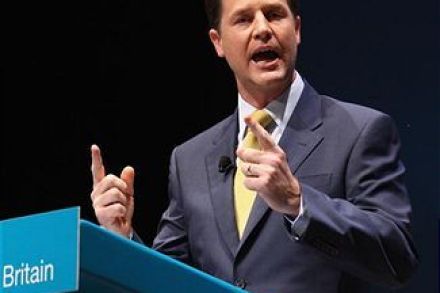
Nick Clegg chose to speak to his party not the country today. His address was a justification of his decision to go into government with the Tories and a plea for his party to stick together over the next five, difficult years.   The crucial bit of the speech came when Clegg said of his party ‘maybe we got used to [being against every government that came along] ourselves’ but ‘imagine if we had turned away. How could we ever again have asked the voters to take us seriously?’ Clegg’s point was that opposition was not an option and ‘this country could not have borne five more years of Labour’. So, coalition with the Tories was the only option.

The coalition must make its case

From our UK edition

The Lib Dems’ week in the sun has started and Nick Clegg has marked the occasion by giving a series of interviews. David has already noted the one in The Independent, but Clegg’s one with The Sun where he talks about playing tennis with Cameron at Chequers and assembling IKEA furniture together is perhaps more revealing of where his heart lies. But this coalition is going to be made or broken by whether it can persuade the public that dealing with the structural deficit and reforming the four great public services are the right things to do and that the coalition is doing them competently. As Charles Moore says in a magisterial column in the Telegraph today, the coalition needs to explain itself. Too often it is leaving a vacuum that its opponents are filling.

Finding a narrative of hope

From our UK edition

In these grim dark days of austerity and cuts, the coalition urgently needs to find a compelling political narrative of hope and optimism. David Cameron's Big Society rhetoric occasionally threatens to contain some philosophical depth, but suffers from the same problem as most new fangled analyses of the world. Namely, it is so fluffy that it becomes bewildering.   To the government's credit, they have managed to prepare the public for the upcoming belt tightening. This achievement is all the more remarkable given the woeful refusal of either coalition party to admit the scale of the fiscal problem facing Britain during the general election campaign.   But softening up public opinion for wide ranging cuts is only a short term tactic, however necessary.

Clegg gets forceful over welfare

From our UK edition

Enter Nick Clegg with another self-assured article for a national newspaper. A few weeks ago, it was his defence of the coalition's Budget for the FT that caught the eye. Today, it's his case for welfare reform in the Times (£). These may be arguments, about dependency and disincentives, that you've heard before – but here they're packaged in a particularly clear and persuasive way. Just what's needed as the welfare wars, between Labour and the coalition, spill back into newsprint.   Writing about the article, the Times frames it as "Nick Clegg [putting] himself on a collision course with his party" – and you can see why they might think that.

Citizen Castro rains on Comrade Hattie’s last parade

From our UK edition

There was praise for Fidel Castro – of all people – at PMQs today. That the tribute came from a Tory MP must make this a unique event in the annals of parliament. Castro’s recent admission that Cuba’s state monopolies might profit from a little nibbling around the edges gave Priti Patel, (Con, Witham), a bright idea. She asked the prime minister if the Marxist cigar-enthusiast might visit the TUC Conference to share his economic vision with the brothers. The PM, who seemed calm, fresh and genially bullish today, caught the joke and ran with it. He offered his own tribute to the semi-retired dictator. ‘Even Comrade Castro is on the same planet as the rest of us. Now we just need to get Labour and the unions across as well.

PMQs live blog | 15 September 2010

From our UK edition

Stay tuned for live coverage of today's Cameron vs Harman clash from 1200. 1200: A prompt start. Cameron begins with condolences for the fallen in Afghanistan. Clegg grabs the PM by the elbow as he sits down - making sure there wasn't an embarrassing lap-sitting moment, I think. 1201: Julian Smith asks whether it is "irresponsible" of Labour to back union strikes. Cameron says it is, natch, 1203: A dignified start by Harman. She passes on her congratulations for the Cameron's new baby, and her condolences for the death of his father. Her question is about what progress the government is making on tackling human trafficking. 1204: Cameron quips that Harman is "by far the most popular" Labour leader he's ever faced across the dispatch box.