David cameron

The government’s strategy has kept the child benefit story running

From our UK edition

We have heard much since the coalition was formed about how Cabinet government has been restored. The child benefit flap reveals how limited this restoration is. There was no Cabinet approval of the decision and, as Andrew Grice confirms this morning, Iain Duncan-Smith was unaware of the change until the morning of the announcement. The other thing that strikes me, as someone who supports the idea and thinks it is potentially good politics, is the very odd approach to spinning this story.

Fox to the rescue

From our UK edition

The best form of defence is attack. Liam Fox distracted conference from the various rows that have afflcited it by castigating Labour’s abysmal record on defence. He was helped enormously by the terrorist outrage in Sanaa, the Yemen – a cowardly atrocity that reinforces his observation that ‘the country's finances are wrecked and the world is more dangerous than at any other time in recent memory.’ He recited the refrain that cuts are regrettable but necessary, before adding that, thanks to Labour, Britain has to fight on with less.

Cameron stumbles onto the stage

From our UK edition

Who'd have guessed that David Cameron would go into his conference speech on the backfoot? This was supposed to be a moment tinged, if anything, with jubilation: the first Tory PM for thirteen years addressing a party that seems to have fallen in love with him. But instead we've got the child benefit row, and with it apologies, rebuttals and hasty repositioning. It is to Cameron's credit that he can breath the two words that evade other, more culpable politicians: "I'm sorry". But on the eve of his big speech? Far from ideal. This exercise in damage limitation may have slightly eased Cameron's situation today – but it has put him in a more difficult long-term position.

Scottish Tories won’t oppose AV

From our UK edition

Annabel Goldie, leader of the Scottish Conservatives, made an odd admission at a fringe event last night. Asked how she would campaign against AV next May, she disclosed that there wouldn’t be a concerted campaign because ‘people have already made-up their minds’. I’m told that David Mundell, Parliamentary Under-Secretary of State for Scotland, sat in impassive agreement while the audience raised its collective eyebrow. Conservatism hasn’t scaled Hadrian’s Wall for twenty years. Representation is thin because residual loathing for Thatcher and Major runs deep. Loud partisanship against AV may incite the hostile populace to vote for it out of spite. Discretion looks the better part of valour.

Cameron says “yes” to the Trident upgrade – but questions remain

From our UK edition

Courtesy of Ben Brogan, one of the most noteworthy passages from David Cameron's appearance on Today this morning: 'Jim Naughtie: Is the Trident upgrade untouchable? David Cameron: We do need an independent nuclear deterrent… JN: Is that a yes? DC: Yes. Basically I was going to give you a longer and fuller answer but the short answer is yes… To me and the Coalition government, yes, Britain’s independent nuclear deterrent is being replaced.' It is certainly the most assertive that Cameron has been on the subject since the advent of the coalition, but a couple of questions remain that prevent it from being utterly unequivocal. First, what timeframe is the PM operating along?

Cameron tries to defuse the child benefit row

From our UK edition

Whether you agree with the plan to restrict child benefit or not – and, broadly speaking, I do – there's little doubting that it has met with some fiery resistance in the papers today. The Telegraph leads the attack, calling it "a hastily conceived about-turn bundled out on breakfast TV". The Daily Mail highlights the "blatant anomaly," currently riling up the Mumsnet crowd, that a single earner family on £44,100 a year might lose the benefit, while a dual earning family on £87,000 can keep it. And the Independent does likewise. It should be said, though, that the Sun, the Times and the Financial Times are considerably more generous about Osborne's proposal. The FT even calls on the Chancellor to go further.

Don’t mention the Conservatives

From our UK edition

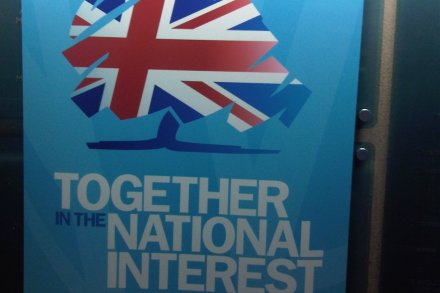
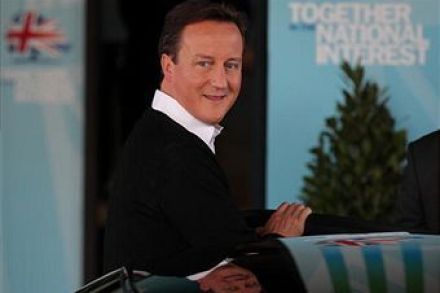
Has somebody stolen the Tory Party? A stranger walking around here would have no idea that its their conference. The word "Conservative" or "Tory" is nowhere to be seen. Just a slogan, "Together in the national interest" – a form of words that Cameron has repeatedly used to describe the coalition. As I say in my News of the World column today, Cameron will this week perform the impossible – to de-Tory the Tory conference and make them love it. There is plenty Tory red meat being served: welfare reform, school reform. It wouldn't susprise me if an announcement on keeping Trident is made this week. So the activists are happy. They also know that there is less than three weeks to the spending review and the battle that accompanies it, so they are in loyalty mode.

The Coulson story returns (again)

From our UK edition

Call it a professional hunch, but I suspect the Tories won't be too pleased that this Guardian story has come out on the first day of their conference. It's about Andy Coulson – and, much like the revelations in the New York Times Magazine last month, features one of his former colleagues alleging that Coulson knew all about the telephonic subterfuge going on at the News of the World. That journalist tells Channel 4's Dispatches that: "Sometimes, they would say: 'We've got a recording' and Andy would say: 'OK, bring it into my office and play it to me' or 'Bring me, email me a transcript of it.'" It's evocative stuff, but – as before – I imagine it's also unprovable. In which case, the Tories will probably just ignore it.

Cameron sets the mood for Birmingham

From our UK edition

It's that time of year again: Conservative Party conference. And with it comes wall-to-wall David Cameron. Our PM has a couple of interviews in the newspapers today and, to accompany them, he slotted in an appearance on the Marr show earlier. In all three, he hops neatly across the all same lily pads – spending cuts, IDS's historic benefit reforms and the defence budget – making the points and arguments you might expect. Yet two snippets stand out, and are worth pasting into the scrapbook. First, Cameron's claim on Marr that, "We have got to ask, are there some areas of universal benefits that are no longer affordable?

Society 3, The State 0

From our UK edition

Cameron and Osborne may just be about to pull off something incredible. This time last year, The Spectator ran a cover story about a new proposal which we could revolutionise welfare: the Universal Credit. It was an IDS idea: he’d sweep away all 50-odd benefits, and replace it with a system that ran on a simple principle – if someone did extra work, they’d get to keep most of the money they earned. It meant a bureaucratic overhaul, of a system that controls the lives of 5.9 million people. The resistance from HM Treasury, the architect of the tax credit system, was as fierce as it was predictable.

Cameron, more ideological than he appears

From our UK edition

The Tory conference in Birmingham is the last big political event before the cuts come. After the 20th, every time a senior Tory appears in public for the next few years they will be about why this or that is being cut. As the row over defence shows, these questions will come from right across the spectrum. For this reason, Simon Schama’s interview with Cameron in today’s FT is probably one of the last that will start with the assumption that Cameron is genial, non-ideological fellow. Once the cuts are happening, it will be harder to cast Cameron as a consensual figure. His edges will appear harder, more defined.  But when Schama asks Cameron what he wants his legacy to be we get a reminder of how non-ideological Cameron is.

Fox, Osborne and Cameron engaged in Whitehall’s oldest battle

From our UK edition

Tory on Tory is a brutal cock-fight when defence is concerned. After the leaking of Liam Fox’s now infamous letter and David Cameron’s measured retaliation, George Osborne has broken his silence. Making unspoken reference to the £38bn black hole in the MoD’s budget, Osborne tells this morning’s Telegraph that he was ‘not thrilled’ to learn of Fox’s ‘do we really want to cut defence this much letter’ and says that Labour left the MoD in ‘chaos’, signing Britain up to ‘expensive and pointless projects’. The press will run this as a conference Tory splits story.

IDS the victor?

From our UK edition

There are still conflicting reports, but Michael Crick and The Times intimate that a deal has been struck: IDS has beaten the recalcitrant Treasury over his £9bn universal benefit reform, with David Cameron’s express help. As Frank Field put it on Sky News, IDS’ plan is ‘good for the country, good for the taxpayer and good for those dependent on welfare.’ Field gave no clue as to the final outcome of this battle, but victory for IDS would be a crucial moment in public service reform. If Crick and the Times are right then this is obviously fantastic news ahead of the Tory conference, where I feel David Cameron should explain to the country beyond the hall what positives a Tory government offers besides sound accounting.

From the archives – Tories go to conference in government

From our UK edition

Strange though it seems in hindsight, the Tory party was not uniformly enamoured with Mrs Thatcher in 1979. The Tories were in government, but doubts over her ability to confront a resurgent Labour party, her shaky presentational skills and the direction of her policy pervaded the 1979 conference. David Cameron goes to Birmingham this week pursued by reservation’s persistent hum, and he does not have winner’s rights to rely on. Ferdinand Mount recorded that Mrs T’s wooden speech did not allay concern or win gratitude; will Cameron fare any better? But do they really love her? Ferdinand Mount – 20th October 1979 Hmm. Or rather perhaps, to put it more accurately, mmh. I quote from the Prime Minister’s speech at Blackpool, passim.

Cameron needs to show that life is better under the Conservatives

From our UK edition

The election of a new Labour leader means that proper politics has resumed. David Cameron now knows who he needs to beat to win the next election. As I argue in the magazine this week (subscribers), if the Tories are to secure a majority in 2015, they’ll need to do better among those in households with an income of thirty-odd thousand or so, what pollsters call the C1s. The last time the Tories won outright, they got 52 percent of the C1 vote—more than double Labour’s total. But in 1997, Labor and the Tories split this group evenly. The Tories have never fully recovered from this.  In 2010, the Tories garnered 39 percent with this group, a mere three percent swing since 2005.

An example of union hostility against people who want to do their jobs

From our UK edition

Amongst BBC political staff, there’s mounting concern about the plans for a strike during Tory conference. One of them said to me at Labour conference that they just didn’t know what to do, they had been put in an impossible position by the decision to call the strike on such politically important days. These journalists fear that striking during Tory conference would undermine the corporation’s reputation for impartiality. So, a whole host of them wrote to their union rep asking him to make representations on their behalf.

Cameron road tests his anti-Ed message

From our UK edition

After Fern Britton's triumph over Gordon Brown a couple of years ago, we should know that This Morning interviews can have a certain bite to them. But if you needed more convincing, then how about David Cameron's appearance on the show this morning? Lurking behind all the talk of baby Florence and the Obamas, was a sprightly discussion of both defence cuts and the new Labour leader. Cameron was combative on both. Most noteworthy were Cameron's attacks on Ed Miliband. I imagine they will set the template for how the anti-Ed operation is conducted in future. The main aim, it seemed, was to defuse Miliband's talk of an optimistic New Generation – a woefully specious phrase, to be sure, but one that some Tories fear might gain traction.

Boles’ immigration revolution

From our UK edition

Nick Boles’ Which Way’s Up? is gaining a quiet cult following in Westminster, and John Redwood has unearthed Boles’ radical approach to immigration. Boles dissents from the view that happiness in Sweden’s utopia rests on pay equality; he observes that it is a homogenous society that has controlled mass immigration. He writes: ‘We will not be able to sustain a social contract in which schooling and healthcare are provided to all citizens free of charge and are funded by taxation if we continue to allow, every year, hundreds of thousands of people from around the world to join the queues at A and E and send their children to British schools.

Forget the culprit, the MoD leak suggests that Fox doesn’t have Cameron’s confidence

From our UK edition

Liam Fox is sombre rather than sombrero. A man to reckon with, you’d have thought - determined to fight dangerous cuts to Britain’s over-extended defence budget and an apostle of the Tory right. Which makes yesterday’s leak all the more extraordinary. The question is not who leaked this incendiary letter, but why Fox wrote it. The night before an important National Security Council meeting, and Fox has an important point to convey. Why not ring the Prime Minister? Go round to No.10 for chat? He is the Secretary of State, but he has to communicate matters of confidence and competence between himself and the PM with such formality, and in such impassioned language. The idea that Fox wrote it to leak it is preposterous.

Miliband’s dilemma

From our UK edition

The day after the leader’s speech is always a slightly flat time at a party conference. But Manchester today feels particularly flat. Everyone knows that the two big political stories are happening down in London: David Miliband’s expected announcement that he is not standing for the shadow Cabinet and the Fox flap. One of the challenges for Ed Miliband is going to be asserting his authority with his parliamentary colleagues, most of whom didn’t vote for him. Added to this is the fact that many of them remember him as a young bag-carrier. Members of the shadow Cabinet were openly mocking his ‘new generation’ line last night. All this is going to make his performances in the Commons chamber more important than usual.