David cameron

Cameron’s certainty contrasts with Miliband’s equivocation

From our UK edition

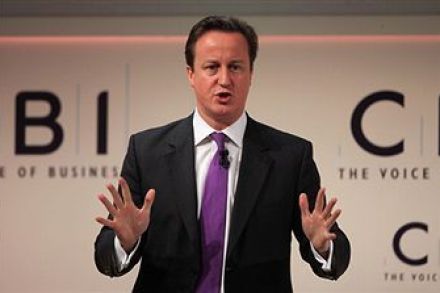
An opportunity to compare-and-contrast David Cameron and Ed Miliband outside the sweaty heat of PMQs, with both party leaders delivering speeches to the CBI this morning. Given the audience, both majored on business, enterprise, and all that – and it meant there was plenty of overlap on areas such as green technology and broadband. There were some differences, though, that are worth noting down. Cameron was first up, setting out a three-step plan for boosting British business. Broadly speaking, it revolved around what the government is trying to achieve in the Spending Review – and so the PM boasted that, "last week, we took Britain out of the danger zone.
The coalition’s feel-good factor

From our UK edition

Since last week's Spending Review – and even before – the government has been operating in a toxic news environment. I mean, just consider the three main news stories that have surrounded the cuts. First, the 500,000 public sector job losses. Then, the IFS report and that single, persistent word: "regressive". And today – on the covers of the Independent and the Times – warnings that we could be dipping back into recession. Set alongside that tidal swell, the outpourings of Simon Hughes and the polling companies register as little more than sour footnotes. Even if the coalition plans to hide some of its better news, there's a clear need for it to push back against the gloom – lest it erode both public and Lib Dem support for they are doing.

Why a LibCon coalition might last beyond 2015

From our UK edition

May 2015 is an age away in political terms. But the question of what happens to the coalition after the next election is too politically interesting to be able to resist speculating on; even if this speculation is almost certainly going to be overtaken by events. Over at ConservativeHome, Paul Goodman asks if Cameron and Osborne share Francis Maude’s view that the coalition should continue after the next election even if the Tories win an outright majority. My impression is that they do. If the Tories won a majority of between 10 and 30, I’d be surprised if Cameron didn’t try and keep the coalition going. There are four main reasons why I think the Tory leadership would want to keep the Liberal Democrats in the government in these circumstances.

Confusion reigns | 24 October 2010

From our UK edition

A hoary old foreign correspondent once advised me on how to report on a new country when parachuted in during a crisis. I was about to be sent to Russia to cover the rouble collapse, when it looked like the whole country was about to implode. I was more than a little nervous. "When you write your first piece you will be completely disoriented, so just write that confusion reigns. No one will know any better," he said. It feels a bit like that with UK politics at the moment. What are we to make of the latest polls that show the majority of the population backing the Coalition's cuts and yet Labour suddenly taking a lead in the polls?

The government goes for growth, as Cable tackles takeovers

From our UK edition

As Benedict Brogan observes, the government's renewed emphasis upon growth is hardly deafening – but it is certainly echoing through this morning's newspaper coverage. Exhibit A is the Sunday Telegraph, which carries an article by David Cameron and an interview with Vince Cable – both of which sound all the same notes about enterprise, infrastructure, deregulation, tax and trade. There's a letter by George Osborne in the Sunday Express, which contains the word "growth" a half-dozen times. And then there's Cameron's claim that the next decade will be "the most entrepreneurial in Britain's history," in a podcast on the Downing St website. Welcome to two weeks devoted, apparently, to growth and reform.   This shift in emphasis is welcome, wise and well-timed.

Cameron’s morals

From our UK edition

By his own admission, to today’s Mail, David Cameron is not afraid of unpopularity. On hearing this, a few quizzical grins may break across his critics’ faces, but, undeniably, the government’s fate was cast this week: either its fiscal plan will work or it won’t. Cameron is unperturbed because he is sure that he is right - not only in his political and economic judgement, but also in terms of morality.

The Arts, Simon Jenkins and the slaughter of the provinces

From our UK edition

Congratulations to Sir Simon Jenkins for winning the top gong at the Editorial Intelligence Comment Awards. This is a well-deserved prize for a journalist who seems to get angrier with every passing day.  As if to prove the point, the swashbuckling journalistic knight used his Friday column in the Guardian to have an almighty tilt at the government, the Arts Council and the London cultural mafia about cuts to the arts announced in the Comprehensive Spending Review. The piece is an exemplary piece of commentary; an exercise in raw fury.

George Osborne is making the going

From our UK edition

There are several interesting columns on George Osborne in the papers today. In The Times, Tony Blair’s former speechwriter Phil Collins warns Labour to stop underestimating the Chancellor, who is defining the political battle on his terms at the moment. Peter Oborne, by contrast, is highly critical of Osborne in his Telegraph column, warning that Osborne’s partisan presentation of the cuts risks undermining support for the whole project. For once, I find myself disagreeing with Peter. I think Osborne is doing some of the political heavy-lifting that Cameron could not do without undermining his standing as a national leader; Osborne’s praise for the 2004 Republican campaign is instructive in trying to understand what is going on here.

Cameron’s warm-up act for Boy George

From our UK edition

Cameron was a mere warm-up man at PMQs today. With Osborne’s statement due at 12.30 the session felt like a friendly knock-up rather than the main fixture. Ed Miliband rose to thunderous cheers from his backbenches and he tried to capitalise on their support by opening up an ancient Tory wound – heartless attitudes to unemployment. Spotting Cameron chinwagging with Osborne instead of listening, Miliband chided the PM for not paying attention. ‘Well, it’s a novel concept,’ said Dave smoothly ‘but in this government the prime minister and the chancellor speak to each other.’   Ed’s problem was that the OBR has predicted rising employment for the next three years. Bad news for the opposition leader.

PMQs live blog | 20 October 2010

From our UK edition

QUICK VERDICT: More heat than light today, but Cameron easily got the better of Ed Miliband. Now to the Spending Review live blog. 1230: Cameron says that as cuts are made, the government will have to reform the way it does criminal justice. This is a prelude for the deep cuts that the Home Office and Justice department are expected to face in the spending review. 1228: The Lib Dem MP asks whether Cameron believes that better-off graduates should bear more for their university costs. Cameron says that he agrees on principle, and claims that "everyone in the House" wants the "same thing": a fair and well-funded university system. 1226: Cameron says that the spending review will contain answers on social housing - but hints that the results may be better than expected.

The Cabinet should show its Big Society credentials

From our UK edition

As we prepare for the Big Society to mop up where the Big State used to be and ministers call for a culture of philanthropy to replace the hand out culture, I have a suggestion for the millionaire axe men of the Coalition government.  After the Comprehensive Spending Review, David Cameron should order each government minister to publish details of his or her charitable giving and the number of days a year they spend on voluntary work. This, after all, is what they are demanding of the rest of us. The richer members of  society will now be expected to underwrite the arts and the charitable sector, while the rest of us volunteer to take on the functions of the public sector.

Cameron reveals the scale of defence cuts

From our UK edition

David Cameron delivered his statement on the Strategic Defence and Security Review with few rhetorical flourishes. He had two main messages: i) the mission in Afghanistan would be spared from the 8 percent cuts in this Parliament’s defence budget, and ii) the problems the review is trying to deal with stem from the fact that “the last government got it badly wrong.”   The appalling legacy that Labour has left the coalition on defence rather hamstrung Ed Miliband in his response. The most memorable line in it was a gag about how he had advance sight of the statement in ‘today’s papers, Monday’s papers, Sunday’s papers.

A test of Cameron’s commitment to the new politics

From our UK edition

In opposition, nearly every politician talks about the dangers of an over-mighty executive. But office has a habit of changing peoples’ views on this subject. Charles Walker’s amendment (which he discusses over at ConservativeHome, here) to match any reduction in the number of MPs with an equivalent reduction in the number of ministers, so that the proportional size of the payroll vote remains the same, is an early test of whether office has begun to erode Cameron’s commitment to a proper balance between the executive and the legislature.   If a reduction in the number of MPs is not matched by a reduction in the number of ministers, then the executive will become more powerful and the House more of a creature of it.

Downton Abbey: the new Brideshead

From our UK edition

Lots of discussion of ITV's Downton Abbey on Radio 4's Broadcasting House and in the Sundays. There is a fascinating piece by Simon Heffer in the Sunday Telegraph extolling its virtues. It turns out that two of his friends are involved: writer Julian Fellowes and actor Hugh Bonneville. He concludes that the acting is excellent and the 1912 setting assiduously accurate. He adds that it is a shame that the series will only run to seven episodes. As I look forward to tonight's fourth episode, I have to agree with him on all counts.  But there is much more to the success of Downton Abbey than mere technical excellence behind and in front of the camera. Like all good period drama, this has a resonance far beyond its own setting.

What Fox can learn from IDS

From our UK edition

The Ministry of Defence’s -7.5 percent budget settlement is a better deal than it appeared the MoD would get back in the summer. Tim Montgomerie hails it as a triumph for Fox and his full-on campaign against the deeper cuts that the Treasury wanted. But No 10 is keen for it not to been seen like this. They don’t want ministers to think next time round that the way to get a good deal is to kick up a fuss and enlist the papers on your behalf. There is so much anger with Fox in Downing Street, even those who are usually sympatheticto him are exasperated with him at the moment, that he’ll have a difficult next few months.

Why the Tories didn’t win

From our UK edition

Courtesy of John Rentoul, Tim Bale, professor of politics at the University of Sussex, offers this appraisal of the 2010 election: 'For all the talk in opposition of decontaminating the Tory brand, of making the party more tolerant and inclusive and less ‘nasty’, the key task facing Cameron when he took over in late 2005 was reassuring voters that the Conservatives could be trusted on welfare and public services.  All the market research suggested that this was the sine qua non — a necessary if not a sufficient condition — of a return to office. When the global financial crisis hit and Britain’s budget deficit ballooned, however, this task remained unfinished and work on it practically ceased.

Ed Miliband has had a good week – only 200 to go

From our UK edition

No one would begrudge Ed Miliband the plaudits for his fine first performance at PMQs. He has made a good start and seemed to take David Cameron by surprise. The Labour leader has a small, under-resourced team, which has been devoted much of the last week to preparing him for the task of his first confrontation with the Prime MInister. This is simply not sustainable. The weekly duel, terrifying though it may be, cannot come to dominate his thinking - however good he comes to be at it, He should always bear in mind the figure of William Hague, whose Labour mirror-image he risks becoming.  It has become a tiresome platitude, reinforced by New Labour rhetoric, that political parties must occupy the political centre ground in order to win elections in the UK.

Cameron’s government has been brave so far; it must not flinch at the finish

From our UK edition

The spending review’s actors are jostling for position at the final curtain call. Bit-part players are stealing for the prominence of the centre, Whitehall’s bigger beasts fight to preserve their dwindling limelight and the leadership try to direct and subjugate the warring egos. Defence seems more or less settled, with the navy’s grandiose element apparently securing its two super-carriers. Doubts remain over the education budget’s final reckoning and welfare is unsettled as yet. Après child benefit, le deluge – so to speak. An attack on the principle of universal benefit would have predictable consequences. Questions have arisen about the government’s commitment to the winter fuel allowance and the cold weather payment.

Cameron’s cruise uninterrupted by Miliband’s confident start

From our UK edition

You could write a book about that. The first ever Dave vs Ed Miliband fixture at PMQs was a fascinating joust between two smart, skilful and ruthlessly ambitious public men who have been groomed for power, in their different ways, from the cradle. Four decades of arduous preparation led to this tumultuous match. Ed Miliband opened in funereal tones and offered ritual homages to the dead of Afghanistan. Then in his modest bank-manager’s manner he pledged to support government reform to sickness benefits. But not, he added ominously, to child benefit cuts. How many families with one stay-home parent would suffer from the forthcoming cuts, he asked. Cameron couldn’t answer with an integer. He gave a percentage. Those who pay the higher tax-rate would be affected.

Miliband starts with a bang

From our UK edition

Score the first round to Ed Miliband. In his debut PMQs performance, Miliband comfortably got the better of David Cameron, forcing him onto the defensive for most of the session. Miliband’s first question was a long and worthy one about the death of Linda Norgrove, the UK aid worker, in Afghanistan last week. Then, he moved to the proposed child benefit changes, asking Cameron to justify the anomaly where a single earner family on £45,000 a year would lose it while a two earner household on £80,000 would keep it. Cameron’s problem was that nine days after the policy was announced, he still has no answer to his point. (Although, I suspect that the number of households that fall into this category is fairly small).