David cameron

British foreign policy needs to promote democracy

From our UK edition

After a week of hesitation and well-publicised problems evacuating British citizens from Libya, the government has led the international community's response to the crisis. The decision to move HMS Cumberland into position was astute, as was the authorisation to rescue the people stranded in the dessert. At the UN, British diplomats have been drafting most of the key resolutions and now David Cameron has out-hawked everyone by saying he'd be willing to contemplate a no-fly zone. US lawmakers have asked the Obama administration why they have not been as swift as the UK. As a Bosnian-born friend of mine said last night: "If only David Cameron and William Hague were around in 1992, so many of my friends would have been alive today!
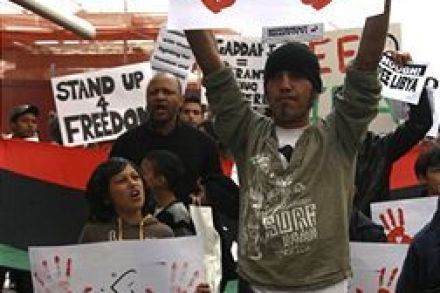
Cameron: military action not out of the question in Libya

From our UK edition

The government’s game of catch-up on Libya continues apace. David Cameron came to the Commons to update the House on the current situation. His main message was now that we have the vast majority of our citizens out, we can have a policy. Indeed, the government is today openly admitting that it was hamstrung last week by the continuing presence of a large number of British nationals in Tripoli. Cameron told the House that ‘we do not in any way rule out the use of military assets’; a dramatic shift from the tone of his entourage on last week’s trip. At the moment, the main military option on the table seems to be a no-fly zone and Cameron said he had asked the MoD and the chief of the defence staff to examine how this could be done.

Boris: give us a referendum on Europe

From our UK edition

Boris kicks off his Telegraph column today by observing that Colonel Gaddafi and Gordon Brown "look vaguely similar". And yet the really provocative copy, at least so far as the government is concerned, is reserved for the final paragraph: "It is bonkers [by pushing for AV] to be pursuing the last manoeuvre of a cornered Gordon Brown. By all means let us have a referendum – the one we were promised, on the Lisbon EU Treaty. Have you noticed the EU policy on North Africa? Have you heard much from Baroness Ashton? Shouldn't we have a vote on all that?" It's hardly a secret that Boris wanted a referendum on Lisbon: he said as much in an interview before the 2009 Tory conference, and irritated the party leadership in the process.

Will Cameron have a Brown moment over petrol?

From our UK edition

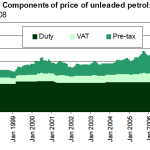
Remember when Gordon Brown came up against Fern Britton in a TV interview? I've pasted the video above to remind CoffeeHousers of two persistent truths: how tricky a subject petrol costs can be for a serving Prime Minister (watch on from around the 0:50 mark), and how Labour are hardly blameless when it comes to the current cost of fuel. As Britton asks in the interview, "How much tax do you put on the fuel?" And the answer that Brown mumbled to avoid, from a House of Commons briefing note at the time, was this: In other words, for a huge portion of the New Labour years, fuel duty accounted for over half of the petrol price at the pumps. For a typical litre of fuel, duty was 36.86 pence when Labour came to power, and 57.19 pence when they left.

The charge that the coalition should fear

From our UK edition

The greatest political, as opposed to strategic, threat to the coalition from the Libya evacuation crisis was that it would give the government a reputation for incompetence. As I say in the Mail on Sunday, Labour are looking to pin the incompetence charge to the coalition at every possible opportunity. The Miliband team knows that if the coalition comes to be seen as incompetent, then it is done for. Once a government comes to be seen as incompetent, then it is almost impossible for it to gain support for any of its proposals as even those who agree with the ideas don’t trust the government to implement them. Equally, any good news is seen to be fortuitous and not a consequence of the policies that the government has pursued.

Corporatism is not an adequate foreign policy

From our UK edition

The events of the last two weeks have demonstrated that David Cameron needs a revamped foreign policy. This is not, in itself, a surprise. Foreign policies sketched out in opposition seldom survive contact with reality. Remember Bush saying he did “not do nation-building”? And who can forget the ignominious fate of Robin Cook’s “ethical foreign policy”? David Cameron sought to distinguish himself from the adventuring, idealistic Blair with what he regarded as a ‘pragmatic’ foreign policy – that is, promoting British exporters.

What difference will sanctions make?

From our UK edition

Slowly, haltingly, the West decides what to do about Gaddafi. The latest news is that, having broken his silence over Libya a few days ago, Barack Obama is now imposing sanctions against its despicable regime: freezing assets, blocking transactions, that sort of thing. It follows a package of sanctions, including an arms embargo, that Britain and France have proposed to the UN. Although these sanctions are better than nothing – the West shouldn't house Gaddafi's slush funds, nor transfer weapons in his direction – they are of limited actual worth. Yesterday, the Mad Dog was parading the parapets once again, promising death for the protestors. You suspect he is unlikely to be put off by restrictions to his and his country's finances.

It’s the Q1 2011 growth figures that matter now

From our UK edition

The Office for National Statistics' preliminary figures for Q4 growth, released a few weeks ago, were a curious beast. They they were, suggesting that because of a snow-laden December our economy had started shrinking again, to the tune of -0.5 per cent. And yet so many other indicators were doing rather nicely: from activity in the services sector to the Exchequer's tax take. Many people, myself included, suspected it was only a matter of time before the ONS revised that -0.5 figure into more positive territory. Now time has passed, and the ONS has just revised the Q4 figure downwards, not upwards. Their preliminary figure wasn't quite right, they say. It should have been -0.6 per cent. Given that the snow was thought to reduce GDP growth by 0.

Will cuts kill the little platoons?

From our UK edition

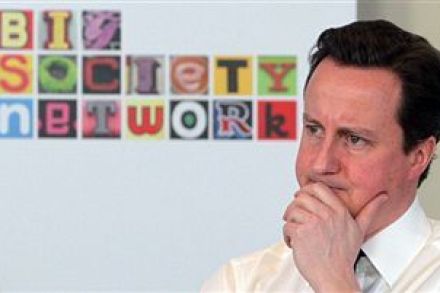
David Cameron is clear that his Big Society is about more than just volunteering. Yet during the recent spat on the matter, one of the strongest, most frequent criticisms voiced against it was that cutting state spending will lead to fewer volunteers. Dame Elisabeth Hoodless, executive director of Community Service Volunteers, claimed that the coalition’s spending cuts risk “destroying the volunteer army”. Johann Hari was also among those making this attack. In the 10 O’Clock Live debate that Fraser blogged last week, he claimed that international evidence tells us that volunteering is highest where public spending is highest.

What the Libyan debacle reveals about the Civil Service

From our UK edition

The headlines about Nick Clegg forgetting that he was running the country and the botched evacuation of British nationals from Libya have combined to make the coalition look rather incompetent, the most dangerous thing for a government to appear as. Certainly, the effort to get British people out of Libya has been a national embarrassment. The whole evacuation debacle is, though, more a tale of bureaucratic incompetence than anything else; a painful reminder that the Civil Service machine, upon which the government relies, is in bad repair. I hear that William Hague has already carpeted senior officials in the department over the whole episode.

Downing Street’s bureaucratic burden

From our UK edition

Do head over to ConservativeHome, where Tim Montgomerie has put together a comprehensive guide to the revamped Downing Street operation. I won't spoil its considerable insights here, except to highlight this: "An analysis of papers sent to Downing Street and the Cabinet Office has revealed that just 40% are directly related to the Coalition's programme. Roughly 30% come from the Whitehall bureaucracy and another 30% from the EU." James makes the point in his latest politics column that Tory ministers are becoming more and more Eurosceptic as they face the EU in government. That pile of European directives in the in-tray must just be getting too much.

Chaos thy name is Libya

From our UK edition

Colonel Gaddafi’s strength appears to be diminishing: Foreign Office sources suggest that the latest YouTube footage suggests that the rebels are now 30 miles from Tripoli, there are reports of Libyan servicemen spiking their guns rather than fire on their compatriots and members of the Gaddafi family have failed to present a united front to the dissent that intends to depose them. But, chaos thy name is Libya. Communications have long been silent, except for the savage drone of state radio, conduit for Gaddafi’s prophesies of victory or martyrdom. Evacuees from Tripoli’s now hellish airport relate a city bristling with arms and testosterone – the fear is that Gaddafi and his dogs of war are sufficiently mad to fight to the last bullet.

The emergence of a Cameron doctrine

From our UK edition

Daniel Finkelstein makes a simple but important point in the Times today (£): a Prime Minister’s foreign policy is determined by events more than by instincts. The revolts in the Middle East are defining David Cameron’s diplomacy. The emerging policy is a realistic expression of Britain’s current domestic and international capabilities. Cameron’s speech to the Kuwaiti parliament did not match Harold Macmillan’s ‘winds of change’ speech because Britain no longer disposes of continents. Likewise, Tony Blair’s messianic tendencies belong to a past era. Colonel Gaddafi’s murderous stream of conscious could have given cause to evoke the moral certainty of an 'ethical foreign policy'.

Ashdown goes Fox-hunting

From our UK edition

There’s a quite remarkable op-ed by Paddy Ashdown in The Times (£) today which goes public with a lot of the griping about Liam Fox that one heard behind the scenes at the time of the Strategic Defence Review. Ashdown remarks that the ‘problem with the SDSR was not speed, but lack of political direction.’ He then details how ‘Sir David Richards, then head of the Army and now Chief of the Defence Staff, had to bypass the whole process (and his Secretary of State) to appeal to the Prime Minister to avert catastrophe in the Army.

Tehran’s latest provocation

From our UK edition

The people of Egypt and Libya may have swung the spotlight onto their respective countries – but it is a spotlight that Iran is keen to exploit. Two of their warships have just passed through the Suez canal en route to Syria, the first to do so since 1979. They were given clearance by Egypt's new military stewards a few days ago. On one level, Tehran's actions are unimpeachable: Egypt cannot forbid access to Suez unless it is at war with the country at sail. But they are also, of course, designed to provoke. Why choose to do this now, other than to suggest something about the new latticework of power, and of power relationships, in a turbulent Middle East? Israel, for its part, is less than impressed.

Cameron’s fine, liberal speech

From our UK edition

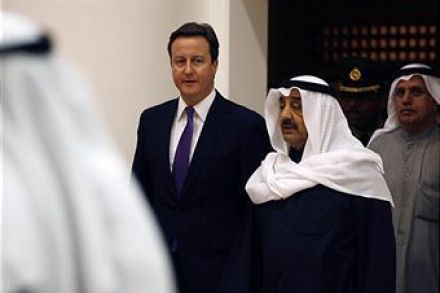
David Cameron’s speech in Kuwait today did not take on his hosts in the way that Harold Macmillan’s ‘winds of change’ speech did. But it was a still fine, liberal speech. The key argument of the speech was that: ”As recent events have confirmed, denying people their basic rights does not preserve stability, rather the reverse. Our interests lie in upholding our values – in insisting on the right to peaceful protest, in freedom of speech and the internet, in freedom of assembly and the rule of law. But these are not just our values, but the entitlement of people everywhere; of people in Tahrir Square as much as Trafalgar Square.” This is the crucial point: crude realism is not realistic.

How young Arabs saved the old West

From our UK edition

Three months ago the future looked bleak for the West. The countries that once dominated the world, invented capitalism, articulated mankind's universal desire for freedom and defended it against all enemies looked destined for an impoverished future squeezed by the authoritarian capitalists of the East and unsure about the righteousness of its ideological foundation. Even one-time liberals, whose life has been shaped in a struggle for human rights embraced China and its state-backed progress. Now, thanks to the pro-democracy protesters in the Middle East, the West is back. Not that it backed the democratic movements and now stands to reap the benefits.

Three reasons why David Cameron should get involved in the No to AV campaign

From our UK edition

Over at Comment Central, Danny Finkelstein has written a post saying that it might not be in the best interests of the No campaign for Cameron to campaign heavily against AV. His argument is that the No campaign’s best hope is to run as a spiky, anti-establishment effort. I think this is true but that the No camp has rather forfeited this chance by appointing Margaret Beckett as its president and having a former Labour MP front its launch. If the No campaign is going to be use so many politicians as spokesmen for it, it might as well have one of the most able ones involved. Second, and most importantly, Cameron’s presence on the trail would highlight Nick Clegg’s absence.

Reforming the NHS: accountability

From our UK edition

Last week, Reform published its 2011 public service reform scorecard. It judged each major government department against the three criteria set out by David Cameron: accountability, flexibility and value for money. The report finds the Home Office’s policing reforms succeeding on all three fronts, but inconsistency across other government departments. The Government’s health reforms are awarded grade D overall, with an E for accountability, a D for flexibility and a D for value for money. Here's how the coalition can get its NHS reforms back on track.   The government has recognised the need for fundamental reform of the NHS. The proposals announced in the July 2010 White Paper are substantial.

Is David Cameron about to have one of his Garibaldi moments?

From our UK edition

To date, this government has not had much of a foreign policy. Where there should have been grand strategy there has been trade promotion. But this appears to be changing. It is certainly striking that Cameron is the first western leader to visit post-Mubarak Egypt. Cameron himself is, normally, at the realist end of the foreign policy spectrum. But, as one close friend observes, one of the most important things to grasp in understanding the Prime Minister is that Garibaldi is one of his great heroes. As Cameron told Charles Moore, he admires Garibaldi’s ‘romantic nationalism'.