David cameron

Britain’s coming crunch with Europe

From our UK edition

It did not take David Cameron long to realise that there were three parties in his coalition. A few months into government, the Prime Minister worked out that only half of the policies he was enacting came from the shared agenda drawn up when the Tories and LibDems got together. The other half comes from the EU. Or, more specifically, the Civil Service machine, which is busy implementing various EU Directives, often passed many years ago. Cameron is trying to put the brakes on this process. As I say in my News of the World column, this has led to much frustration in Whitehall. And dismay: the Civil Service remembers how easily Labour waved through EU regulation and the piles of fat that Whitehall likes to pile on top of the EU regulation.

A clue to how Cameron really thinks things are going

From our UK edition

The most interesting question in politics right now is, to my mind, what does David Cameron really think about how his premiership is going? Does he subscribe to the view that the coalition is getting the big things right and that the numerous u-turns that Fraser referred to in his post really don’t matter that much. Or does he worry that the government is failing to communicate a message and that his defining political project—the big society—is coming under rapidly increasing fire. My own view is that the truth rests somewhere between these two statements. But my feeling has been that Cameron is too blasé about how Downing Street is functioning.

Cameron’s Eric Morecambe problem calls for the wisdom of Corporal Jones

From our UK edition

It looks like the most almighty mess. The government’s communications are tongued-tied, the Big Society is flightless and the reform agenda is being neutered by inertia. The political will has been met by the administrative won’t. But, despite the gloom, the government should pay heed to Corporal Jones: don’t panic. The slow progress of public service reform is a positive. Haunted by the memory of Blair’s paralysis, the government embarked on its programme in fevered delirium. Its ambitions were much too great. It is now time to halt and concentrate on delivering cuts. Rome was not built in a day and it certainly cost more than Britain can currently spare.

The Commons rejects prisoner voting rights

From our UK edition

The Davis Straw motion on keeping the ban on prisoner votes has just passed by 234 votes to 22. It is a crushing victory on what was a very good turnout given that both front benches were not voting. The 22 against the motion were a bunch of Liberal Democrats plus the Ulster MP Lady Hermon, the Plaid MPs Jonathan Edwards, Elfyn Llwyd and Hywel Williams, the Green Caroline Lucas,   Labour MPs Barry Gardiner, Kate Green, Glenda Jackson, Andy Love, Kerry McCarthy, John McDonnell, Yasmin Quereshi  and  one Tory Peter Bottomely, David Cameron now finds himself between a rock and a hard place. His MPs hate the idea of giving prisoners the vote and if he tries to force them to do it, he’ll end up in a very messy fight.

A well fought fight

From our UK edition

Plenty of personality at today’s PMQs. Not much policy. Miliband opened with one of his stiletto questions. Short sharp and deadly. ‘How’s his Big Society going?’ he asked the prime minister. Potentially this is tricky ground for Cameron and he rose to a barrage of Labour jeers. At least he’s had time to rehearse his defence. ‘Devolving power to local authorities was in the opposition manifesto and in ours and in the LibDems’ …Every member of the House of Commons backs what we’re talking about,’ he said cheerily. A robust counter-attack. Pose as an optimistic philosopher-king and leave Ed Miliband looking like a whining defeatist.

PMQS live blog

From our UK edition

VERDICT: A rowdy session, but constructive. Miliband went for the Big Society, which is in severe difficulty at present. He was very effective, but his attacks lacked absolute coherence. He failed to establish a link between his examples and his wider political point that the agenda is mere packaging for latent libertarianism. So, Cameron had enough wriggle room to repulse Miliband and was able to launch his own attacks on the Labour leader's irresponsible opportunism, and he also savaged Liverpool Council's reactionary politicking. Both leaders had good lines and were deft on their feet, as point was met by counter-point. Their supporters were in full voice too, sufficient to allow the quibbling Speaker to intervene and re-assert himself after last week's wife-related incident.

A legion of attacks

From our UK edition

Some attacks hurt more than others. And the attack launched by Chris Simpkins, the director-general of the Royal British Legion, on the government's approach to the military covenant will be particularly painful. For it comes after a Defence Review that left few happy, and when the nation is engaged in a war from which many feel the Prime Minister is a bit too keen to withdraw. Speaking to The Times, the Royal Legion chief said plans set out in the Armed Forces Bill requiring the Ministry of Defence to publish an annual report on the unwritten pact between society and the military were not the same as writing it into legislation - something he said the government pledged to do last June.

The Big Society in crisis?

From our UK edition

An ungodly alliance has converged on the Big Society. From the left, The Voice of the Mirror, the Unions and Steve Richards have published diverse critiques; from the right, Philip Johnston has joined Peter Oborne in suggesting that the policy is suffering a near-death experience. The Local Government Association and councillors have added their disgruntled voices as the day has progressed. All in all, it’s quite a circus and the government’s gentle response has been totally inadequate. Francis Maude penned an article for today’s Times (£), which, despite being commended by Tim Montgomerie, couldn’t really distract from the mauling Maude received on Newsnight last night.

Cameron was right to give the speech he did

From our UK edition

David Cameron’s speech yesterday was one of the most important he has given as Prime Minister. I’d urge you to read the whole text just to see how absurd some of the opportunistic, party political attacks on it have been. As I say in The Mail on Sunday, they’ll be a huge amount of resistance in Whitehall to the course that the PM is charting. But he is surely right that state money and recognition should not be going to any group that does not promote integration and believe in the liberal values on which this country is based. To do anything else would be fundamentally illiberal. A lot of the criticism of the speech seems to come down to the idea that this is an issue best not discussed. This idea is toxic.

The laddie is for turning

From our UK edition

In opposition, one of David Cameron’s strengths was the speed at which he dumped bad ideas. But, now, he is starting to acquire a habit for U-Turns – especially those called for by minor celebs. We’ve seen Scottish school milk, NHS Direct, BookStart, school sport – and soon, I suspect, forests, World Service cuts and (the biggie) NHS reform. A depressing pattern is emerging: anyone with a decent two-day campaign and a splattering of celebrities can probably force a concession out of the government. I make this case in my News of the World column (£) today. Here is a summary of my main argument. 1. Cameron seems to be pioneering the Celeb-induced U-Turn.

How much do we spend on the military?

From our UK edition

As shocks go, Politician Uses the Correct Statistic is not particularly electric stuff. But I was struck nonetheless by Cameron's claim in his speech earlier that, "we still have the fourth largest military budget in the world." You see, Gordon Brown used to exaggerate this figure by various sneaky methods – and so, by his account, we'd be second in the military spending league table, rather than around fifth. Whereas Cameron had it spot on. Here's what the latest top ten looks like, going off the best measurement that the Stockholm International Peace Research Institute knows (see their explanation here): On the face of it, this would appear to be a strong point against the claim that we underspend on defence. But it doesn't close the case.

Cameron signs up to muscular liberalism

From our UK edition

"State multiculturalism has failed." Angela Merkel put voice to that sentiment last October. Now it David Cameron's turn to do the same. In a speech in Munich today, the Prime Minister has taken a rhetorical torch to Islamic extremism. "Frankly," he says, "we need a lot less of the passive tolerance of recent years and much more active, muscular liberalism." It is, at the very least, a significant political moment. What Cameron is doing here – as explained by Charles Moore and Paul Goodman – is publicly signing up to a philosophy of the world. It is a philosophy that rejects the idea that extremism should simply be contained. Instead, it says that extremism must be fought – and that means engaging in a battle of ideas.

What to do about IPSA?

From our UK edition

I wish I could tell you that the main topic of conversation in Westminster today is Egypt and the future of the Middle East. But it isn’t. It is those Sally Bercow photos.  But if it wasn’t the picture of the Speaker’s wife naked but for a sheet that MPs were talking about it would be IPSA, the expenses body, following the publication of their claims for September and October. MPs detest IPSA. They believe, with good reason, it to be arrogant and inefficient. So strong is MPs’ opinion on this front, that David Cameron told Tory MPs late last year that if IPSA hadn’t sorted itself out by April, he’d sort it.

Body blow for the Big Society

From our UK edition

A major setback has befallen David Cameron’s Big Society. One of the four pilot schemes opened by Cameron as the ‘vanguard of the Big Society’ last autumn has fallen under a barrage of government cuts. Using unaffordable start-up costs as an excuse (although unidentified structural impediments were also mentioned), senior councillors of Labour controlled Liverpool Council have insisted that the scheme be curtailed immediately. Courtesy of Andrew Sparrow, the Liverpool Echo has the story. To dismiss the council’s decision as politically motivated would be transparent. Naturally, politics lurks behind the scenes; but this is an acute embarrassment for the Prime Minister.

As the oldest parliament yawned, the oldest civilisation erupted

From our UK edition

One yawn every minute. That’s how PMQs felt today. Foreign affairs dominated the session as Ed Miliband and the Prime Minister exchanged lofty words about the Cairo demonstrations and the spread of democracy around the world. Doubtless they felt they struck a suitably elevated tone but to the viewers they came across as a pair of prep school smart-alecs trying to sound like great statesmen disposing of liberated peoples after the fall of empires. Egypt and Afghanistan were both treated to a torrent of high-minded vacuities. David Cameron found the demonstrations ‘incredibly moving.’ Ed Miliband was impressed by the sight of ‘hundreds of thousands of people facing overwhelming odds to ask for their democratic rights.

Consensus reigns over PMQs

From our UK edition

A very different PMQs this week: six questions on foreign affairs and almost total consensus between Cameron and Miliband. Miliband’s office had given No 10 advance warning of the topics they wanted to raise and the two agreed on pretty much everything. Miliband argued that ‘the best route to stability is through democracy.’ Cameron agreed but stressed that democracy means more than just elections. You get the picture. At the risk of disagreeing with Pete, I must say that the exchanges were a reminder of just how dull PMQs would be if it was not confrontational.

PMQs live blog | 2 February 2011

From our UK edition

VERDICT: What a refreshing change that was. After several weeks of Punch 'n' Judy rivalry, the two party leaders finally put down their batons and stumbled upon a new way to do it. Much of the credit must go to Ed Miliband, for asking pacific questions about Egypt and Afghanistan in the first place. But credit, also, to Cameron, for answering them in a straightforward and statesmanlike manner. The rest of the House, for its part, was stunned into silence by this peculiar scene. Some of the blood rushed back into proceedings with the backbench questions, and as Cameron directed attacks at Ed Balls, but this must still go down as the most decourous PMQs in recent memory. Less spice, more meat – not a bad trade-off in this case.  1231: And that's it.

Ten things you need to know about the NHS reforms

From our UK edition

At last we have it: a defence of the coalition's NHS reforms that is worthy of the name. It came courtesy of David Cameron, speaking on BBC Breakfast earlier, and you can watch it in the video above. Suffice to say, the Prime Minister dwelt on the endemic waste and excessive bureaucracy of the current system, yet he also found room to explain why choice matters, and why it won't leave patients stranded. But, even then, the performance wasn't perfect. Cameron may have thought he was being disarmingly honest by admitting that his brother-in-law's fellow hospital consultants have qualms about the proposals, but one suspects it has served only to arm his opponents. Downing Street spokesmen have since put out hurried explanations that the PM was trying to "humanise" the issue.

The coalition feels the squeeze

From our UK edition

The Institute for Fiscal Studies are out prowling the airwaves again, and they bring happy and unhappy tidings for the coalition. On the happier side, at least presentationally speaking, is their assessment that, "those being hit the very hardest [by tax and benefit changes] are those on [a] higher level of earnings" – just as Cameron and Clegg suggest. But far less marketable is the IFS's claim that 750,000 people will be pulled into the 40 per cent rate of tax as a result of the threshold being reduced from £37,400 to £35,001 this April.   To be fair to the government, they have at least been upfront about this tax change.

Cameron’s gloomy brand of optimism

From our UK edition

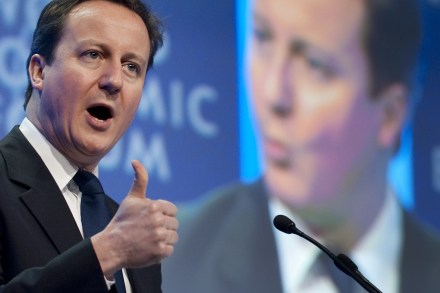
A weird, sprawling kind of speech from David Cameron in Davos this morning. It started off on an unusually, if expectedly, gloomy note: all talk of Europe's debt-induced decline in the face of competition from India, China and Brazil. And he emphasised, of course, that Britain would, and should, stick to its current trajectory of "tough" deficit reduction. But it's where it went from there that was more striking still. Cameron contrasted his position with that of "the pessimists". These people, he claimed, have a charter which includes propositions such as, "we in Europe are incapable of solving our debt and deficit problems," and, "we're attached to liberal values that are leaving us far behind the juggernaut of authoritarian capitalism".