David cameron

Tax versus philanthropy 

From our UK edition

I was on the panel of Any Questions last night in Saltaire, the most beautiful town I’ve seen outside of the Highlands. Jonathan Dimbleby always warms everyone up with a test question, which lets the panelists make their mistakes early. The first question was this: the town of Saltaire was founded by a philanthropist, Sir Titus Salt. What can be done to make today’s rich pay their fair share? Lucky for me that it was not recorded, because I went on for ages. Sir Titus was living in an era before the welfare state, where welfare was provided voluntarily, by people in the community. Had he been alive today, the government would be confiscating 52 per cent of what he earned – thanks to George Osborne’s recently increased tax.

Could Warsi’s next job be High Commissioner to Pakistan?

From our UK edition

Sayeeda Warsi’s upbraiding of Pakistan for not living up to Jinnah’s ideals is another sign of how the government believes Baroness Warsi to be uniquely able to speak to Britain’s most difficult ‘ally’. David Cameron and his circle were thoroughly impressed by how Warsi managed to cool tempers in Islamabad following the Prime Minister’s criticism of Pakistan, in of all places India, for facing both ways in the war on terror and have been using her since to speak to the country’s leadership.

Britain makes new senior diplomatic appointments

From our UK edition

From the Number 10 website: The Prime Minister is pleased to confirm the following senior appointments: Sir Peter Ricketts, currently the Prime Minister’s National Security Advisor, to become HM Ambassador to France; Sir Jon Cunliffe, currently the Prime Minister’s Advisor on Europe and Global Issues, to become the UK’s Permanent Representative to the European Union in Brussels; Sir Kim Darroch, currently the UK’s Permanent Representative to the EU, to become the Prime Minister’s National Security Adviser; and Sir Peter Westmacott, currently HM Ambassador France, to become HM Ambassador to Washington. These changes will take effect from January 2012.

Solving the government’s aid conundrum

From our UK edition

Earlier this week, Jonathan Jones reported on the problems facing the government on international development spending.  Their plan to increase the DFID budget is deeply unpopular. Today we’ve released a new YouGov poll that sheds a lot more light on the situation, and suggests a way out whereby the government can still fund their most prized objectives but take the heat out of public anger on the issue. The first thing to understand is that the public doesn’t just resent any money being spent on international development. Freezing the budget is significantly more popular – with 69 per cent support and 12 per cent opposed – than scrapping it outright – with 43 per cent support and 33 per cent opposed.

Cameron: no more bailouts

From our UK edition

It’s another of those special Cameron victories in Europe: we’re in for a second Greek bailout, but not quite as much as we might have been. Britain will contribute a sum through the IMF; however, it will not be contributing to EU funds. Cameron has succeeded in ensuring that the European bailout will be conducted under the permanent European Financial Stability Facility (EFSF), to which only eurozone members are signatories. Although it should be noted that some Brussels experts doubt that the European Financial Stabilisation Mechanism (to which Britain has subscribed) could have been used in this instance, which further devalues the government's victory. Anyway, attention now turns to Greece and whether it will default.

Poll round-up | 23 June 2011

From our UK edition

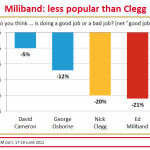
We haven't dwelt on the polls very much on Coffee House recently, although we have flagged up some nuggets on Twitter. Here are some of the measures of public opinion that provide an interesting backdrop to Westminster's machinations: Labour in trouble despite poll leads Two weeks ago I reported on a poll that showed the extent of Ed Miliband's unpopularity. There have since been a few more polls to compound his unease. ICM found that he had worse approval ratings even than Nick Clegg: YouGov find that 58 per cent of the public think he's doing a bad job, but perhaps more worrying for "Red Ed" is that he even has negative ratings among the very people who won him the leadership election: trade union members.

Obama draws down his forces

From our UK edition

It is as Matt Cavanagh predicted in his article for Coffee House, a few weeks ago. Barack Obama has decided to pull 10,000 of the 30,000 American "surge" troops out of Afghanistan this year. The remaining 20,000 will be outtathere by next summer. "Drawdown," is the word that the US President used in his address last night, and it is happening at quite a pace. He presented this approach as a victory, suggesting that America has already achieved most of its goals in the country, and that "the tide of war is receding". But there were one or two revealing notes of concession. "We will not try to make Afghanistan a perfect place," quoth Obama. And he nodded towards the fiscal cost of the war, as much as its human cost.

Miliband’s myopia

From our UK edition

The Prime Minister declared war at PMQs today. Not once but twice in the same sentence. ‘We’re at war in Libya and in Afghanistan,’ he said, in a throwaway footnote to some ritual noises about his ‘huge respect for our armed forces.’ Until this historic moment Britain had been engaged in peace-keeping and nation-building in Afghanistan, and in civilian protection and tyrant-bothering in Libya. But now it’s official. We’re mobilised on two fronts. Ed Miliband might have made more of this but he was too busy mentally preparing himself for this week’s shock ambush. This week’s shock ambush wasn’t quite as shocking as it might have been because it had exactly the same three-pronged shape as last week’s shock ambush.

Devil in the detail

From our UK edition

David Cameron is not a details man. He has always been more comfortable with the grand sweep than the nitty-gritty of policy. Ed Miliband, by contrast, is a natural-born policy wonk who is never more confident than when discussing detail.   Miliband is trying to turn this to his advantage at PMQs and, for the second week in a row, succeeded in catching Cameron out on the details of government policy in an emotive area. Last week it was benefits for cancer sufferers, this week it was the retention of DNA from those arrested for, but not charged with, rape.    The Prime Minister is a good enough performer at the despatch box to get through these moments without sustaining too much damage.

Public opinion on international aid isn’t where Cameron thinks it is

From our UK edition

Andrew Mitchell was recently informed that the public is split 50:50 for and against increasing the international aid budget to £12 billion in 2013. A YouGov@Cambridge poll for Politics Home suggests that he should get some better advice. The poll shows that while the public is indeed split fairly evenly on the general principle of aid (41 per cent in favour, 38 per cent against), when it comes to the government's promise to increase the aid budget by a third, those against outnumber those for by more than 2 to 1. The policy is by no means a Cameroon brainchild. In 1970 the United Nations set the target for government aid at 0.7 per cent of GNI; in 2004 the Labour government pledged to meet it by 2013 and in 2006 David Cameron signed the Tories up to that pledge.

America and Britain turn their minds to the (fiscal) cost of war

From our UK edition

Five-thousand, ten-thousand, or fifteen-thousand? That's the question hanging in the air as Barack Obama prepares to clarify his withdrawal plan for Afghanistan this evening (or 0100 BST, if you're minded to stay up). And it relates to how many of the 30,000 "surge" troops he will decide to release from the country this year. Washington's money appears to be on 10,000, with half of them leaving this summer and half in December. But no-one outside of the President's clique really yet knows. His final decision will say a fair amount about his intentions in Afghanistan, or at least about just how fast he wants to scram out of there. What's really striking, though, is the emphasis being placed on the bill for Afghanistan.

When u-turns matter

From our UK edition

When I asked one Tory how things were going the other day, he replied "we’re living by that Silicon Valley phrase: ‘fail fast and fail often’." His argument was that for all that we in the press work ourselves into a frenzy over u-turns, the public don’t much care about them and it is much better to get these things out of the way quickly.   When I challenged him that all these shifts made Cameron look weak, his rejoinder was that as long as the coalition stuck to its deficit reduction programme voters would know that it could hang tough when it needed to.   I suspect that this argument is half-right.

Cameron muscles Clarke off the stage

From our UK edition

The toughening-up effort continued with David Cameron's press conference just now. There he was, at the prime ministerial lectern, not just announcing a stricter sentencing system than Ken Clarke broached a few weeks ago, but explaining why the government's change of mind was actually "a sign of strength". Out are the 50 per cent sentence reductions for those who plead guilty early. In is a commtiment to jail those caught using a knife threateningly, as well as a bundle of tougher measures all round. "Being strong is about being prepared to admit that you didn't get everything right the first time around," said Mr Cameron, again and again.

Lib Dems wary of “Tory traps”

From our UK edition

The government’s u-turn on sentencing reveals something quite important about the Lib Dems' approach to coalition. Despite having backed Ken Clarke in private, they have stayed as far away as possible from the issue in public.   The Liberal Democrats were determined not to put themselves on the wrong side of the public on this issue, to end up copping the blame for ‘soft sentencing’. As one senior Liberal Democrat said to me recently, "we’re determined not to walk into any bear pits. If there is a big flashing neon sign above something saying ‘Tory trap’, we’ve got to be disciplined enough not to fall into it.

Cameron gets tough

From our UK edition

Toughness, or at least the appearance of it, is clearly the theme of the week on Downing Street. After the vacillations over NHS reform, David Cameron seems to be going out of his way to sound that little bit more hard. There's the headline on the front of today's Times, for instance: "Cameron to Europe: not one penny more." And there was the PM's claim, yesterday, that a Tory majority government would be "tougher" on immigration and welfare. Even the recent hyperactivity of Michael Gove is, I'm sure, all part of the plan, given that schools reform is broadly one of the areas where the government will (probably) never apologise, never surrender. But the new hardline isn't just a straight one, oh no.

The trouble with Ban Ki-moon

From our UK edition

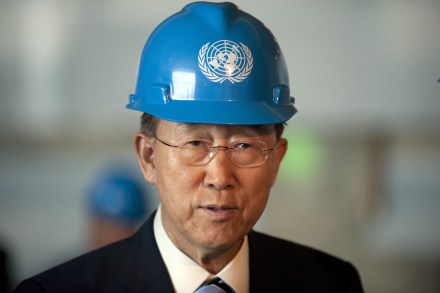
In the little compound known as “Bantanamo,” located outside the UN headquarters in New York, a small sigh of relief was probably breathed last week. For, inside, UN Secretary-General Ban Ki-moon had just been told of the UN Security Council’s unanimous decision recommending that he be elected for a second term. Gabon's UN ambassador Nelson Messone made the announcement to the press after the 15-nation council met behind closed doors. The UN General Assembly will probably vote this week, confirming that Ban will run the organisation until the end of 2016.

The limits of stigma

From our UK edition

As James says, it’s been a day of high passions here at The Spectator. He feels strongly that many of the problems in Britain are societal, and require a cultural shift. Maybe so. I disagree with James when he says a Prime Minister's role is to “lead society". I disagree. We pay him to run the government, not offer his advice (or, worse, condemnation) on how society is running itself. Sure, society is shaped by government incentives. Cameron can fix these. But shaping society by exhortation is not what we expect of limited government. Fundamentally, it confuses what I see as the natural pecking order. In Britain, the people pass judgment on politicians. Not the other way around.   Tim Montgomerie is on James’ side, and chastised me yesterday.

Cameron is right to use the bully pulpit of his office

From our UK edition

The normal Monday morning calm of The Spectator was disturbed today by an argument about David Cameron’s comments about fathers who go ‘AWOL’. I thought Cameron was right to say what he did, my editor didn’t. He felt that it wasn’t the Prime Minister’s job to moralise, and that him doing so was the beginning of a descent into totalitarianism.   The reason I think Cameron was right to speak out is that so many of the problems in this country are social or cultural. They can’t be solved by another piece of legislation or a government initiative.