David cameron

The New York Times’ austerity myth

From our UK edition

Yet again, the New York Times fact-checkers seem to have taken the day off. The newspaper yesterday printed an editorial about British economic policy which contained basic errors – identical to those made in a blog which Paul Krugman bashed out last week. It's worth fisking a little, because Krugman appears to be using the newspaper to create an austerity myth. 'A year and a half ago, Prime Minister David Cameron of Britain came to office promising to slash deficits and energize economic growth through radical fiscal austerity. It failed dismally.' This is right, insofar as there was no austerity. The below shows current spending, for every month since the government took power. They overspendt.
The referendum question Pt. 2

From our UK edition

Earlier this morning, Number 10 briefed that fiscal union in the eurozone would not trigger a referendum in this country because sovereignty will not be transfered from London to Brussels — a pre-requisite for any vote. The problem for Cameron is that some of his backbenchers say there should be a referendum. Bernard Jenkin was on the Daily Politics earlier, insisting that fiscal integration marks a new era in the history of the Eurozone, which he dubbed ‘Maastricht Plus’. On the other hand, some eurosceptic backbenchers caution that now is not the time to hold a referendum — stability in the eurozone is the order of the day.

Improving the health of the nation

From our UK edition

Britain’s future prosperity, we are frequently told, lies in scientific discovery, so it's odd that David Cameron has not given a major speech on it as prime minister until now. He will talk later today about the need to deregulate pharmaceutical licensing to encourage private investment in public health. He views the life sciences sector as a vital source of future economic growth. The PM will announce four new initiatives.

The referendum question

From our UK edition

As French and German officials make final preparations ahead of tomorrow’s meeting on fiscal union, it’s worth reconsidering the coalition’s triple referendum lock. James Kirkup has an incisive post on the issue, describing a potential government split. The division was evident on TV this morning: Iain Duncan Smith told Dermot Murnaghan that a referendum would be held ‘if there is a major treaty change’, while Nick Clegg told Andrew Marr that only ‘an additional surrender of sovereignty from us to Brussels’ can spark a vote. Kirkup argues that IDS reflects the broader sceptic position on the Tory backbenches: that the PM has promised a vote on all substantial treaty changes.

The Gospel according to Delors

From our UK edition

An old enemy of England nestles in the pages of today’s Daily Telegraph. Charles Moore travelled to Paris to meet Jacques Delors, the architect of the euro and advocate of Europe’s ‘social dimension’. Moore found defiance where one might have expected humility, perhaps even repentance. Delors insists that the fault was in the execution not the design of the euro.

A tale of two cities | 2 December 2011

From our UK edition

Nicolas Sarkozy is grudgingly admired by French socialists as a political fighter, capable of thriving even in the most desperate situation. David Cameron is coming to understand what they mean. It is the best of times and the worst of times between Paris and London. Two months ago, David Cameron and Nicolas Sarkozy assumed the victor’s garlands in Benghazi; today, they met at odds, if not yet in animosity, over the contested logic of ever closer union in Europe. Sarkozy appears to have got his wish: the 17 countries of the Eurozone will deepen their economic and political relations in an attempt to save the single currency — and with it, he hopes, France’s economic and political strength on the international stage.

How happy is Britain? 7.4

From our UK edition

Remember General Well-Being – David Cameron's attempt to come up with a new set of statistics to encapsulate all the things that GDP doesn't? Well one aspect of it, the Office for National Statistics says, is 'subjective well-being'. That is, how do people rate their own well-being? It's not all there is to well-being, we're told – health, personal relationships, job satisfaction and economic security will need to be added to the mix too – but it is an important part. And so, the ONS has set about measuring it. Over the last few months, they've begun asking the public four questions: Overall, how satisfied are you with your life nowadays? Overall, to what extent do you feel the things you do in your life are worthwhile?

Sarko’s renaissance

From our UK edition

When David Cameron sits down for lunch with Nicolas Sarkozy today, he is bound to ask his host how the presidential election is going. In response, President Sarkozy is likely to break into one his wide-faced smiles, and begin moving about energetically, as he tends to do when he is excited. Forget the polls that put Francois Hollande ahead in a two-way race. It is too early to tell what people really think and, crucially, it won't be a two-person race. It is a five-person, two-round election. And so far, Sarkozy is doing very well. Besides Sarkozy and Hollande, four other candidates could make a difference to the outcome: Marine Le Pen, François Bayrou, Eva Joly and Jean-Luc Mélenchon.

Woolf tucks into perfidious Albion

From our UK edition

Yesterday night's news that a senior FCO official lobbied Oxford University on behalf of Saif al-Islam Gaddafi adds more ordure to the already fetid story of Britain’s role in Colonel Gaddafi’s rehabilitation. The Woolf Inquiry into Saif’s dealings with British universities and businesses found that, 'It was made clear [to Oxford] … that the FCO would appreciate help in this case since Libya was opening up to the West again.'  Oxford resisted; but this episode has hardly covered Britain’s elites in glory: the civil service, BAE and august universities are all criticised in Woolf's report.

Rowdy and raucous — but that’s how we like it

From our UK edition

It was vicious. It was frenetic. It was full of rage and class-hatred. It was great political sport. If you like a serious punch-up, the Commons at mid-day was the place to be. The viewing figures at home were boosted by the many millions of strikers who couldn’t quite make their local anti-cuts demo and were sitting out the revolution with a nice cup of tea and PMQs on the Parliament channel.  Ed Miliband started by claiming that the PM had been seen in private rubbing his hands, like Moriarty, and boasting that ‘the unions have walked into my trap’. Cameron, although not denying this, slammed the Labour leader for supporting a strike which had been called in the middle of the negotiations.

Will the strikes exacerbate Cameron’s women problem?

From our UK edition

We've already heard a lot about Dave's problem with female voters. Melanie McDonagh wrote our cover piece on it in June, and in September there was that memo detailing Number 10's efforts to respond. But, judging by the polls, we may well be hearing even more about it after today's strikes. It seems that, while the government has men broadly on its side in the battle against the unions, women are far less supportive. 51 per cent of men told ComRes that public sector workers are wrong to strike today, but only 42 per cent of women agreed: TNS BMRB asked people whether they thought that the government was right to press ahead with the reforms, or that public sector workers were right to strike against them.

Dave and Ed strike each other

From our UK edition

It was a real blood and thunder PMQs today. This was the politics of the viscera; whose side are you on stuff.   Ed Miliband chose to start on the strikes. David Cameron ripped into him from the off, calling him ‘irresponsible, left-wing and weak.’ Miliband came back with an attack about how he wasn’t going to demonise dinner ladies who earn less in a year than George Osborne’s annual skiing holiday costs, though he flubbed the line slightly.   The Tory benches were in full cry, and throughout the session Cameron kept coming back for another swing at Miliband and the union link.

Cameron may have more leverage in Europe than he thinks

From our UK edition

There's just over a week to go until the crunch EU summit on 8-9 December, so David Cameron has to decide how best to play his cards — and quick. The problem, as Daniel Korski has pointed out, is that Britain faces the risk of ‘structural isolation’ in Europe in the short-term. To counter this, Cameron effectively has two options. First, work with allies on both sides of the euro divide to seek political assurances — formal or informal — against the formation of a two-tier Europe with a more integrated eurozone in the driving seat. Or, second, press ahead with UK-specific carve-outs from the EU structure.

How can Cameron protect our interests in Europe in the short term?

From our UK edition

Chatting to people in Brussels last week, I couldn't help feeling that David Cameron's EU problem is one of timing. The PM will probably be able to piece together a repatriation package that includes measures such as a withdrawal from the over-implemented Working Time Directive and a reduction in the EU budget. But none of this is likely to be enough for his party. Indeed, I suspect the budget won't be finalised until two minutes to midnight during the Lithuanian EU Presidency in 2013. Add to this the Tobin Tax, where there seems to be little leeway for the British government. Barosso, Merkel and Sarkozy are determined to introduce it, and even a Eurozone-only tax will harm the City.

Cameron cross-questioned

From our UK edition

A quick post just to add the Guardian's interview with David Cameron to your Saturday reading list. It takes the unusual approach of fielding questions to the PM from a range of ‘public figures’ — and, although many of those questions reduce down to ‘why aren't you giving more money to X?’, the results are still generally engaging and occasionally insightful. And so we learn, after an enquiry by The Spectator's own Toby Young, that Cameron doesn't keep a diary. And we also have the PM justifiying his stance on Europe to Nigel Farage; skipping over a question about what he may or may not have inhaled during his time at Eton; claiming that ‘not everything [Gordon Brown] did was wrong’; and more besides.

Without growth, Osborne’s best-laid schemes will go awry

From our UK edition

Strikes, Olympic boycotts and obesity league tables — it's a dreary set of newspaper front covers this morning. But none of them are quite so dreary as the Telegraph's, which speaks of ‘The return of recession’. According to their story, the OECD has told ministers that its latest set of forecasts, released on Monday, will have the UK economy shrinking for the first six months of next year. They're not the first forecasting organisation to suggest a double-dip — going by the Treasury's overview of indpendent forecasts, Schroders Investment Management have economic ‘growth’ at -0.4 per cent in 2012 — but they are the most prominent so far. Shudder ye might. Of course, one forecast does not make a recession by itself.

Breaking down those record immigration figures

From our UK edition

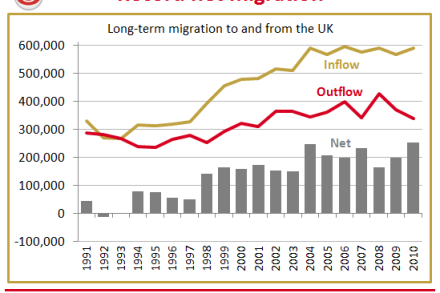
New immigration stats out today show that 2010 set a new record for net migration into the UK. The figure hit 252,000 – a 27 per cent increase on 2009 and 7,000 higher than the previous record in 2004:   As this graph shows, the number of immigrants moving to the UK has actually been fairly constant – at around 580,000 – since 2004 (when the 'accession eight' countries in eastern Europe joined the EU). But the number of people leaving the country has dropped off significantly in the past couple of years – from 427,000 in 2008 to 339,000 last year, hence the increase in net migration. So, as Gillian Duffy might ask, where are they flocking from? Here's where the 591,000 people who migrated to the UK last year came from: And why do they come?

Miliband’s opportunity in the economic debate

From our UK edition

Political debate is going to be dominated by the economy between now and the autumn statement. Ed Miliband is trying to use this moment to persuade the public that the Coalition's economic policies have failed. By contrast, the Tories want to highlight how much deeper trouble the country would be in if it did not have the confidence of the bond markets. The Tories hope that this 'stay close to nurse for fear of something worse' approach will eventually deliver an election victory for them in 2015, given how hard Labour is finding it to regain credibility on the economy. As Ben Brogan wrote the other day, this strategy worked for them in 1992 — the campaign on which both Cameron and Hilton cut their political teeth.

Cameron: ‘We have to end the sicknote culture’

From our UK edition

The Prime Minister has backed the proposal for a new independent service to sign workers' long-term sicknotes, instead of GPs. The plan, which Pete wrote about at the weekend, is aimed at ensuring that people on sick pay or sickness-related benefits really are too ill to work. Cameron describes how it would work in today's Mail: 'The independent service would be free to all employers from four weeks of sickness absence, with the option for employers to pay for it earlier. It would provide an in-depth assessment of an individual's physical and mental function. So if they're unable to work, they’ll be helped – but if they are fit, they'll be identified and supported back into the workplace.

Ed looks more dead than deadly

From our UK edition

If Roman Abramovich owned the Labour party, Ed Miliband would be toast by now. The floundering opposition leader gave the sort of inept, predictable and ill-organised performance at PMQs that would get a manager sacked in the Premiership. It scarcely helps that Mr Miliband seems to prepare for these sessions like a deluded psychic. He and his team of prophets at Labour HQ clearly believe they can foretell what the prime minster will say and how best to smash his answers to pieces. Referring to the rise in unemployment, Mr Miliband began by attacking the PM for scrapping the Future Jobs Fund in March. He boasted, rather weirdly, that ‘under Labour, youth unemployment never reached 1 million.