David cameron

The two types of Tory modernisation — and which one’s on the rise

From our UK edition

There have always been two types of Tory modernisers. Both wanted to talk about issues that the party had neglected — public services, the environment and the like. But the soft modernisers were more prepared to compromise ideologically, to go with the flow of the age. The hard modernisers’ interest, by contrast, was in applying Tory thinking to these areas. Michael Gove’s education reforms are, perhaps, the best example of hard modernisation in action. As Charles Moore puts it in the Telegraph today, ‘Mr Gove offers an attractive combination — complete loyalty to the Cameron modernisation, but a Thatcher-era conviction politics as well’.
The ruckus over Lords reform

From our UK edition

Both the Tory and Lib Dem manifestoes promised to reform the House of Lords, as did the Coalition Agreement, but the gulf in enthusiasm between the two parties is enormous. For many Lib Dems, this is of course — as Nick Clegg put it in December — ‘one boat that urgently needs rocking’. For many Tories, it is something to be ambivalent about, or to oppose. Which is why the politics around the ongoing Lords Reform Bill are likely to be so fraught. James has already written of how there are ‘more than 81 [Conservative] MPs prepared to vote against it.

The dark side of the Big Society

From our UK edition

The A4e scandal is getting worse. Emma Harrison has quit as David Cameron’s back-to-work tsar, the police are still investigating a case discovered last year and there’s a suggestion their investigation is widening. This is, for David Cameron, the dark side of the Big Society. In my Daily Telegraph column today, I explain why. ‘The Big Society’ is a silly name for a good idea: that lots of companies, charities, etc will help provide government services. They are given freedom to innovate, to create — and the freedom to get things badly wrong. This is the freedom which A4e seems to have availed itself of. It grew like crazy, perhaps too fast. Its internal audit procedure found four staff who had been falsely claiming to get people back in work.

The tension’s rising inside the coalition

From our UK edition

Talking to a Downing Street adviser earlier this week, I was struck when they observed that a ‘2014 election wouldn’t be too bad really. David would have done his best, Nick would have done his best. But they just couldn’t make it work anymore.’   The Tories have spent some time recently contemplating the possibility that the coalition might not run for the full length of the parliament. At a recent Chequers away day, the prospect of the Liberal Democrats walking out in 2014 was openly discussed.   That this possibility is even being talked about is revealing of the mood inside the coalition, which is the subject of my piece in the magazine this week. Things are becoming increasingly tense.

Miliband snipes, Cameron deflects, Bercow bobs

From our UK edition

Let’s be honest. I shouldn’t say this but I can’t help it. I’m fed up. The NHS reform process has been dragging on for months, and still there’s no end in sight. Ed Miliband brought it up at PMQs for the third week running. The position remains the same. Miliband loves it. Cameron lives with it. The PM claimed that 8,200 GP practices are now practising his reforms and the Labour leader replied with a list of professional bodies — nurses, doctors, midwives, radiologists — who oppose them. And that’s exactly the trouble, for me, at least. If the issue were a race-horse some crazy campaigner would plunge beneath its thundering hooves. But it’s not. It’s a set of abbreviations.

Murphy launches Labour’s defence review

From our UK edition

Remember when Jim Murphy spoke about defence cuts last month? It was not only a smart refinement of Labour's fiscal position, but also a preview for the defence review that they're conducting as an alternative to the government's SDSR. Well, that review was officially launched this morning, and I was in the audience on reporting duty. Here's a quartet of quick observations that I bashed out on my phone: 1) Cuts, cuts, cuts. There was, it is true, a greater emphasis on the ‘constrained fiscal circumstances’ in Murphy's opening remarks than there is the consultation paper that Labour released today. But that emphasis was still striking in itself.

Miliband revels in his NHS attack

From our UK edition

Today’s PMQs was a reminder that whenever Ed Miliband goes on the NHS he is guaranteed a result. Indeed, I don’t think I’ve ever seen Miliband enjoying himself as much in the chamber as he was today. When Andrew Lansley leaned over to try and tell Cameron the answer to a question, Miliband mockingly remarked ‘Let me say to the Health Secretary, I don’t think the PM wants advice from you’. As Cameron’s assaults became more direct, Miliband did not — as he often does — go into his shell. As he sat down at the end of it all, the Labour leader had to push down on his knee to disguise the adrenalin shakes he was having.

Miliband guarantees a return to Brown’s Big Idea for the NHS

From our UK edition

It would be so much easier for Ed Miliband to attract headlines if he could shout in Andrew Lansley's face. As it is, the Labour leader has had to make do with giving a speech today attacking the NHS reforms. Within the parameters of what he might say, it's an okay effort. The predictable lines about ‘creeping privatisation’ are leavened by the admission that ‘the question is not reform or no reform. It is what type of reform.’ And he adds, by way of a cross-party sweetener, that he would ‘get round the table’ with David Cameron to discuss ‘the future of the NHS’. But the substance of the speech, rather than its rhetoric, is a little more questionable.

A question of trust for Andrew Lansley

From our UK edition

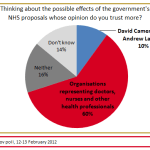
It's not too surprising that people trust ‘organisations representing doctors nurses and other health professionals,’ well above David Cameron and Andrew Lansley, when it comes to the NHS reforms. People are sceptical of politicians in a way that they aren't of the health service, its unions and its workers. 64 years of ‘national religion’ status for the NHS, and many more years of gross political let-down, have made sure of that. But today's YouGov findings still shine a fresh light on Cameron and Lansley's changing approach to the reforms.

If Cameron doesn’t talk about greater powers for England, Labour will

From our UK edition

Action over Scotland is certainly producing a reaction in England. It's not what you'd call an ‘equal and opposite reaction’ yet, but it's there — and it's crystallised by Tim Montgomerie's article for the Guardian this morning. I'd recommend that you read it in full, but Tim's basic point is that David Cameron could score a ‘triple crown of political victories’ by moving towards a more federal UK: ‘By offering to extend Scottish devolution he can be the Conservative leader who saves the union. By promising to balance Scottish devolution with a commitment to new arrangements for the government of England, he can radically improve his own party's electoral prospects.

From the archives: Why England and France will never be best friends

From our UK edition

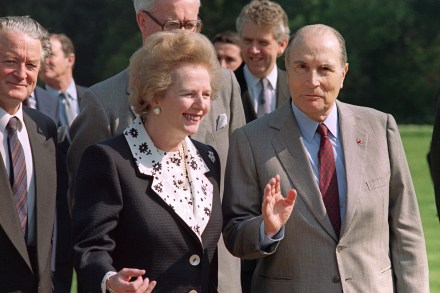
To mark David Cameron’s get-together with Nicolas Sarkozy today, we’ve dug up this essay from the Spectator archives by Lord Powell. As foreign policy advisor to Lady Thatcher and Sir John Major, Powell provides a first-hand insight into the incompatibilities that separate our two nations. A fundamental incompatibility?, Charles Powell, The Spectator, 3 September 1994 A few summers ago, I accompanied Margaret Thatcher to a meeting with President Mitterrand in Paris. The weather was sunny and the mood equally so. The agenda was rapidly disposed of and the President proposed that we adjourn to the Elysée garden. Once there, he took Mrs Thatcher — as she then was — off for a stroll while Jacques Attali and I subsided on a bench in the sun.

L’entente nucléaire

From our UK edition

There's no wound that a press conference won't heal, or at least that's the impression that David Cameron and Nicolas Sarkozy created earlier. The pair played down the tensions and grudging handshakes of the past few months to talk up Britain and France's ‘incredibly strong relationship based on shared interests’. And there was more than just talk too: they announced a £500 million deal between French and British companies for nuclear power plants. And they hailed progress towards the creation of a joint ‘command and control centre’ for military operations.

Miliband’s NHS pledge

From our UK edition

Ah, there he is! With the coalition — and David Cameron — dominating the political news on every day of this half-term week, Ed Miliband has finally caused a ripple in the national consciousness. He's appearing before nurses in Bolton today to make a pledge: ‘Before he became Prime Minister, David Cameron concealed his plans for creeping privatisation of our National Health Service. So people didn’t get a vote on these plans at the last election. But I give you my word that if he goes ahead, they will be a defining issue at the next.’ Put aside the rhetoric about ‘creeping privatisation’ (which would surely make Tony Blair shudder), and it's understandable why Miliband is stressing this point.

Cameron’s new offer for Scotland could mean a new offer for England

From our UK edition

The consensus opinion across most of today's papers appears to be that Dave done good in Scotland yesterday. And now the Prime Minister's cause has been helped that little bit more by the Lords Constitution Committee. ‘We are firmly of the view that any referendum that is held must be a straight choice between full independence or the status-quo,’ says the committee's chairman Baroness Jay. ‘A third “devolution-max” option is clearly something every part of the UK must have a say in as it has the potential to create different and competing tax regimes within the UK.’ The strange thing is, a UK-wide referendum on ‘devo max’ could actually produce the sort of result that Alex Salmond would want.

Cameron’s risky move could play into Salmond’s hands

From our UK edition

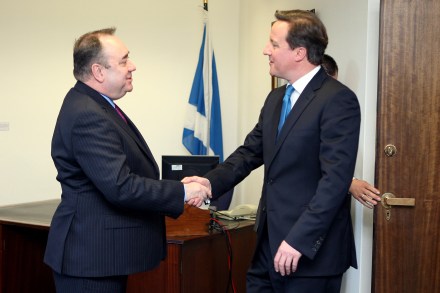
Not many politicians would conjure up the spectre of Alec Douglas-Home to scare the Prime Minister, but that is exactly what Alex Salmond did today — to some effect. The Scottish First Minister was responding to David Cameron’s ‘jam tomorrow’ offer to the Scottish people. ‘Vote “no” in the independence referendum,’ Mr Cameron effectively told Scots today in his latest attempt to make some progress in the independence debate, ‘And I’ll see that you get major new powers for the Scottish Parliament.’ It was one part bribery, one part political strategy and Mr Salmond was on to it quicker than the average Scot can order a haggis supper.

Cameron’s plan to protect the Union

From our UK edition

‘When the referendum on independence is over, I am open to looking at how the devolved settlement can be improved further. And yes, that means considering what further powers could be devolved.’ These words in David Cameron’s speech today, which follow on from what the Scottish Secretary Michael Moore said at the weekend, make clear what the Unionist campaign’s message will be. They’ll say to the Scottish electorate ‘Vote no to independence and then we can talk about devo-max’. This strategy will probably ensure victory in the referendum. But there are risks to it. First, more constitutional debate will create more uncertainty.

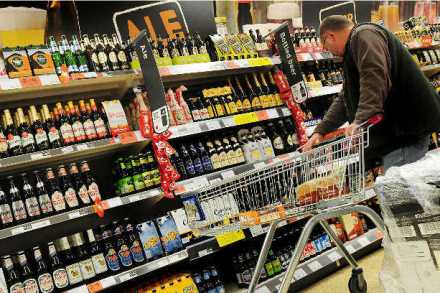
How to implement a minimum price for alcohol

From our UK edition

Pete posted earlier on the Prime Minister’s latest intervention on the issue of problem drinking. The new proposals — like a greater police presence in A&Es, and ‘drunk tanks’, special units where drunks are taken to sober up — are sensible enough, but seem small relative to the scale of the supposed problem, and focus on peripheral (though important) side-effects, rather than the core of the issue. The ‘big idea’ seems to be missing, even though the Conservatives have been flirting with it for some years, is a minimum unit price (MUP) for alcohol: far more controversial, but potentially far more effective. The last Labour government, in which I was an adviser, looked at this idea in some depth.

Minimum pricing, maximum controversy

From our UK edition

Just because there's no PMQs today, it doesn't mean you won't hear from David Cameron. The Prime Minister is readying his anti-booze cruise once again, and taking it on tour to a hospital in the North East. Once there, he will rail against ‘alcohol abuse’ and its consequences, which include, he will say, a £2.7 billion a year bill for the NHS. And he will preview some of the solutions that may make it into the government's ‘alcohol strategy’ next month: ‘drunk tank’ cells where binge drinkers can be dumped overnight; ‘booze buses’ to deliver people to these cells; police heavies in A&E wards; and, possibly, minimum pricing for alcohol. Confusion abounds on the last of these.