David cameron

Cameron’s coming battle over the ECHR

From our UK edition

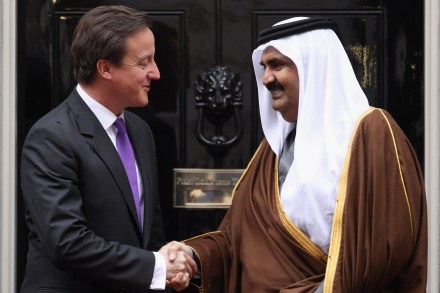
The coming release of Abu Qatada on bail is going to put bellows under the whole debate about the European Court of Human Rights. In his recent speech to the Council of Europe, David Cameron rightly protested about a situation with terror suspects in which ‘you cannot try them, you cannot detain them and you cannot deport them.’ We will now find out how quickly Cameron is prepared to act on this issue. If Cameron wants to makes changes to the Courts and the Convention, then he is going to have to get agreement from every member of the Council of Europe. There’s no guarantee that he’ll be able to get this and it will take an awfully long time.
Don’t let’s be beastly to the bankers

From our UK edition

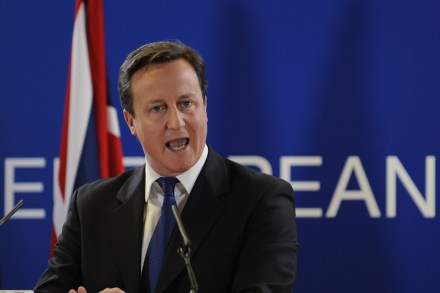
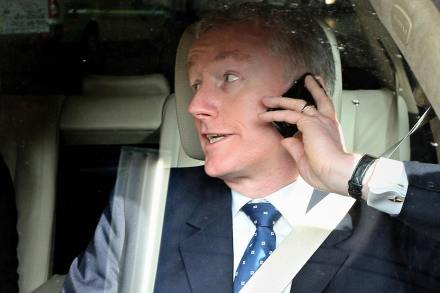
The Twitter hashtag #BankerOutrage was launched by Radio Four yesterday summing up a very popular mood. It’s not unusual for bankers to be hated after crashes. After the South Sea Bubble burst in 1721, there were calls in the Lords for the bankers involved to be dumped in sacks filled with serpents and dropped in the Thames. But that was the immediate aftermath: what’s odd now is the timing. As we say in the leading article of this week’s Spectator, Hester had a bonus twice the size last year — and no one seemed to care. Now, it’s suddenly a crisis and Fred the Shred’s knighthood is a matter of urgency.

A Syrian Srebrenica?

From our UK edition

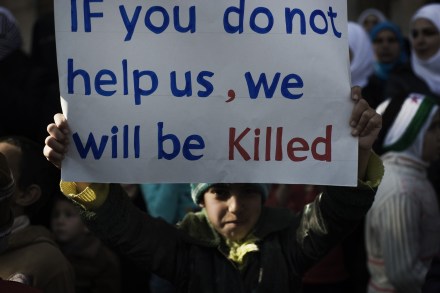
Every day things are getting worse in Syria. Today the Syrian regime started what looks like an all-out assault on the key city of Homs, reportedly killing at least 55 people. The attack took place as the UN Security Council prepares to vote on a draft resolution backing an Arab call for President Bashar al-Assad to give up power. The problem has been the lack of information about events on the ground. Though the Syrian government has failed to quell the uprising, it has succeeded in limiting access to information by the outside world. So a lot remains unknown, unreported or clouded in pro-regime propaganda. But speaking to people in Syria, some things appear clear. First, there is now a guerrilla war of popular resistance against the Syrian regime.

Chris Huhne charged by the CPS

From our UK edition

The CPS was building up to a bang, not a whimper, after all: the Director of Public Prosecutions has just announced that Chris Huhne and Vicky Pryce will have criminal charges brought against them for 'perverting the course of justice'. Both will appear in court on 16 February. We have not yet heard from the minister himself, although there are reports that he will resign to ‘clear his name’, etc. And even if he didn't volunteer to leave, all signs are that Cameron and Clegg will act on the advice of the cabinet secretary and shunt him out anyway. And his replacement? As it stands, the Lib Dems' Ed Davey is the favourite to take over at DECC in a limited reshuffle. UPDATE: You can watch and read Keir Starmer's statement here.

Clegg faces a potential dilemma over Chris Huhne

From our UK edition

Neither David Cameron nor Nick Clegg is a fan of Chris Huhne. The Prime Minister would, by all accounts, shed few tears if Huhne had to step down.   But I suspect that the deputy Prime Minister will be hoping that tomorrow does not bring any adverse developments for the Energy and Climate Change Secretary. If there were to be charges, Clegg would be placed in a very difficult position. He would, despite his efforts to hide behind the Cabinet Secretary, have to decide whether the man he narrowly beat to the Lib Dem leadership could stay in post. This would be a lose-lose situation for Clegg for obvious reasons.   Now, it should be stressed that Huhne denies any wrongdoing. Also beware of anyone making any confident predictions about what will happen tomorrow morning.

Don’t expect repatriation in this Parliament

From our UK edition

When David Cameron wielded his veto at the European Council in December many Tories thought this was the beginning of a process of repatriation of powers from the EU. Myself, I thought it would be the high water mark of the government’s Euro-scepticism — and so it has proven. But things are about to get even worse for the Bill Cashes of this Parliament. In the short-term, at least.   Why so? Well, the government appears to be concluding that it will not get a receptive ear from its European partners on any repatriation bid. The other European leaders are simply too busy fixing the euro to even read any UK proposals. And what's clear already is that they will remain too busy not just for another few months, but for another year or more.

The MoD wastes another opportunity

From our UK edition

Today’s White Paper on defence procurement makes disappointing reading for the UK defence industry — and for anyone who believes that one of the lessons of the last few years is that we need a more active industrial policy. IPPR set out the case in a recent report on globalisation, arguing for sustained support for industries, like defence, which have high potential for growth, for exports, and for high-skill manufacturing jobs. We need robust safeguards on the sale of defence equipment to repressive regimes, as well as greater transparency on government lobbying to avoid a return to the bad old days of the Pergau Dam — or minor embarrassments like David Cameron’s attempt to rebadge an export drive in the Gulf as a tour of the Arab Spring.

Miliband finds his niche, and leaves Cameron looking boorish

From our UK edition

Miliband is getting the measure of PMQs. Not with respect to Cameron. With respect to himself. He’s learned that his strongest register — sanctimony — will always ring hollow unless it’s attached to a powerful cause. And his gags don’t work. So he’s ditched his team of funny men and wise-crackers and turned to his political instincts instead. Miliband’s gut worked today. He began with a question which he knew Cameron couldn’t answer. Why hasn’t the government activated the laws requiring banks to name all employees earning over a million year? The PM answered by not answering. He performed a transparent switcheroo from the particular question to the general topic.

Tories push benefit cap in PMQs, Miliband ignores it

From our UK edition

As expected, the Tories did everything they could to make the benefit cap the subject of PMQs. One Tory MP managed to slip in a question on it just before Miliband got up, allowing Cameron to press the Labour leader on the issue even before he had started speaking. Tory MPs kept coming back to the benefit cap — there were five questions on it in all — allowing Cameron to repeatedly mock the Labour front bench for not saying what its position is. ‘Just nod — are you with us or against us?’ was one of the lines Cameron tried to goad them with. But in the main clashes between the two leaders, which were on top pay and the NHS, Miliband actually did pretty well.

The battle for ‘fairness’ continues

From our UK edition

Today’s PMQs will be another skirmish in the battle for fairness. All three parties know that there is no more potent word in British politics at the moment than fairness and they all want to be its champion. But what will make PMQs interesting today is that Cameron and Miliband each have a powerful weapon in the fairness debate, but also a vulnerability. Miliband’s weapon is bankers’ bonuses – the government’s inaction over Stephen Hester’s bonus has given him plenty of material. But he’s acutely vulnerable over the benefits cap. Cameron will be desperate to move the debate onto this territory.

Cameron cheered by the Lib Dems, spared by the Tories, mocked by Labour

From our UK edition

If you wanted proof that Cameron has softened his stance towards Europe since the hard chill of December, then just look to the Lib Dems. Nick Clegg, unlike then, was sat next to the Prime Minister as he gave his statement to the Commons this afternoon. And the questions that followed from the likes of Menzies Campbell and Simon Hughes were generally warm and approving. Campbell started by, in his words, ‘praising the pragmatism of the PM’. Hughes celebrated a ‘more successful and satisfactory summit than the one in December’. That praise, while friendly enough, creates obvious problems for Cameron — and it was those problems that Ed Miliband sought to exploit in his questions to the PM.

The Tories are extending their lead on the economy

From our UK edition

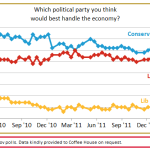
It looks like Dave’s still made of Teflon. Even after the economy shrank by 0.2 per cent and the unemployment rate rose to its highest point since 1995, the public still think his party is better at handling the economy than Labour. And the Tories’ lead on what is by far the most important issue to voters hasn’t just survived all this bad economic news — it’s actually grown. Before Christmas, 31 per cent said the Tories would best handle the economy, against 27 per cent for Labour.

Miliband the eurosceptic? Not yet

From our UK edition

Ed Miliband is not naturally a eurospectic, but he certainly sounded like one during his appearance on ITV's Daybreak show earlier. ‘I'm very concerned about what David Cameron has done,’ he said in reference to the PM's equivocation over Europe yesterday. ‘He's sold us down the river.’ Whether this is Miliband committing towards the sort of euroscepticism that is being urged on him by some of his colleagues, it's too early to say. It's only words, after all. But my guess is that — just as when Miliband attacked Cameron for not signing up to the latest treaty, but couldn't say whether he'd have signed it himself — this is more him trying to have his cake and eat it.

Modernisation 2.0

From our UK edition

One of the flaws of Tory modernisation was that it was never interested enough in pounds and pence. Social issues, the environment and public service reform were what the modernisers specialised in, not economics. But tonight’s Macmillan lecture by Nick Boles, one of the most intellectually influential modernisers, is devoted to the subject of how Britain’s global competiveness in the global economy can be improved. His argument is that: ‘What really threatens the general wellbeing of the British people is the stalling of productivity growth and the certainty that the next 20 years will expose them to competition that is vastly more intense than anything we have ever seen.

Cameron softens his stance on Europe — but who benefits?

From our UK edition

‘We will insist that the EU institutions — the court, the commission — that they work for all 27 nations of the EU.’ So said David Cameron, back in December, suggesting that he'd block Europe's ‘fiscal compact’ countries from using EU-wide institutions to enforce their, er, fiscal compact. But now this component of his ‘veto’ appears to have come to naught, and that veto is looking all the thinner for it. On the Today Programme this morning, William Hague confirmed that Britain wouldn't block the use of EU institutions, such as the court, for the fiscal union. ‘We're not intending to take action about that now,’ is how he put it rather resignedly.

Peston: Hester will not take bonus

From our UK edition

Stephen Hester’s decision to waive his bonus, revealed by Robert Peston just after 10 o’clock, will be a source of great relief to David Cameron and George Osborne. A story that could have dragged on for weeks, undermining their argument about fairness has just lost most of its potency. Ed Miliband, though, will be able to claim — with some justification — that it was the threat of a Commons vote on the matter that led to Hester renouncing his bonus. But this isn’t quite the end of this business. There’s now the question of what happens to the bonuses for other members of staff at RBS and then there is next year’s round. There’s also the whole issue of RBS’ status.

A skewed response to a skewed question

From our UK edition

‘A clear majority of people in Scotland now back independence, according to an exclusive poll for the Sunday Express. Using Alex Salmond’s preferred referendum question, the Vision Critical survey found 51 per cent would vote ‘yes’ with 39 per cent against. If such a dramatic result were repeated in the autumn of 2014, the First Minister would have an absolute mandate to negotiate an end to the Union with England.’ So runs the story. CoffeeHousers may have spotted two of the snags: the poll uses Salmond’s laughably loaded question, and seems to have been conducted by a chain of opticians.

The government’s Hester problem intensifies

From our UK edition

First there was Fred Goodwin, now there's Stephen Hester. The chief executive of RBS is fast becoming the bête noire of the British banking system, thanks to his roughly £1 million share bonus which, we learn in the Sunday Times (£) this morning, may be topped up with an extra £8 million over the next few years. Little wonder that Iain Duncan Smith admitted on the Marr show earlier that there may be a severe public backlash, and that the government could suffer from it. He suggested that it would be better, for all concerned, were Hester just to forego the million. It's one of those debates where it's easy to see and understand both sides of the argument.

Osborne needs to come up with radical growth policies, and soon

From our UK edition

When it comes to defending the free market, and making the case for fiscal sanity, there's scarcely anyone better than David Cameron. He was on superb form in Davos yesterday, giving much-needed blunt advice to the continentals. ‘Eurozone countries must do everything possible to get to grips with their own debts,’ he said. And he's right. The snag, as I say in my Daily Telegraph column today, is that Cameron's definition of getting to grips with debt involves increasing it more than Labour planned to, more than France, Germany, Italy or Portugal. On the first sign of trouble, his government gave up on its deficit reduction timetable – it will now halve the deficit over five years, whereas Darling promised to do it in four.

Let’s talk about Qatar

From our UK edition

The rise of Qatar has been one of the most remarkable developments in the recent history of the Middle East. How this small, oil-rich Gulf state built Al Jazeera and parleyed the TV station's influence into a diplomatic role across the region is an insufficiently explored issue. The list of the monarchy's achievements is impressive, even putting aside how they secured the football World Cup for 2022. Qatari diplomats have mediated in Lebanon, helped rejuvenate the Arab League, led condemnation of Bashir al-Assad and joined the fight against Libya's Muammar Gaddafi. In a way, Qatar has become one of the region's lynchpins, second only to Saudi Arabia as the West's go-to country.