David cameron

A quiet PMQs, ahead of today’s main event

From our UK edition

It started like a bit of good old political knockabout. PMQs opened with a planted question from Mark Menzies (Con, Fylde) asking the PM about Britain’s sick-note culture. Cameron, looking suitably grave, declared that the fake-sniffle problem afflicts even senior management. Ed Miliband, he told us, had recently claimed he was too ill to attend a rally called by health workers. Three hours later he was seen heartily cheering at a football match having been driven to the ground in a Rolls Royce. ‘What was it,’ asked Cameron, ‘that first attracted the Labour leader to the multimillionaire owner of Hull football club?’ This prompted howls and jeers from every part of the house. Ed Miliband ignored them.

Yes to new roads, no to a pensions raid

From our UK edition

New roads in Britain are badly-needed, but who should bear the costs? Motorists, says David Cameron — and his speech today is a move in the right direction. No tolls would be slapped on existing roads, so motorists are free to drive as freely as they do now. But if they want a shortcut, they'll have to pay for it. What I'm uneasy about is Cameron trying to raid our pension funds to help subsidise this. There are many ways to raid pension funds — QE is one. The National Association of Pension Funds estimates that a scandalous £130 billion has been wiped from the value of our collective pensions because Sir Mervyn's Magic Money Machine is artificially lowering interest rates.

The coalition needs to get a move on

From our UK edition

David Cameron’s speech today says all the right things about infrastructure. But the test will be whether Cameron forces these changes through the system.   Already, the planning reforms have been held up by a lengthy consultation. The government will respond to this consultation this week. But that won’t be the end of the matter. For even after the government has set its plans before parliament, there’ll be a ‘transition’ period between the old rules and the new ones.   All of which is a reminder that if Britain, and especially the capital, is going to get the extra airport capacity it so desperately needs, then decisions will have to be taken soon.

Where will Cameron’s road proposal take us?

From our UK edition

Are we facing ‘toll road UK’, as the Mirror suggests this morning? That is certainly a possibility arising from David Cameron's plan to allow private firms to bid for chunks of Britain's motorway system — but I wouldn't get too excited just yet. It's a very distant possibility at the moment. After all, just note the details of the story. The routes that the coalition has in mind are very significant ones, but they still add up to only 3 per cent of the national network — ‘toll road UK’ may be pushing it. And then there's the fact that nothing has been entirely decided yet. We're told that, ‘The Treasury and the Department for Transport will carry out a feasibility study with a view to reporting back to Mr Cameron in the autumn.

Taleb in 30 minutes

From our UK edition

Nassim Taleb, the Lebanese-American academic whom we interviewed in The Spectator last month, is the subject of a Radio Four profile by The Economist's Janan Ganesh that was first aired last Monday but will also be on Radio 4 at 21:30 this evening. David Willetts is interviewed, saying that Taleb's work underlines the folly of long-term forecasts because ‘the big events that shape the world today are those which no one predicted four or five years ago’. The discovery of Shale gas, for example, could utterly change Britain’s energy requirements. Taleb’s heroes are Burke and Popper: his emphasis is on the need for humility, on how hard it is for any government to know what’s going on in society.

Downing St plans to boost construction

From our UK edition

In the last few months, there’s been a distinct change in the attitude of the Tories at the heart of government. They are now far more cognisant of just how difficult it is to drive change through the government machine. It is no longer just Steve Hilton and Michael Gove complaining about this, but Osborne and Cameron too. The Chancellor’s particular frustration at the moment is over the pace of planning reform. Osborne and his brains trust believe that simplifying the planning rules is one of the things that they could do to both give the economy a short term stimulus, by encouraging more construction, and improve its long term prospects. But the coalition is making slower progress on the matter than Osborne would like.

Cameron and Obama bargain over fuel

From our UK edition

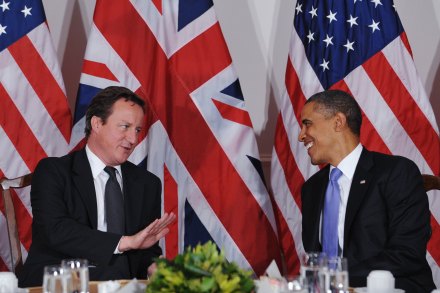
No wonder David Cameron and Barack Obama were being so chummy: they both knew that they could help each other. The Times carries an intriguing story (£) on its front page this morning, about how the two men discussed a plan to get fuel prices down in the UK and the US. The idea is that both countries — and perhaps more — would release some of their oil reserves. And so supply would go up, and prices would come down. As would our reliance on the oil-rich countries of the Middle East. Apparently, we're some distance from a deal yet, but you can see why both the PM and the President would want one to be struck — and soon.

Cameron dines with Obama… and Clooney

From our UK edition

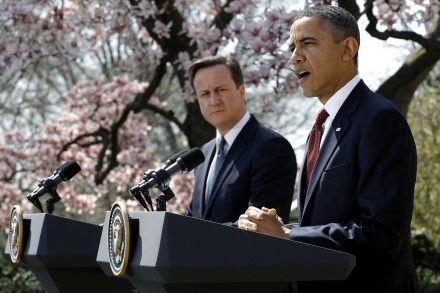
https://www.youtube.com/watch?v=mX6mT0kpoyQ The Camerons weren’t the Obamas' only big-name guests at the State Dinner last night. They were joined by a host of stars including Warren Buffett, Richard Branson and George Clooney, who’s just returned from war-torn Sudan. In their speeches (above), the two leaders had very warm words for each other. Of Cameron, Obama said: ‘In good times and in bad, he’s just the kind of partner that you want at your side. I trust him. He says what he does and he does what he says.’ And the PM returned the compliments: ‘There are three things about Barack that really stand out for me: strength, moral authority and wisdom.

Afghanistan overshadows Cameron’s America trip

From our UK edition

Afghanistan, what now? After a week of death and retaliation in the country, it appears that a car bomb has been detonated on the runway at Camp Bastion — probably aimed at the visiting US Secretary of Defence, Leon Panetta. A spokesman has since said that ‘at no point was anyone on board Mr Panetta's plane at risk,’ but it certainly highlights the dangers attached to his visit. What chance, now, that he will be successful in his goal of ‘easing tensions’? The incident cropped up very briefly in David Cameron and Barack Obama's press conference just now.

Cameron and Obama, sans yellow mustard

From our UK edition

Above is what they call the ‘raw video’ of David Cameron's and Barack Obama's trip to a basketball game last night. It's the unrefined version of what Downing St hopes will be refined, packaged and sent to your television screen at hyperspeed: images of the PM and the President dressed casually and chatting away as the game goes on. Like I said yesterday, it's political theatre — designed to benefit both men. They were then both interviewed at halftime, which you can watch here.

Cameron lands in America

From our UK edition

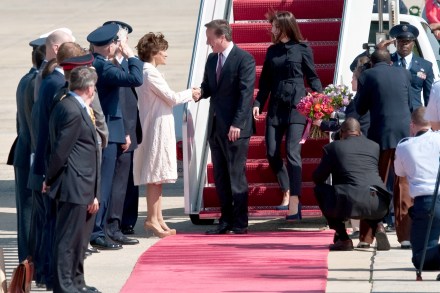
David Cameron’s plane has just landed in Washington. The next few days should provide him with a set of images that will portray him as a significant figure on the global stage. The Obama administration is giving Cameron the full works: a huge event on the White House lawn and the kind of banquet that is normally reserved for heads of state. This is an arrangement that benefits both sides. The Obama re-election campaign wants to foster the sense that the President is friends with a Conservative British Prime Minister given that their Republican opponent in the fall will accuse him of being a left-wing radical. I suspect, though, that Downing Street will be rather worried that the arrests of Charlie and Rebekah Brooks could overshadow the opening day of the visit.

Will Obama and Cameron discuss a faster pullout from Afghanistan?

From our UK edition

The political theatre of David Cameron's trip to America will have Downing Street drooling. The PM is, today, not only going to become the first world leader to fly aboard Air Force One with Barack Obama, but then they're also going to take in a game of basketball together. It's a carefully calibrated blend of statesmanship and down-to-earth-ship that will suit both men. Obama, because it might appeal, in some way, to conservative voters ahead of this year's presidential election. Cameron, because, well… does Ed Miliband do this sort of thing? The theatre carries over into print too, with a joint article by Cameron and Obama in today's Washington Post.

Cameron’s Human Rights quandry

From our UK edition

The combination of the European Court of Human Rights and the European Convention on Human Rights is, I predict, going to give David Cameron an increasing number of headaches in the coming months. As Fraser wrote yesterday, Michael Pinto-Duschinsky’s principled resignation from the coalition’s Commission on the British Bill of Rights has revealed that this body was never really serious about dealing with the problem. The exposure of this Commission as merely a holding device will add to the pressure on the Prime Minister to clarify what he actually intends to do about the problem.

Cameron’s sub-prime thinking

From our UK edition

You’d think the American sub-prime crisis would have taught politicians the world over not to try to rig the housing market. But no, David Cameron is back on it today — about how to ‘unblock’ the system so the debt geyser starts to gush again. ‘The problem today is that you have lenders who aren’t lending, so builders can’t build and buyers can’t buy,’ says the Prime Minister. ‘It needs the government to step in, and help unblock the market.’ The idea that lenders may not lend because they feel the housing market may fall, and people may be unable to repay, is instantly dismissed. He speaks as if debt is the solution, and unavailability of debt is a self-evident problem.

How Clegg outmanoeuvred Cameron over the ECHR

From our UK edition

News that Nick Clegg has brilliantly outmanoeuvred Cameron over the British Bill of Rights will come as no surprise to CoffeeHousers — we told you so last March. The panel was stuffed full of ECHR enthusiasts, balanced by Tories most of whose competence lay in other legal areas. Perhaps Michael Pinto-Duschinsky, the most clued-up of the Tory appointees, didn’t realise this when he joined the panel. He has twigged now, and has quit (or was eased out, depending on whose version of events you believe); observing that the ‘Lib Dem tail is wagging the Conservative dog’. As was evident from the start.

The role of Baroness Ashton

From our UK edition

Recent reports have suggested that David Cameron is interested in swapping Cathy Ashton’s job as the EU’s high representative for foreign affairs and security policy for another commission post. But sources close to Number 10 tell me this ain’t happening. Supposedly, Cameron was interested in swapping Ashton’s current role for the post of commissioner for the internal market, currently held by the Frenchman Michel Barnier. But, in reality, this was never on the cards for a whole host of reasons. Foremost of these was that Nicolas Sarkozy was never going to give up the French claim to this job just weeks away from a French presidential election.

Why Cameron should pay heed to Romney

From our UK edition

Cameron flies out to Washington on Tuesday, and when he gets there he’ll have no need to play the infatuated teenager. The days of Gordon Brown-style adulation are over, and Cameron has a more mature, less needy relationship with Obama. The truth is that there’s precious little he can learn from Obama, but there might be a thing or two he can learn from Mitt Romney. I look at this in my Telegraph column today. Cameron has never loved America, in the way that so many people in SW1 do. He toured America in his youth, but had never been to Washington until he became Tory leader. Cameron is more interested in the West coast, the latest theories from California about how information can change government. But from Obama? Not so much.

Osborne eager to act on 50p

From our UK edition

The debate on the 50p tax rate is moving fast. I was told by one Downing Street source today that ‘it is now more likely than not that it goes in the Budget.’ Now, obviously, there is a big caveat here. The Budget is not yet agreed: this is all subject to change. But I understand that the Chancellor is pushing hard to at least set out the roadmap to its abolition on the 21st March. I also hear that the Prime Minister is nervous about quite how determined Osborne is to do this. Cameron’s worry is that a Budget that tackles the 50p rate will be remembered solely for that — which would risk reinforcing the Tories’ reputation as the party of the rich.