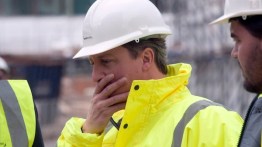
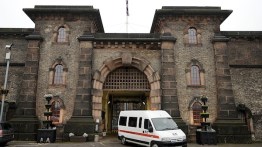
David cameron

What kind of regime imprisons people for what they tweet? Oh, hang on…

From our UK edition

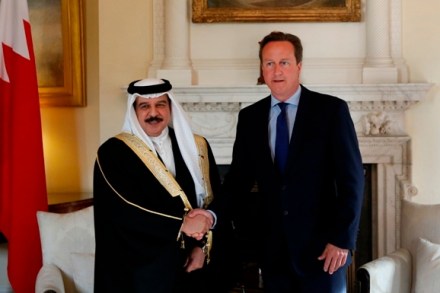
The King of Bahrain certainly doesn't seem to like it up him. In this week's Spectator, Kirsty Walker said her last complaint - before quitting journalism — was from the King objecting to her being rude about his regime. A Bahraini man has just been sentenced to six months in jail for ‘defaming’ the king on Twitter. Three similar Twitter users are up on similar charges next week. David Cameron should be making clear how appalled he is at this repression - except he is not in a very good position to comment. After last year's riots, police threatened to arrest users for inciting the looters. It seemed daft: would you really arrest people for writing posts, mostly moronic, on Twitter?
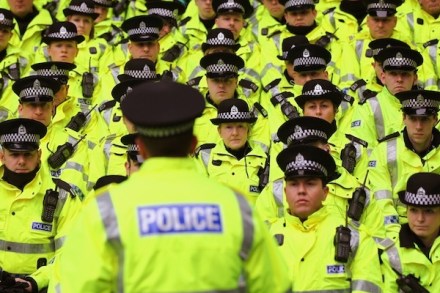
David Cameron tries to drum up interest in the Police and Crime Commissioner elections

From our UK edition

David Cameron spent yesterday campaigning for Conservative Police and Crime Commissioner candidates in Bedfordshire and Leicestershire. The visits, though, received scant national attention: the only coverage I’ve spotted so far is on page 33 of The Times. Talk to ministers and they maintain that the Police and Crime Commissioner elections are more visible out in the country than they are in London, where there’s no contest. They argue that the capital-centric nature of the media explains why the press keep writing the elections off as a damp squib. There is, I suspect, some truth to this charge. But an average turnout of only 20 percent would still not be impressive.

Dame Helen Ghosh and the elite cupcakes

From our UK edition

Dame Helen Ghosh's words about women and David Cameron's government have put Downing Street backs up this afternoon. Dame Helen, whose Civil Service career spanned thirty-three years culminated in a troublesome spell as Permanent Secretary at the Home Office, told Cambridge students it was ‘difficult for women to get in’ when the Prime Minister favoured his male school chums. Lines such as ‘women don’t network. It is actually quite difficult for a woman to get in as part of an Old Etonian clique. They are far too busy doing other things’ have gone down particularly badly. However, I hear that Dame Helen was not totally adverse to a bit of networking.

The View from 22 — the fight for press freedom and an EU problem for Cameron

From our UK edition

What effect would any form of statutory regulation have on the press in this country? In this week's cover feature, Nick Cohen writes that if the Leveson Inquiry recommends strong measures to curtail the press, they will not be practical thanks to the constant evolution of the media industry. On this week's View from 22 podcast, Nick explains the problems of defining who exactly is the press and who are journalists: 'You can't say what a newspaper is and you can't say who a journalist is. When I started in journalism, people used to say it was a trade, not a profession...that was true in theory but false in practice — you couldn't be a journalist unless you worked for a state or private media conglomerate.

David Cameron reassures MPs that he’d prefer a cut in EU budget

From our UK edition

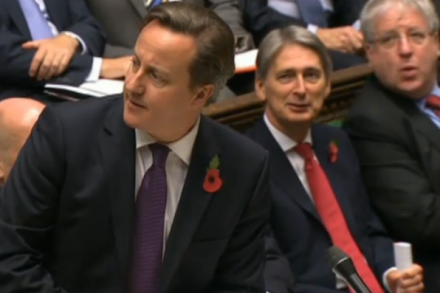
The Prime Minister needed to reassure his own side at PMQs today on the EU budget and give his whips something to work with. He largely did that, saying almost immediately that his position was that at best, he’d like it cut and at worst, frozen. That Cameron has said he’d like it cut will give those of his backbenchers who stick with him tonight some cover. They’ll be able to say that they’re supporting the government which already wants a cut. Ed Miliband’s decision to lead on the issue and try and use it to paint Cameron as ‘weak’ has also made the issue more partisan. I suspect that a few Tory MPs who might otherwise rebel will balk at walking through the lobbies with Ed Balls.

PMQs: David Cameron needs to show he has control of EU vote

From our UK edition

At PMQs today, David Cameron will need to go some distance to meet his backbenchers and head off a government defeat tonight on the EU budget. He’ll need to say that he personally would like to see the EU Budget reduced and that if other countries are prepared to agree to that, he’d be delighted. But that the one thing he’ll guarantee is that he’ll veto any real terms increase. He’ll also need to take the fight to Labour on the matter, pointing out how Blair gave up a chunk of the rebate for the vaguest of promises on CAP reform. Part of the reason that Europe votes keep causing Cameron so much trouble is that Number 10 goes into Maastricht mode every time one comes along.

Change at Number 10

From our UK edition

Gabby Bertin is one of David Cameron’s long-marchers; she has been with him since he won the leadership in 2005. Bertin has acted as his political spokeswoman for the last seven years, pushing the Cameron message and dealing calmly with the inevitable crises and mishaps. Few people know what Cameron thinks as well as Bertin does and are as prepared as her to tell him when he is going wrong. Cameron, for his part, values Bertin’s ability to, in his words, ‘see round corners.’ But in a fortnight’s time, she goes off on six months maternity leave. I understand that Susie Squire, currently running the press operation at CCHQ, will step into Bertin’s shoes.

Why David Cameron isn’t proposing a cut in the EU budget

From our UK edition

Cutting the EU budget is a very good idea. Much of it is spent inefficiently and its priorities are all wrong, 40 percent of it goes on agriculture. Given that a cut would also be popular with voters, why doesn’t David Cameron propose one? The reason is that there’s virtually no chance of getting agreement to it. If there’s no agreement, the EU will move to annual budgets decided by qualified majority voting—stripping Britain of its veto. But Labour’s tactical positioning in calling for an EU budget cut has been, as Isabel said earlier, extremely clever. It has left Cameron defending a complicated position which puts him on the wrong side of public opinion and many of his own MPs.

Cameron outfoxed from right and left on EU budget

From our UK edition

David Cameron now appears to have been outfoxed by his own backbench and the Labour party on the European budget. A Downing Street spokeswoman confirmed this morning that while the opposition and a group of rebellious MPs will campaign for a real-terms cut in the multi-annual budget, the Prime Minister remains committed to negotiating for a real-terms freeze. The spokeswoman said: 'His position is a real terms freeze: there has not been a real terms freeze in the multi-annual budget in recent years. That's what we are committed to negotiating for.' As I blogged earlier today, moves are afoot within the Conservative party to push for a real-terms cut, and there is now no backbench motion supporting the Prime Minister.

EU budget: Cameron’s leadership under pressure

From our UK edition

David Cameron is already irritating European leaders with his refusal to support any real-terms increases in the multi annual EU Budget, but this week, the Prime Minister is going to come under pressure to go even further and force a real-terms cut. This morning, he has Ed Balls and Douglas Alexander breathing down his neck, with a piece in the Times arguing that a cut is 'difficult but achievable with the right leadership and the right approach from the UK'. In his own party, Liam Fox says it is 'obscene' to 'even increase for inflation the inflated wages of the eurocrats' and is arguing in a speech today that weaker members of the eurozone should leave the currency at the same time.

The Conservative renegotiation strategy

From our UK edition

In The Spectator this week, Charles Moore argued that David Cameron — despite his oft-stated desire to renegotiate the terms of Britain’s EU membership — doesn’t actually have a European policy. Charles’ criticisms have clearly stung. For in his Telegraph column, he outlines what post-2015, the Conservatives would seek in any renegotiation: “In essence, the scheme is to turn the EU into two concentric rings. The inner ring shares the euro and undergoes political union. The outer ring avoids both these things and has a looser, trading membership grounded in national parliamentary sovereignty. You could say that this split already exists, in fact if not in theory, but the difference is that, in the emerging model, the EU would be legally reconstituted.

The Brussels budget imbroglio

From our UK edition

The EU budget negotiation, now a month away, promises to be David Cameron’s next big European test. The Prime Minister has repeatedly declared that he wants to see the EU budget frozen at 2011 levels and that he’s prepared to use the need for unanimity to achieve that. The Economist this week has a very useful scene-setter for the budget talks. It sketches the contours thus: ‘Countries are coalescing around loose (yet often divided) groups. There are the 'friends of cohesion': the net recipients of regional spending, such as Poland, Hungary and the Baltic states. And there are the 'friends of better spending': the net contributors, such as Germany, France, Britain and several northern European states.

David Cameron rebuked by statistics chief over PMQs comments

From our UK edition

David Cameron's taunt at Ed Miliband yesterday during Prime Minister's questions that the 'good news will keep coming' was taken by some as a hint at today's GDP figures, which the PM has early access to. Now the chair of the UK Statistics Authority Andrew Dilnot has written to Cameron to rebuke him for the line. The letter, which you can read in full here, says: 'The Pre-Release Access to Official Statistics Order 2008 states that recipients of pre-release access must not disclose 'any suggestion of the size or direction of any trend' indicated by the statistic to which the recipient has been given such access. It is clear from media reports that although this may not have been your intent, your remarks were indeed widely interpreted as providing an indication about the GDP figures.

Herman van Rompuy’s revelatory Downing Street lunch

From our UK edition

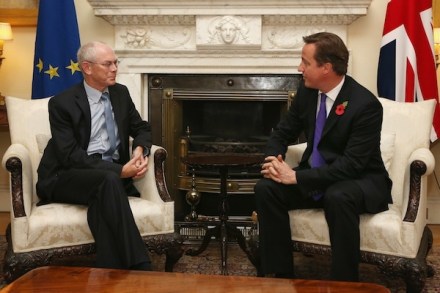
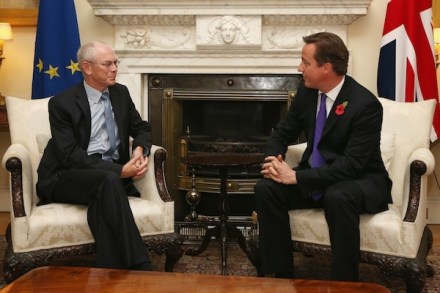
David Cameron had lunch with Herman van Rompuy in Downing Street today to discuss the UK's position on the EU budget. Despite the Prime Minister's tough talking in public about his determination to veto any real-terms increases in the money available for the multi-annual budget, the Downing Street spokeswoman refused to confirm that there was in fact any mention of this threat at today's meeting, which Nick Clegg apparently popped into briefly. She said: 'Discussions focused on the multi-annual budget. Both the Prime Minister and the Deputy Prime Minister made clear the Government's position that we do not support a real-terms increase in the EU budget.

PMQs sketch: Miliband gives up on Songs of Dispraise and attacks Cameron on competence

From our UK edition

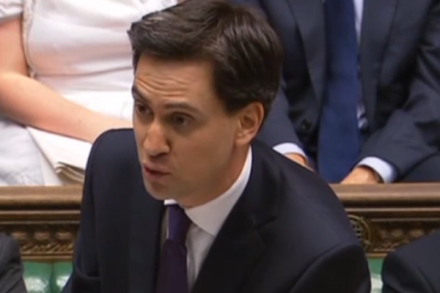
Goodness, he’s enjoying himself. Ed Miliband is brimful of confidence these days and he handles himself like a master juggler at PMQs. He flicks out deft gags and acerbic asides while keeping the central question in the air. He’s having fun. And it’s a pleasure to watch. Greatly helpful to him is the government’s pledge to deliver at least one major and one minor cock-up every week. Last Wednesday it was Cameron’s improvised announcement that energy companies must give customers the lowest tariff. Today he tried to explain this. ‘There were 400 different energy tariffs last year,’ the PM told the Commons. ‘That’s totally baffling.’ ‘The only people baffled,’ said Miliband. ‘were his ministers last week.

‘Prisoners are not getting the vote’, Cameron confirms

From our UK edition

David Cameron was in a particularly irritable mood at Prime Minister's Questions today. But he did what he needed to do and made clear that ‘prisoners are not getting the vote under this government’. It seems there may be another Commons vote to further demonstrate the will of the House on this matter. If there is, it’ll be fascinating to see whether the Attorney General, who is far more concerned about upsetting the Strasbourg court than his Conservative colleagues, chooses to excuse himself. Ed Miliband enjoyed mocking the Prime Minister and the Chancellor in his questions; I’ve rarely seen the Labour leader more confident on his feet at PMQs. But Cameron, even on slightly poor form, now has a ready-made response: to point to the encouraging economic news.

Did David Cameron break an embargo on GDP figures?

From our UK edition

Last week David Cameron found himself in trouble after Prime Minister's Questions over a slip of the tongue about energy bills: this week he's managed to get himself into trouble over what looks like yet another slip of the tongue at PMQs. The Prime Minster appeared to suggest that tomorrow's GDP figures, which are under strict embargo, will be good news for the government. The heat was on for Cameron, as Ed Miliband was performing reasonably well, with some good jokes (including 'I asked him a question about the railways - I have to say the Chancellor shouts, it's not the ticket that needs upgrading, it's the Chancellor of the Exchequer').

David Cameron must rule out votes for prisoners at PMQs

From our UK edition

The issue of prisoner votes has turned into a question of trust between David Cameron and his backbenchers. Most Tory MPs well remember that the Prime Minister’s initial intention was to comply with the Strasbourg court’s ruling; he only changed his mind after seeing how strong feelings were on the issue on the Tory benches and in the country. For this reason, Cameron needs to scotch all this talk of a draft bill on votes for at least some prisoners at PMQs today. If he doesn’t, he’ll have just as large a rebellion on his hands as he did last time. The issue will also drive a further wedge between Cameron and his backbenchers.

Prime Minister auditions as his own press officer after shambolic week

From our UK edition

In between confusing the Chamber just a little bit more on his European policy this afternoon, David Cameron appeared to be auditioning to work as his own press officer, reading out a list of the government's achievements such as falling unemployment and lower inflation figures over the past week to MPs, just in case they'd missed them, as evidence that Britain does have a great deal to offer to Europe. He had already taken pains to emphasise this earlier today after his crime speech, saying: 'We need to focus on the big picture. What actually happened last week is that unemployment fell, inflation fell, waiting lists in our hospitals fell, crime fell, the right decision was made about Gary McKinnon.

Cameron irked on Europe as backbenchers rattle the referendum cage

From our UK edition

Throughout his statement on the European Council, David Cameron seemed slightly irritated. One sensed that the headlines of the last few days have rather got under his skin. Cameron began by declaring that the Council meeting had made ‘limited progress’, which is hardly much to report to the House. He also was unable to resist another pop at Chris Bryant; complaining that he still hadn’t apologised to him when the Labour MPs asked a question. It was striking what a pro-European tone Ed Miliband took in his response to Cameron. It was all about how Cameron was losing control of his party over Europe and needed more friends there.