Conservative party

What Theresa May should put in her manifesto

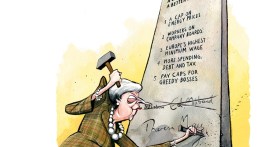
Will executive pay pop up in Theresa May’s manifesto? An objective of her snap election is to secure a larger majority on the basis of a smaller burden of manifesto promises than she inherited from David Cameron. But in her only leadership campaign speech last July, her reference to ‘an irrational, unhealthy and growing gap between what those companies pay their workers and what they pay their bosses’ was one of the phrases that caught the most attention. Back then, she was in favour of imposing annual binding shareholder votes on boardroom remuneration, as well as spotlighting the ratio between chief executives’ and average workers’ pay, and even forcing companies

The Tories have got something right - but what?

Twenty years ago this week Tony Blair came to power with a thumping majority, claiming Labour to be ‘the political arm of none other than the British people as a whole’. As a phrase it sounds mildly deranged but it wasn’t totally cut off from reality. New Labour had claimed support among a cross-section of the public, including over 60 per cent of DE voters and a clear majority of those in the C2D category. Today, the Conservatives have a 17-point lead among working-class voters, despite there being a squeeze on health and education spending, and the party offering not much in the way of optimism or charisma. What went right, then? Of

Is the end nigh for Ukip?

Ukip is a party dwelling on its past glories rather than its future this afternoon. The party’s leader Paul Nuttall has very few crumbs of comfort from the results so far: Ukip has lost every single one of the seats it had previously held. It has, just moments ago, snatched a single seat from Labour in Lancashire. Yet even the most optimistic Kipper would struggle to put a spin on the performance so far. The line that there are still results to come through is rapidly wearing very thin. Instead, when Nuttall broke his silence earlier he talked of the party’s ‘electoral success over recent years’ and how the party had forced the

Local elections: Labour lose control of Glasgow council for first time in 40 years

Labour’s performance in the local elections is going from bad to worse. The party has, for the first time in four decades, lost overall control of Glasgow Council. Not too long ago, the city’s council would have been a banker for Labour. Under Jeremy Corbyn, it’s a different picture. Labour needed to win 43 seats on the council to keep control. But having stood only 43 candidates in this election, they needed every single one to come through. That hasn’t happened and the party’s performance in Glasgow is likely to be the nadir in a dismal local election campaign. Labour’s pain isn’t the only story to come out of the results

Why Wales decided to forgive the Tories

The recent Welsh poll showing a ten-point Conservative lead in voting intentions for the forthcoming general election (and also, though much less reported, the first ever Conservative lead in devolved voting intentions in Wales), came as a shock to many. The next Welsh poll, out next week, will tell us whether this first one was just an outlier or the more solid harbinger of an historic realignment in Welsh politics. But why should it be such a surprise that the governing party of the UK, with around a twenty-point opinion poll lead across Britain, should have a lead half that size in one particular part of Britain? The astonishment is

The West Midlands will tell us how big May will win in June

The most intriguing aspect of today’s local elections is the contest for the new West Midlands Mayoralty. In normal times, you’d have this marked down as a shoe-in for Labour—they have 21 of the region’s 28 MPs and control six of its seven local authorities. But these aren’t normal political times and the Tories have run a vigorous campaign with a strong candidate, the former John Lewis boss Andy Street. Labour, by contrast, have an underwhelming candidate, the MP turned MEP Sion Simon—whose greatest distinction is his time as a restaurant reviewer for this magazine. Labour have run a distinctly low-energy campaign in the West Midlands, relying on the local

Never mind the election – Corbynism isn’t going away

General elections are meant to produce a government and an opposition — ideally, a decent version of both. It is obvious what government this election will deliver: a Tory one with an increased majority. That, after all, is one of the reasons why Theresa May has decided to go to the country three years early. But it is not clear what opposition there will be. What passes for optimism in moderate Labour circles these days is the belief that a shellacking in this election will lead to Jeremy Corbyn’s departure, as the party’s membership sobers up and elects a new and sensible leader. But it is far from certain that

My brush with the pro-Corbyn Twitter mob

When my old friend – a lifelong Labour supporter – told me he was voting Tory at the election, I posted a message on Twitter: https://twitter.com/RevRichardColes/status/858296208477040640 That was that, I thought. But then the replies started piling in. One of the first responses came from someone who thought my friend would regret his decision if he ever needed the NHS. ‘He’s an NHS consultant’, I replied. Even that didn’t stop the disbelief: many of those responding struggled to believe that someone working for the NHS could possibly vote Conservative. Was my friend real, they demanded to know. Admittedly not everyone thought I was making it up. Others seemed convinced that

Theresa May hits out at the 'bureaucrats of Brussels', full transcript

I have just been to Buckingham Palace for an audience with Her Majesty The Queen to mark the dissolution of this Parliament. The 2015 Parliament is now at an end, and in 36 days the country will elect a new Government and choose the next Prime Minister. The choice you now face is all about the future. Whoever wins on 8 June will face one overriding task: to get the best possible deal for this United Kingdom from Brexit. And in the last few days, we have seen just how tough these talks are likely to be. Britain’s negotiating position in Europe has been misrepresented in the continental press. The European Commission’s negotiating stance

The Conservative party is treating the electorate like mugs

What a curious election this is proving to be. It is hard to think of another general election in which the two largest political parties indulged in so much nonsense, nor did their best to persuade you that what is evidently true cannot possibly be true.  In the first place, the Conservative party asks you to believe the Labour party could yet finagle its way into Downing Street. You can’t afford to take a risk on Jeremy Corbyn, the Tories tell a public that has not the slightest intention of taking a risk, or anything else, on Jeremy Corbyn. Undaunted, the Tories warn: Look, there remains the prospect of a

Jean-Claude Juncker could learn a thing or two from David Davis

Even David Davis’s loudest critics would concede one thing about the Brexit secretary: he is nothing if not breezily confident. His performance on the media rounds this morning was no exception; and his message following Theresa May’s now-famously frosty Downing Street dinner with Jean-Claude Juncker could not have been clearer: keep calm and carry on – there’s nothing to worry about. Davis dismissed talk in the papers this morning that Theresa May will be sidelined by other EU leaders when thrashing out the terms of the Brexit deal. Instead, the Brexit secretary said that the PM will be front and centre of talks. Davis was also quick to dismiss discussion

The snap election is likely to make the Commons a lot more dull

At midnight, we won’t have any MPs. The dissolution of Parliament means that no-one who has sat on the green benches of the Commons for the past two years has any official status above their fellow candidates in the General Election. Some will return victorious for another five years (or until another advantageously early election). Some have decided that it’s time to go. Others will find that their local electorates have decided it is time for them to go.  Elections are exciting for the political world. They activate a gene in politicians that the rest of us fortunately do not possess, which makes them enjoy six weeks of trying to

Sunday political interviews round-up: Theresa May says Conservatives will not raise VAT

Theresa May – Conservatives will not raise VAT Touring both the BBC and ITV studios today, Theresa May tried her best to avoid giving specific answers about the Conservatives tax policies after the election. However, during an interview with Robert Peston, the Prime Minister appeared to disown David Cameron’s ‘triple lock’ and make a commitment that a Conservative government would not raise the level of VAT above 20% over the next Parliament: Peston: Given what you say your record as a party is on taxes, do you need to repeat David Cameron’s triple lock – no rise in VAT, no rise in National Insurance, no rise in income tax –

Political activists who behave like zealots will do no good at all

The election debate so far has included a fair bit of to-ing and fro-ing over whether religion has a place in politics and whether religious politicians have to spend significant portions of interviews talking about their views on what other people get up to in bed. But one striking feature of all political debate is how many of its participants behave like religious zealots without even realising it.  Media vicar Reverend Richard Coles yesterday tweeted that he’d spoken to a friend who planned to switch from Labour to the Conservative, rather than the Lib Dems, as Coles might have expected. The replies to this message were rather instructive. A number of

Why the Tories are talking up Labour

Considering that their party is expected to win by a landslide, the Tory spin doctors sound unusually panicked. They are keen to point out that the polls aren’t always right, and the pollsters are still trying to correct what they got wrong at the last general election. They insist that national voting tells you little about what will happen in the key marginal seats. These are normally the pleas of a party that is failing, and trying to persuade voters that it is still in the race. But Labour isn’t doing a good job of spinning its own prospects — so the Tories are doing it for them. This is

Why the Midlands will matter on June 8th

It is no coincidence that Theresa May chose to hit the campaign trail in Wolverhampton and Dudley last weekend; both are areas where Ukip did especially well in 2015. What is emerging is that the West Midlands – particularly the Labour-held Midlands marginals – will be the key battleground in this coming election. From the creation of the Mercian kingdom by Alfred the Great, to the Battle of Bosworth and Germany’s bombing of Coventry in 1940 – not to mention the 2015 election which led to Brexit – the Midlands has provided the backdrop against which the future of our country has been shaped. The election on 8 June will be no

Why Tories are talking up Labour

Considering that their party is expected to win by a landslide, the Tory spin doctors sound unusually panicked. They are keen to point out that the polls aren’t always right, and the pollsters are still trying to correct what they got wrong at the last general election. They insist that national voting tells you little about what will happen in the key marginal seats. These are normally the pleas of a party that is failing, and trying to persuade voters that it is still in the race. But Labour isn’t doing a good job of spinning its own prospects — so the Tories are doing it for them. This is

How to vote to save the Union

When launching the Scottish National Party’s election campaign, Nicola Sturgeon said the word ‘Tory’ 20 times in 20 minutes. For much of her political lifetime, it has been used by the SNP as the dirtiest word in Scottish politics. Nationalists have long liked to portray the Conservatives as the successors to Edward Longshanks: an occupying army with little affinity for the people they were trying to govern. But things are changing fast in Scotland. Amid the other political dramas of the past few months, the revival of Tory support north of the border has gone relatively unnoticed. They had only one MP after the last election, but a poll this

Labour's Brexit plan was doomed before Keir Starmer even opened his mouth

Brexit comes in all shapes and sizes: hard, soft, clean. Today, Labour added a new type: a ‘reckless Tory Brexit’. That’s what Keir Starmer accused the Government of trying to drive through as he detailed Labour’s plan for waving goodbye to the EU. The main purpose of Starmer’s tour of the airwaves was to clear some of the mud out of the water of Labour’s Brexit tonic. To be fair to Starmer, he did manage to offer some clarity: there would be no second referendum under Labour, which puts helpful space between the party and the Lib Dems who have promised voters a second say. Staying in the single market

The Tories don't need Zac back in Richmond. They need Luke Parker

Are the Conservatives sharp enough to be able to beat the Liberal Democrats in battleground Remain-voting seats? We hear today that they might put forward Zac Goldsmith as their candidate for Richmond Park – the same Zac Goldsmith who quit the party in protest at the Heathrow decision, then triggered a by-election and ran as an independent. But he lost to a Lib Dem. So now he has decided to rejoin the party and run again – and oddly, they’ve let him. He’s in the final three. To select him would be a huge tactical own goal for the Tories: as Neil Kinnock found out, when voters turn something down, they don’t like to be