Conservative party

Osborne’s Paul Daniels strategy

From our UK edition

Is George Osborne the first British Chancellor to hide good news in the small print? I ask this in my News of the World column (£) today, and ask what he’s up to. Listening to Nick Clegg on Marr this morning, even he can’t quite say that the same forecasts that predict 500,000 public sector job losses also envisage three times as many jobs created in the private sector. Why so coy? I suspect because it would spoil the magic. That there is a deliberate gap between what this government is saying and what it believes it is doing.   James Forsyth was the first to write (in his political column, now available to non-subscribers) about ‘Gordon Osborne’, using Brownite tactics. But whereas Brown hid the bad stuff, Osborne is hiding the good stuff.

The government goes for growth, as Cable tackles takeovers

From our UK edition

As Benedict Brogan observes, the government's renewed emphasis upon growth is hardly deafening – but it is certainly echoing through this morning's newspaper coverage. Exhibit A is the Sunday Telegraph, which carries an article by David Cameron and an interview with Vince Cable – both of which sound all the same notes about enterprise, infrastructure, deregulation, tax and trade. There's a letter by George Osborne in the Sunday Express, which contains the word "growth" a half-dozen times. And then there's Cameron's claim that the next decade will be "the most entrepreneurial in Britain's history," in a podcast on the Downing St website. Welcome to two weeks devoted, apparently, to growth and reform.   This shift in emphasis is welcome, wise and well-timed.

Sticking up for free schools

From our UK edition

I'm on the train back from doing Radio Four's Any Questions – broadcast live from Derby, repeated at 1.10pm tomorrow – where I had a bust-up with Christine Blower of the NUT. CoffeeHousers may recall she was the star of a cover story we ran a few weeks back, about the campaign of bullying and intimidation levelled against headteachers who are trying to seek Academy status. She raised that article during recording, and things kinda kicked off. I told her she should be ashamed of the way her union thugs try to intimidate young teachers who seek to break away from local authority control and reach independence. She denied writing the words ascribed to her, I sought to read them to her – and things descended from there. Anyway, a few thoughts... 1.

George Osborne is making the going

From our UK edition

There are several interesting columns on George Osborne in the papers today. In The Times, Tony Blair’s former speechwriter Phil Collins warns Labour to stop underestimating the Chancellor, who is defining the political battle on his terms at the moment. Peter Oborne, by contrast, is highly critical of Osborne in his Telegraph column, warning that Osborne’s partisan presentation of the cuts risks undermining support for the whole project. For once, I find myself disagreeing with Peter. I think Osborne is doing some of the political heavy-lifting that Cameron could not do without undermining his standing as a national leader; Osborne’s praise for the 2004 Republican campaign is instructive in trying to understand what is going on here.

Labour loses the last semblance of its economic credibility

From our UK edition

A quiet but important change to Britain’s political landscape took place in Brussels on Wednesday. The European Parliament passed a motion to increase the EU Budget by 5.9 percent, dashing, for the moment, government hopes that the EU might share in its citizens’ austerity. Labour’s MEPs were central to the motion’s success – 10 (one of whom glories in the name Michael Cashman) out of 13 voted against the Conservative-backed amendment to freeze the EU Budget.      As Alan Johnson took his feet and, like a gamey slim-line Falstaff, began to condemn public sector cuts, Labour MEPs saddled the over-stretched taxpayer with £900m in extra contributions – more than the odd nurse could have been saved with that tidy little sum.

Osborne’s inoculation strategy has worked

From our UK edition

Several of tomorrow’s newspapers lead on the IFS’ conclusion that those on the lowest income will suffer most from the cuts. This charge is problematic for the conclusion but far less problematic than it would have been if we hadn’t spent so much of the last few weeks discussing George Osborne’s decision to remove child benefit from families with a higher rate taxpayer in them. That change, however unpopular it may have been with normally Tory voters, inoculated the coalition against the charge that it was trying to balance the budget on the backs of the poor. Osborne’s preparation of the ground has not, though, stopped the Lib Dems slipping down to 10 percent in the polls.

The morning after the day before

From our UK edition

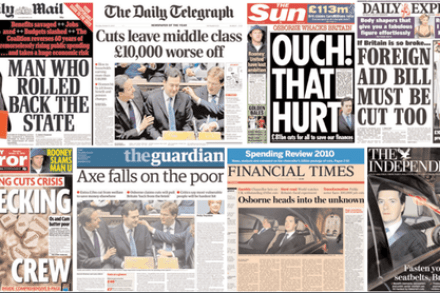
The last time the doomsayers were proved so wrong was when the Hadron Collider didn’t blow us all up. Osborne’s cuts have come and life, the universe and everything continue insouciantly. In fact, the cuts were nowhere near as deep as many expected. As the graphic above proves (courtesy of ConHome), the press reaction is cordial, which was the best the Osborne could hope for. The Times (£) and the Guardian express concern about fairness, based on decile graphs that suggest the poor will receive less direct income from the state; and the Telegraph grumbles about the ‘squeezed middle’.

The Tory response to Osborne’s Spending Review

From our UK edition

George Osborne was well received by the 1922 committee of Tory backbenchers when he addressed them on the spending review earlier. There was much thumping of desks, the traditional sign of approval at meetings of the ‘22.   Talking to Tory MPs this afternoon, they are pretty happy with the package. They are glad that the money being taken out of the welfare budget means that the departmental cuts are less than expected. Overall, they think the package is politically sellable and has denied Labour that many targets.   One concern is about how local councils, including Conservative ones, might react to a 28 percent cut in their funding from central government.

Cameron’s warm-up act for Boy George

From our UK edition

Cameron was a mere warm-up man at PMQs today. With Osborne’s statement due at 12.30 the session felt like a friendly knock-up rather than the main fixture. Ed Miliband rose to thunderous cheers from his backbenches and he tried to capitalise on their support by opening up an ancient Tory wound – heartless attitudes to unemployment. Spotting Cameron chinwagging with Osborne instead of listening, Miliband chided the PM for not paying attention. ‘Well, it’s a novel concept,’ said Dave smoothly ‘but in this government the prime minister and the chancellor speak to each other.’   Ed’s problem was that the OBR has predicted rising employment for the next three years. Bad news for the opposition leader.

PMQs live blog | 20 October 2010

From our UK edition

QUICK VERDICT: More heat than light today, but Cameron easily got the better of Ed Miliband. Now to the Spending Review live blog. 1230: Cameron says that as cuts are made, the government will have to reform the way it does criminal justice. This is a prelude for the deep cuts that the Home Office and Justice department are expected to face in the spending review. 1228: The Lib Dem MP asks whether Cameron believes that better-off graduates should bear more for their university costs. Cameron says that he agrees on principle, and claims that "everyone in the House" wants the "same thing": a fair and well-funded university system. 1226: Cameron says that the spending review will contain answers on social housing - but hints that the results may be better than expected.

The unavoidable cruelty of necessary cuts

From our UK edition

Even though the SDSR promises that it "will be used by units returning from Germany or retained for other purposes," the loss of RAF Kinloss will still be a body blow to Moray. For years, it has sustained hundreds of airforce families in Elgin, Forres and Nairn - mine amongst them. And I can picture the bakeries, shops and other small businesses that will be hit by losing so many clientele. About 6,000 jobs depend on the RAF up there: not just Kinloss but Lossiemouth, 15 miles away, whose future also looks bleak. Jet fuel for the Tornados in Lossie is sent via Inverness harbour, so it would mean job losses there. The downgrading of Kinloss, of course, means the end of Nimrods.

Time for a new approach to the EU

From our UK edition

All eyes are on the spending review, but yesterday another potentially huge challenge landed in the Coalition’s in-tray: the prospect of a new EU treaty.   In the small town of Deauville in Lower Normandy, French President Nicolas Sarkozy and German Chancellor Angela Merkel struck another of those ‘Franco-German compromises’ that tend to set the EU agenda, and have too often left the UK on the back foot. Yesterday’s compromise will see Sarkozy backing German calls for a new EU Treaty to introduce new a mechanism that would enable countries within the euro area, such as Greece, to default.   And Merkel means business.

Putting the cuts into context

From our UK edition

Having been accused of being a “pain denier” by Tim Montgomerie yesterday, I’d like to quickly defend myself. In my News of the World column, I sought to put this in some perspective. I put in the fact that has been reported nowhere: that we know what the cuts will be. Total cuts to government spending will be 3.7 percent, spread over four years. It is debt interest which forces departmental cuts down to an average of 13 percent, again spread over four years. There will of course be real pain, for thousands of workers facing redundancy. For commuters facing a huge 30 percent rail fare increase.

Fox in the dock?

From our UK edition

Split-stories have their own momentum. As soon as you know that a certain secretary of state is in the dog house with Downing Street, you start seeing things through that prism. So when I saw that the press release on the government’s new national security strategy contained quotes from the PM, the Foreign Secretary, the Home Secretary and the Development Secretary, but not the Defence Secretary, I immediately regarded it – and perhaps wrongly – as part of the Westminster Fox hunt.   Liam Fox’s appearance on the Politics Show on Sunday was ill-advised.

Laws helps Gove

From our UK edition

Michael Gove has just been explaining in the Commons where the £7 billion for the fairness premium that Nick Clegg announced on Friday will come from. Revealingly, David Laws was present as Gove answered this urgent question. I understand that Laws was crucial to both the pupil premium being implemented at a decent level and the real-terms increase in the schools Budget.   Laws himself told John Pienaar’s show last night that “obviously I've talked to him [Nick Clegg] about some of the things that I've been associated with in the past, like the schools funding issue... because I was the schools spokesman in the last parliament”.

The presentational battle begins in earnest – as the double-dip warnings wind down

From our UK edition

Rule 97 in the Practitioner's Guide to Westminster Politics: if you want to get a message out pronto, then corral a bunch of impressive names into writing a letter to a national newspaper. We saw the tactic used by both Labour and the Tories before the election. And we see it again today, with a letter in the Telegraph, drafted by the Tory peer Lord Wolfson and signed by 35 business leaders, pushing George Osborne to "press ahead with his plans to reduce the deficit". And you know what? He may just do that. In truth, these kinds of letters are hardly a bad thing for the government, however stage-managed they might be. As the week of the spending review kicks in, the headline that people will see is: "Cut now or pay later, say business leaders".

Osborne gets behind infrastructure

From our UK edition

One of the most significant things we have seen today is George Osborne’s announcement that Crossrail, Mersey Gateway, the big science project Diamond synchrotron and universal broadband would all go ahead. Osborne has decided that it is worth cutting deeper now in other areas to protect the kind of investments that will make Britain a more attractive place to do business down the line. As I said after the Budget, Osborne’s desire to protect this kind of capital spending is a key part of his plan – along with his reductions in corporation tax – to boost the private sector in Britain as the public sector is downsized. The Crossrail announcement is also a big boost to Boris Johnson’s re-election bid.

The axe hovers over welfare (and welfare cheats)

From our UK edition

As we know, education and defence have now had their budgets settled – another two ticks alongside the checklist. But that still leaves the third member of the coalition's trio of sticky settlements unresolved: welfare. The "quad" of David Cameron, George Osborne, Nick Clegg and Danny Alexander will meet today to bash out the final details. Yet some of their key talking points and decisions have already made it into the papers (especially in this article (£) in the Sunday Times). Here's my round-up, along with brief comments: 1) Crackdown on welfare cheats. George Osborne sets the tone with his article in the News of the World (now also behind a paywall). "A welfare cheat," he writes, "is no different from someone who comes up and robs you in the street.

Why the Tories didn’t win

From our UK edition

Courtesy of John Rentoul, Tim Bale, professor of politics at the University of Sussex, offers this appraisal of the 2010 election: 'For all the talk in opposition of decontaminating the Tory brand, of making the party more tolerant and inclusive and less ‘nasty’, the key task facing Cameron when he took over in late 2005 was reassuring voters that the Conservatives could be trusted on welfare and public services.  All the market research suggested that this was the sine qua non — a necessary if not a sufficient condition — of a return to office. When the global financial crisis hit and Britain’s budget deficit ballooned, however, this task remained unfinished and work on it practically ceased.

The cuts are almost settled

From our UK edition

We are entering the end game of the spending review. The Department of Education settled this morning, according to both Tory and Lib Dem sources. Although there is confusion about whether the money for the pupil premium is coming from inside or outside the education budget – Clegg’s speech suggested outside but other Whitehall sources are not so sure. Liam Fox has told friends that he knows the final number for the defence budget and that it is a lot better than expected over the summer. Fox has played a blinder in terms of defending his budget but this has come at a huge personal cost for him. Even supporters say that they don’t think his relationship with Downing Street will ever fully recover.