Conservative party

Five more things you need to know about the IDS reforms

Last November, I put together a ten-point summary of IDS’s benefit reforms – so why add five more points now? Two reasons. First, it’s worth dwelling on what, I believe, will be one of this government’s defining achievements. Second – and far more prosaic – the Insistute for Fiscal Studies released a report on the matter yesterday. The following points have all been harvested from that document, and represent the IFS’s judgement, so to speak. Only one judgement among many, but one that warrants some attention. Here goes: 1. Who gains and who loses (in financial terms)? This question courses through most of the IFS report, and stands out in

PMQs live blog | 12 January 2011

VERDICT: Woah. If you ever needed a PMQs to brush away the last morsels of festive cheer, then this was it. Every question and answer came laced with some sideswipe or other, and it made for a scrappy exchange between the two party leaders. Both struck blows against each other, but both were also guilty of errors and mis-steps. Miliband squandered an easy attack on bankers’ bonuses, even allowing Cameron to turn it back against Labour. While, for his part, the Prime Minister was so relentlessly personal that it came across as unstatesmanlike. I don’t think either one really emerged victorious, or well, to be honest. It was simply unedifiying

Dave and Boris, united in anger

A potent Tory tag team in the Sun today, as David Cameron and Boris Johnson join pens to take on the unions. The tone of their article is as blunt as anything we’ve heard from them on the matter, particularly the Prime Minister. “Let’s call these threats what they are,” it says about the prospect of strikes during the Royal Wedding and the Olympics: “nothing more than headline grabbing to score political points”. And it continues to deliver a warning to union bosses: “you can try to drag this country back to the 1970s, to a time when militants held our country to ransom, but you will not succeed.” It’s

Clegg: time to air our differences

Why vote Lib Dem? Even Nick Clegg is now asking that question. After 8 months of broken pledges, deep cuts and atrocious polling (due to reach its nadir tomorrow in Oldham East and Saddleworth), Clegg worries that his party is losing its identity. Speaking to the Guardian, Clegg reveals that he hopes to arrest decline by expressing publicly his private differences with David Cameron. This is not defiance from Clegg but a statement of positive intent. Taking brave decisions, he says, has proved that the Liberal Democrats can govern and that coalition works; the government’s strength is sufficient to withstand disagreement. That’s all very well, but Clegg needs more than

The new faces of Tory euroscepticism

Britain is avowedly eurosceptic. But euroscepticism is not homogeneous; there are different tones of disgust. Many decry further political integration; others oppose Europe’s penchant for protectionism; some are wary of the EU’s apparent collective socialism; a few are essentially pro-European but believe too much sovereignty has been ceded; others hope to redefine Britain’s cultural and political relationship with the Continent, as a bridge between the Old World and the Anglosphere; most see Brussels as an affront to elective democracy; and a handful just want out and vote UKIP. So it has always been – perhaps one reason why William Hague’s ‘ticking time-bomb’ has not yet exploded. Time passes and Britain

The coalition decides to accept the flak over bonuses

The truth, as they say, is out: it doesn’t look as though the coalition will be doing much about bankers’ bonuses after all. According to this morning’s Times (£), it’s a case of the Tories getting one over the Lib Dems – and particularly Vince Cable – by not pushing down with more taxes on the City. But that, I suspect, is only half the story. The other half is that the coalition never had much in their armoury, but harsh rhetoric, in the first place. If they want the banks to start lending to business again, then their most substantial hope has always been a trade-off over bonuses. Which

An unsurprising coup for UKIP

As Adam Boulton says, the Oldham by-election has produced another noteworthy moment. And, in this case, it’s one of the smaller parties making the splash. In a press conference in the constituency this afternoon, UKIP confirmed that Stuart Wheeler has joined their party as treasurer. This is, of course, the Stuart Wheeler who gave £millions to the Tories during the wilderness year after 1997 – including a £5 million mega-donation in 2001 alone. That Wheeler has made the conversion is unsurprising. He was expelled from the Conservatives, in 2009, for donating £100,000 to UKIP. And, soon after, he wrote a piece for The Spectator explaining why he would be voting

Showdown at the Blame Game Corral

Alastair Campbell, of all people, shows how the ghastly Tucson shootings are to be exploited for political purposes: What the right are now doing is trying to portray the killer of Tucson, Arizona as a crazed loner operating in some kind of vacuum. But even if it turns out that he had never heard of the Tea Party, did not know who he was shooting, and was in fact a card-carrying member of the Democrat Party, (all three unlikely) it is time for the right-wing prophets of hate, many of whom have grown rich and famous on the back of their bile, to recognise the harm they do to public

Cameron sells the coalition’s economic policy

David Cameron was on Marr this morning (with yours truly doing the warm-up paper review), talking about the “tough and difficult year” ahead. Others have been through the interview for its general content. What interested me was its economic content: not the most sexy subject in the world, I know, but, as Alan Johnson unwittingly demonstrated on Sky this morning, the Labour Party looks unable to scrutinise the government’s economic policy. Anyway, here are ten observations:   1) “Because of the budget last year, we are lifting 800,000 people out of income tax, we’re raising income tax thresholds. That will help all people who are basic rate taxpayers.” Thanks to

The pollsters have Labour running away with it in Oldham East

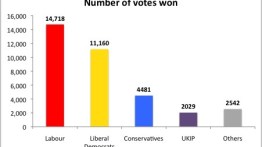
The same, but completely different. That’s the electoral paradox that emerges from a couple of opinion polls on the Oldham East & Saddleworth by-election this morning. The same, because both the Lord Ashcroft survey for the Sunday Telegraph and the ICM survey for the Mail on Sunday produce the same result as in the general election: Labour first, the Lib Dems second and the Tories in third. Completely different, because this is no longer the achingly close contest that it was back in May. Both polls have Labour soaring 17 percentage points above the yellow bird of liberty. Of course, the polls aren’t always right. Yet these latest will surely

What’s the big idea?

If you’re not quite sure what the Prime Minister means when he talks about the big society, you’re not alone. If you’re not quite sure what the Prime Minister means when he talks about the big society, you’re not alone. Before the election, a poll found that most people hadn’t heard of it and only very few who had knew what on earth it meant. Even some Tories deride it as ‘BS’, though Jesse Norman is not one of them. A former banker and academic, Norman was elected MP for South Herefordshire this year. And, as the author of two serious texts on the future of conservatism, he’s well-placed to

Coalition polling

As Tim Montgomerie notes, tonight’s Angus Reid poll asks an interesting question about who voters would support if asked to choose between Labour and a Coalition party. This questions pushes up support for Labour with Labour scoring 45 percent on it compared to 40 percent on a normal voting intention question. The increase in Labour support comes from the fact that 46 percent of Lib Dem voters from the 2010 election would in these circumstances vote Labour compared to the 32 percent who’d go coalition. Polling on a hypothetical should, obviously, be treated with caution. But the fact that the coalition together polls worse than the coalition apart is interesting.

Clegg strikes an uncertain balance

By my count, it’s the fourth speech that Nick Clegg has delivered specifically on the subject of deflating the state since last May. And like his last three, today’s number was stuffed with words like “liberty” (23 times), “freedom” (19) and “power” (14). Much of the more specific content was familiar, too: like the confident asides about ID cards and a Freedom Bill. What we really wanted to hear, though, was what Clegg would say about control orders. And what he said was … well, not much. Like the PM earlier this week, the Deputy PM suggested that control orders are an imperfect mechanism – and that “they must be

Gove’s school reforms approach a tipping point

Today marks something of a milestone for Michael Gove’s school reform agenda. Free schools – i.e. ‘Academies’ which are independently run, yet within the state sector – now account for more than 10 percent of British secondaries. This is what I have always thought of as a tipping point – where independent schools offer real competition to council schools (i.e. those run by their local authority). One hesitates to sound too confident, but the genie of choice seems to have been yanked out of the bottle, and a few facts are worth nothing: 1. There are now 407 Academies open, twice the amount in May 2010. The 400 mark was,

Clegg: Read my lips…

This comment from Nick Clegg – speaking to the Evening Standard today – deserves pasting into the political scrapbook: “Let me be absolutely clear once and for all. The Liberal Democrats will fight the next election as we did the last – as an independent political party in every constituency in the country.” Which is considerably less equivocal than David Cameron and George Osborne have managed recently. When the Tory pair were pressed on the matter towards the end of last month, they said only that they “expect” the coalition parties to fight independently of each other come election time. Not that the Clegg quotation rules out electoral chicanery altogether.

Clegg and Cameron decouple

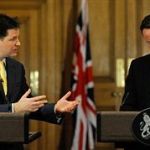
Cameron and Clegg are putting on a show for the in-laws. After mounting disquiet from the fringes of their respective parties, the two leaders are journeying to Oldham East to quash rumours of a merger and reaffirm that theirs is a marriage of necessity. David Cameron will travel north in due course. God knows what he will say? Presumably that he no longer wishes his partners well – get out there and biff ‘em, or words to that effect. On the other hand, Nick Clegg will declaim his lines today. His script is hyperbolic, replete with wishful fantasy about a ‘two-horse race between Labour and the Liberal Democrats’. Oldham is

The Tories turn their fire on ‘lamentable’ Johnson

Come back, you insufferable relatives, all is forgiven: the political class has devoted an afternoon to trading insults about who said what about VAT and when. However, there have been some intriguing exchanges amid the New Politics’ latest outing. First, Labour seems to be fighting the two coalition partners as a single entity in Oldham East. Cameron, Clegg and Simon Hughes have received equal measures of opprobrium this afternoon and all have been lumped together. This was always a danger, but, as Fraser noted, Clegg and Cameron invited the manoeuvre by uniting their parties’ central operations in the cause of government. If Cameron and Clegg don’t differentiate in the general,

Will Osborne be vindicated in 2015?

VAT, VAT, VAT – but what’s this? The main headline on today’s FT doesn’t mention the sales tax at all, and the piece below it only does so in passing. Instead, a declaration that “UK austerity measures [are] expected to pay off,” based on a survey of economists conducted by the paper. Although those polled have concerns about inflation and the eurozone, only 13 percent say that George Osborne needs a Plan B for dealing with the public finances. As always, we shouldn’t place too much stock in this kind of thing. Some economists will back the coalition, others will back Labour; some will be right, others will be wrong.

Boles beats his old drum

To accompany Fraser’s suggestion that Cameron and Clegg are planning a merger, it is notable that the ubiquitous Nick Boles has renewed his calls for a formal pact. Previously, Boles averred that Liberal Democrat ministers should be protected in three-way or Conservative-Liberal marginals. This time round, his argument is more philosophical. He told Radio 4’s PM: ‘The Coalition has enabled the Conservative party to be more radical than it would have been able to had it formed a government on its own with a small majority… Jacob Rees Mogg who’s a fellow MP who’s certainly not a sort of liberal Tory like I am in the sort of modernizing sense. In five

Wrong to be too Right

From a right-wing perspective, there are several things wrong with David Cameron’s leadership – not least the fact that he did not win the 2010 election outright. As an unassailable report by Lord Ashcroft showed, the Tory campaign squandered a historic lead over Labour. The policy disagreements – over the EU, civil liberties, and the AV referendum – are compounded by personal grievances. The Prime Minister, despite investing quite a lot of time placating quarrelsome  MPs – calling them, writing them letters, inviting them to No 10 – cannot shake the impression of a man who is buoyed by confidence verging on arrogance, and someone who is reliant on –