Conservative party

The chart that will decide Rishi Sunak’s fate

From our UK edition

After his five key pledges speech this week, one can only conclude that Rishi Sunak must have been shown the chart.  The chart in question crops up in a regular update that polling firm YouGov puts out on the key political issues, as seen by various segments of the electorate. It measures the priorities of those who voted Conservative in 2019 and therefore have it within their collective power – and potential inclination – to grant the party yet another term in office. And it has told a consistent story for the past two years. The three biggest issues for voters – miles ahead of anything else – are the state of the economy, immigration and asylum, and healthcare.

Why won’t the Conservatives stand up for conservatism any more?

From our UK edition

Is it supposed to be enough for those of us of a culturally and socially conservative persuasion to know that some Tory MPs share our outlook? Are we meant to look back over the radical left’s march through the public realm during these past 12 years of Tory-led governments and think: 'Well, at least some Conservative MPs tried to make a bit of a fuss about it, so we’d better vote Tory again?' It should not take a genius in Conservative Campaign HQ to realise that no, it isn’t enough. Not when one of the Tory prime ministers from this long phase of nominally conservative government has just come out to say she agrees with the SNP’s policy of gender self-ID.

The liberal-conservative tug of war for the GOP

For the last thirty years, the Republican Party has been a battleground between two competing ideologies. One of these is fundamentally liberal, although it is packaged and sold under a variety of brand names: “compassionate conservatism,” neoconservatism, classical liberalism, and — most misleadingly — Reagan conservatism. The other ideology is a rejection of modern liberalism and the post-Cold War elite consensus in American politics. It is skeptical of free trade, large-scale immigration and US involvement in foreign conflicts. Pat Buchanan and Donald Trump are the primary representatives of this view, which is often called populist or nationalist. The two sides are not evenly matched.

liberal-conservative

Why Liz Truss had to go

London, England Nobody in British politics really thought things could get worse than last night. Conservative MP Charles Walker told the BBC that the day was a "pitiful reflection" of the party; he added that there was "no coming back from it." Seasoned political editors described Wednesday as the most catastrophic day of their careers. The government victory on fracking — with 326 votes opposing the Labour motion to 230 backing it — was tarnished by claims of intimidation and bullying in the House of Commons. The home secretary, Suella Braverman was fired for sending official documents from her personal phone, something which is likely now a relief for her. Two other figures were said to have quit, but remained in their posts when questioned twelve hours later.

liz truss

Five ways the Liz Truss saga could end

From our UK edition

How does this end? That's the question being asked by Tory MPs as Liz Truss’s government finds itself in turmoil once again. The Prime Minister’s decision to axe her chancellor and U-turn on a plan to ditch the corporation tax has only added to nerves in the Conservative party as to how sustainable the current situation is in. It's clear that different wings of the party are incredibly unhappy with the current leadership. Yet Truss is technically safe from challenge for another year. What's more, it's not clear who exactly the party could agree on. Earlier this month, I wrote for the magazine on the scenarios being war-gamed by ministers, MPs and aides.

Removing PMs hardly ever ends well

From our UK edition

As Tory MPs appear to descend into a panic of buyers' remorse over the election of Liz Truss, they would be well advised to take a deep breath and reflect upon the absurdity of removing a leader after six weeks. As they do so, they might find it instructive to look across the sea to Australia to see the folly of constant leadership turmoil and the ever more lethal poison it injects into the bloodstream of political parties.    Over the past decade and a half, Canberra – whose politics are famously robust – earned the unenviable taunt of having become the ‘coup capital of the South Pacific,’ as both sides of politics butchered their leaders in a fratricidal game of conspiracy, political assassination and payback.

Things can always get worse

From our UK edition

As I was saying, way back in July, it is hard to love the Conservative party. Every time it tries to navigate another bend in the road it ends up causing a disaster even its most ardent critics could not have foreseen. ‘Things can’t get any worse,’ said rebels in the party while Boris Johnson was still PM, before the summer. Then we were introduced to Liz Truss. Now, within weeks of her taking office, you can hear members of the parliamentary party saying with vigour: ‘She has to go.’ At which point I feel the country wanting to place our collective heads in our hands, yell and walk away. Does anyone have time for all this? Does the Conservative party just plan to hold endless leadership contests in perpetuity while the country looks on?

What does Michael Gove want?

From our UK edition

Tory conference has long been more stage-managed than other party meetings, but this year the official speeches from ministers have also been condensed into a very strange late afternoon slot lasting just two hours. The rest of the time is free for fringe meetings and plotting. Ministers and their aides have been told they have to keep their addresses to the hall announcement-lite, which makes those two hours feel largely pointless. Kwasi Kwarteng didn't announce very much at all, even though his two U-turns have dominated the day's agenda. This morning, the Chancellor dropped the plan to abolish the 45p rate of tax, and this evening it has emerged that he is also bringing forward his medium-term fiscal plan from 23 November – something ministers had been asked to hold the line on.

Why Kwarteng’s next fiscal event will have to be brought forward

From our UK edition

In a tetchy performance on The Andrew Neil Show, Tory party chair Jake Berry repeatedly insisted that everyone would have to wait until the Chancellor’s unveiling of his fiscal plan on 23 November to find out whether or not there would be spending cuts and when the government believes it will hit its 2.5 per cent growth target. Berry’s performance, which involved repeatedly trying to answer a different question to the one he was asked, made it even harder to believe that this line can hold. If every minister interviewed for the next six weeks sounded like Berry did just now, then it would be a disaster for the government. https://twitter.com/Channel4/status/1576607943277019137?

Truss can’t hide from the crisis she created

From our UK edition

For a politician who only a few days ago was bravely mocking Vladimir Putin as a ‘sabre-rattling’ loudmouth ‘desperately trying to justify his catastrophic failures,’ Liz Truss has turned out to be the greatest coward ever to be prime minister. At least Putin feels the need to justify the catastrophe he has inflicted. Truss and her Chancellor believe they can hide away like children putting pillows over their heads to escape a bad dream, and say nothing at all. The public may not understand the full ramifications of the crisis the Conservatives have unleashed in a moment of ideological delirium.

Is Truss in trouble?

From our UK edition

The history of political popularity shows things go in one direction: down. John Major entered office with a net satisfaction of +15 and left it having lost 42 points. Blair moved into Downing Street a whopping 60 points in the positive. When he left he’d fallen to -27. And so the story goes – even the Maybot started quite popular with a +35. Where you start can make all the difference. If things are only going to go one way, you want as handsome a margin as possible. That’s why today’s political monitor poll from Ipsos Mori could spell trouble for Truss. She’s beginning her term in office on minus two. She joins Boris Johnson as the only prime ministers since 1982 to start on a negative rating.

Canada’s new Conservative leader is no Donald Trump

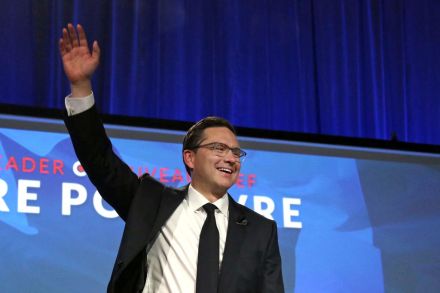
Contrary to media messaging, Pierre Poilievre, the new leader of Canada's Conservative Party, is no Donald Trump. But he does represent a challenge to the left, so the brush must be dipped in the most lurid colors available. On September 10, Poilievre won the Conservative leadership contest in a landslide, giving the party its first credible leader since Stephen Harper. Andrew Scheer, a former leader who squared off against Justin Trudeau, was likable but failed to project confidence, notably when the left held his feet to the fire over his Catholic pro-life views. Far less convincing was Scheer's successor, Erin O’Toole, who wasn’t even likable. When it came to policy, O’Toole acted like a Liberal who’d somehow wandered into the Conservative caucus.

Thatcherism is a cult the Tories should not follow

From our UK edition

Friedrich Nietzsche may not be the most fashionable member of the conservative canon, but doubtless he wouldn’t care much. He knew that one of the main symptoms of a civilisation in decline is ‘herd thinking’. Regardless of the victor, this summer’s Conservative leadership contest has been a case in point for Freud’s narcissism of small differences. None of the candidates have dared deviate from the dogma of Thatcherism. Grant Shapps said it loudest: like Thatcher, he would confront union ‘Luddites’ to save an ailing economy. Liz Truss wants to to ‘crack down’ on trade union ‘militants’ by making it harder for them to call strikes.

Is Liz Truss sowing the seeds of her own downfall?

From our UK edition

Liz Truss looks to be winning a decisive victory for cold-eyed conservatism. A victory for I went to the school of hard knocks and university of real-life conservatism. For I never asked for charity and worked for every penny conservatism. For public-sector workers are lazy and benefit claimants are scroungers conservatism. For get on your bike and get off my land conservatism. For no one ever said that life was fair and have you seen how many holidays teachers get conservatism. Most people can be provoked by the waste of public money into thinking like that for some of the time. Liz Truss appeals to people who think like that all of the time.

Letters: How Rishi Sunak could beat the odds

From our UK edition

Injured party Sir: Prue Leith’s short interlude as a Conservative party member and subsequent resignation underlines a feature of the current membership and the impact of resignations (Diary, 30 July). The Johnson era has seen the continuing decline in party membership brought about by the resignation of many members who were dissatisfied with the evidence of endemic dysfunctionality by the Prime Minister. The consequence is that the membership is likely to be dominated by Johnson diehards. Liz Truss is certainly focusing on them. Those who did not renew their membership but are still likely to be Conservative supporters in a general election are now disenfranchised. Sir Charles Walker is right to call for an overhaul of this electoral process.

How Rishi Sunak won over the Tories of West Suffolk

From our UK edition

‘I’ve cancelled my exercise class for this! I hope he’s worth it,’ said Selina in the hotel lobby. Rishi Sunak was coming to West Suffolk to meet members of our Conservative Association. Would he be worth a listen? Clearly our members thought so. More than 90 of us rocked up at one day’s notice to meet Rishi (or Sushi, as one of our older members kept calling him). Rishi wanted to pitch for our votes. His strategy is to introduce himself to as many members as possible. Last weekend, he met 2,000 activists in constituencies where 10,000 Tory members are based. He needs every single one of our votes if he is to overtake Liz Truss, and currently the odds are against him. One doubtful member told me at the beginning: ‘He can’t beat Truss.

Meet the Tories battling for Boris Johnson’s job

Boris Johnson’s departure has left a vacancy at the top of British politics. For so long, he seemed to be the "teflon Tory" who could get away with anything; now a raft of scandals have brought him back down to earth. His resignation earlier this month triggered a leadership election among his Conservative party colleagues in the House of Commons. After a week of ballots, just two now remain: Rishi Sunak and Liz Truss. That pair of names will go to the party’s 160,000 members in constituencies across the country to decide which one will be Britain’s next prime minister. The former would be Britain’s first Asian premier; the latter its third female one.

The high price of failure

From our UK edition

I was listening to a rich bastard on the radio explaining why he was feeling disinclined to give any more of his money to the Conservative party. The term ‘rich bastard’ is the one which I was habituated to use when I was a member of the Labour party and which I have disinterred now to give my opening sentence a little more punch. It was axiomatic to us that anyone with sufficient dosh to consider squandering a few hundred thou on a political party must be a bastard and was both immoral and undeserving of his wealth. Wealth in any shape or form appalled us in an almost Freudian fashion – Sigmund, you may recall, equated potty training with the accumulation of money, and the supposedly subconscious link between faeces and money has never quite been expunged from the left.

The future of the Tories is at stake

From our UK edition

To govern is to choose. So leadership contests for a party in government tend to come down to a key policy question. In 2019 it was how to break the Brexit deadlock; this time it is what to do about the economy. Should the new prime minister prioritise tackling inflation or delivering immediate tax cuts? The candidates have been divided on this issue. Rishi Sunak, the former chancellor, who I have been friends with for years, argues inflation makes everybody poorer and so getting control of it must be the primary objective. On the other side is Liz Truss. The Foreign Secretary wants, as she tells Isabel Hardman in this issue, to introduce £30 billion of tax cuts straight away.

My life as a political spouse

From our UK edition

When I was a teenage Tory activist in the mid-1990s, I hoped one day I’d be part of a leadership election campaign team. The energy and the intrigue looked so exciting. Eventually, I did end up right in the thick of it – but as a political spouse. These races have changed a lot since then. Michael Portillo’s plan to run against John Major was rumbled when his allies were found to have installed dozens of phone lines in a campaign headquarters: that was how you did it back in the 1990s. Now, it’s all done in WhatsApp groups. Kemi and I joke about what we would have made of each other then. I’m glad we didn’t meet: I’m not sure we have would have appreciated each other’s qualities at that time.