Conservative party

The lesson from today’s PMQs? Unemployment makes Cameron uncomfortable

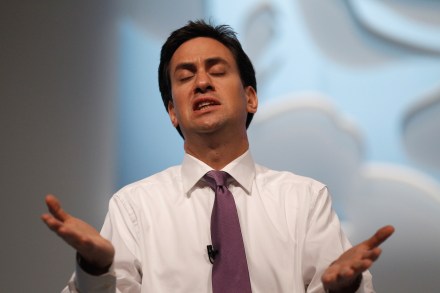
What’s the point of Ed Miliband? Does the Opposition leader have any purpose in life other than to provide ritual entertainment for the Tory wrecking crew at PMQs? Having spent the New Year listening to lethal attacks from his dearest supporters, Mr Miliband has now seen his leadership shrivel to a pair of policy statements which rival each other in desperation and barminess. The first, outlined by Liam Byrne this morning, is a fantasy tax on banking, ‘to create 100,000 jobs’. The second is Labour’s new position on the government’s austerity programme. This would baffle the dippiest and trippiest resident of Alice in Wonderland. We hate the cuts. We back

Cameron endures his monthly unemployment grilling

Downing Street is painfully aware that one PMQs in four is going to be about unemployment. Today, with the monthly figures having come out this morning, Miliband led on the subject. The Cameron-Miliband exchanges were not particularly enlightening. Miliband said ‘it really is back to the 1980s’ and Cameron mocked Miliband for being ‘so incompetent, he can’t even do a U-turn properly’. In the backbench questions, Cameron wasn’t put under much pressure. The news of the session came when he said in response to a question from Andrew Rosindell that the National Security Council had devoted a whole session to the Falklands yesterday. At the end of the session, there

What Boris Island tells us about Cameron

He already has his bikes and his buses, but might Boris get his island too? Today’s Telegraph reports that David Cameron is going to announce a consultation into building a new airport in the Thames estuary, as was first proposed by the London Mayor. The PM will wait until that consultation is over before making a final decision, but he’s said to be ‘provisionally supportive’ of the plan at the moment. Nick Clegg, by the sounds of it, is more provisionally negative. Even the very prospect of Boris Island is a triumph for the Mayor, and not least because Cameron and George Osborne were previously opposed to it. It also

The Lib Dems’ differentiation strategy, pictured

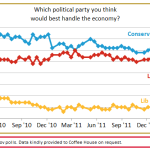
As revealed in Rachel Sylvester’s Times column (£) today: “Richard Reeves, Mr Clegg’s political adviser, draws a graph that plots ‘Government unity and strength’ against ‘Lib Dem identity’ as two lines, one going down and the other up, between 2010 and 2015. The lines cross in 2012. ‘Every minute of every day between now and the election we will turn up the dial on differentiation,’ says a strategist.” So I’ve pasted my own version of the Reeves graph above to, erm, get it on paper, as it were. Of course, it’s not surprising that the Lib Dems — or, indeed, the Tories — would do more to distinguish themselves as

Gove’s Royal yacht proposal in full

This morning’s Guardian scoop about Michael Gove’s suggestion that the nation should present the Queen with a new Royal yacht for the Jubilee is the talk of Westminster. But the full correspondence indicates that Gove was not proposing any taxpayer funding for a new Britannia.   Gove refers to ‘David Willetts’s excellent suggestion for a Royal Yacht’. This proposal was made in a letter from Willetts to the Prime Minister on the 5th September, which was copied to various colleagues. Willetts writes that Rear Admiral Bawtree sees The Future Ship Project for the 21st Century ‘as a potential replacement for the Royal Yacht Britannia’.   Willetts says that ‘The proposed

Clegg versus vested interests (and the Tories)

‘Another week, another speech about the evils of capitalism.’ So joked Nick Clegg at the start of his speech to Mansion House earlier, and there was some truth in this particular jest. All three parties are jostling to be seen as the harbingers of a new economy at the moment — one that doesn’t reward failure; that benefits everyone ‘fairly’; that won’t seize up as the old one did; that etc, etc. Ed Miliband sketched out his rather insipid vision for this economy last week; David Cameron will hope to do a better job later this week. Today, though, was the Deputy Prime Minister’s turn. So what did Clegg say?

A Cameron-friendly backbench group

The 301 Group is the nearest that David Cameron has to a loyalist backbench support group; it is named after the number of seats the Tories will need at the next election to win a majority. The Times today reports the group’s concerns that the Tories are in danger of forgetting the importance of a broad agenda that goes beyond the party’s staple issues. I suspect that several people in Downing Street will nod along at these concerns. The group has certainly been encouraged by Number 10, which has difficult relations with the 1922 Committee. Its early speakers have included the chief whip Patrick McLoughlin and the vice-chairman of the

Gove: It’ll take ten years to turn around the education system

Speaking on the new Sunday Politics Show, Michael Gove said that it would take a decade for his reforms to change education in this country. Pressed by Andrew Neil on whether he would be able to reverse England’s fall in the PISA rankings, Gove remarked that it would take ten years before we can see whether his reforms have worked in reversing England’s educational decline in comparison to other OECD economies. Interestingly, Gove suggested that one of the measures of the success of his reforms was whether private schools started entering the state sector. He also defended his decision to force some schools to become academies. He argued that he

Simon Hughes speaks out against the benefit cap

In the Cameroon effort to redefine the politics of fairness, the benefit cap of £26,000 a year is key. When George Osborne announced it in his 2010 conference speech, he explained it – rightly – as a matter of fairness that ‘no family on out-of-work benefits will get more than the average family gets by going out to work’.   The Tories were also aware of just how potent a wedge issue it would be. If Labour opposed the cap, they would be in favour of some households in which no one is working receiving more from the state than the average salary people achieve by working. This is, to

From the archives: Saving the Union

With Scottish independence very much the issue of the week, we thought you might enjoy this Spectator leader from 1979, arguing for a ‘No’ vote in that year’s referendum on Scottish devolution: To preserve the Union, 24 February 1979 ‘So, Sir, you laugh at schemes of political improvement?’ ‘Why, Sir, most schemes of political improvement are very laughable things.’ The Scotland Act, which comes before the judgement of the Scottish people on Thursday, is certainly laughable. Would that it were no more than that. If the Scottish Assembly is instituted it will be the most important constitutional change the United Kingdom has known since the Irish Free State came into

IDS must stay the course on welfare reform

Welfare wars are erupting again, with Iain Duncan Smith’s bill amended in the Lords and more showdowns ahead. Number 10 has been completely robust, threatening to use rarely-invoked powers to overrule the Lords. In my Telegraph column today, I say why it’s so important that David Cameron does not go wobbly – as his predecessors did.   Tony Blair understood the need for radical welfare reform, especially when his idol Bill Clinton introduced it in America. Listening to his speeches in the mid-90s is heartbreaking: he had precisely the right idea, but lacked the determination to implement it. Frank Field was asked to ‘think the unthinkable’, but when disabled protesters

Cameron hints at child benefit taper

David Cameron’s comments to The House magazine on child benefit are causing quite a stir this morning. The Telegraph splashes on the PM’s line that ‘Some people say that’s the unfairness of it, that you lose the child benefit if you have a higher rate taxpayer in the family,’ he said. ‘Two people below the level keep the benefit. So, there’s a threshold, a cliff-edge issue.’ ‘We always said we would look at the way it’s implemented and that remains the case, but I don’t want to impinge on the Chancellor’s Budget.’ I suspect that what Cameron means by this is that they are looking at a taper. When one

Osborne sparks the unionists’ fightback

Edinburgh It became clear last night why George Osborne was put in charge of the Coalition Government’s fightback against Alex Salmond and separatism: he is the only one who has the ability to really score points off the Nats. The Chancellor’s intervention on currency and bank notes – suggesting that an independent Scotland might not be able to keep the pound and that, if it did, it might be banned from producing Scottish bank notes – hit the SNP hard. Osborne’s remarks shook one of those comfortable certainties which the SNP has been peddling for so long – that Scotland would simply keep sterling after independence and everything would progress

Uncivil service

Political cultures differ. In Iran, for example, hyperbole is expected in all political conversations. So slogans always call for ‘Death to the US’, and nothing less. In Britain, of course, the use of language is more even-tempered, but other rules apply. Blaming the civil service for failure is considered OK, but charging an individual official, even a Permanent Secretary, for the same is considered off-limits. If a minister were to try it, then he’d be accused of trying to pass the buck on towards defenceless officials. But, as Camilla Cavendish points out in today’s Times (£), failure is often also the fault of senior officials who, despite problems in the

More Mili-woe

It gets worse for Ed Miliband in the polls today. After revealing last week that just 20 per cent of the public think he’s doing well as Labour leader, YouGov now find that only 17 per cent think he’d make the best Prime Minister. That’s his lowest score yet, and it compares to 41 per cent for David Cameron. But the way those numbers break down may be even more worrying for Ed. Only half of current Labour supporters say he’d be the best PM, and a minority — just 43 per cent — of 2010 Labour voters pick him. By contrast, Cameron has the backing of 97 per cent

Ed Miliband lives to flop another day

Miliband survives! That news should steady Labour nerves. For today at least. Their leader has the knack of turning near-certain defeat into absolutely-certain catastrophe, but he bumbled through PMQs this afternoon without suffering a serious setback. He has so little ground from which to attack the government that he had to lead on a niche issue. Rail fares. He asked the prime minister why the operating companies have managed to hike prices by 11 per cent on the busiest routes. Cameron: ‘Because of a power given to them by the last Labour government.’   With that lethally terse response the PM sat down. To his credit, Miliband wasn’t rattled. But

A fairly bland PMQs

Today’s PMQs was rather a bland affair. Ed Miliband started with three questions on train fares that David Cameron batted away, but there is a little row brewing over whether Cameron’s claim that he is simply continuing the policy of the last government is correct. Later, Miliband moved onto the safe territory of the Union and consensus broke out with only the half dozen SNP MPs dissenting from it. Angus Robertson, the SNP’s Westminster leader, then asked the PM a question that, in a preview of the SNP’s campaign tactics, was designed purely to get the words Cameron, Thatcher and Scotland into the same sentence. There were two other things

The coalition finds its balance over Scotland

As much as I dislike the phrase ‘the third way’, it sums up what the coalition has done today. Given the choice between hobbling or accommodating Alex Salmond and his referendum on Scottish independence, it has decided to do neither and both. In the words of the Scottish Secretary Michael Moore, speaking in the House just now, the referendum will be ‘made in Scotland, by the people of Scotland’ — just so long as Westminster okays it first. Maybe that’ll make more sense if we look at what, specifically, was announced today. Moore’s main point was that any referendum held by the Scottish government, without the approval of the UK