Conservative party

Osborne needs to speed up

Will the Budget make a difference? Nowadays, we have a quick and easy guide: Box 3.1 from the Office for Budget Responsibility — otherwise known as the ‘blind bit of difference’ test. Sure, Budgets can make your hot takeaway lunch 20 per cent more expensive and your cigarettes cost £7.50 a packet, but the question, in a recession, is whether any stardust can be found between its pages. Whether it will be do anything for jobs, the deficit or economic growth. The Budget nowadays is handed to the OBR in advance of publication and assessed for its impact on the economy. The verdict: speeding up the corporation tax cut (another welcome move, and brave

Tory MPs welcome the Budget

George Osborne and David Cameron have just addressed the 1922 Committee of Tory backbenchers. They received the traditional desk banging reception and Tory MPs seemed in good spirits as they left the meeting. Interestingly, they were nearly all relaxed about the increase in the personal allowance, believing that they would get the credit just as much — if not more than — the Liberal Democrats. One told me that ‘the public view this as a Conservative government when things are going well and a coalition one when things are going badly’. Perhaps the biggest piece of news out of the meeting is that Osborne offered Tory MPs considerable encouragement that

A quiet PMQs, ahead of today’s main event

It started like a bit of good old political knockabout. PMQs opened with a planted question from Mark Menzies (Con, Fylde) asking the PM about Britain’s sick-note culture. Cameron, looking suitably grave, declared that the fake-sniffle problem afflicts even senior management. Ed Miliband, he told us, had recently claimed he was too ill to attend a rally called by health workers. Three hours later he was seen heartily cheering at a football match having been driven to the ground in a Rolls Royce. ‘What was it,’ asked Cameron, ‘that first attracted the Labour leader to the multimillionaire owner of Hull football club?’ This prompted howls and jeers from every part

More advance snippets from the Budget

The big Budget news tonight is that the personal allowance will rise to £9,205. This is a larger increase than expected and, intriguingly, will be paid for — in part — by a couple of billion more of spending cuts. So, the Lib Dems see considerable progress on their main budget priority, raising the income tax threshold to £10,000, but this will be partially funded by something Tory MPs have been calling for, more spending cuts. It also appears that the coalition will further increase the pace of its corporation tax cuts as well as introducing a new higher rate of stamp duty for £2 million plus houses. There’ll also

Tax transparency is a triumph for Osborne

Transparency marches on, and what a joy it is. According to the newspapers today, George Osborne will tomorrow turn Ben Gummer MP’s call for tax transparency into government policy. And so we will all get statements detailing just what our tax pounds are spent on. To use the example being bandied around this morning, a £50,000 earner will learn that they contribute £4,727 towards welfare payments. As James put it at the weekend, George Osborne tends to have both economic and political motives behind his actions — and the two are present, if almost indivisible, here. No doubt the Chancellor hopes that taxpayers, on seeing where their hard-earned ends up,

Sundays should be about more than just economics

The Chancellor didn’t even bother to hide the thick end of the wedge as he inserted the thin end into the Sunday trading laws. He declared yesterday that restrictions on Sunday trading would be lifted for the duration of the Olympics and Paralympics on the basis that ‘It would be a great shame if the country had a “closed for business” sign on it.’ And he went on to remark, ‘maybe we will learn some lessons from it’. What might those be, do you suppose? That people, left to themselves, will shop all day, every day and should therefore be able to? Certainly that was the conclusion of The Times,

Osborne makes his appeal to Britain’s grafters

‘A Budget for Working People’. That’s the headline theme of this year’s Budget, says our former editor Matt d’Ancona in the Sunday Telegraph today. And his words are borne out by George Osborne’s interview with the Sun on Sunday. ‘We’ve got to help people into work, particularly young people,’ says the Chancellor, ‘We have to make this a competitive place in the world to set up in business and employ people.’ The measures being broadcast around this morning include a trial suspension of Sunday trading regulations, timed for during the Olypmic Games. At once, this is both an unsurprising and genuinely risky venture from Osborne. Unsurprising, because the votes of

Is Andrew Lansley’s time finally running out?

A few months ago, I was invited to speak at the Health Service Journal conference, and hugely enjoyed meeting various reformers from within the NHS (and, of course, their enemies). One representative from the NHS Confederation pointed out that in most countries which were run by coalitions, the junior party was always given control of health — because nothing good can ever come from it. When things are going well, you hear nothing. When flu epidemics strike, then health is a horrible brief. A good point, which David Cameron may be taking to heart. Patrick Hennessy reveals in tomorrow’s Sunday Telegraph that Cameron is mulling a pre-Olympics reshuffle which would

The man behind the Budget

In today’s Telegraph, I profile Rupert Harrison, chief economic adviser to George Osborne and the man who’ll do more than anything else (including his boss) to shape next week’s Budget. In the British political system, special advisers are given very little attention — even though the best of them are more influential than the average Cabinet member. The Treasury’s vast power, assembled by Brown, is still there. That can’t be said for Osborne: he spends half his time in Downing St, and is sufficiently detached from the Budget process that he felt able to take a couple of days’ holiday in America last week to jump in the motorcade and

How mayoral elections can strengthen the Tories

The most important political changes are those that will not be reversed. I think that both directly elected mayors and police commissioners fit this mould. I can’t imagine voters choosing to cede the ability to hold power to account that these positions will give them. Tellingly, more people in London now favour independence for the capital than want to scrap the office of mayor. Police commissioners and mayors also provide the Conservatives with a massive opportunity to rebuild the party in urban Britain, as I argue in my column this week. The Conservatives have little chance of gaining overall control of the council in, say, Leeds. But they could win a mayoral

The significance of Clegg’s PMQs win

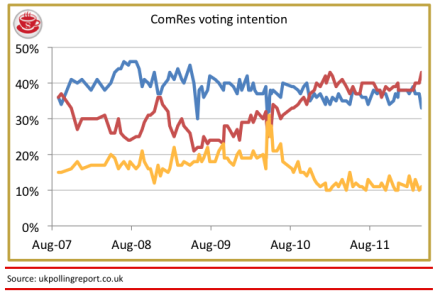
Nick Clegg’s assertive performance at PMQs today was a demonstration of the fact that he now feels more confident than he has since his failure in the AV referendum. The deputy Prime Minister doesn’t crouch defensively at the despatch box anymore, and he brushed off some rather good one-liners from Harriet Harman. She joked that the only thing the deputy Prime Minister stands up for these days is the PM entering the room.   Clegg and his team feel that things are looking up for them, that they are setting the agenda. Even the Lib Dem’s lowly poll rating isn’t dampening their mood.   So, what does this change mean

Cameron lands in America

David Cameron’s plane has just landed in Washington. The next few days should provide him with a set of images that will portray him as a significant figure on the global stage. The Obama administration is giving Cameron the full works: a huge event on the White House lawn and the kind of banquet that is normally reserved for heads of state. This is an arrangement that benefits both sides. The Obama re-election campaign wants to foster the sense that the President is friends with a Conservative British Prime Minister given that their Republican opponent in the fall will accuse him of being a left-wing radical. I suspect, though, that

IDS’s important call for ‘social value’

It’s the same for celebrities and policymakers: talking about marriage gets you headlines. Hence why the newspapers have concentrated on Iain DuncanSmith’s remarks today that ‘marriage should be supported and encouraged’ by the state. But there were two other parts of IDS’s speech — and the ‘social justice strategy’ document behind it — that I found more arresting. The first was his incisive attack on the Gordon Brown approach to fighting poverty (define it statistically and then massage the statistics so that they work in your favour), which deserves repeating: ‘First, we have seen a social policy overwhelmingly focussed on moving people above the income poverty line. A laudable ambition

A Lib Dem alternative to Beecroft

When the Beecroft report’s recommendation of ‘Compensated No Fault Dismissal’ was first leaked back in October, Norman Lamb was one of the strongest Lib Dem voices to speak out against it, describing it as ‘madness’. Back then, he was Nick Clegg’s chief of staff. Now, thanks to Chris Huhne’s resignation and Ed Davey’s promotion, he’s in an even better position to prevent this ‘madness’: Employment Minister in the Department for Business. As James has said, the Lib Dem MPs are unanimous in their opposition to Beecroft’s proposals, and until recently it didn’t look like they would be translated into policy at all. But last week, George Osborne threw his weight

Cameron’s Human Rights quandry

The combination of the European Court of Human Rights and the European Convention on Human Rights is, I predict, going to give David Cameron an increasing number of headaches in the coming months. As Fraser wrote yesterday, Michael Pinto-Duschinsky’s principled resignation from the coalition’s Commission on the British Bill of Rights has revealed that this body was never really serious about dealing with the problem. The exposure of this Commission as merely a holding device will add to the pressure on the Prime Minister to clarify what he actually intends to do about the problem. The fact that the Cameroon’s favoured think tank, Policy Exchange, have today hired Pinto-Duschinsky shows

How Clegg outmanoeuvred Cameron over the ECHR

News that Nick Clegg has brilliantly outmanoeuvred Cameron over the British Bill of Rights will come as no surprise to CoffeeHousers — we told you so last March. The panel was stuffed full of ECHR enthusiasts, balanced by Tories most of whose competence lay in other legal areas. Perhaps Michael Pinto-Duschinsky, the most clued-up of the Tory appointees, didn’t realise this when he joined the panel. He has twigged now, and has quit (or was eased out, depending on whose version of events you believe); observing that the ‘Lib Dem tail is wagging the Conservative dog’. As was evident from the start. Duschinsky made his j’accuse on BBC1’s Sunday Politics

Clegg previews the Lib Dems’ election pitch

Nick Clegg’s speech today was a preview of what the Liberal Democrat argument will be in 2015: coalitions work and we’re the ‘one nation’ party who will ensure that the government is fiscally credible but fair. This strategy is the leadership’s best hope for the next election. But it is reliant on coalition government being seen to work, something which isn’t going to be the case if the coalition partners continue to wash their dirty linen in public. In terms of the coalition, there were a few interesting lines in the speech. Clegg said that the Budget ‘must offer concrete help to hard-pressed, hard-working families: a big increase in the

The politics of post-2015

Have you noticed, CoffeeHousers, that our politicians are talking more and more about what they’d do after the next election? This has been happening, really, since last November, when George Osborne extended the forecasting horizon of his Budget to 2017. That had a hint of chicanery about it, ensuring that Osborne continued to meet his first fiscal rule — but it has still triggered a fashion for future gazing. Since then, both Labour and the Lib Dems have talked, in broad terms, about what they would offer for after 2015. I mention this now because of a story in today’s Sunday Times (£). Osborne, apparently, is going to signal a

Vince puts his aggressive hat on

Ever since Chris Huhne’s departure from government, Vince Cable has become a more and more aggressive coalition figure. His deliberately provocative interview with The Guardian in which this Keynesian, corporatist lambasts the idea that deregulation is key to growth as “ridiculous and bizarre” has drawn a heated Tory reaction. One source told me earlier that “BIS [Cable’s department] imposes ten stupid expensive things on business for every one they’re forced to drop. BIS is mired in useless committees that churn out red tape because Vince loves the EU and hasn’t a clue about small business.’ Just how irritated some Tory Cabinet Ministers are with Cable spilled out into the open