Classical music

Class prejudice is keeping talented children out of classical music

From our UK edition

Musicians have always had an uncertain social status in England, the traditional reactions varying from amused condescension to mild repulsion. The former was the old class-based judgment on men who had chosen to take up a profession which at best was associated with society women and at worst seemed menial; the latter directed towards brass players from rough backgrounds whose lips juggled pint pots with mouthpieces and not much else. The most respectable practitioners were probably organists, often referred to as ‘funny little men’, but taken seriously.

At opposite ends of the scale

From our UK edition

A book which opens in the bushes of a Venetian garden and ends, more or less, in the cafés of Parma with chocolate panettone and biscotti dipped in coffee knows how to command attention. Given that what unfolds between these sensory episodes is densely constructed and formidable in scope, this is just as well: Peter Conrad writes engagingly and lures his reader into a grand game of cultural chess. There is no winner or loser, but we need to be alert for fear of missing a wry connection or a devilishly clever move. The oddity of the title hints at the awkwardness of the subject matter.

An aura of sanctity

From our UK edition

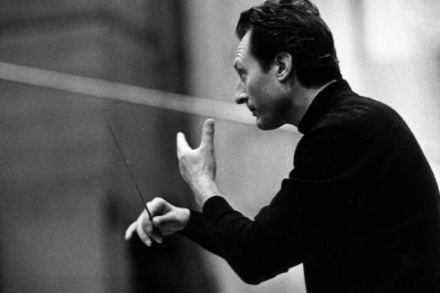
According to Arturo Toscanini, ‘any asino can conduct, but to make music is difficile’. According to Arturo Toscanini, ‘any asino can conduct, but to make music is difficile’. The technical side of conducting did not appeal to Carlo Maria Giulini, the subject of Thomas Saler’s highly illuminating biography. He was an immensely spiritual man, ‘an old-fashioned poet in a world of ego- maniacs and prosaic technicians’ in the words of Martin Bernheimer. In many ways the two maestri were polar opposites, Giulini (who died in 2005) being a gentle aristocratic in demeanour, while Toscanini behaved like an irascible bulldog.

Hit Liszt

From our UK edition

Damian Thompson highlights the gems among the prolific and pilloried composer’s nine million notes The extraordinary thing about Franz Liszt is that he remains one of the most famous composers of the 19th century despite the fact that the overwhelming majority of his music is forgotten — and likely to stay forgotten. He wrote enough of it, that’s for sure. If you were to listen to his works one after another without interruption, it would take about a week. I’m basing that estimate on the fact that Leslie Howard’s 98 CDs of Liszt’s complete piano music, which are just about to be reissued by Hyperion, last for just over five days. That’s nine million notes spread over 12 miles of printed pages, in case you were wondering.

Festival: City of music

From our UK edition

Lucerne is a city with powerful musical associations, the most celebrated being Wagner’s living there for the six years between 1866 and 1872, the most tranquil of his life, in Haus Triebschen, now a magnificent Wagner museum. Lucerne is a city with powerful musical associations, the most celebrated being Wagner’s living there for the six years between 1866 and 1872, the most tranquil of his life, in Haus Triebschen, now a magnificent Wagner museum. But he had visited before, most notably in 1859, when he finished Tristan und Isolde in the Hotel Schweizerhof; but also in 1850, a visit recorded with surprising sympathy by Stravinsky, a late convert to Wagner, when he visited Lucerne for the last time in 1969: ‘I went from Triebschen to the Schwann Hotel for tea.

Box of delights

From our UK edition

Sitting on my desk as I write are two objects of wonder and delight. They are a pair of box sets from the Deutsche Grammophon label celebrating the company’s 111 years of existence. An odd anniversary to celebrate, you might think, and I suspect the real reason is that the marketing men somehow forgot the centenary and are catching up late, with the rather lame excuse that the number 111 ‘enjoys a special kudos in musical circles’ because Op. 111 was Beethoven’s last piano sonata. The first box was released last year, and very quickly sold out. By the time I became aware of it, you could only lay your hands on second-hand copies selling for eye-watering prices. It was such a success, however, that DG has recently reissued it, along with a second collection.

Fate, death and Alma

From our UK edition

Gustav Mahler is the most subjective, the most autobiographical, of composers. Other composers, particularly in the previous century, have asked their audiences to show an occasional interest in their private lives, sometimes in rather coded ways. There are the allusions, which of course never were completely private, of Schumann’s piano cycles, Carnaval and Davidsbundlertanze; there are the heartbreaking bits of autobiography in the late Beethoven string quartets; there are significant mottos about private acts of adoration even in Brahms’s third symphony; and, much later, a hidden love affair to be decoded in the Berg Lyric Suite. But these were occasional diversions, for the most part, and music continued to be as impersonal, public and abstract an art as it ever was.