Christianity

Spare us from the snarky Christmas bauble

I have been scouring the internet for a Christmas bauble for my mother-in-law. I have fond memories of the blown glass baubles of my childhood – the little wooden cabin in the trees, covered in powdery snow; the half papaya, its orange cocoon concealing bright purple seeds inside. Last year I bought myself a glass bauble of Big Ben which, though perhaps not traditional, is still charming. We have a red post box too, which occasionally disappears and turns up in my son’s Lego set.  This year, though, I ventured to Etsy for a bauble and was shocked by what I found. The first one that caught my eye was a cartoon-like depiction of the nativity, with a speech bubble pointing to the babe in the manger and saying: ‘Spoilers: he dies.

Are angels real?

From our US edition

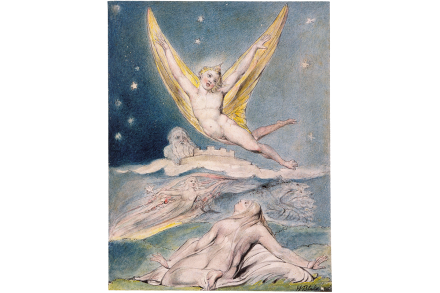
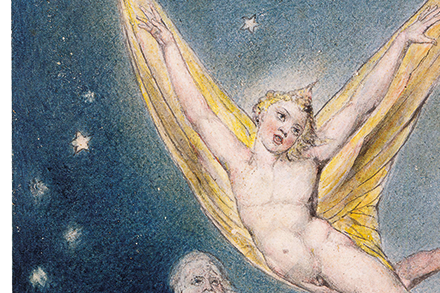
One day while out walking, William Blake saw angels sitting in the trees: “bright angelic wings bespangled every bough like stars.” He was eight years old. His fascination – some have called it an obsession – with angels lasted for the rest of his life. When he sat to have his portrait painted by Thomas Phillips, the two men began to argue about who painted a better angel, Michelangelo or Raphael. Phillips, not unreasonably, suggested that since Blake had never seen even an engraving by Michelangelo, he was not qualified to give an opinion on the matter. “But I speak from the opinion of a friend who could not be mistaken,” replied Blake. “And who may he be, I pray?” asked Phillips. “The Archangel Gabriel, sir.

The radical message of Christianity

A meeting planned in secret. A message deemed subversive. The authorities both antagonised and confused. The gatherings of the early Church in the time of the Roman Empire? Or Tommy Robinson’s proposed carol concert at an as yet undisclosed London location, proclaimed as the event to put ‘Christ back into Christmas’? To draw even the most strained comparison between the two would seem to offend most mainstream sensibilities. Established churches across the country have reacted with horror and disdain at the former football hooligan and recent prison inmate claiming to be Christianity’s champion this Christmas.

Should I wear a burka in the House of Lords?

On Advent Sunday, our grandson Christian became a Christian. He was baptised, sleeping, in the font of our parish church. On the whiteboard in the maternity ward, the newborn’s name beneath his was Mohamed. As is usual (and, in my view, preferable) nowadays, he was christened in the middle of the communion rather than separately. As is less usual, the rite was that of the Book of Common Prayer, ‘The Ministration of Publick Baptism of Infants’. It is tougher than the modern version. The godparents, in the name of the child, had to ‘renounce the devil and all his works, the vain pomp and glory of the world, with all covetous desires of the same, and the carnal desires of the flesh’, but managed with perfect equanimity to drink champagne afterwards.

Yes, Europe’s civilization is being erased

From our US edition

Last week the Trump administration expressed its fear that Europe faces "civilizational erasure." Its concern was articulated in a 33-page National Security Strategy that outlined Donald Trump’s world view and how America will respond economically and militarily. The sentence that caused the most reaction on the other side of the pond was the assertion that, if current trends continue, Europe will be "unrecognizable in 20 years or less." Those trends are mass immigration and what conservative French commentators call the "Islamification" of Europe. If Europe doesn’t address these trends, the Trump administration predicts the continent’s "civilizational erasure.

Why is the modern Church embarrassed by angels?

One day while walking in Peckham Rye Park, William Blake saw angels sitting in the trees: ‘bright angelic wings bespangled every bough like stars’. He was eight years old. His fascination – some have called it obsession – with angels lasted for the rest of his life. When he sat to have his portrait painted by Thomas Phillips, the two men began to argue about who painted a better angel, Michelangelo or Raphael. Phillips, not unreasonably, suggested that since Blake had never seen even an engraving by Michelangelo, he was not qualified to give an opinion on the matter. ‘But I speak from the opinion of a friend who could not be mistaken,’ replied Blake. ‘And who may he be, I pray?’ asked Phillips. ‘The Archangel Gabriel, sir.

Why Charlie Kirk was a modern prophet

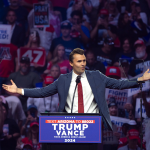
Most of us indulge in mild fortune-telling. We think ‘If the light changes before I count to five, I’ll get the job’ or ‘If the solitaire hand comes out my tests will be negative’, and so on. We understand prophecy as the ability to foretell the future. But biblically, prophecy was not prediction but castigation. And prophets were those who were inspired by God to describe the present. Dr King, Malcolm X and Charlie Kirk were modern prophets. Their lives and speech forced the populace to confront the unacceptable and obvious, which is why they were killed. Mass murderers and political assassins are incapable of facing the truth that their fury is not caused by ‘the other’ but by their own mind.

Put Christ back into Christmas cards

It’s that time of year when the cards landing on the doormat compete for the title of most fatuous. Will it be a reindeer spouting an obscenity, or a painterly robin perched on a frosted gatepost in snowy landscapes? Might it be a sanitised cartoon of a coach and four outside a snow-encrusted inn, bright yellow lights glowing from within, a kind of Pickwickian fantasy of Victorian yuletide? Or will it be a trio of children around a scarfed snowman, or a Christmas tree, perhaps? Most likely it will be a sclerotic Father Christmas, or a bright Santa (that’s with a silent ‘t’) as he’s now increasingly known, dominating the foreground or flying through the air on his sledge over a snowy landscape, even though it never snows any more.

Why is it left to Trump to highlight the persecution of Christians in Nigeria?

20 min listen

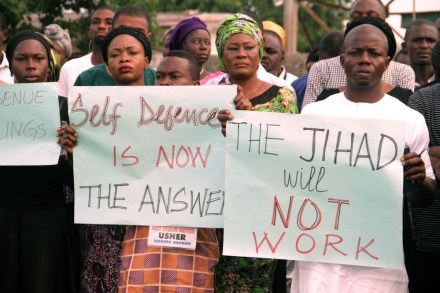
Fr Benedict Kiely, founder of nasarean.org, and Freddy Gray join Damian Thompson to discuss the persecution of Christians which has reached new and terrifying levels. Since this podcast was recorded last Friday, we have had the further news that over 300 children and staff were abducted from a Christian school – while around 50 of the children have since managed to escape, the rest remain missing and a local Bishop has criticised the Nigeria government for its failure to act. Over 185,000 Christians are estimated to have been killed in Nigeria in the past 15 years – so why has it taken the efforts of President Trump to push this horrific topic up the agenda? Produced by Patrick Gibbons.

Nicki Minaj and Mike Waltz team up at the UN

From our US edition

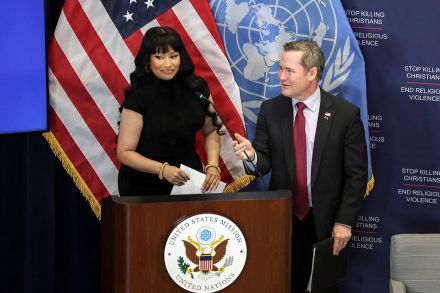
Before Nicki Minaj spoke at the United Nations today, Ambassador Mike Waltz referred to her as “the greatest female recording artist” and a “principled individual who refuses to remain silent in the face of injustice.” Adele, Beyoncé, Madonna, Lady Gaga, Barbra Streisand and many others would like to have a word with Ambassador Waltz (I hear he’s on Signal). But unlike Minaj, none of them appeared at the UN to speak out against the persecution of Christians in Nigeria.   “Ambassador,” Minaj wrote on X, “I am so grateful to be entrusted with an opportunity of this magnitude. I do not take it for granted. It means more than you know. The Barbz & I will never stand down in the face of injustice.

nicki minaj mike waltz

Why did the Danish PM call for a ‘spiritual rearmament’?

22 min listen

Earlier this year, Denmark’s Prime Minister, Mette Frederiksen, stood before a group of university students and made a striking statement: ‘We will need a form of rearmament that is just as important [as the military one]. That is the spiritual one.’ This was all the more remarkable from the leader of the Social Democrats, and in a country which is amongst the most secular in the world. Danish journalist Iben Thranholm – who joins Damian Thompson for this episode of Holy Smoke – says that in some ways the welfare state had replaced the belief in god in Denmark. So to what extent is Frederiksen's call to action a political project, and how reactionary is it? And is this part of the Christian revival, shoots of which are being seen across the global West?

Film and TV are run by satanists

I once came up with a brilliant idea for a children’s Sunday-evening TV series. It would follow the adventures of young Jesus in Britain, circa AD 16, and his rich, tin-trading great uncle Joseph of Arimathea. There’d be dragons and giants and lots demonic figures, all trying to kill the boy Messiah before He achieved his true purpose. And young Jesus would continually be constrained from using any of His real powers because it was all a secret and His time had not yet come. If you’re clever, you can probably guess the title. But it’s never going to get made because a) I haven’t written it and b) the film and TV worlds are run by satanists. Not literal satanists, perhaps. Well, not all of them.

Pope Leo is following in Francis’s footsteps

From our US edition

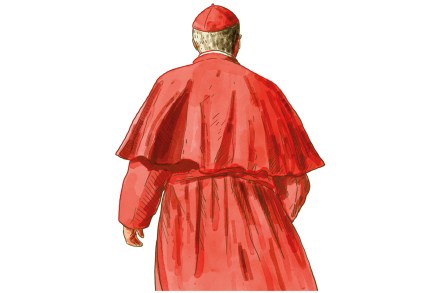
Since Pope Leo XIV’s election in May, Catholics have wondered whether he would continue Pope Francis’s radical agenda or ignite a more conservative reaction. After five months, the verdict appears clear. Leo will not only promote the principal policies in Francis’s agenda, but work to solidify them. This includes suppressing traditionalist theology and liturgy while bolstering activism on the environment, migration and same-sex relationships. Traditionalists initially viewed Leo with hope. They noted his ability to recite the Latin Mass, his choice of papal livery favored by Pope Benedict XVI and his meeting with Cardinal Raymond Burke, who supports maintaining the Latin Mass. But the new pope refuses to discipline bishops who move against traditionalists.

leo
black metal

Are black-metal bands going Christian?

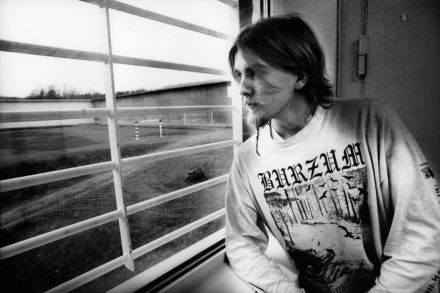
In his youth, Emil Lundin became obsessed with the idea of recording the world’s “most evil album.” The lanky, long-haired Swede formed a black-metal band and set to work. He faced an immediate obstacle. In making history’s most nefarious musical creation, he could hardly use Swedish, with its singsong tones. English was also out of the question: he didn’t want to sound like ABBA. That left Latin, the native tongue of the occult and, it is said, of demons. In a quest for suitably devilish lyrics, he pored over arcane texts. That led him to Latin editions of the Sayings of the Desert Fathers – badass early Christian monks – and St. Augustine’s Confessions.

How the occult captured the modern mind

The British science-fiction writer Arthur C. Clarke, author of 2001: A Space Odyssey, proposed a "law of science" in 1968: "Any sufficiently advanced technology is indistinguishable from magic." Clarke’s proposition had a quality of rightness, of stating the obvious with sparkling clarity, that propelled it into dictionaries of quotations. The timing was perfect: Concorde would soon be flying over rock festivals packed with hippies obsessed with "magick." Naturally Clarke’s readers understood the difference between aerodynamics and sky gods. But African tribesmen gawping at an early airplane, or Pacific Islanders watching an atomic explosion, could only conclude that they were witnessing a supernatural event: for them, a scientific explanation was literally inconceivable.

When foreign-policy critique becomes blood libel

From our US edition

“I’m a Christian man,” the college student at the University of Mississippi said to J.D. Vance, our future 48th (or 49th) President, during a TPUSA event attended by thousands. Uh-oh, here we go. “And I’m just confused why there’s this notion that we might owe Israel something… or that they’re our greatest ally or that we have to support this multi-hundred-billion-dollar foreign aid package to Israel… to quote Charlie Kirk, ‘ethnic cleansing in Gaza.’” That was nothing you wouldn’t hear outside of, say, Glenn Greenwald’s Twitter feed, but then it got dark. The student continued, “I’m just confused why this idea has come around considering the fact that not only does their religion not agree with ours but also openly supports the persecution of ours.

blood libel

Is the cult of St Edward the Confessor justified?

18 min listen

October marks the month of Edwardtide – a series of celebrations commemorating St Edward the Confessor, the King that ruled England in the 11th century for over two decades. Nowadays, he is remembered for three reasons: as one of the last Anglo-Saxon monarchs, for commissioning Westminster Abbey and for being the only English King canonised by a Pope. But does the historical record justify the cult of St Edward? Professor Tom Licence from the University of East Anglia joins Damian Thompson to discuss. Produced by Patrick Gibbons.

The perils of Catholic social media evangelism

From our US edition

Jesus, it could be reasonably observed, recruited a motley cast to serve as the first heralds of the gospel. An endlessly squabbling band of fishermen, with a few tax collectors and zealots thrown in, the biblical narratives have them endlessly jockeying among themselves for prominence and status before they, to a man, flee when the going gets tough and their Messiah gets arrested. In the two thousand years since, the Catholic Church has done its best to balance the inevitable imperfections of its messengers with the perfect truths they are supposed to announce. It’s not always an easy task – and as with so many other things, the internet has made it much more complicated.

Catholic

Is the Anglican Communion dead?

29 min listen

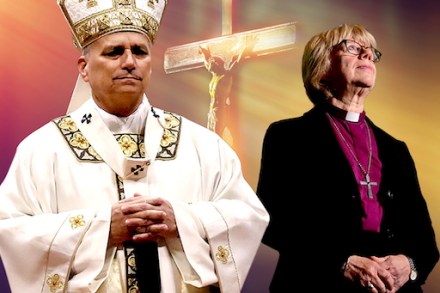
In the space of a month, the Church of England has acquired its first female Archbishop of Canterbury, a majority of the world’s Anglicans have left the Anglican Communion in protest at the mother Church’s willingness to bless same-sex relationships – and the House of Bishops has suddenly backed away from introducing stand-alone gay blessings. The situation is chaotic. In this week’s Holy Smoke, theologian Andrew Graystone talks to Damian Thompson about the almost insoluble problems that will face Archbishop Mullally after she is enthroned in January.  Produced by Patrick Gibbons.

How did faith shape Thatcher?

38 min listen

How did faith shape Margaret Thatcher’s politics? To mark the centenary month of Margaret Thatcher’s birth, Damian Thompson introduces a conversation between the Spectator’s Natasha Feroze, Thatcher’s biographer Lord Moore and Bishop Chartres who delivered the eulogy at her funeral. They discuss her relationship with faith, how both her family background and her training as a scientist influenced her beliefs and her understanding of the relationship between wealth and society based on Jesus’s parables. Plus – what would Thatcher have made of the much talked about ‘Christian revival’ in the West? Produced by Patrick Gibbons and Natasha Feroze.