Christianity

Losing faith

A landmark in national life has just been passed. For the first time in recorded history, those declaring themselves to have no religion have exceeded the number of Christians in Britain. Some 44 per cent of us regard ourselves as Christian, 8 per cent follow another religion and 48 per cent follow none. The decline of Christianity is perhaps the biggest single change in Britain over the past century. For some time, it has been a stretch to describe Britain as a Christian country. We can more accurately be described now as a secular nation with fading Christian institutions. There is nothing new in the decline of the church, but until

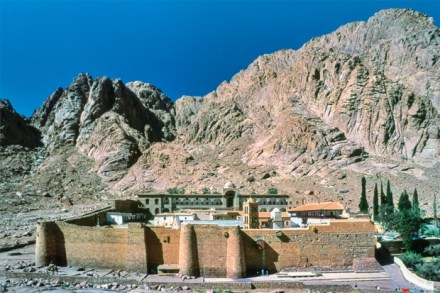
On Moses’s mountain

A medieval party of 800 Armenians at the top of Mount Sinai suddenly found themselves surrounded by fire. Their pilgrim staffs shone like candles but, wisely chanting ‘Kyrie Eleison’, they were relieved that after an hour or so the fire abated and not an eyelash of theirs was harmed. The top of Mount Sinai is no place to be stuck in an electrical storm, even less exposed to the fire of God’s presence. A steep mass of weathered granite 7,616 ft high overlooking the Red Sea, it could be climbed on foot (but not on mule-back) with the help of 3,700 steps built into the rock. The slog was worth

The death of the funeral

Funerals ain’t what they used to be. Today’s emphasis is more on celebrating a life past than honouring the future of a soul. While I am not averse to a celebratory element, the funeral is morphing into a spiritually weightless bless-fest. This was brought home to me last week at the funeral of Enid, a lady I knew only through our mutual attendance at bingo in the community centre. I was uncomfortable from the moment we gathered outside the church, where my sombre suit set me apart from the Technicolor crowd of family and friends. The atmosphere was more akin to a wedding, even a hen do, than a funeral,

Let’s renew the EU

From the time of the French revolution, the Catholic Church has always encouraged relationships between nations that draw them together rather than divide them. It is for this reason that the Church has always been broadly supportive of the European Union, although with reservations. There will be many Catholics on both sides of the coming referendum. Many of us have concerns about recent developments in the EU, such as the official removal of the reference to the continent’s Christian history from the European Constitution a few years ago. The more general push towards secularisation troubles us, too. Recent popes have questioned the tendency to regard the goal of the EU

Britain's Christian culture has risen above the recent religious brawl

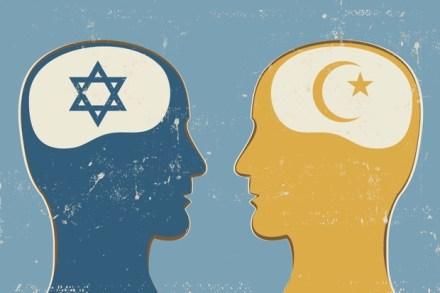
Our political culture contains some tension between Jews and Muslims. And some secular anti-Semitism, particularly on the left, and some Islamophobia. But, at the risk of getting Pollyannaish, let us see the positive. This country’s main religious culture, Christianity, is not involved in any of this nastiness. It does not contain any substantial prejudice against Muslims or Jews. It is not significantly invoked by our (rather mild) nativist movement, Ukip. Yes, Farage sometimes says that he stands for Christian values, but this is just a harmless and desperate bit of rhetoric. The louder message is that the Queen asked that lovely Muslim baker to her party. Let us be quietly proud that our

The BBC should commission a Christian version of Woman's Hour

In his new book God is No Thing: Coherent Christianity, Rupert Shortt notes that religion is in some ways taken more seriously now than a decade or two ago. But huge habits of ignorance and condescension remain: ‘When secular humanists attack Christianity, they often fail to realise that it is the gospels which provide unseen elements in their own outlook.’ He rightly draws attention to the ‘tension between the enormous cultural footprint of Christianity on the one hand, and its concealment in a secular multicultural society such as Britain on the other.’ And he tentatively criticises the subtle marginalisation of Christianity from public discourse. This is a difficult thing to

The devil in footnote 351

Last week we reached the beginning of the end of the pontificate of Jorge Bergoglio — the ‘great reformer’ of the Catholic church who, it appears, has been unable to deliver the reforms that he himself favours. This despite being Pope. On Friday, he published a 200-page ‘exhortation’ entitled Amoris Laetitia, ‘The Joy of Love’ (or ‘The Joy of Sex’, as English-speaking Catholics of a certain vintage immediately christened it). This was Francis’s long-awaited response to two Vatican synods on the family, in 2014 and last year, which descended into Anglican-style bickering between liberals and conservatives. At the heart of the disputes lay the question of whether divorced-and-remarried Catholics could

The Spectator's Notes | 31 March 2016

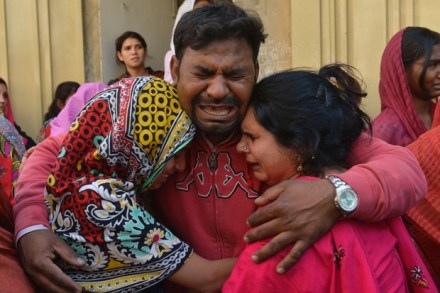
You might expect that the murder of Christians would excite particular horror in countries of Christian heritage. Yet almost the opposite seems to be true. Even amid the current slew of Islamist barbarities, the killing of 72 people, 29 of them children, on Easter Day in Lahore, stands out. So does the assault in Yemen in which nuns were murdered and a priest was kidnapped and then, apparently, crucified on Good Friday. But the coverage tends to downplay such stories — there has been much less about Lahore than Brussels, though more than twice as many died — or at least their religious element. The BBC correspondent in Lahore, Shahzheb

Can Islam move away from theocracy?

Terrorism is a distraction. It’s a distraction from the big question of our day, about Islam and violence. Only a tiny minority of Muslims affirm that sort of violence. A far larger proportion of Muslims condone another, vaguer sort of violence. It is this that we must confront. I mean the violence of theocracy. Theocracy is the belief that one religion should be absolutely culturally dominant. Of course it thinks that the state should enforce this; if the state fails to do so it loses legitimacy. This theocratic worldview is the underlying cause of Muslim terrorism. To judge from its founding texts, and its history, Islam is a religion that

Courting Sultana Isabel

The idea for a mechanical cock was never going to work. In 1595 the English ambassador to Constantinople, Edward Barton, advised Queen Elizabeth I that the surest way for her to impress Sultan Mehmed III, the new leader of the formidable Ottoman empire, was to send him a ‘clock in the form of a cock’. Knowing that Mehmed had a growing reputation for psychopathy rather than ornithology — he had his 19 brothers circumcised and then strangled to death — Elizabeth demurred and eventually sent him an elaborate clockwork organ instead. The organ was accompanied by its maker, Thomas Dallam, who spent his first month in Constantinople fixing the damage

British Christians must start to think and act like a minority

Rights compete for privileged status in a liberal society. The right to redefine one’s gender, for instance, conflicts with a woman’s right to undress in a room reserved strictly for women. The right to speak one’s mind on campus comes up against the right of students to live free from unwelcome opinions. And the right to articulate a deeply held religious belief crashes headlong into the right of a whole smorgasbord of groups who don’t want to hear it. Last year, a Christian bakery in Northern Ireland was fined for refusing to make a cake promoting gay marriage. The prosecution was backed by the Northern Ireland Equality Commission, which covered

The Lahore attacks are just the latest atrocity in a war on Christians

Imagine if correspondents in late 1944 had reported the Battle of the Bulge, but without explaining that it was a turning point in the second world war. Or what if finance reporters had told the story of the AIG meltdown in 2008 without adding that it raised questions about derivatives and sub-prime mortgages that could augur a vast financial implosion? Most people would say that journalists had failed to provide the proper context to understand the news. Yet that’s routinely what media outlets do when it comes to outbreaks of anti-Christian persecution around the world, which is why the global war on Christians remains the greatest story never told of

The price of a cathedral

We’ve all done it: been overcome by a sudden sense of hard-upness at the moment when the collection plate comes round at the end of a cathedral service. We fumble in our pockets, feel a £1 coin and a £10 note, and decide that the £1 coin will do. This is a cathedral, for goodness sake, not a parish church: they must be rich, with all those gold-coloured vestments and choristers in ruffs. But if we want our cathedrals to be alive and singing psalms in 20 years’ time, this misconception about cathedrals must change. Indeed, the sub-dean of Coventry is openly clamping down. At the end of organ recitals, he

Following the followers

In his new book Apostle Tom Bissell has an advantage over writers who go looking for Jesus: he can start with human remains. His frame for this uneven combination of travel and Church history is a series of trips to the alleged tombs of the apostles. To flesh out 13 ghosts (the 12 disciples and Paul) Bissell mines the gospels, the work of Church historians both early and late, and the Apocrypha. ‘Without the Apocrypha,’ he admits, ‘the 12 apostles would seem even more irrevocably distant.’ The former disciples of Jesus are an elusive bunch. Destroyed or partial texts throw up discrepancies and cases of contested identity, equivocal traditions set

Could Britain's evangelical Christians ever support a Trump-like figure?

Building walls, banning Muslims, mass deportations. However bad things appear in UK politics, we console ourselves with the thought that Trump could never happen here. Before that comforting thought tips over into full schadenfreude at the expense of our American cousins, we might wonder why that’s the case. There are two obvious reasons we don’t have a Trump figure. Firstly, Trump’s appeal is in a class of its own. There’s nobody in British politics who matches his ‘outsider’ status, brazen style and celebrity. Secondly, our electoral system prevents significant gains by any outsider candidates. Ukip’s paltry one MP from over four million votes at the 2015 election confirms this. Leaving aside the

Hellzapoppin’

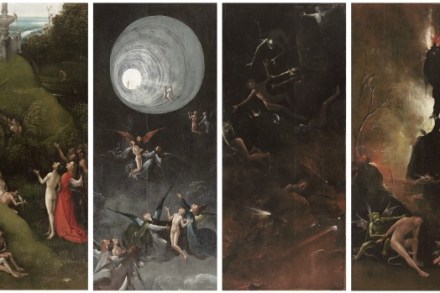
The 20th-century painter who called himself Balthus once proposed that a monograph about him should begin with the words ‘Balthus is a painter of whom nothing is known. Now let us look at the pictures.’ But while Balthus may have felt that far too much was known about his private life, Hieronymus Bosch is an artist about whom we truly know if not exactly nothing then very little that is personal or revealing. He adopted his name from his native town, ’s-Hertogenbosch, where his death 500 years ago is marked by a superb exhibition. Bosch (c.1450–1516) was christened Jheronimus — alternatively Joen or Jeroen — van Aken, came from a

On the trail of Piero

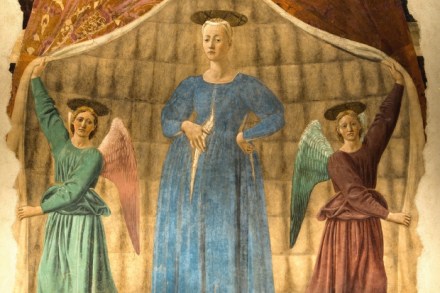
Piero della Francesca is today acknowledged as one of the foundational artists of the Renaissance. Aldous Huxley thought his ‘Resurrection’ ‘the best painting in the world’. His compositions marry art and science with cool precision and a sophisticated grasp of perspective — he was, after all, a mathematician. But he was only rediscovered in the mid-19th century after centuries of relative obscurity. Following his death in 1492, his artistic achievements faded in the memory and he became known chiefly as a geometer (his numerous writings include an innovative treatise on solid geometry and perspective). This is not wholly surprising. Many of the most impressive paintings in Piero’s oeuvre are not

Gays for God

The LGBT rights movement — so the story goes — has split the Christian churches in two. On one side are the progressives, who believe that Christianity should accept gay people and recognise gay marriage. Lined up against them are the conservatives, who hold fast to the belief that being gay is sinful. It’s not entirely false, that story. There are just a vast number of Christians who don’t fit into it. Ed Shaw is an evangelical pastor in Bristol and is gay — or, as he puts it, he ‘experiences same-sex attraction’. It’s a less misleading term, he tells me. ‘If I say to people in conversation, “I’m gay,”

Dan Walker's creationism shouldn't disqualify him from breakfast TV

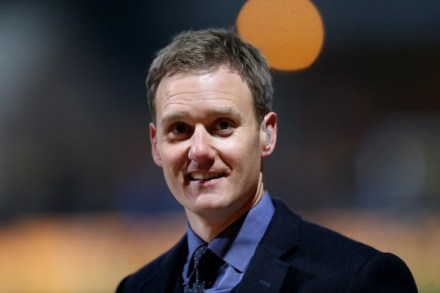
According to the Times, Dan Walker, the new BBC Breakfast presenter, is ‘a creationist’. A ‘senior BBC figure’ is quoted as saying that this ‘nutty’ belief would make life difficult for Walker if, say, he had to present a story about a 75,000-year-old fossil. How could he if he thinks the earth is less than 10,000 years old? Rupert Myers goes further in the Telegraph: ‘Creationists cannot be trusted to report objectively,’ Myers claims, ‘or to interact reasonably with their interviewees and with the public’. Before jumping to conclusions, it’s worth saying that Dan Walker’s beliefs aren’t publicly known. Anyone who thinks God made the world is a ‘creationist’ in some sense.

In the case of Bishop Bell, the Church has shown real compassion

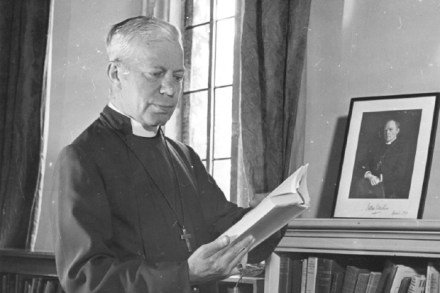
Christian columnists of left (Giles Fraser) and right (Charles Moore, Peter Hitchens) agree: Bishop Bell has been most sorely wronged. The Church should not have compensated the person he allegedly abused about seventy years ago. It has damaged the reputation of one of its major figures, without any sort of trial taking place. I disagree. I think the Church has behaved – shock, horror – Christianly. The Church knew what a huge step it was taking in believing this woman, who has now told her story to the Brighton Argus. (She was a relative of a member of staff in the bishop’s palace; she was occasionally read bedtime stories as she