China

Tariffs and the psychodrama of Trump diplomacy

A bleached white conference room, somewhere near Jeddah in Saudi Arabia. On one side sits Volodymyr Zelensky, the Ukrainian leader, in his soldier-boy outfit. On the other, Russian President Vladimir Putin in dark suit and tie. And in the middle, a beaming President Donald J. Trump. "People said this could never happen," he says, as Zelensky and Putin stare awkwardly at the floor. "But it’s a beautiful thing." A White House memo lands in inboxes across the world: "THE PEACEMAKER-IN-CHIEF..." Pure fantasy, perhaps, but Trump does have an almost cosmic ability to get what he wants – and he really wants to end the war in Ukraine. Last night, having spent weeks telling the world how "disappointed" he was with Putin, Trump abruptly announced "great progress" in US-Russia dialogue.

trump Steve Witkoff and Vladimir Putin shake hands (Getty)

The Art of the Dealmaker-in-Chief

Who really thought Donald Trump’s America was about to join the stampede of first-world powers promising to recognize Palestine at the United Nations?  "Wow!" He exclaimed this morning on Truth Social. "Canada has just announced that it is backing statehood for Palestine. That will make it very hard for us to make a Trade Deal with them."  All over the world, commentators convinced themselves that Trump’s expression of concern on Monday about "real starvation" in Gaza meant he was pivoting with global opinion and against Israel.  It turns out, however, that Team Trump is not for turning when it comes to the Middle East. Marco Rubio, the US Secretary of State, has accused the countries now embracing Palestinian statehood of falling for "Hamas propaganda".

Trump deals

China targets US citizens with biowarfare weapons

On June 3 the Department of Justice announced charges against two nationals of the People’s Republic of China (PRC). The offenses ranged from conspiracy and false statements to visa fraud and smuggling. The final charge was the most concerning, as the item in question was a fungus called Fusarium graminearum. According to DOJ, this fungus is “a potential agroterrorism weapon” responsible for head blight, a disease that targets multiple crops from wheat and maize to barley and rice. It causes billions of dollars in economic losses worldwide each year, and its effects are pronounced: vomiting, liver damage, and reproductive disruptions in both humans and livestock. Welcome to the newest front in the Chinese Communist party’s (CCP) cold war against Americans.

Biowarfare

America’s next president must study Trump’s golden escalator ride

On June 16, 2015, Donald Trump descended a golden escalator in Trump Tower and into political history. The press corps snickered. The consultant class rolled its eyes. Late-night comedians feasted on the spectacle. Most people thought it was a joke. What they missed – and still miss – is that Trump didn’t invent the anger that powered his campaign. He simply noticed it first. The pundits focused on Trump’s bombast. But voters were focused on something else entirely: someone, finally, was saying out loud what they’d been thinking for years. Take China. In 2015, Trump said, “They’re ripping us off.” It wasn’t elegant. But it was true.

Donald Trump

How Harvard lost America

President Trump’s proclamation, “Enhancing National Security by Addressing Risks at Harvard University,” pays a compliment to that crossroads of brilliance and turbidity. It treats Harvard as a serious educational institution, and one that in its misbehavior “presents an unacceptable risk to our Nation’s security.”    Trump was not referring to the risk of immersing some of America’s brightest and most ambitious students in a toxic soup of anti-Semitism, DEI and disdain for our republic. Nor were the “risks” he had in mind “everybody-gets-an-A" grade inflation or a curriculum that wastes the students’ intellectual talents on courses that sound more like entertainment (e.g.

harvard

Will the new ‘communist’ leader of South Korea abandon the US for China?

American divisions over politics look positively civil compared to the polarization that has gripped South Korea over the last few years. During the 2022 elections, Yoon Suk-yeol of the conservative People Power party (PPP) narrowly won the presidency over his liberal opponent Lee Jae-myung from the Democratic Party by a razor thin 0.73 percent. But Yoon hastened the demise of his own presidency when on December 3, 2024, he made the poor decision to declare martial law over baseless accusations that the National Assembly’s progressive opposition were collaborating with North Korea. Martial law lasted for only a few hours after both parties unanimously voted to lift the decree.

South Korea

America no longer knows how to fight a war

When educated Americans think about war, they’re apt to think of it in ideological terms. Wars are fought between dictatorships and democracies and the goal is to establish one form of government or the other in the defeated opponent’s territory. That’s certainly been the way American policymakers have thought about the wars of this century and it was the framework during the Cold War as well, when the conflict was said to be, fundamentally, a clash of ideologies. The French Revolution is probably the source of this concept, as the wars it set off were indeed largely about regime change, if not that alone.

war

How China is out-innovating the West

The world received a jolt in 2018 – and it wasn’t from a Silicon Valley whiz or a lab at MIT. It came from Shenzhen, China, where a lanky, unassuming biochemist named He Jiankui did the unthinkable. Using the newly discovered CRISPR-Cas9 toolkit, and asking no one’s permission, He edited the genes of Lulu and Nana, twin baby girls, so that both were born immune to HIV. The scientific establishment gasped, jaws dropped and the moralists clutched their pearls. “Monstrous!” the bioethicists cried. “I was just horrified,” said Jennifer Doudna, who won the 2020 Nobel Prize in Chemistry for inventing the CRISPR gene-editing technique.

China

The frightening advance of China’s military capabilities

“The number (of kills) could have been higher. We showed restraint.” – Pakistan’s Air Vice Marshal Aurangzeb Ahmed “Godzilla 3? Godzilla 3? ... Explosion in Air.” – Indian Air Force flight radio “China’s hypersonic missiles could destroy US aircraft carriers in just 20 minutes.” – US Defense Secretary Pete Hegseth Historians of the future will need a word or phrase to describe the shock and the disorienting anxiety the West will feel in the coming months as it realizes that China has caught up with – even surpassed it – in technological capability. We could call these “DeepSeek” moments, named after the recent jolt to the western psyche caused by the astonishing capabilities of Chinese artificial intelligence.

South Africa

Inside the struggle for technological control in South Africa

In the dawn light of a South African savanna, a team of rangers huddle around a satellite dish aimed skyward. Their phones spring to life with a signal – an unthinkable result just months earlier in this remote, off-grid conservation zone. The source is Starlink, Elon Musk and SpaceX’s satellite internet service, offering encrypted, high-speed connectivity far from state-controlled networks. But in South Africa, this signal didn’t just connect – it disrupted. And that disruption provides some subtext to the extraordinary “Wild West Wing” showdown between Donald Trump and South African President Cyril Ramaphosa in May, which played out in the Oval Office – with Musk looking on.

Why Washington should make Latin America a priority

As American eyes remain fixed on the Middle East — understandably so — China has been rolling out the red carpet for Latin America, and we have barely noticed. While Xi Jinping welcomes Colombia, one of Washington’s historically reliable allies, into the controversial Belt and Road Initiative, he’s also introducing visa-free entry for South America’s largest economies and greeting regional leaders in Beijing with billion-dollar credit lines and lavish, all-expenses-paid political junkets. Washington, meanwhile, was… busy. If this sounds familiar, it’s because it is. The US has been snoozing through Latin America’s strategic realignment for years, occasionally waking up to mutter something about narcos or illegal migration, then hitting the snooze button.

washington

DoGE should make ending the opioid crisis its legacy

As President Donald Trump trots the globe shopping for a new Air Force One and takes long-distance phone calls in a quest to end the “bloodbath” in Ukraine, a clear and present – and costly, in more ways than one – danger persists on his own country’s soil. A new, first-of-its-kind study from Avalere Health has found the annual average cost of each opioid use disorder (OUD) case in the US “is approximately $695,000 across all stakeholders analyzed.” Per the report’s executive summary:  The costs to the federal government, state/local government, private businesses, and society are driven by lost productivity for employers ($438 billion), employees ($248 billion), and households ($73 billion).

opioid

J.D. Vance makes nice with Munich

It was an emollient J.D. Vance who showed up at the Munich Leaders Meeting in Washington, DC. Gone was the Vance who dissed the Europeans in Munich on February 15 by complaining that they were practicing censorship of political views and who met with a representative of the far-right Alternative für Deutschland party. Gone was the Cerberus who barked at Ukrainian President Volodymyr Zelensky on the Oval Office on February 24 that he had exhibited a dismaying lack of gratitude toward America for its assistance to his beleaguered nation. Gone was the Ohio senator who declared in July 2024 that he didn’t give a fig about Ukraine’s fate and was more interested in pursuing an Asia First policy.

jd vance

Why Trumpism won’t fix Clintonomics

As a longtime critic of the Clinton administration’s “free trade” agreements, I’ve lately been mocked by liberal friends who suspect I’m sympathetic to the “plan” hatched by Donald Trump and his senior advisor on trade, Peter Navarro, to “ruin” the country with indiscriminate import tariffs. This sort of jokey ridicule goes with the territory when you jab at neoliberalism from the left. Bill Clinton still has legions of fans among the Democratic party establishment and its media acolytes, and it’s hard for them to face up to the fact that the former president’s economic policies have led directly to Trump’s election as president not just once, but twice.

trade
scientists

Why won’t western scientists condemn Wuhan?

“I am officially launching my new company: Cathy Medicine. We will eradicate diseases in future generations through germline gene editing.” This is one of several strongly – and strangely – worded tweets sent in recent weeks from the X account of He Jiankui, a Chinese scientist who served a three-year prison sentence for gene-editing two human embryos. Those embryos are now people: seven-year old twin girls living under the pseudonyms Lulu and Nana. “Good morning bitches,” Dr. He wrote on April 16. “How many embryos have you gene edited today?” “Get in luddite, we’re going gene editing,” he added the next day. He also wrote: “I literally went to prison for this shit.” Is it the real Dr. He? The journalist Antonio Regalado, who first broke the story of Dr.

Will Jeff Bezos steal Elon Musk’s electric crown with a $20,000 truck?

Though it got somewhat lost in our daily swirl of World In Crisis, last week marked a potentially significant moment in American industry: the formal introduction of a new, low-cost US-based car company. This company is called Slate, mercifully no relation at all to the online magazine. The startup, significantly backed by Jeff Bezos, last week pulled the sheet off a $27,000 fully electric pickup truck, which should be available by the end of 2026.The Slate Truck is significant for what it doesn’t have. The body is plastic, the manually adjustable seats cloth and it lacks electric windows. The driver will operate the windows with a manual crank. It has two doors, a 4x5 bed and black painted steel wheels. It comes in basic gray.

Bezos

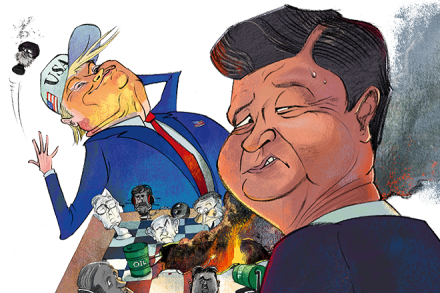
Deals, deals, deals vs China, China, China

How was your Liberation Month? It’s been almost 30 days since Donald Trump stood in the Rose Garden of the White House and announced a shocking set of massive tariffs on the world. The event caused huge convulsions in the economic universe: trillions were wiped off the stock market and, under huge pressure, Trump did agree to a 90-day pause on reciprocal tariffs. After that he exempted electrical goods, though his standard 10 percent remains, and the heads of most financial analysts are still spinning trying to figure out what it all means. Yet for all the angst and the apoplexy, yesterday the S&P 500 index closed just 1 percent down from where it was at the beginning of the month.

Josh Hawley talks Trump’s first 100 days: pro-life ‘needs to be a priority’

Senator Josh Hawley of Missouri has been one of Donald Trump’s fiercest allies on Capitol Hill. But since his easy re-election last November, he’s also been someone within the Republican party who demanded public commitments from Trump’s nominees on several issues of importance to him – areas of concern that include the influence of big tech, the encroaching role of China and a promise on the part of nominees with little or no record on the abortion issue to support pro-life policies. Senator Hawley spoke to me on the 100th day of Trump’s second presidency about what he’s seeing on tariffs, foreign policy and China.

hawley

A mammoth 100 days of Trump’s America First foreign policy

One hundred days into the second Donald Trump presidency, his presence in the Oval Office represents the largest sea change in US foreign relations since the end of the Cold War.  Within the space of fewer than four months, Trump has forced Ukraine to deal with reality, by delivering hard truths about what ending the war will require. He has deployed J.D. Vance to shock the international system, with tough messages to our allies in Europe and Asia. Trump’s declaration of a litany of cartels as foreign terror organizations has kicked off a redirection of our relationship with Mexico, Panama and the Western hemisphere. His close relationship with Israel, a clear break with Joe Biden’s approach, has shifted expectations for the Middle East.

foreign