Catholic church

The benefits of breeding like a rabbit

Let’s face it. Whatever Pope Francis actually means when his head is in the clouds during those in-flight press conferences of his, we Europeans need to breed like rabbits if we want to preserve Europe. That is not why I have bred like a rabbit, but it is the brutal truth. I have five children aged 11 down to three — because until the age of 40 I thought I was infertile and did not think I could breed at all, let alone like a rabbit; and because though I am a devout agnostic, I am married to Carla, a devout Catholic, who is much younger than me and refuses

French secularism is starting to feel the strain

France is to institute something called a National Secularity Day, which will happen on 9th December every year, when French schools will remind pupils how to sing the national anthem, what the tricolor stands for and generally celebrate the values of the Republic. Odd, isn’t it, that this should sound so much like the reflexive, everyday practice in the United States, where flag veneration and the separation of church and state are hardwired into the consciousness of US children, without impinging at all on the extent of religious observance? Every French school will have to go through this Secularism observance day but it’s painfully apparent which community it’s directed at:

Catholics must not breed like rabbits, says the Pope. Yes, you read that right

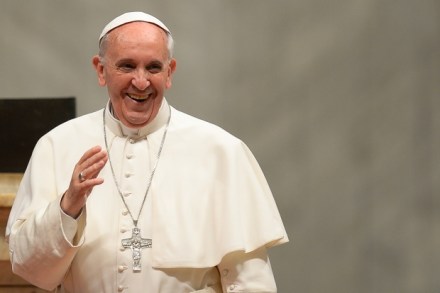
Catholics should not breed like rabbits and gender theory is a bit like the Hitler Youth. Yup, the Supreme Pontiff is giving another of his in-flight interviews and yet again he leaves everyone shaking their heads: ‘He said what?’ Now, let’s be clear. Francis reaffirmed Catholic teaching on birth control (sort of) while observing that ‘God gives you methods to be responsible. Some think that – excuse the word – that in order to be good Catholics we have to be like rabbits. No.’ I know what he means. I think. Contraception and family planning are fine so long as you don’t artificially block procreation. But the subliminal and unintended messages are (a)

Pope Francis: despite the glowing headlines, the jury is still out

How many of Pope Francis’s spiritual diseases do you suffer from? The pontiff laid out no fewer than 15 of them in an ‘exchange of Christmas greetings’ yesterday. They included ‘spiritual Alzheimers’, ‘existential schizophrenia’, ‘working too much’, ‘planning too much’, ‘working without co-ordination’ and, above all, ‘the terrorism of gossip’. I did a quick check and found two I definitely don’t suffer from: working too much and ‘feeling immortal, immune and indispensable’. It reminds me of the narrator of Three Men in a Boat who, on leafing through a medical dictionary in the British Museum, discovers he suffers from every ghastly malady except housemaid’s knee. A funny way to wish your staff a

Sex, lies and El Sistema

The two trendiest words in classical music are ‘El Sistema’. That’s the name for the high-intensity programme of instrumental coaching that turned kids from the slums of Venezuela into the thrilling Simon Bolivar Youth Orchestra (SBYO), conducted by hot young maestro Gustavo Dudamel before he was poached by the Los Angeles Philharmonic. Or so the legend goes. When the SBYO was booked for the Proms in 2011, the concert sold out in three hours. Sir Simon Rattle, no less, declared El Sistema to be ‘the most important thing happening to classical music anywhere in the world’. Audiences wept at the sight of former street urchins producing a tumultuous, triumphant —

Watch out Pope Francis: the Catholic civil war has begun

‘At this very critical moment, there is a strong sense that the church is like a ship without a rudder,’ said a prominent Catholic conservative last week. No big deal, you might think. Opponents of Pope Francis have been casting doubt on his leadership abilities for months — and especially since October’s Vatican Synod on the Family, at which liberal cardinals pre-emptively announced a softening of the church’s line on homosexuality and second marriages, only to have their proposals torn up by their colleagues. But it is a big deal. The ‘rudderless’ comment came not from a mischievous traditionalist blogger but from Cardinal Raymond Burke, prefect of the Apostolic Signatura

Border controls are a basic human right – is it un-Christian to oppose mass immigration?

[audioplayer src=”http://traffic.libsyn.com/spectator/TheViewFrom22_21_August_2014_v4.mp3″ title=”Damian Thompson joins Fraser Nelson to discuss the Pope v the Vatican.” startat=928] Listen [/audioplayer] Is it sinful to be not so keen on the whole immigration thing? I suppose Justin Welby thinks so, according to his recent comments. ‘We have to be careful and you can’t over-burden the community, you have to be realistic about that but also we must never – part of the Christian, at the heart of Christian teaching about the human being is all human beings are of absolutely equal and infinite value and the language we use must reflect the value of the human being, and not treat immigration as just a

The disgraced bishop and the loyal parish: Catholic double standards at their finest

The Catholic bishops of England and Wales are to hold an inquiry into the case of the Rt Rev Kieran Conry, he of the two (or is it three?) girlfriends, who resigned as Bishop of Arundel and Brighton when he had a crisis of conscience caused by the tabloids knocking on his door. Displaying their celebrated transparency, the bishops have decided to keep the name of the ‘chair’ of the inquiry secret. The committee will focus on whether Conry breached guidelines on ‘vulnerable adults’. I very much doubt whether it will ask why Cardinal Cormac Murphy-O’Connor persuaded Rome to make his protégé a bishop when his relationship with a woman was already

After the Pope’s Synod-on-family fiasco, let’s judge Catholicism on Catholic terms

[audioplayer src=”http://traffic.libsyn.com/spectator/TheViewFrom22_2_Oct_2014_v4.mp3″ title=”Luke Coppen and Cristina Odone join Freddy Gray to discuss divorced Catholics.” startat=1053] Listen [/audioplayer] The Church’s extraordinary Synod on the family hasn’t gone down terribly well with secular pundits. It’s been billed as a failure on the BBC, which declared that gay Catholic groups are ‘disappointed’ with the inability of the Synod to make progress towards acknowledging gay relationships. Other groups are similarly disappointed by the Synod’s refusal to admit divorced and remarried people to communion. As Damian Thompson observes, Pope Francis probably has no-one but himself to blame, in that he allowed so much of the pre-Synod discussion to focus on these contentious areas. All the

‘Earthquake’ in Rome as Vatican synod talks about homosexuality and divorce

The Synod on the Family in Rome today caused an ‘earthquake’ – the word is being used on Catholic blogs everywhere – when it appeared to tweak the Church’s line on homosexuality and second marriages. ‘Line’, please note, not its teaching on the sinfulness of all sexual acts outside marriage, which it does not have the authority to change and will remain intact long after this pontificate. But the ‘line’ matters, and here it is, unveiled in an alarmingly haphazard fashion in a document called the relatio post disceptationem – a half-way report on the discussions read aloud in the synod hall this morning. As Mark Greaves of the Catholic Herald reports, it has been drafted by synod

Spectator letters: St Augustine and Louise Mensch, war votes and flannel

Faith and flexibility Sir: What a contrast in your two articles on religion last week: one liberal atheist parent (Claire Stevens) concerned about her son’s turn to conservative Islam, and one conservative Catholic (Louise Mensch) determined that her children understand her unbending fidelity to the tradition.  Ms Mensch’s problem is endemic throughout the western church, Catholic and Protestant alike: greater confidence in human sinfulness than in God’s forgiveness. Mrs Stevens’s problem is the opposite: a lack of confidence in her atheism. Brought up to believe in nothing, one is prone to believe in anything. At least if you bring a child up Christian, he can always choose to reject the

The Scottish Church showed little statesmanship or common sense during the referendum

A few hours after the final result of the Scottish referendum was announced, I visited the cemetery at Cille Bharra on the Outer Hebridean island of Barra. It’s the burial place of Sir Compton Mackenzie (1883-1972). I wondered what this versatile character, World War I British spymaster, novelist, and Catholic convert whom the students at Glasgow university elected as their rector in 1931, would have made of the result. He believed that the Catholic faith had greatly influenced the nations’s long-term personality and felt that its soul had shrivelled with the retreat of that faith to remote outposts such as Barra, where he had his home in the 1930s. An

Could homosexuality split the Catholic Church?

Cardinal Timothy Dolan, the ebullient Archbishop of New York, has welcomed the ‘wise decision’ by organisers of the city’s St Patrick’s Day parade to lift their ban on gay groups marching under their own banners. He has ‘no problem with it at all’. His predecessor, Cardinal John O’Connor, who supported the ban in 1990, must be turning in his grave. More to the point, conservative American Catholics feel let down by Dolan, an orthodox and tribal prelate who likes to roll up his sleeves and jab in the direction of the snidely liberal New York Times. Here’s the response of Deal Hudson, a leading Catholic Republican (and certainly not an anti-gay bigot): Cardinal Dolan’s mistake,

Podcast: Britain’s jihad, the Pope vs the Vatican, and the existence of ‘The One’

[audioplayer src=”http://traffic.libsyn.com/spectator/TheViewFrom22_21_August_2014_v4.mp3″ title=”Britain’s jihad, the Pope vs the Vatican, and the existence of ‘The One'” fullwidth=”yes”] The View from 22 podcast [/audioplayer]The murder of James Foley by an Isis fighter ‘with a London accent’ has been treated with understandable revulsion. But we shouldn’t be surprised, says Douglas Murray in his cover piece this week. On this week’s podcast, he outlines how Britain came to be the West’s leading producer of ‘foreign fighters’. Shiraz Maher, one of Britain’s leading authorities on radicalisation, joins him, and explains why the British jihadis are regarded as some of the most vicious and extreme fighters. Just what is really going on in Pope Francis’s pontificate?

British Muslims must confront the truth of the ‘Trojan Horse’ schools

The Trojan Horse reports are in, and they make for damning reading.  ‘An aggressive Islamist agenda… a coordinated, deliberate and sustained action to introduce an intolerant and aggressive Islamist ethos’. Teachers who claimed that the Boston marathon bombing and the murder of Lee Rigby were in fact hoaxes and an ‘Attack on Islam’. And so on. The grim details are out. But there is a story behind this story which has not been thought about, though it ought to be. That is the response of Britain’s Muslim communities to these awful revelations. Ever since 9/11 a considerable appeal from the non-Muslim majority in the West has been ‘where are the moderates?

Women bishops: the game’s up for Anglo-Catholics

From the moment the General Synod voted for women priests in 1992, it was inevitable that it would also vote for women bishops. Conservative evangelicals and Anglo-Catholics engineered a delay of 21 years, but I doubt they’ll be shocked by today’s decision. Some traditionalists have even been arguing that, although they were still opposed to the measure on principle, another ‘no’ vote would be a disaster for the Church of England. That strikes me as hopelessly muddled thinking, but remember that these are the people who brought you the Alice-in-Wonderland notion of ‘flying bishops’. How will Pope Francis react? Some Anglicans suspect that he’s secretly pleased: they see him as

Britain needs ‘Church schools’ and ‘faith schools’

Following Freddy Gray’s piece yesterday about the pundits’ efforts to exploit the ‘Trojan Horse’ affair in order discredit ‘faith’ schools, I thought you might be interested in the statement below, from the Catholic Education Service, which pretty well sums up the argument. One person the CES may have in its sights when it talks about the charge of indoctrination is the former Education Secretary, David Blunkett, who observed yesterday that: there was a ‘muddle’ in the heart of government when it comes to religious schooling. ‘Our society does need an open, liberal — small ‘l’ — curriculum that embraces all faiths and no faiths, and teaches children to think for

Did the pope say ‘inequality is the root of all social evil’?

The following blog from a Catholic commentator about the Pope’s controversial tweet suggesting that “inequality is the root of social evil” puts the row about it on Twitter into context. But the real question is the language in which Pope Francis first tweeted: Spanish or Latin? In Latin, as the author of this blog observes, the critical noun is “iniquitas”, which you might as well call “sin”; come to that “malus” doesn’t mean social evil so much as any sort of evil. And to say that sin is the root of evil is sort of tautologous, at least for Catholics. But if the pope’s thought was first expressed in Spanish,

The Spectator: on popes and poverty since 1828

A year ago, a relatively unknown Argentine cardinal, Jorge Mario Bergoglio was elected Pope. A few days later he announced he would take the name Francis, after Saint Francis of Assisi, because, he said, he had particular concern for the poor. In the 1880s, Pope Leo XIII also drew the attention of his clergy to St Francis’s teachings on poverty. The Spectator approved, and recommended it to Protestants as well as Catholics, but it took issue with the Pope’s argument that the spectacle of rich people joyfully embracing holy poverty would be enough to encourage the poor not to mind being poor. ‘It seems very doubtful whether the foundation of

Podcast: Cameron’s Northern Alliance, Christianity and the left, and the end of two-party politics

Is David Cameron’s new gameplan to look to the northern states for allies? Fraser Nelson is joined on the podcast by Stephen Booth of Open Europe, to discuss the influence that people such as the Dutch PM Mark Rutte – who has a clear and impressive reform plan – and Angela Merkel are having on our PM. Could Cameron really be serious about making Britain an honorary member of Scandinavia? And could this strategy really be enough to pull him through the next election? Ed West and Andrew Brown of The Guardian also discuss the church’s left-wing bias. Ed has written frequently about this issue in the Catholic church. But is this, in fact, an