Cancel culture

My Epstein confession

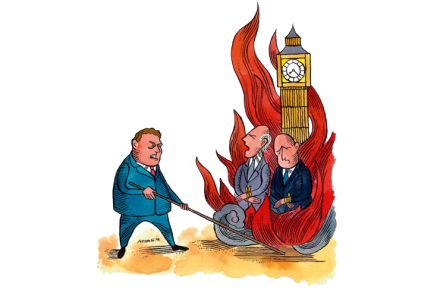
As the flames of the Epstein Inquisition burn higher, let me get my general confession into the public domain before the guardians of public morality come for me. Here begins my deposition. I, Matthew Francis Parris, do solemnly confess that I know slightly and have been on mostly friendly terms with former British ambassador to the US Peter Mandelson; and continue to believe him to have been a far-sighted force in the creation of a sane and successful Labour government such as we so notably lack now. I CONFESS: that I know former prime minister Sir Tony Blair, who knows Lord Mandelson, who knew Jeffrey Epstein, and appointed Mandelson to high office in the last century.

epstein

Remembering Scott Adams

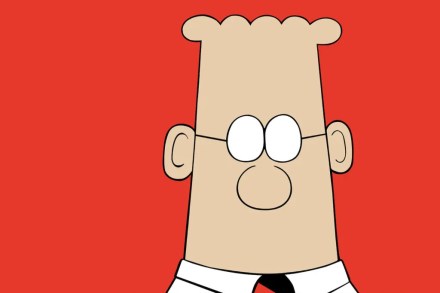
Dilbert taught me how to read. Stacked perilously high – between Calvin & Hobbes and The Far Side – in my childhood home’s bathroom, Scott Adams’s cartoon provided the perfect reading material for the porcelain throne. Even before I knew what most of the words meant, I’d belly laugh at page after page of banal workplace humor. This is bizarre: why, as a preschooler, was I so tickled by these jokes about human-resources departments and fax machines? Adams, who died in the night, enjoyed more than a three-decade run as honcho of the funny pages, starting in 1989.

Woody Allen’s first novel takes on cancel culture

Say what you like about the actor, director and writer Woody Allen – and people have undeniably been known to – but it takes a certain amount of gall to publish your first novel at the age of 89. Not that Allen doesn’t have form in this regard: he has brought out five collections of short stories, most recently 2022’s Zero Gravity and a 2020 memoir, Apropos of Nothing, which was greeted with horror by the publishing industry and literary critics alike. The New York Post described it as one of “the most tone-deaf, disgusting, bitter, self-pitying, horrifically un-put-downable memoirs since Mein Kampf.

woody allen

Kimmel makes the case for free speech

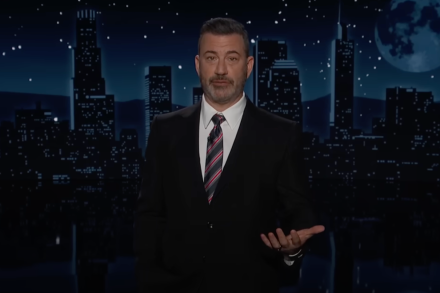
After a few days in politically-induced time out that felt like a decade, Jimmy Kimmel made a triumphant return to late night TV on Tuesday. “I’m not sure who had a weirder 48 hours,” he said. “Me, or the CEO of Tylenol.” Given that Tylenol is a brand name and has no actual CEO, let’s say Kimmel, who Disney/ABC pulled off the air last week under political pressure from station ownership and the chairman of the FCC after he made a bad-taste joke about Charlie Kirk’s assassin.  Kimmel suddenly became the most famous man in America not named Donald Trump, and his audience met his return with a roaring standing ovation, chanting “Jimmy! Jimmy! Jimmy!

Kimmel

You can’t cancel the cancelled

From our UK edition

When Theresa May appointed me as a non-executive director of the Office for Students, the Downing Street press office decided to embargo the news until midnight on New Year’s Day 2018. It may be that it hoped to slip it out under the radar, calculating that most journalists would be too drunk to notice. If so, it didn’t work. The Guardian decided it wasn’t going to let the government get away with this sleight of hand and stuck the following headline on its website at 12.01: ‘Toby Young to help lead government’s new universities regulator.’ The offence archaeologists immediately set to work digging through everything I’d said or written, looking for material to be outraged by. It didn’t take them long to find it. By 12.05, I was trending on Twitter.

Svitlana Morenets, Michael Simmons, Ursula Buchan, Igor Toronyi-Lalic, Richard Morris & Mark Mason

From our UK edition

37 min listen

On this week’s Spectator Out Loud: Svitlana Morenets says that Trump has given Zelensky cause for hope; Michael Simmons looks at how the American healthcare system is keeping the NHS afloat; Ursula Buchan explains how the Spectator shaped John Buchan; Igor Toronyi-Lalic argues that art is no place for moralising, as he reviews Rosanna McLaughlin; Richard Morris reveals how to access the many treasures locked away in private homes; and, Mark Mason provides his notes on bank holidays. Produced and presented by Patrick Gibbons.

Putin’s trap, the decline of shame & holiday rental hell

From our UK edition

50 min listen

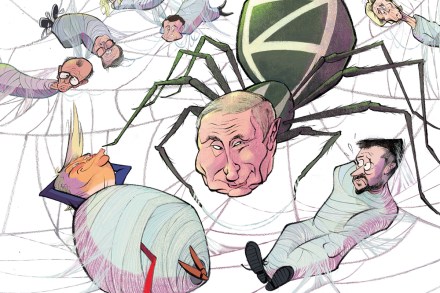
First: Putin has set a trap for Europe and Ukraine ‘Though you wouldn’t know from the smiles in the White House this week… a trap has been set by Vladimir Putin to split the United States from its European allies,’ warns Owen Matthews. The Russian President wants to make a deal with Donald Trump, but he ‘wants to make it on his own terms’. ‘Putin would like nothing more than for Europe to encourage Ukraine to fight on… and lose even more of their land’. But, as Owen writes, those who count themselves among the country’s friends must ask ‘whether it’s time to choose an unjust peace over a just but never-ending war’. Have European leaders walked into Putin’s trap? Owen joins the podcast alongside Gideon Rachman of the Financial Times.

Art and moralising don’t mix

From our UK edition

Against Morality is not against morality. But it is against moralising. Which is a start. Anti-cancel culture, anti-identity politics, Rosanna McLaughlin’s small book of essays is the first insider-artworld publication to condemn the Savonarolan turn within culture. A cause for celebration, you might think. Her argument is perfectly sound. ‘Morality has become the central pillar, the justification for art, the bar by which we measure whether something is good or bad’, and it’s been a disaster.

Culture clash: Sympathy Tower Tokyo, by Rie Qudan, reviewed

From our UK edition

Language, it has been said, is the only true democracy – changed by the people that use it. But as with any democracy, there is plenty of disagreement about what alterations are either possible or permissible. Japanese uses three distinct writing systems – kanji, hiragana and katakana – and the relationship between two of them, kanji and katakana, is a key theme of last year’s prizewinning speculative fiction Sympathy Tower Tokyo by Rie Qudan – a lyrical, witty, satirical but meditative and meticulous text, now published in Jesse Kirkwood’s vibrant and faithful English translation. We are in the sprawling metropolis of Tokyo in the lightly altered mid-2020s.

Edinburgh Fringe’s war on comedy

From our UK edition

Every day my inbox fills with stories of panic, madness and despair. The Edinburgh Fringe is upon us and the publicists are firing off emails begging critics to cover their shows. If the festival is a national X-ray, this year’s image is shadowed by emotional frailty and a distinct sense of humour failure. The brochure is full of performers advertising their mental disorders (ADHD, OCD, PTSD, and so on), as if they were badges of achievement. The chair and chief executive of the Fringe say that the festival means ‘giving yourself over to the (safe) hands of our performers allowing yourself to be swept away by their creativity’. The word ‘safe’, in brackets, assures nervous visitors that their mental wellbeing won’t be jeopardised.

The mechanics of cancel culture

Must we approve of an author’s private life in order to enjoy his or her books? Possibly not, to judge by the continuing popularity of writers as diverse as Charles Bukowski, Allen Ginsberg, P.L. Travers, Roald Dahl and Norman Mailer, to name but a few of those whose domestic affairs have fallen short of the temperate or monogamous ideal. And what of the sage of Cornish, J.D. Salinger, most of whose interactions during his long years of New Hampshire exile involved hanging around with local teenagers? In 1972, a fresh-faced journalism student named Joyce Maynard left college and went to live with the 53-year-old author of The Catcher in the Rye at his invitation. After eight months, she was unceremoniously dumped.

Bailey

Is Shiloh Hendrix the new Luigi Mangione?

When a white mom called a black kid the N-word the immediate expectation was that she’d be canceled, possibly arrested. It was not that just a few days later she would have $700,000 in the bank.Shiloh Hendrix accused a five-year-old Somali boy of rummaging through her diaper bag in Rochester, Minnesota, last week. “Did you call that child the N-word,” a man who filmed her asked. “Yeah,” Shiloh snarled back, “if he’s gonna act like one.”She didn’t back off. She repeated the accusation, then turned on the man filming her with a string of insults. The video quickly went viral. But Shiloh didn’t follow the usual playbook of hunkering down to weather the online storm. She fought back. On GiveSendGo, Shiloh painted herself as the victim.

shiloh hendrix

Harry Sisson and trial by TikTok

This week, a story emerged about a dozen or so young women who each thought they were monogamously dating 22-year-old Democratic influencer Harry Sisson, albeit digitally. The 11 women, all around the same age as Sisson, claim that he had convinced each of them separately that they were the only woman on his “roster”; that they were the only women he was speaking to. He spoke to many of them for months at a time, with the conversations often being erotic in nature. Nudes were exchanged. But while each woman claims they believed to be the only person Sisson was doing this with, via social media, they have now come to learn that this wasn’t the case – he’d been flirting and sexting with several women at a time.

harry sisson

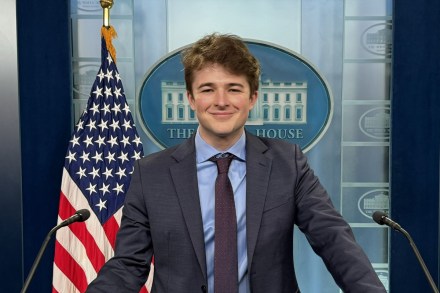
Who is Katherine Long?

Marko Elez. If that name means anything, you might spend a little too much time on the internet. Elez is a whizz kid at DoGE, the newly minted Department of Government Efficiency, which is currently taking a flamethrower/bazooka/heavy weapon of your choice to whole departments of the federal government. Cue much wailing and gnashing of teeth from politicians, journalists and common-garden liberals everywhere. On Thursday, a Wall Street Journal article uncovered some embarrassing tweets Elez had made on an anonymous account, and he was forced to resign his post. What Elez said was no doubt offensive to some — “I was racist before it was cool,” “You could not pay me to marry outside my ethnicity,” “normalize Indian hate” — but isn’t that always the way?

elez

Is it time to cancel Strictly?

From our UK edition

The BBC's Strictly Come Dancing returned this weekend, but rather than being met with the usual fanfare there is a growing feeling that the glitter ball may have been irreparably tarnished. Some former contestants have alleged that they were subject to bullying by their professional partners and – having already used almost 300 contestants in its now 20 year history – many think that the producers have been scraping the bottom of the celebrity barrel in recent years. Such criticisms have led to speculation that it might be time to cancel the show. Cancel culture won’t yet claim Strictly as another victim. There are signs of life, however. This year there has clearly been an attempt to secure some genuine celebrities amongst the fifteen hopefuls.

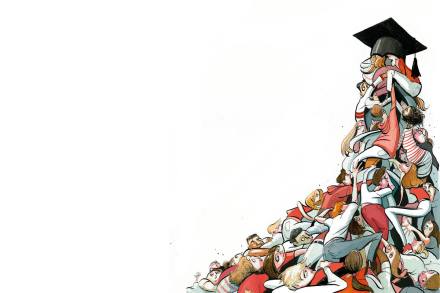
Coercion and coddling take campus

On October 7, 2023, I was the chairman of the political science department at a large public university, but not for long. I did what I presumed universities are for, encouraging students to talk with professors about big questions and important issues of the day. So on October 18, I held a faculty-student discussion with a Middle East expert. I opened the event by stating some facts: that a terrorist organization committed to the death of Jews had attacked Israel, raping and murdering many young people at a peace concert and seizing hostages. I said that these events raised deep moral questions about what should be done in response, regarding the destruction of Hamas and the fate of thousands of noncombatant Palestinians. Discuss. The discussion did not go well.

campus

Downfall: how Nigel Farage became the left’s greatest weapon

From our UK edition

44 min listen

This week: Downfall. Our cover piece examines Nigel Farage’s role in the UK general election. Spectator editor Fraser Nelson argues that Farage has become the left’s greatest weapon, but why? How has becoming leader of Reform UK impacted the campaign and could this lead to a fundamental realignment of British politics? Fraser joined the podcast to talk through his theory, with former UKIP MEP Patrick O’Flynn (02:10). Next: Spectator writer Svitlana Morenets has returned to Ukraine to report on the war, which is now well into its third year. How are Ukrainians coping and what is daily life like? Svitlana joined the podcast from Kyiv with Ukrainian author Andrey Kurkov (21:53). And finally: has ‘cancel culture’ been cancelled?

Yes, Will Smith is still a movie star

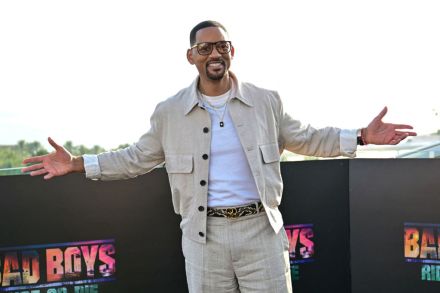
If you were standing somewhere around Hollywood today, you would hear a long, deep exhalation. The new Bad Boys film, snappily subtitled Ride or Die, has indeed ridden, rather than expired, at the US box office. It grossed $56 million in its opening weekend — and not only is this the highest opening for an R-rated film since Oppenheimer nearly a year ago, but it indicates that in a summer where blockbusters have been routinely un-performing (Furiosa and The Fall Guy may have been critically acclaimed, but it looks unlikely either will cover their considerable production costs), there is still hope for a crowd-pleasing action film that appeals to a wide audience. Yet the film’s success was also a quasi-referendum on the pulling power of its leading man.

will smith

Nellie Bowles critiques progressivism and the media that covers it

One of many fascinating things to be learned from Morning After the Revolution: Dispatches from the Wrong Side of History, by former New York Times correspondent Nellie Bowles, is the process by which someone gets canceled. I was of course familiar with the concept of cancel culture and figured it meant blackballing the wicked, but I’d never gotten a clear idea of how the thing was actually done. On the evidence of Bowles’s book, it means going on Twitter (OK, X) and posting derogatory tweets (X-pressions, whatever) about the offending party contemporaneously with others doing the same thing.

Bowles

X and the return of the social-media sandbox

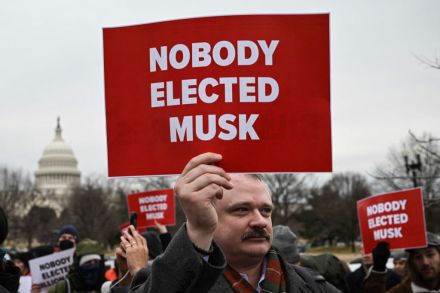
Elon Musk’s X, the social media site once known as Twitter, is a wasteland. It consists of uncontrolled pornography, crypto spambots, broken “mentions,” unpaid invoices for subscriptions, a useless search algorithm and unverified accounts spreading baseless conspiracy theories and being financially rewarded for juicing controversial or untrue content. It has become practically unusable as a functioning social media platform. But old Twitter, after what it had become, had to be absolutely and unequivocally destroyed for the sake of the future of open online discourse. The Jack Dorsey-Parag Agrawal iteration of Twitter had become part of an intelligence and corporate media censorship apparatus, which would spring into action against any user it viewed as an ideological opponent.

X