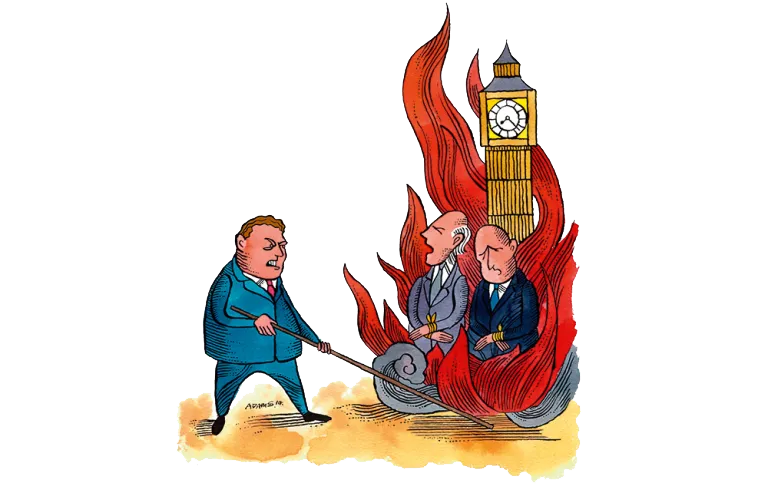



As the flames of the Epstein Inquisition burn higher, let me get my general confession into the public domain before the guardians of public morality come for me. Here begins my deposition.
I, Matthew Francis Parris, do solemnly confess that I know slightly and have been on mostly friendly terms with former British ambassador to the US Peter Mandelson; and continue to believe him to have been a far-sighted force in the creation of a sane and successful Labour government such as we so notably lack now.
I CONFESS: that I know former prime minister Sir Tony Blair, who knows Lord Mandelson, who knew Jeffrey Epstein, and appointed Mandelson to high office in the last century. And I know and respect Benjamin Wegg-Prosser, who ran a company with Lord Mandelson, and who on Mandelson’s instruction once met Jeffrey Epstein for 25 minutes, and that I continue to regard Mr. Wegg-Prosser as a friend.
We may on occasions rub along with many strange or even deplorable people, and enjoy doing so
I CONFESS: that I know and am on friendly terms with the editor of the UK edition of this magazine, who knew Lord Mandelson, who knew Jeffrey Epstein.
I FURTHER CONFESS: to a lifelong habit of visiting friends in prison who have been -convicted of criminal offenses. In 1977, I visited a friend serving a sentence in Brixton prison for possession of marijuana, and tried to take him some (legal) cigarettes. Some years later I testified to the otherwise good character of a friend who had tried to smuggle an illegal immigrant girlfriend into the UK, in the boot of his car; and was imprisoned for this. Knowing he (rightly) planned to plead guilty to this undoubted crime, for which he was (rightly) imprisoned, I remained willing to offer evidence in mitigation.
I CONFESS: to having visited, in Maidstone prison, an old school friend who had been convicted of fraud. I confess also to encouraging him to believe his life was not over and that those who knew him still cared for him.

I CONFESS, TOO: to accompanying to court a longtime friend and former colleague accused of viewing some indecent images, for one of which he was given a suspended sentence. I hoped that by my continuing friendship I could encourage him to know his life was still worth living. I do not regret that.
NOR DO I REGRET: remaining friends with individuals who have fallen into disgrace; nor being by disposition unwilling to write people off even if they have done something very wrong. Should disgrace ever befall me I would hope they might treat me likewise.
I WOULD NEVER, THEREFORE: hold it against anyone that they had been friends with – or been friends with someone who had been friends with – a disgraced person, so long as they had not been complicit in the disgrace itself.
SO I MAINTAIN: and intend to continue maintaining, a wide circle of friends, many of whom are different in character, belief or behavior, from myself, and some of whom I may not always and in every respect approve.
AND FINALLY, I MAINTAIN: that staying friends with somebody, or doing business with somebody, is not, ipso facto, to condone everything they do and are. And that we may on occasions rub along with many strange or even deplorable people, and enjoy doing so.
Here ends my deposition. It must not be taken to imply that Epstein was anything other than a deeply wicked individual, or that remaining close to him while suspecting or knowing as much was anything other than a terrible error of judgment and a serious moral mistake. I could never forgive, or like, such a person. But, as many besides myself have remarked, there is something medieval, something of Salem in the time of witches, something of Senator Joseph McCarthy and the House Un-American Activities Committee, about the current mood in Britain: a mood in which guilt by association spins its web ever wider.
I think about my life inside and around politics – a span now of almost half a century. How many rumors, how many hints have I been privy to that I never felt the responsibility to follow up? How many men (mostly men) have I known with half-secrets that never came to light? How many government and opposition whips have I known – and how great a store of secret knowledge have they possessed? If all the parliamentary whips in the past hundred years, alive still or in another place, were to be gathered into Westminster Hall and provided with whistles to blow, they could blow the roof off.
I have blown a whistle or two but by no means all the whistles within my reach. I’ve fended off self-reproach by murmuring to myself that there’s nowt so queer as folk. I’ve enjoyed the company of friends who knew more, sometimes rather too much more, of the wickedness of the world than I did. Heavens, I’ve even enjoyed a friendly chat with the late Jeremy Thorpe, accused of complicity in a planned murder.
So I pick up an old copy of my now 30-year-old book, written with the journalist Kevin Maguire, Great Parliamentary Scandals. Our sometimes forgiving tone would not be extended to devils like Epstein, but, still, I thumb the index for my entry on the late Reginald Maudling, a leading Tory who faced suspension from the House after very serious allegations involving corruption.
The then Labour leader, the late Michael Foot, warned the House not to succumb to a “liberal form of lynch-law… Of all mobs, the most objectionable is the sanctimonious.”
I’d met Maudling. I wrote: “It is not unusual to find that men who have been touched by power, and also by some kind of disgrace, show towards the end a sort of frankness, an impatience with certitude, and a weary humanity… [A] certain knocked-about quality in a statesman can add proportion, compassion, and a redeeming cynicism to his judgment.”
So, as the inquisitors gather my books for the bonfire… I CONFESS: I still believe that.





Comments