Cambridge university

The Jason Arday review already knows who to blame

From our UK edition

In case you were in any doubt that Cambridge University’s ‘independent review’ into the Jason Arday affair will blame the media for his death, the appointment of Nazir Afzal OBE as chair confirms it. The former chief crown prosecutor for north-west England is no friend of press freedom. ‘Hate Speech is NOT Free Speech,’ he tweeted in 2024. It’s a racing certainty that his report will spare the blushes of the Cambridge authorities and call for a public inquiry into Britain’s out-of-control newspapers and magazines. ‘I do not shy away from using the terms “institutional racism”, “institutional misogyny” and “institutional homophobia”,’ he told MPs after his independent review of the London Fire Brigade in 2024.
The word ‘tragedy’ has lost all meaning

From our UK edition

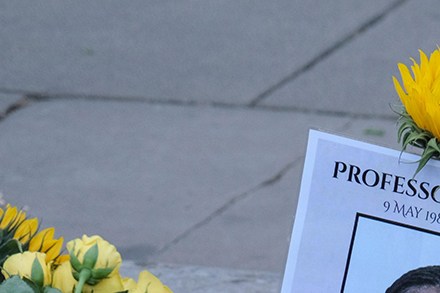
The Chancellor of the University of Cambridge has said the university has ‘lessons to learn from the Jason Arday tragedy’. Well, you can make words mean what you want – the ancient Greeks invented the word tragôidia and it meant ‘goat-song’ – but is ‘tragic’ really the word for Arday? Tragedies reworked the fate of great ancient heroes, whose death was of high significance and meaning to the watching audience. Such dramas were typically characterised by a number of markers. They could include prophecies, warnings, ignorance of the true state of affairs (generating irony), over-confidence accompanied by self-delusion and understanding too late to avoid disaster.

The questions Cambridge still has to answer about Jason Arday

If poor Jason Arday killed himself, it will be necessary to work out why. To do so, it will help to know why he resigned his professorship. It seems highly unlikely he resigned if Cambridge University did not want him to. It had defended him in public throughout, after all. Yet if he had been confident of Cambridge’s continuing support, why did he sacrifice the benefit of its protection? If Cambridge suggested to him that its protection would, for whatever reason, shortly cease, what caused its change of mind? What a terrible shock for him if the institution which had raised him so high was now ready to cast him out. Is the institutional attack on the press over this matter a deflection from the truth?

Letters: Cambridge University is not a victim

From our UK edition

After Arday Sir: Lara Brown scathingly condemns Cambridge University’s acceptance of Jason Arday’s credentials (‘The fabulist’, 8 August). That it did so comes as no surprise, given the modish progressivism that pervades academia. However, the sheer extent of its gullibility in taking Arday’s claims at face value is startling, and the reputational damage that will follow is hardly undeserved. Cambridge University is not a victim here. Our sympathy should be with the qualified black teachers and students for whom it is already hard enough to make headway. They will now have to contend with the inevitable shadow over their legitimacy cast by the Arday farce.

Jason Arday and the Dukes and Dauphins of DEI

The Music Man, The Sting, Catch Me If You Can: movies and theater have a rich tradition of stories about imposters who manage to fool a lot of people. The literary branch includes the Duke and the Dauphin in The Adventures of Huckleberry Finn, and Herman Melville’s riverboat epic, The Confidence-Man. Indeed, tricksters are found almost everywhere stories are told. Native Americans have their tales of Coyote. Ananse, the spider, a key figure in West African and African-American folklore. We admire the cleverness of such cozeners, at least in fiction. Their victims often get what they deserve. The DEI agenda, as long as it prevails, will ensure a long line of Jason Arday fabulists And this may be the case with Jason Arday too.

Jason Arday at Cambridge (Credit: YouTube)

The radical left will regret embracing political violence

From our UK edition

What are the circumstances in which it is right to smash up a building? When might one justifiably destroy an artwork? And what are the conditions under which one might splinter someone’s spine with a sledgehammer? Many on the left seem to have satisfied themselves on all these questions. But I wonder if they have even begun to reckon with the consequences. One can only hope that those who urge on ‘direct action’ have no idea how slippery a slope they are on Back in 2019 a group of activists from Extinction Rebellion took their views on fossil fuels to Belvedere Road in central London. There, at the site of the Shell building, they smashed windows, spray-painted walls and caused other criminal damage.

An ancients’ guide to sexual incontinence 

From our UK edition

King’s College Cambridge has lost (according to the papers) a ‘famous’ classicist, who resigned because he slobbered wet kisses all over an unimpressed woman. But everyone knows there is only one famous classicist, and she is not at King’s. The classicist at issue surely cannot have been paying too much attention to the literature which one assumes he has studied, because Eros was seen as a sickness, a madness, a god who robs us of our wits, creating a strong and obsessive desire (‘desire doubled’ as an ancient puts it). Plato saw sexual incontinence as a ‘disease of the soul’. Sophocles thought of sex as a ‘mad and savage master’.

Cambridge University should be ashamed of itself for honoring Angela Davis

Remember Angela Davis? Few people under fifty do. Was Cambridge University counting on that historical ignorance when it decided to honor Angela Davis with an honorary degree?   In case you, Dear Reader, are a little fuzzy about Davis, I note for the record that the former Black Panther and two-time vice-presidential candidate on the Communist Party ticket with Gus Hall is the recipient of many honors, including the Soviet Union’s Lenin Peace Prize.  Cambridge University, of course, has long demonstrated a certain fondness for Commies, as the names “Kim Philby,” “Guy Burgess” and “Anthony Blunt” remind us.

Is the Met finally getting tough on pro-Palestine protests?

From our UK edition

It was airily pleasant to walk round Parliament Square on Monday morning. I had come up to London to go to parliament and to interview Kemi Badenoch at a Policy Exchange event across the square. Palestine Action had announced a protest march against Donald Trump’s and Israel’s ‘genocide’ for that time. Although the Met had banned it from the area, I had recently witnessed so many ill-contained and threatening protests there – almost all for Palestinian causes – that I fully expected delay, disruption and occasional harassment. This time, however, it turned out that the Met meant business. The protest was well-contained in the designated streets round Trafalgar Square. May this mark the permanent change many of us have long been calling for.

Christianity, culture wars and J.D. Vance: a conversation with James Orr

From our UK edition

62 min listen

James Orr was living the life of a young, high-flying lawyer when, after a few drinks at a New Year's Eve party, he asked for signs that God existed. The signs came; among other things, he narrowly avoided a fatal skiing accident. Now he is a passionate Christian and a conservative culture warrior who helped defeat an attempt to impose the tyranny of critical race theory on Cambridge University, where he is an associate professor of the philosophy of religion. He's also an intellectual mentor to the vice president of the United States; Politico describes him as 'J.D. Vance's English philosopher king'. Dr Orr says Vance is 'extremely articulate, but he takes no prisoners'.

Cambridge in crisis, Trump’s wicked humour & the beauty of AI ceramics

From our UK edition

53 min listen

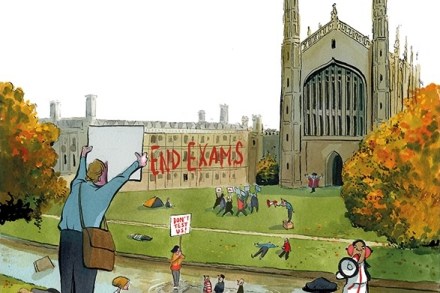
This week: Decline and Fall – how our greatest universities are betraying students.Our greatest universities are betraying students, writes David Butterfield, who has just resigned from teaching Classics at Cambridge after 21 years. What went wrong? First, class lists of exam results became private, under alleged grounds of ‘data protection’, which snuffed out much of the competitive spirit of the university. Now even the fate of examinations hangs in the balance. Grade inflation is rampant, and it is now unheard of for students to be sent down for insufficient academic performance. For students, the risks have never been lower.

Echoes of Tom Brown’s School Days: Rabbits, by Hugo Rifkind, reviewed

From our UK edition

The year is 1993 and 16-year-old Tommo has been moved from a day state school of 2,000 pupils in brown blazers that ‘when it rained… smelled of shit’ to Eskmount, an elite Scottish boarding school, where boys wear kilts and put their ‘cocks on your shoulder’ when you’re working in the library (easier in a kilt) and routinely hang ‘smaller kids in duvets... out the window’. The horseshoe effect in schooling terms: the more expensive, the more savage. Hugo Rifkind’s Rabbits opens with a bang: ‘When the shotgun went off under Johnnie Burchill’s brother’s chin, word had it, the top of his head came off like the top of a turnip lantern.’ It is reminiscent of Donna Tartt’s The Secret History.

Cowards vs culture 

From our UK edition

For some while I have marvelled at the way in which artworks seem to have become the focus of hatred for people wanting to say something banal. If you wish to make a point about politics, the climate or anything else, there are a range of ways to do it. But the least effective must surely be to glue yourself to a painting, throw soup on it or attack it with a knife. Nonetheless, artworks have become the means to communicate certain rote-like messages – with the violence stepping up a notch each time. It is two years since a couple of morons from Just Stop Oil decided to throw a tin of soup at Van Gogh’s ‘Sunflowers’ in the National Gallery. A glass cover protected the painting.

Fame came too late for Nick Drake

From our UK edition

A friend suggested I might bring a feminine twist to this review by imagining what it felt like to be Nick Drake’s mother. It was a startling thought. When I read artists’ biographies I tend to stand with them eye-to-eye, rather than conjure the perspective of an older generation. But the further we are distanced in time and age (the singer-songwriter died in 1974, aged 26), the more the picture morphs. Just as we’re supposed to grow out of liking Shelley (I never did) or learn to swap Mozart for Bach, our view of someone who was both an undoubted genius and the definition of callow inevitably matures.

Jesus College plots overhaul of its China Centre

From our UK edition

During the past two years Jesus College has been a regular in the newspaper headlines. The Cambridge University college was last month found to have accepted cash from a 'very high risk' Chinese university for research into China’s prime tool of foreign influence. It came after a string of stories which contrasted the willingness of Jesus to accept donations from controversial Chinese sources with its efforts to remove a historic memorial linked to the slave trade from its chapel. Now though, it seems that the college has been moved to act. According to an email seen by The Spectator, 'following a detailed review by a panel of Fellows, the college has today announced the restructure of the China Centre, including changing its name and funding model'.

Revealed: Huawei’s Oxbridge millions

From our UK edition

British universities have received twice as much funding from Huawei as previous estimates suggest, according to new figures obtained by The Spectator. Freedom of Information requests sent by Steerpike show that a further £28.7 million has been received from the Chinese tech giant by nine leading UK universities, on top of the sums identified in a landmark report by the China Research Group in June. By far the biggest recipient of donations and research grants is Cambridge University which has taken £25.7 million from Huawei alone since 2016. Huawei has been banned from participating in Britain’s 5G network from 2027 amid security concerns.

Braverman’s brush with the law

From our UK edition

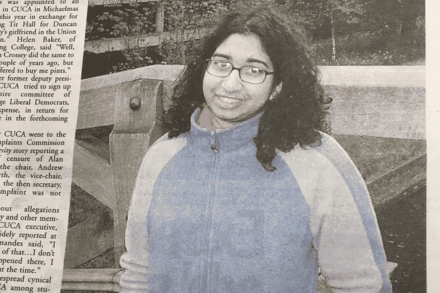
Ah student politics: is there anything quite like it? The strange creatures it attracts, the passions it unleashes, the adolescent ambition and the glorious pettiness of it all; so vicious precisely because the stakes are so small. Such an ignoble tradition has spawned many of our lords and masters – Boris Johnson was an unabashed Union hack at Oxford while William Hague was 'convicted of electoral malpractice' in one election of the Oxford University Conservative Association (OUCA). And having spent some time recently in the Cambridge University archives, Mr S is delighted to see the route from the common room to the Commons is still alive and well.

Cambridge’s hysterical reaction to a Hitler impression

From our UK edition

Last week, the Cambridge Union hosted a debate on the motion ‘This House Believes there is no such thing as good taste.’ During the debate, the prominent and respected art historian Andrew Graham-Dixon made the point that humans have an instinctive feeling for what is beautiful and what is repellent. There are obvious, undeniable examples of good and poor taste. To demonstrate this, he staged a long impersonation of Hitler’s views on ‘degenerate’ modern art. His parody included many offensive and racist comments of the sort you would expect from Der Fuhrer. Graham-Dixon’s argument was clear, even if his impression of Hitler was shaky and his presentation somewhat eccentric.

National Trust members fight back

From our UK edition

At the National Trust’s annual general meeting last week, the voting was much more unusual than the public will have learnt from media reports. In most resolutions, the numbers voting exceeded 100,000. In past years, the figures have been lower than 40,000. The reason for this high turnout was the controversies of the past 18 months. Motions about the erosion of curatorial expertise and the ill treatment of Trust volunteers would have won easily had not the chairman exercised the right to use the discretionary proxy votes which the Trust’s curious governance permits. Without these, the rebel resolutions would have been more than 15,000 votes ahead.

Why Jesus College shouldn’t have returned its Benin bronze

From our UK edition

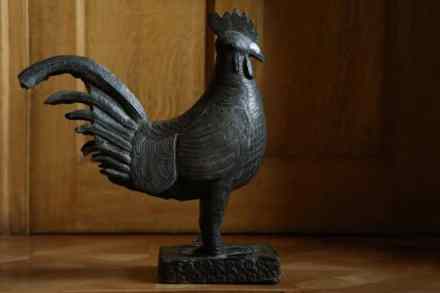
Jesus College Cambridge can claim a world first. It is the first institution, at least in the twenty-first century, to return a so-called Benin Bronze because it was looted in a British punitive raid in 1897 on the historic Kingdom of Benin, now part of the territory of Nigeria. The College’s Master Sonita Alleyne has today handed over its Okukor – a brass statue of a cockerel that took pride of place in the college’s dining hall peering over generations of students – to Nigeria’s National Commission for Museums and Monuments.