Bridge theatre

An amazing piece of entertainment: Reunion, at the Kiln Theatre, reviewed

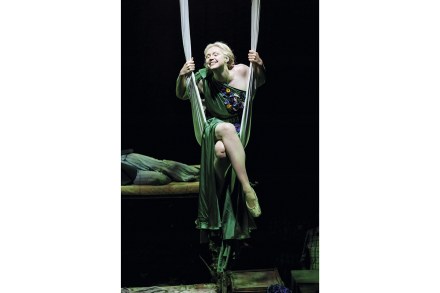
What a coincidence. Two plays running in London have the same storyline: an obsessed lover bursts into a family gathering to reclaim the woman who spurned him.The Lady from the Sea, written and directed by Simon Stone, is based on a late drama by Ibsen. Alicia Vikander stars as the neurotic Ellida, who feels repelled by her charming, erudite, handsome and successful husband, Edward. Ellida can’t shake off the memory of a fat, bearded eco-warrior, Finn, who raped her when she was 15. And when Finn shows up at her beautiful home in Cumbria, she has to choose between Edward (Andrew Lincoln) and her rapist (Brendan Cowell). It’s Paul Newman vs Shrek. Naturally Ellida chooses Shrek. After all, this is Ibsen. Poor Edward has other problems.
A show for politicians: John Gabriel Borkman, at the Bridge Theatre, reviewed

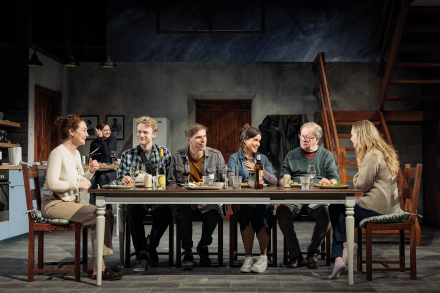
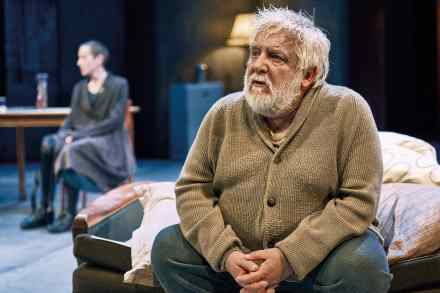
Clunk, clunk, clunk. John Gabriel Borkman opens with the obsessive footfalls of a disgraced banker as he prowls the attic of a shabby townhouse. On a beaten-up sofa lies Gunhild, his estranged wife, who guzzles Coke and watches TV game shows. The whole place stinks of stagnation and failure. The reclusive Borkman was once the country’s best-known banker until envious colleagues accused him of embezzlement and got him sent to jail for five years. After his release, he began a life of self-destructive solitude. The family are more riven with feuds than the royals. Gunhild loathes her twin sister, Ella, while Borkman blames both women for his downfall. His one hope, his son Erhart, openly shuns him and prefers the company of a sexy local seductress.

Hytner hits the bull’s eye: The Southbury Child, at the Bridge Theatre, reviewed

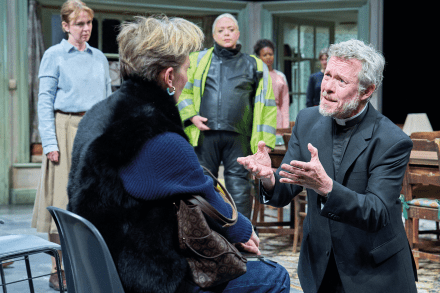
The Southbury Child is a comedy drama set in east Devon featuring a distressed vicar, Fr David, with a complex addiction history. Alex Jennings stars with his habitual urbane charm. Is there perhaps a credibility gap there? Jennings seems far too decent, clever and friendly to be a problem drinker who likes nothing better than a fling with a randy wench. And, more crucially, he doesn’t face the fallout from his days of boozing and bedhopping. His dramatic task is unconnected to his personal flaws. https://www.youtube.com/watch?v=z8Nei2P9xeA A little girl has died in controversial circumstances and her parents want balloons at her funeral. No way, says the vicar. The family fight back.

A play for bureaucrats: David Hare’s Straight Line Crazy reviewed

It’s good of Nicholas Hytner to let Londoners see David Hare’s new play before it travels to Broadway where it belongs. Few Brits will know the subject, Robert Moses, an urban planner of the 1920s who built the roads and bridges that gave New Yorkers access to seaside resorts in Long Island. This is a play for bureaucrats. Nit-picking and box-ticking are the main points of interest. Squiggles on forms. Correct signatures at the bottom of proof-read documents. Hare is copying George Bernard Shaw and his script is a celebration of rhetoric above all other qualities. Dialogue-junkies will enjoy the screeds of quickfire chatter that keep the play motoring along. And like Shaw, Hare omits many of the elements that make a drama feel lifelike.

Artless, crude and thuggish: Bridge Theatre’s Book of Dust reviewed

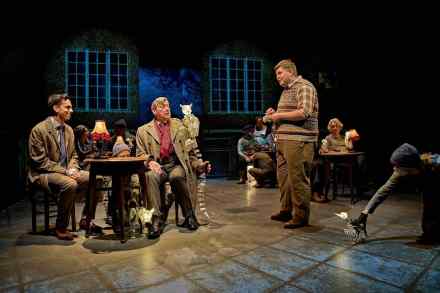
Philip Pullman’s The Book of Dust has been adapted at the Bridge. The yarn is set in Oxford, and the surrounding countryside, and the whole of the first act is devoted to exposition because Pullman’s fantasy world is impenetrably complicated. The chief character, a dim-witted child, wanders around the place and listens while terms like ‘magisterium’, ‘alethiometer’ and ‘daemon’ are explained to him. Meanwhile we’re introduced to Pullman’s range of human personalities. He can do two: first, the ooh-arr yokel who is thick but kind, and secondly, the posh academic who is clever but evil. These archetypes give rise to a total of 32 characters who are represented by 16 actors. A lot of simplification was needed here.

Actors will be in trouble if the Bridge Theatre’s latest experiment catches on

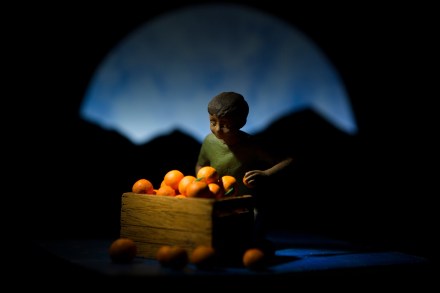
Flight has been hailed as a new form of dramatic presentation — prefab theatre. It’s great to look at. A set of model boxes containing stick figures and colourful landscapes slides past the seated viewer while a voiceover reads the narrative. No thesps are required, which may be a relief to producers and directors but the acting profession will be in trouble if this experiment catches on. The story, adapted from Hinterland by Caroline Brothers, follows two Afghan teenagers, Kabir and Aryan, who decide to walk to Europe in search of a better life. All they have is $2,000 in cash and a spare pair of trainers each. Along the way, they keep up their spirits by chanting the somewhat roundabout route they plan to take once they’ve left the Asian landmass.

Enjoyable but hardly classic Alan Bennett: The Outside Dog & The Hand of God reviewed

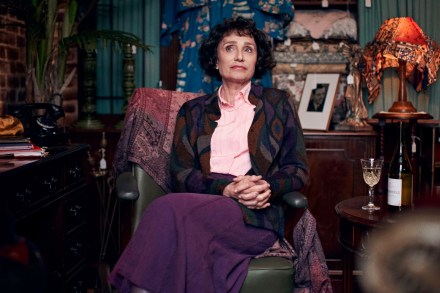
The season of Alan Bennett’s Talking Heads continues at the Bridge. In The Hand of God we meet Celia, a posh antiques dealer, who befriends old maids in the hope of acquiring their valuables cheaply. Like everyone in her trade she uses play-acting and mind games to give her the advantage while haggling. If her enemy falters, she pounces. A man visits her shop and becomes visibly excited by a framed drawing which Celia hoped to flog for £30. Spotting his eagerness, she trebles the price. He pays up and hurries out. Later she learns that the drawing was by an old master whose style she failed to recognise. Millions have slipped through her fingers. Kristin Scott Thomas is well cast as this suburban snake in the grass. All the visuals are beautifully judged.

Covid marshals are killing theatre: The Shrine & Bed Among the Lentils reviewed

Covid marshals have invaded theatreland. Arriving for a weekday matinee at the Bridge, I was greeted by stewards holding up illuminated boards. ‘PLEASE WEAR A FACE COVERING.’ Inside, the seating had been rearranged into clumps of twos and threes with the odd single perch sticking out like a toadstool. Nicholas Hytner offered us a pair of the best-loved scripts by his favourite living playwright, Alan Bennett. The afternoon was stuffy and I took sips from a bottle of water in accordance with signage which suggested that masks might be removed for the purposes of drinking. After each glug I diligently replaced my covering. Ten minutes into the show, I was visited by a Covid marshal who informed me that the position of my mouth-wear dissatisfied him.

Chaotic, if good-natured, muddle: Hytner’s Midsummer Night’s Dream reviewed

Nicholas Hytner’s A Midsummer Night’s Dream opens in a world of puritanical austerity. The cast wear sombre black costumes and Oliver Chris, with menacing swagger, brings a note of palpable sadism to the role of Theseus. Then things relax as the ‘mechanicals’ in modern boiler suits prepare to rehearse the play. Hammed Animashaun (Bottom) dominates this little scene with his impish charm and unpredictability. He’s a high-calibre talent of whom more will be heard. After this solid opening, disaster strikes. The forest sequences, already devilishly overcomplicated, are presented on double beds which move restlessly all over the shop and make the story almost impossible to follow. And Hytner has flipped the chief roles.

Privatisation is the best option for the South Bank Centre

I must have written about this subject 100 times in 30 years and I’m still having to restate the bloody obvious. London’s South Bank Centre, which has just gone bleating to the government for more money, is the biggest subsidy guzzler in the country and the despair of the rest of British arts. The South Bank receives £19 million a year from the Arts Council, on top of the many millions that go to each of the so-called ‘resident ensembles’ that perform within it. What it does with the money is anyone’s guess because, as far as the eye can see and the nostrils can smell, the South Bank is now a fast-food mall with an occasional classical concert buried within it. How did it get so bad?