Brexit

Watch: IDS’s Sky News Brexit clash

From our UK edition

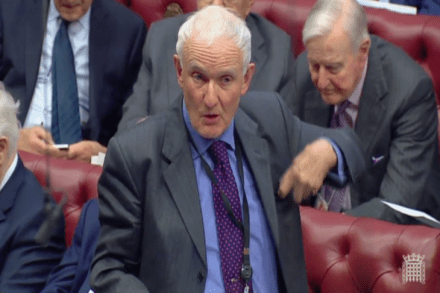
Cabinet is certain to be tetchy this morning after Boris Johnson called the PM's preferred customs arrangement 'crazy'. Things were no different on Sky News just now when Iain Duncan Smith popped up to discuss Brexit. IDS clashed repeatedly with Adam Boulton as the pair discussed borders, Brexit and whether Boris would do a better job than Theresa May. Here’s how it unfolded: IDS: Let me finish, because you need to understand what the problem is AB: No, but you’re making an assertion IDS: No, I’m not … IDS: Adam, sorry, just wait. Let me finish. Wouldn’t you like to know the answer to that question? AB: Yeah IDS: Right, let me finish. … IDS: Do me a favour, Alan, err Adam. You ask me a question, let me finish.

Theresa May won’t abandon her customs partnership idea: but she should

From our UK edition

Theresa May has received a shot in the arm from the local election results. But, as I say in The Sun this morning, she still needs to deal with the whole customs partnership question. Even after the remarkable rebuff that the ‘new customs partnership’ received from the Brexit inner Cabinet on Wednesday, despite the Prime Minister putting her authority on the line by making clear her support for it, Number 10 won’t give up on the idea. It believes that with a few changes it can be made to work. Already, ministers are being told that what really matters is getting out of the EU. The case is being made that once Britain is no longer, legally a member of the EU all these problems can be ironed out.

The UK economy isn’t all doom and gloom

From our UK edition

This is an extract from this week's 'Any Other Business' column.  The UK economy grew just 0.1 per cent in the first quarter, says the ONS, reflecting low construction activity, sluggish manufacturing, squeezed consumers, Brexit uncertainties and bitter weather. That’s the worst quarter since 2012 — so no wonder I had such a feeble response to my call a fortnight ago for evidence of feelgood. Two readers broke through the gloom, however. The first is a veteran banker who lends to small-to-medium UK corporate borrowers and describes himself as ‘miserable, cynical and pessimistic’ by nature and experience.

The Spectator Podcast: Mayday!

From our UK edition

In this week’s podcast, we discuss Theresa May’s impossible situation - how can she get herself out of the bind created by the Brexiteers and the Remainers? We also discuss the hostile environment policy, and ask, will Ireland appeal its Eighth Amendment? First, Theresa May finds herself in a real dilemma. Her cabinet colleagues, the EU and her advisors are all pulling her in different directions over the question of the customs union. While Remainers argue that a ‘customs partnership’ is the only way to avoid a hard border in Northern Ireland, Brexiteers believe ‘max fac’ (a maximum facilitation agreement, which includes a technology based border in Ireland) is the only way forward.

Jacob Rees-Mogg’s critics are missing the point

From our UK edition

Surprisingly though it may be to some of my readers I have never been that bothered about Brexit. I even voted Remain – not on the strength of the economic arguments, which I thought fairly evenly balanced – but because I could see the danger in precipitating the break-up of the European Union: that it might lead to the drift back eastwards of former Soviet bloc countries. But once the decision was made I was very happy that it be executed, so long as it be in an economically liberal way and done properly; not leaving us stuck in some halfway house where we are bound to EU rules, bound to its trade policy, paying into its coffers and yet without a hand on the tiller.

The Brexit delusion

From our UK edition

As time passes, some things become clear. The problem isn’t Brexit; the problem is the Brexiteers. Or, to put it slightly differently, while Brexit may be sub-optimal, the Brexiteers are much worse than that. They are awful.  Extraordinarily, Jacob Rees-Mogg is now the bookmakers’ favourite to be the next prime minister. As the champion of the backbench Brexiteers he can no longer be dismissed – or, indeed, indulged – as an enjoyable eccentric. He is serious and perhaps now merits being taken seriously himself.  As an intellectual matter, Brexit remains a respectable cause.

Can May’s Brexit stance survive its latest Lords defeat?

From our UK edition

Another day, another Brexit defeat in the House of Lords for the Government. This time around, peers have voted to back an amendment to the Brexit bill which would hand Parliament, rather than ministers, the power to decide what to do if MPs reject the final deal agreed with Brussels. The margin in today’s vote was considerable: 335 to 224. But more worrying for the Government is the number of times it has been now been defeated in the Lords on Brexit, with this afternoon's vote marking the seventh time peers have gone against the Government on the issue. Among those who backed the amendment were 19 Tory lords, including 11 former ministers. The names of those who rebelled are no surprise. But make no mistake: this vote will worry ministers.

Is Brexit a human rights emergency? The UN seems to think so

From our UK edition

How easy it would be to be goaded by the visit of Tendayi Achiume, the UN’s “Special Rapporteur on Racism” to Britain. “My mission...will focus on explicit incidents of racism and related intolerance as well as attention to structural forms of discrimination and exclusion that have been exacerbated by Brexit,” she says, as well as “xenophobic discrimination and intolerance aimed at refugees, migrants and even British racial, religious and ethnic minorities”. How tempting it will be for some to tell her to bug off and deal with some real human rights abuses.

What does the French white van man think about Brexit?

From our UK edition

I am living in Paris in the unofficial role of Diplomatic Wag. Though since I am neither wife nor girlfriend, but fiancée, or, in best Franglais, la vielle balle et chaîne, I have been searching for a new acronym. Foho (Foreign Office Hanger On)? Andy is a ‘Directeur de SIN’, a demonic job description out of C.S. Lewis’s The Screwtape Letters. SIN is the government’s Science and Innovation Network, promoting collaboration between international scientists. There is goodwill in laboratories on both sides of the Channel to go on working together post-You-Know-What. Brexit is pronounced to rhyme with Brigitte, as in Bardot. Parisians ask if you’re American or English and when you say English they bring up Brexitte.

Brexit isn’t to blame for dismal GDP growth – and nor is the weather

From our UK edition

The government’s opponents were not slow, as usual, to blame today’s disappointing data on economic growth on Brexit (the IOD) or ‘austerity’ (John McDonnell) – while the Chancellor, Philip Hammond, chose to fall back on that old chestnut used by corporate spokesmen when announcing dismal results: the weather. None of these will really do as an explanation as to why GDP growth, according to the ONS, plunged from a healthy 0.4 per cent in the final quarter of last year to a miserable 0.1 per cent in the first quarter of 2018. As for Brexit, GDP figures have been shrugging it off for nearly two years – the economy even accelerated for the first two quarters.

Portrait of the Week – 26 April 2018

From our UK edition

Home No. 10 insisted: ‘We will not be staying in the customs union or joining a customs union.’ The undertaking came after a defeat for the government on the matter in the House of Lords and before a vote in the House of Commons. The government proposed two alternatives: one being a ‘customs partnership’ in which the UK would collect tariffs on the EU’s behalf on goods coming from other countries, and the other being a ‘highly streamlined customs arrangement’.

Nicola Sturgeon’s response to Brexit has utterly failed

From our UK edition

What's Nicola Sturgeon playing at on Brexit? Quick answer: politics. Longer answer: politics.  The SNP leader has rejected a deal to resolve the impasse between Westminster and Holyrood over the repatriation of powers from Brussels. She accuses the Tories of a 'power grab' because some areas of responsibility will initially go to the UK rather than Scottish parliament and threatens to deny consent to the government's Brexit Bill. If she does so – and her SNP holds a majority of seats at Holyrood with unofficial junior coalition partners, the Greens – it will fix a procedural wheel clamp on Brexit. At which point, the only way the Bill could go ahead is if Westminster explicitly overruled the Scottish Parliament.  You see where I'm going with this?

A decade in crisis

From our UK edition

‘I voted to stay in a common market. No one ever mentioned a political union.’ It is the complaint of an entire generation — the generation, by and large, that switched its vote between 1975 and 2016. It is also, as Robert Saunders shows in this eloquent history of the earlier poll, based on a false memory. Anti-Marketeers in 1975, especially Tony Benn and Enoch Powell, constantly talked about ‘our right to rule ourselves’. Supporters of the EEC, for their part, were never happier than when lecturing voters about the benefits of swapping theoretical sovereignty for actual power. But the voters — empirical, practical, Anglo-Saxon — wanted examples. Abstract nouns like ‘sovereignty’ left them cold. What did sovereignty mean?

David Davis tries to calm fears over a customs union reversal

From our UK edition

For those Brexiteers worried the government may change its mind on leaving the customs union, David Davis’s appearance in front of a select committee gave reasons for reassurance – but also possibly some cause to worry. The Brexit secretary was clear that he is sticking firmly to his guns on the issue. But can he – and the government – continue to do so under pressure from MPs who are seeking to keep Britain inside the customs union? Hilary Benn asked Davis what would happen if the vote in Parliament on the Brexit trade bill went against the government.

Who is making the case for leaving the customs union?

From our UK edition

Whole industries will be devastated. There will be thirty mile queues of lorries stretching back from Dover. The price of food will rocket, our farmers will be wiped out, and the IRA will be letting off bombs all over the UK as the Troubles return to Northern Ireland. With every day that passes, the scare stories about leaving the customs union are getting more and more hysterical – and the pressure is growing to stay inside. In fact, most of it is nonsense. The fifth largest economy in the world is perfectly capable of managing its own trade arrangements. But leaving needs a big sell. Why? Because there is a powerful alliance of industrial lobbyists and ultra remainers behind staying inside, and that means the case for getting out may easily be lost.

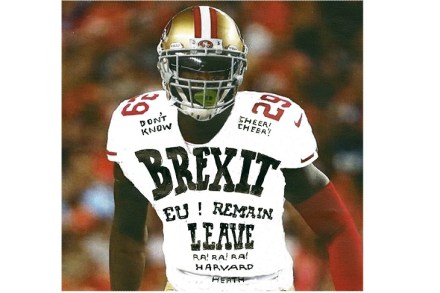
None of my Harvard students thinks Brexit is a good idea

Across the street at the Museum of Fine Arts, there is an extraordinary collection of Georgian furniture and paintings from Boston just before the revolution. It all seems a lot more sumptuous than the sort of thing that would have been found in a contemporary English town of 15,000. The colonials were, of course, more lightly taxed than the British, yet they rebelled. Might it have been to do with sovereignty and ‘taking back control’? I suppose it worked out for them. Still, when I asked my study group at Harvard’s Kennedy School whether Brexit was a good idea, not a single hand went up.

harvard brexit

Why Brexiteer ministers are so concerned at the moment

From our UK edition

Senior Cabinet Brexiteers are more concerned about the project than they have been in some time, I write in The Sun this morning. The reason for this is that there is a concerted push underway to keep Britain in a customs union with the EU for good even after December 2020. If Britain is to take full advantage of the opportunities that Brexit offers, this must be resisted. A customs-arrangements between Britain and the EU which speeds up checks, minimises bureaucracy and helps maintain cross border supply chains would be sensible, and mutually beneficial. What wouldn’t be, is a situation where the EU determines both the taxes charged on goods coming into this country from the rest of the world and which countries can export their goods to Britain tariff and quota free.

Low life | 19 April 2018

From our UK edition

A week ago I plucked my eight-year-old grandson Oscar from the bosom of his rumbustious young family and took him on an orange aeroplane to Nice, and from there up into the hills of the upper Var to spend 11 days in our breeze-block shack. His second visit. On his first, last August, the temperature hit 45 degrees Celsius and we were roasted alive. This one, though, was relentlessly cold and wet and the mop and bucket were in constant use in the living room. Confined to barracks, we played Dobble, a card game akin to snap, but more complicated and requiring sharper wits. Several games of Dobble revealed beyond all argument that grandad’s dementia was much more advanced than had previously been thought.

Investing in zero-carbon shipping will only benefit the UK economy

From our UK edition

The shipping industry contributes around 2% of all global carbon emissions – a figure comparable to the entire CO2 emissions of a country the size of Germany.  In many ways that isn’t surprising: shipping powers the world economy, and carries 90% of all international trade. But although people understand the link between trade and prosperity, they quite rightly demand it is done in a responsible and environmentally friendly way. Globalised trade has brought rapid growth and helped see a remarkable fall in extreme poverty around the world, but it is not without negative consequences. Scientists say that to stave off potentially dangerous levels of warming later in the century, global emissions need to decline quickly to near-zero.

The Spectator Podcast: The Wrong Brexit

From our UK edition

This week we ask why Theresa May is pulling up the drawbridge to Britain, exactly when she should be advertising Britain’s openness in a post-Brexit world? We also discuss why charities are working to shut down schools in Africa, and hear from Quentin Letts on his experience of being pursued by the Establishment. As Commonwealth leaders meet in London this week, Theresa May has been under fire for her government’s treatment of the Windrush generation. The government initially refused a meeting requested by Commonwealth leaders to discuss the issue, only to U-turn on it hours later.