Book review

Highway to hell

From our UK edition

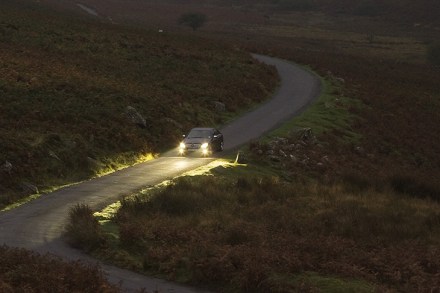
A lingeringly strange atmosphere hangs about Benjamin Wood’s third novel, in which the settings and paraphernalia of a new wave of British weird fiction — old children’s TV series, rustic bloodletting, the starkness of the northern landscape — encroach steadily on a retrospective story of childhood murder and deceit. The setting is northern England in the early 1990s, as the young Daniel Hardesty, a bookish 12-year-old, embarks on a road trip to Yorkshire with his estranged dad Francis, a jobbing stage carpenter, philanderer and liar. They’re on their way to the set of The Artifex, the sci-fi TV drama on which Francis works and with which his son is obsessed.
Family mysteries

From our UK edition

Maggie is sitting alone in the park when she’s approached by Harvey, who introduces himself as a recruiter for MI5. This is the starting point of Mick Herron’s This is What Happened (John Murray, £16.99). The company Maggie works for is under investigation as a possible threat to national security. She takes on a task, to feed a virus into the company’s computer network, but during this operation she accidentally kills a security guard. Harvey places her in a safe house. No windows, a locked door, no television, no internet, no way of knowing what’s going on beyond her room. Years pass. Harvey visits now and then, telling her the country has descended into anarchy. They have sex.

Outpourings of the heart

From our UK edition

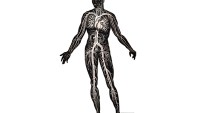
The numbers invite awe: three billion beats in a lifetime; 100,000 miles of vessels. But on the hospital floor, wonder is often in short supply. Doctors forget how intimate their examinations and investigations can be. Stethoscope to chest. Order a blood test. I remember on a morning ward round at medical school, our consultant wanted to check that the oximeter was working (a device which measures heart rate and blood oxygenation through the nail bed). He asked a harassed junior doctor to present her forefinger. The screen’s digits betrayed her stress levels. She was clinically tachycardic. Her pulse was so fast it would have been worrying had it been the patient’s. I have not forgotten this uninvited invasion of her heart.

A remarkable show of devotion

From our UK edition

On 13 September 1964, at the age of 42, Philip Larkin began writing to his mother Eva (his ‘very dear old creature’) by taking stock: Once again I am sitting in my bedroom in a patch of sunlight, embarking on my weekly task of ‘writing home’. I suppose I have been doing this now for 24 years! on and off, you know: well, I am happy to be able to do so, and I only hope my effusions are of some interest to you on all the different Monday mornings when they have arrived. A great deal of what is characteristic about Letters Home is evident here.

Opposites attract

From our UK edition

‘Marianne had the sense that her real life was happening somewhere very far away, happening without her, and she didn’t know if she would ever find out where it was and become part of it.’ This is the most frustrating part of being alienated and young. You hope that there’s a better life in store for you but you can’t yet bank on it. Sally Rooney appeared two years ago with Conversations with Friends and has rightly been fêted as one of the most important writers of her generation. The question of generation matters because she’s writing about young people. Both novels feature protagonists who are undergraduates in Rooney’s own Dublin.

The coming of the Messiah

From our UK edition

England has been home to three great composer-entrepreneurs since 1700: Benjamin Britten in the 20th century; Arthur Sullivan in the 19th; and George Frederick Handel in the 18th. The operatic landscape they encountered was relatively fallow, yet each cultivated his patch of earth, produced works of astonishing originality and impact, and revolutionised both the art form and the country’s opera industry, at least for a time. Handel was the most incongruous of the three, this gruff German son of a barber-surgeon, with heavily accented English who, aged 26 and following the phenomenal success in London of his opera Rinaldo, found himself parachuted into the centre of British court and theatrical life.

What you see is what you get

From our UK edition

The Wellcome Trust puts on some of the most engaging exhibitions in London and holds in its permanent collection a number of fine works. Its roots are in biomedical research, but those roots have, with modification, sprouted so many disciplines and areas of tangential enquiry that it makes perfect sense to have commissioned Iain Sinclair to write about the physical and psychological effects of buildings and places on the health of the people who inhabit them, pass through them, long to get out of them, represent them, think about them. Sinclair’s approach is not that of a sociologist, an off-the-peg analyst of urbanism (density good, sprawl bad) or a travel writer on a journey to ‘find himself’ (in the way that they wearyingly will).

The burden of freedom

From our UK edition

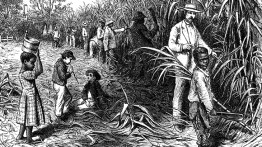
It’s 1830, and among the sugar cane of Faith Plantation in Barbados, suicide seems like the only way out. Decapitations and burnings are performed with languorous cruelty. Women give birth and are sent straight back to work after lying their ‘tender-skinned newborns down in the furrows to wail against the hot sun’. Esi Edugyan’s third novel does not retreat to softer ground after her last, Half-Blood Blues, dealt with Nazi ideology. Both Germany and Barbados have chapters in their histories when humans were treated like mere creatures. Hope arrives with the plantation master’s brother, Christopher ‘Titch’ Wilde, a scientist, inventor and abolitionist. Titch chooses a slave boy, George Washington Black, to be his apprentice.

In a forest dark and deep

From our UK edition

Brian Catling’s great trilogy takes its title from The Vorrh, his first volume. This final book fulfills all the promises of the first two. It has a place beside such modern masters of the imagination as E.R. Eddison, Tolkien or Peake, and it is as completely unlike them as those three-deckers are of each other. Again we visit the Vorrh, the endless forest based on Raymond Roussel’s in Impressions of Africa. Built on its outskirts, Essenwald, a crumbling colonial city, exists because of the timber it cuts with the labour of ‘the Erstwhile’, the forest’s enslaved, semi-human inhabitants.

An age of paradox

From our UK edition

‘It was the best of times, it was the worst of times... it was the epoch of belief, it was the epoch of incredulity, it was the spring of hope, it was the winter of despair, we had everything before us, we had nothing before us ... in short,’ as Charles Dickens famously told the first readers of A Tale of Two Cities, it was a period very much like their own. Dickens was right. John Stuart Mill once claimed that the two great ‘seminal minds’ of the period were Coleridge and Bentham, and in that brilliant yoking of opposites — the warm, creative current of Coleridgean thought and the chillier stream of Benthamite utilitarianism — is summed up all the contradictions and paradoxes that the Victorian age was heir to. This is the fascination of the period.

We were all unwell then

From our UK edition

On the one hand, I am supremely qualified to review this book. In 1984, bored beyond endurance after graduating with one of those degrees that leaves you both over- and under-qualified for employment, I decided to take my dole money down to the Coach and Horses pub in Soho, where this magazine’s Jeffrey Bernard held court, and pay my respects to him, for I liked his prose style and his stories. I stayed there for three years or more, a postgraduate course in itself, only packing my bags at the end of 1987 when I met the woman who was to become my wife.

No longer the tough guy

From our UK edition

Only to Sleep is the third Philip Marlowe novel written by someone other than Raymond Chandler and while the authors of Perchance to Dream and The Black-Eyed Blonde both found freedom to play with Marlowe and explore his potential, it is Lawrence Osborne who has run the furthest with the source material. The novel opens in 1988, with Marlowe living in retirement in Baja, Mexico. He is 72, and enjoying a leisurely life in the sun, when he is asked to take on one last investigation into insurance fraud. A Reagan-era Marlowe unlocks an aspect that Chandler never considered.

Curiosity – and cats

From our UK edition

To Jan Morris, I am anathema. That goes, too, for David Attenborough. It is a word that this unarguably great writer likes: ‘It rolls well off the tongue.’ Why are your reviewer and the great broadcaster anathema, you ask. Well, we have been to the zoo. In this almost entirely enjoyable book no-one comes in for quite so much disapproval as those of us who have been to the zoo.I mention David because, when I was young, he took me to the zoo. However, despite this sinfulness, I would be surprised if Morris, who is a year older than Attenborough, does not recognise in David a confrère in the war for niceness against nastiness, kindness against cruelty. This book, apparently written because Morris has ‘nothing much else to write’, is more weighty than it seems.

Guns and roses

From our UK edition

During the civil war in Afghanistan in the late 1980s, Mr and Mrs Roami, a science professor and a nurse, sent their children away from Kabul to Europe for safety. Tragically, they lost the phone number of where the children had moved to and had no way of contacting them. The couple found solace in gardening. Despite the constant explosions of rockets and shells, they were unwilling to leave their home. They named flowers after their children, and tended and spoke to them. It gave them the hope that one day the family would be reunited. At one point, battle raged on all four sides and it was too dangerous to cross the road to fetch water from the stream. The garden was starting to die.

A class act

From our UK edition

‘I’m sorry to bother you, Peter, but you were a famously successful Leader of Their Lordships and I wondered whether you had any tips before I took it on.’ ‘All you’ve got to remember is that you are the headmaster of a second-rate public school.’ Lord Carrington’s answer to my enquiry was entirely characteristic: funny, and flattering, as though he knew you would instinctively understand the joke. You and he, he implied, belonged in the same place. It was a technique which he lavished with great success on those who worked for him. He was much loved in Their Lordships, at the Foreign Office and at the Ministry of Defence — and with reason. He was fun to work for and loyal to those who worked for him.

A recitation of wrongs

From our UK edition

In 1923, a Frenchman, Emile Coué, persuaded millions of Americans to finger a piece of string with exactly 20 knots. It was an exercise in auto-suggestion. At each knot of this secular rosary, the user intoned: ‘Every day, in every way, I am getting better and better.’ Sylvia Plath’s letters — until they implode on p.790 when she discovers the affair between Ted Hughes and Assia Wevill — are a similar numbing iteration of optimism and self-improvement. Thereafter, the story changes, darkens. Up until then, her story is cropped for improvement: she takes her finals at Cambridge but the letters are silent on her degree result (II: i). She explains to her brother Warren that she doesn’t write when her moods are black.

Man’s true best friend

From our UK edition

This unusual book begins with an account of the author’s ten-year love affair with dairy farming and an attempt ‘to give a flavour of what our cattle do for us’. It then turns into a survey of the various British breeds of cattle. After poor A-levels, Philip Walling took odd jobs in his native Cumbria, such as building dry-stone walls, until he managed to acquire a small farm of his own. With great determination, he ran this single-handed, keeping both beef and dairy animals and raising poultry and a couple of pigs. They were, in retrospect at least, ‘ten years of almost undimmed joy’. But aged 30, discouraged by the daily grind, which included a milk round, and feeling he had missed out on a proper education, he gave it all up.