Book review

The man mountain of Fleet Street

From our UK edition

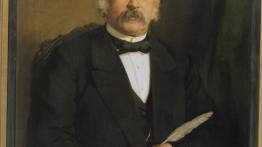
A. N. Wilson has a queasy feeling that he won’t be re-reading the works of G. K. Chesterton for a while Yet another book on Chesterton! William Oddie is only half way through his immensely detailed two-volume biographical-cum-theological study of the man mountain of Fleet Street. Last year we had Aidan Nichols on Chesterton’s theology. And now Ian Ker comes with the familiar account of how the son of a Kensington estate agent, educated at St Paul’s and infected with the spirit of the Nineties, moved from being a Bedford Park aesthete-agnostic, through socialism and liberalism to distributism, and from unbelief to a broad, generous sympathy with the Anglo-Catholicism of his wife, Frances Blogg.

In search of a character

From our UK edition

A chronicle of three young actors desperate to forge careers in the acting profession sounds like a dangerously familiar proposition. We are all now habituated to the weekly Saturday evening drama of wide- eyed dreamers drilled, mauled, culled and reculled in search of a Nancy, Dorothy or Maria. In Lucky Break, however, Esther Freud redraws the path that leads from Television Centre direct to London’s glittering West End. These young hopefuls are plunged into the maelstrom of a three-year drama school programme that stretches and befuddles them in equal measure. There is a squirm- inducing accuracy to the students’ earnest endorsement of their training, hilariously realised in the principal and the quasi-mystical movement teacher.

Looking on the bright side . . .

From our UK edition

Anyone who thinks that a stable and loving family background is the key to a happy life had better read this book; for its protagonist, now 80 years old, was rejected as a baby by his unmarried mother, looked after by a doting and doted-on grandmother until he was four, and then, inexplicably (given that he had various relations who could have cared for him), consigned to an orphanage of Dickensian grimness from which he was finally discharged at the age of 14 with nothing but a Bible, a new suit, and a ten-shilling note. Yet Peter Paterson’s fascinating memoir shows him to have led a life of almost unnatural contentment. He has spent nearly 60 years of it in journalism, having drifted into it by accident and considered himself ever since the luckiest man alive.

. . . or sensing impending doom

From our UK edition

‘What am I? A completely ordinary person from the so-called higher reaches of society. ‘What am I? A completely ordinary person from the so-called higher reaches of society. And what can I do? I can train a horse, carve a capon, and play games of chance.’ So reflects Botho von Rienäcke, the central character of Theodor Fontane’s novel of 1888, Irrungen, Wirrungen (newly translated as On Tangled Paths). His bitter self-examination is a consequence of his predicament. Like many a fellow officer, he has taken up with a working-class girl. He met her on a boating trip when he came to her rescue from an accident in the water.

Beastly behaviour

From our UK edition

If the production team of The Archers ever needs a scriptwriter at short notice, they need look no further than Miranda France. For her latest book, she’s gone back to her roots as the daughter of a farming family and created a novel that’s a cross between an omnibus edition of the radio soap and the gimlet-eyed prose of Stella Gibbons. Hill Farm is set in a nameless village somewhere on the borders of Sussex and Kent. Hayes loves the land, but not farming. His wife Isabel loves the idea of the country but not the reality of the falling-down farm to which she is shackled by duty rather than affection.

Fish and chaps

From our UK edition

This is the ultimate ‘niche’ book. This is the ultimate ‘niche’ book. It focuses on that singular decade between the years of rockers and punks, when toffs, freed from school or army uniforms, and toughs, discarding skinhead aggression, found a sartorial meeting point. This new style, the cool child of late Fifties mods, had been given a huge public oomph by the Beatles and ‘their silly little suits’ as David Bailey (who has stated that he, along with myself, was the unwitting originator of the look) succinctly puts it. It was sharper, leaner and hinted at androgeny. Its creators were no longer found in caverns down Carnaby Street, nor high in the King’s Road, but centered round that time-honoured dandy’s inferno, Savile Row.

The world according to ants

From our UK edition

The South American rain forest is the perfect environment for a dank, uncomfortable thriller. It’s brutally competitive; life is thrillingly vulnerable; you can’t safely touch or taste anything, and, beyond a few yards, you can see nothing at all. Even Amerindians are anxious in this environment, and credit it with all manner of horrors. In my own experience, it is, in every sense, a spine-tingling environment. So novelist Edward Docx has chosen well in the setting for his dark tale. It’s not a complex plot but there’s the constant feeling that you’re not seeing the whole picture, and that nothing is quite as it seems. Docx is a master of disquiet, and brilliantly captures the bewildering effect of the forest.

Go out and govern New South Wales

From our UK edition

‘In the mists and damp of the Scottish Highlands, 61-year-old Sir Bartle Frere was writing a letter. ‘In the mists and damp of the Scottish Highlands, 61-year-old Sir Bartle Frere was writing a letter. Straight-backed, grey-haired, he had the bright eye and bristled moustache of an ageing fox-terrier.’ Reading this, at the beginning of a chapter, we cannot be sure whether what follows will be Lytton Strachey or John Buchan. The tale might go either way. The letter might be either an invitation to shoot grouse or in answer to a summons to cope with a crisis threatening the British empire. The second guess would be right.

Cuckoo in the nest

From our UK edition

Caradoc King, the well-known literary agent, was adopted in 1948 as a baby into a family of three girls, shortly joined by a fourth, presided over by a difficult, unhappy mother and her feebly adoring husband. He grew up unaware of the adoption and has never discovered its motive. His adoptive mother, Jill, the moving spirit behind every family decision, may have simply longed for a boy. If so, she was singularly ill-prepared for standard boyish delinquencies. Young Carodoc liked playing with matches, embroidering the truth, and inspecting — in a spirit of scientific enquiry — the private parts of his younger sister.

The evil of banality

From our UK edition

Aimez-vous Heidegger? According to his admirers, he was the most significant and influential philosopher of the 20th century. For Hannah Arendt, despite her claims eventually to have found the perfect husband in Heinrich Blucher, Heidegger was the love of her life. She was his precocious teenage pupil when he lectured on Plato’s Sophist at Marburg in 1924, and the Herr Doktor’s dark-eyed Jewish mistress not long afterwards. He was 35, married with two sons, only one of whom (it emerged much later) he had fathered. His wife Elfride was an eager anti-Semite; Heidegger’s eagerness was for his own advancement and fame. Hannah never got over the thrill of being his cookie.

When the best defence is no defence

From our UK edition

This remarkable book is the account by their lawyer of the trial, imprisonment and sentencing to death in the late Eighties of a group of young men who came to be known as the Delmas Four. It is also a wonderfully vivid and at times alarming account of the inner workings both of ANC ‘operations units’ and of the police, who used torture, murder and intimidation without compunction in the fight to save South Africa from what they saw as a communist threat. As South Africans in general drew closer to some sort of détente between the ANC and the nationalist government, neither the ANC on the one hand nor the security police on the other were prepared to hold back. It was as if this was the last hurrah for their deepest fears and hopes for the country.

The empire strikes back

From our UK edition

Something strange happened in New York on a cold November afternoon in 1783: the city effectively turned itself inside out. Mounted on a grey horse, George Washington marched down Manhattan at the head of the victorious US army. At the same time, British troops headed frantically in the opposite direction. When they reached the southernmost tip of the island, they clambered into longboats and rowed out to the Royal Navy ships waiting in the harbour. All this, of course, left the thousands of loyalists who had supported the British during the War of Independence in a very tricky position.

Walking wounded

From our UK edition

Paul Torday’s phenomenal success with Salmon Fishing in the Yemen was always going to be a hard act to follow. Paul Torday’s phenomenal success with Salmon Fishing in the Yemen was always going to be a hard act to follow. The idea of it was the thing — a wonderfully funny, mad idea, carried out economically in an epistolary style that rushed along from start to finish in a single fluid motion. ‘When once you have thought of big men and little men,’ a curmudgeonly Johnson said of Gulliver’s Travels, ‘it is very easy to do all the rest,’ but Salmon Fishing in the Yemen showed just how crucial that good idea is. Torday’s new novel, More Than You Can Say, at its outset, seems to offer the same kind of treat.

BOOKENDS: Hang the participle

From our UK edition

An awful lot of books are being published these days about the English language. David Crystal has a new one out every few weeks, and John Sutherland probably has half a dozen on the go. The Language Wars: (John Murray, £17.99) is Henry Hitchings’s third and unlikely to be his last. An awful lot of books are being published these days about the English language. David Crystal has a new one out every few weeks, and John Sutherland probably has half a dozen on the go. The Language Wars: (John Murray, £17.99) is Henry Hitchings’s third and unlikely to be his last.

And then there was one . . .

From our UK edition

The English fascination with spies is gloriously reflected in our literature, from Kim to A Question of Attribution, and while their Egyptian and Israeli counterparts remain untranslated, and the Americans unreadable, English spy novelists rule. Compromised, divided and alienated, the spy is a model modern hero, and the spy’s world, with its furtive and fetishistic arcana, is an admirable theatre of identity, of English attitudes to sex and class, hypocrisy and betrayal. (The best recent spy novel is John Banville’s The Untouchable, which tells the story of Anthony Blunt more freely than Alan Bennett’s play, nudging the facts into outrageous fiction — casting Graham Greene as the villain, for example.

A war of nutrition

From our UK edition

The long summer that led up to the last days of peace in Europe in 1939 — the vigil of the Nazi assault on Poland on 1 September and the ensuing Phoney War — gave little hint of the storm to come. The long summer that led up to the last days of peace in Europe in 1939 — the vigil of the Nazi assault on Poland on 1 September and the ensuing Phoney War — gave little hint of the storm to come. As German troops engulfed Poland, however, the Nazi science of massacre was put to the test. Within two months of Hitler’s invasion, an estimated 5,000 Jews were murdered behind the Polish lines. Millions were subsequently starved to death. Food is the central focus of this grimly absorbing enquiry into the second world war.

Too good for words

From our UK edition

I confess myself baffled by this fable. The narrative is as clear, the prose as uncluttered, as one expects from Susan Hill, but its very simplicity leaves me wondering whether I’ve missed the point. I confess myself baffled by this fable. The narrative is as clear, the prose as uncluttered, as one expects from Susan Hill, but its very simplicity leaves me wondering whether I’ve missed the point. The strapline tells me to expect a tale of ‘greed, goodness, and an extraordinary miracle’. Well, it doesn’t seem to be about greed at all. There isn’t a greedy person in it. Needy, yes; it deals with need. ‘Goodness’ is more like it.

On the silver trail

From our UK edition

The Spanish empire was the first of Europe’s great overseas empires, and for many years the richest and most powerful. The Spanish empire was the first of Europe’s great overseas empires, and for many years the richest and most powerful. It was also unusual in being an empire of colonists. The Portuguese, and later the Dutch, created coastal forts and settlements which served as trading posts for high-value commodities, chiefly spices. But the Spanish extended their power into the vast spaces of the South American interior, populating the towns with native Spaniards and their half-caste cousins, and lording it over the indigenous inhabitants who worked the great agricultural estates and ranches.

The gentle touch

From our UK edition

My main disappointment with this collection of stories was that I had already read six of them, in publications ranging from the New Yorker to the Guardian. This, however, only goes to prove the eagerness with which I seize upon Julian Barnes’ intelligent and subtle writing wherever it may first appear. Barnes’ two previous collections of short stories were loosely linked by a theme, though this was never overbearing: Cross Channel explored Anglo-French relationships, while The Lemon Table circled bleakly around old age. The stories in Pulse are more tenuously linked — except in so far as this is a collection about the tenuousness of links within human relationships.