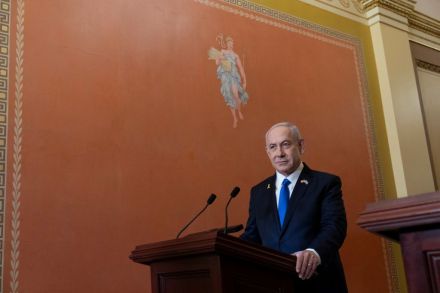
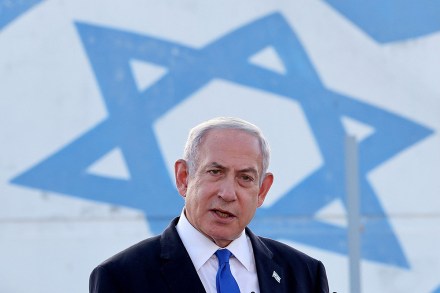
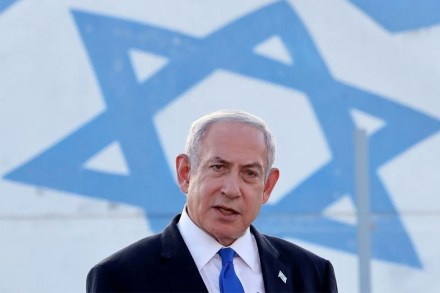
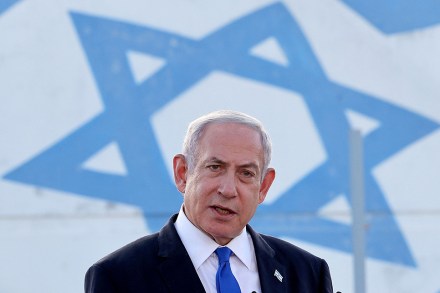
Benjamin netanyahu

Kamala’s coronation doesn’t help the Democrats

Does anyone else feel like an entire year has happened in the last week? Last Monday, former president Donald Trump arrived at the Republican National Convention after being a quarter-of-an-inch away from assassination (and losing part of his ear in the process), Jack Smith’s classified documents case against Trump was thrown out by a federal judge, President Joe Biden caught Covid and, finally, yesterday Biden announced that he is not running for re-election and endorsed his vice president Kamala Harris to be the new nominee. Deep breath in, deep breath out. Today’s edition of the DC Diary includes multiple items that will hopefully help you feel more prepared for what may come next.

Why state bureaucracy is crucial to our happiness

From our UK edition

Most days, outside the local courtroom where I live in Finchley Central, a man holds up a placard that says in big black capitals: ALL OUR BRAINS ARE MICROCHIPPED BY THE SECURITY SERVICES. It’s a foolish conspiracy theory, of course, but it’s also a symptom of the fear and loathing of the state which has grown in recent years and which, according to this lucid and persuasive book, threatens to return us to a time when we were governed by the whims of a monarch whose wishes were implemented arbitrarily by his family, friends and flatterers. The problem, say Stephen E. Hanson and Jeffrey S. Kopstein, is not that this presages an end to democracy.

Netanyahu thinks he’s Churchill, Israelis see Chamberlain

From our UK edition

Aleading member of Israel’s wartime cabinet has threatened to resign should Benjamin Netanyahu fail to present a strategy for ending the war in Gaza. The liberal politician Benny Gantz, who would win an election were one held now, has given a public ultimatum. He will collapse Netanyahu’s fragile coalition if no peace plan is delivered by Saturday. Netanyahu might believe he’s a Churchill; most Israelis consider him a Chamberlain Meanwhile, the largest protest since 7 October took place last weekend when 120,000 Israelis marched in Tel Aviv. Families of the 120 hostages held in Gaza (at least a third of whom are presumed dead) have joined the growing demonstrations against the government.

Biden’s pause of weapons shipments to Israel is another misstep

President Biden just made a strong move against Israel, ordering the US government to stop shipping weapons supplies to the Israeli Defense Forces. It was his fine strategic mind at work, once again.  Usually the public defers to the president and his advisors on foreign policy, unless the issues become very prominent or the president forfeits their trust. Those are the two problems now facing the Biden administration. The war in Gaza is a major issue — and the public has zero confidence in Joe’s strategic wisdom. He lost the public’s confidence on that score after the disastrous withdrawal from Afghanistan and the failed attempts to appease Iran. Now, they are unlikely to defer to his judgment in distancing himself from Israel, America’s greatest ally in the region.

biden weapons

Putin may seem confident – but Russia’s future is bleak

From our UK edition

How old will you be when Vladimir Putin’s next presidential term ends in 2030? Which of today’s world leaders will still be in office? By that time Putin will have been in power for 29 years, and just under half the population of the Earth at that time will have been born during his reign. On current form, Putin is set to see in at least two more US presidents – or more, if he chooses to stay in power until 2036. Putin has made a fetish of defending a Russian national sovereignty that no one had attempted to destroy When Putin launched his invasion of Ukraine in 2022 many dared to hope that defeat on the battlefield would force Russians to finally accept that they are no longer a great global superpower and confront their imperialist assumptions.

Permanent stalemate in Gaza suits Netanyahu

From our UK edition

Jerusalem After midnight on Thursday is dead-time for the Israeli media. The weekend editions have gone to print (newspapers don’t come out on Shabbat) and the Friday night TV news shows have been pre-recorded. The country’s journalists are yearning for respite from a long week covering the war. Benjamin Netanyahu chose that black hole of news, 2 a.m. last Friday, to leak his ‘Day after Hamas’ plan for post-war Gaza. There was no speech. No briefings. Just a page and a bit, double-spaced, presented to his cabinet for discussion. The plan has not been designed to end the war in Gaza. It is about Netanyahu’s own political survival But the plan is not a plan.

Biden’s Gaza gaffe risks relations with the Democratic base

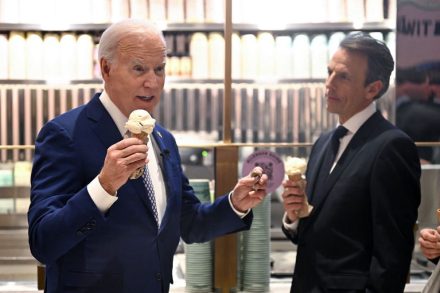
One of the first rules of politics and policy is to keep expectations low, lest you disappoint your constituents and embarrass yourself for being hopelessly naive.  Apparently President Joe Biden didn’t get the memo.  During a stop in New York City this week for a taping of NBC’s Late Night with Seth Meyers, Biden was eager, if not downright giddy, about the prospects of a temporary ceasefire in Gaza. Ice cream cone in hand, the president told the White House press corps that Jake Sullivan, his national security advisor, believes a truce is close at hand.  “My hope is that, by next Monday, we’ll have a ceasefire,” Biden said.

joe biden gaza gaffe

Why hasn’t Hamas freed its American hostages?

Hamas’s most valuable assets are the American hostages it holds. That simple fact means the terrorist organization will demand the highest value in return. What can America give Hamas in exchange? Not prisoners, since the US doesn’t hold any Hamas fighters. That means the US cannot follow the Israeli pattern of giving Hamas three Palestinian prisoners in exchange for every one held by Hamas. Nor can America provide boatloads of cash, as the Biden administration has for Iran. Biden could continuing giving Iran money, but that is much harder in the midst of war. And it is untenable politically to pay Hamas directly while the fighting continues. The Biden team might promise to help rebuild Gaza later, but that’s not valuable to Hamas right now, as it fights for its life.

hamas

Benjamin Netanyahu is increasingly seen as Israel’s curse

From our UK edition

Jerusalem On Tuesday, I was driving down to an Israeli army headquarters on the border with Gaza as a massive convoy of police cars and black bullet-proof limousines forced me onto the side of the road by the town of Ofakim. In Israel, only one man travels in a convoy that large.  It was 7 November, a month after the Hamas attack on Israeli communities in which 1,400 were murdered and the war between Israel and Hamas in Gaza began. Even during peacetime the Prime Minister’s movements are shrouded in secrecy until he is safely back in one of his homes or offices.

Protests and confusion follow the Gaza hospital blast

On President Biden's last-minute trip to Israel Wednesday, the commander-in-chief pledged America's support to the Jewish state alongside Prime Minister Benjamin Netanyahu. Following what the world’s media covered as Tuesday’s massive explosion of the Al-Ahli al-Arabi hospital in Gaza, Jordan abruptly canceled a summit set to be held in Amman with leaders from Egypt and Palestine. The country’s king, Abdullah II, called off the four-way summit, blaming the Israeli Defense Forces for the explosion that, according to the Hamas-run Health Ministry, killed around 500 Palestinians. The Jordanian demanded an immediate end of Israel’s offensive, labeling the event a “shame on humanity.

gaza hospital

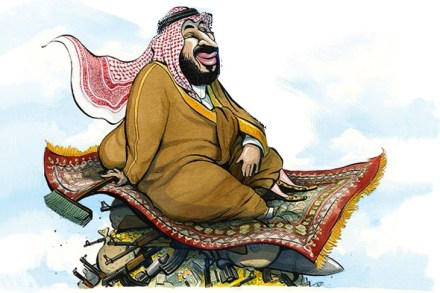
Is a Saudi-Israel deal now off the table?

Joe Biden can point to a few concrete foreign-policy accomplishments during his presidency thus far. Ukraine would be in far worse shape against Russia were it not for the financial, economic and military assistance the White House has provided. Washington has also done a commendable job getting Japan and South Korea back on speaking terms after years of bickering. Yet both of these items are tactical in nature and aren’t going to bring Biden into the history books. Shepherding a comprehensive normalization agreement between Israel and Saudi Arabia, however, just might. That was, until an unprecedented Hamas-led attack into Israel threw a wrench into his plans.

saudi

The increasing irrelevance of Benjamin Netanyahu

From our UK edition

Jerusalem The most tedious question in Israeli politics is: ‘Will this be the end of Benjamin Netanyahu?’ It has come up again in recent weeks as Israel has found itself on the brink of chaos over his coalition government’s attempts to pass laws weakening the independence of the judiciary, including the Supreme Court. And while the civilian unrest is unprecedented in the country’s history, anyone who has spent even a moderate amount of time observing Israel in the past decades should know by now that the answer, as long as Netanyahu is still breathing, is ‘no’. Netanyahu can’t discipline or sack his ministers.

Biden should butt out of Israeli politics

Two days after Israeli prime minister Benjamin Netanyahu postponed his government’s planned judicial reforms, President Joe Biden felt it necessary to go after his own country's ally. In an off-the-cuff comment, he said, “Like many strong supporters of Israel, I'm very concerned. And I'm concerned that they get this straight. They cannot continue down this road. And I've sort of made that clear.” “Hopefully the prime minister will act in a way that he can try to work out some genuine compromise,” he continued, “but that remains to be seen.” Later on Tuesday, the president added that he hopes Netanyahu “walks away from it [the reform].” There are plenty of reasons to be concerned about Israel’s judicial reforms.

joe biden women’s rights

Spoilt for choice in the Windy City

Spoilt for choice in the Windy City If the heavy defeat suffered by incumbent mayor Lori Lightfoot last month is anything to go by, Chicagoans have plenty to grumble about when it comes to how their city is managed. But when they head to the polls in the mayoral runoff next week, they cannot complain about a lack of choice. The two candidates are both Democrats, to be sure, but they offer sharply different approaches on the crime and public safety — issues that have dominated the race and which polls suggest are at the forefront of voters’ minds.  Paul Vallas, who used to run the city’s public schools, is running in the moderate lane: sharply critical of Lightfoot and prioritizing public safety above all else. Brandon Johnson is the progressive option.

chicago

Netanyahu’s war on lawyers has thrown Israel into turmoil

From our UK edition

Chaos reigns in Israel, a country in the throes of an ad hoc general strike called by trade unions, university students, numerous industries across the country, and many military and civil defence reservists. Demonstrators are storming buildings and fighting the police. Some council leaders say they are beginning a hunger strike. If you wanted to fly into Ben Gurion airport today, as tens of thousands of people usually do of a weekday, I’m afraid you’re out of luck. It’s closed.  Why is all of this happening? In the immediate term, because Prime Minister Benjamin Netanyahu sacked his defence minister, Yoav Gallant. Gallant is a member of Netanyahu’s Likud party and is a loyalist.

Why Netanyahu is right about Israel’s rogue supreme court

Despite recent hyperbole, Israel is not on the verge of authoritarianism. The proposed reforms to the country's judicial system, which have attracted so much controversy — usually under the assumption that they will turn Benjamin Netanyahu into an Israeli Viktor Orbán — are lacking in historical context. The Israeli Supreme Court is one of the most activist courts in the world. It has assigned itself more authority and subverted the balance of power between Israel's different branches of government. It has done all this while at the same time lacking any kind of serious accountability to the electorate.

bibi

It looks like Bibi is back from the dead

From our UK edition

Could it really be over? As Israeli political reporters stand before their cameras or hunch over their keyboards, their brains screaming with caffeine, that is the one question they’re asking. As are millions of voters, who remarkably turned out on Tuesday in impressive numbers, despite their election fatigue.    As I write this, there are still a quarter of the votes in Israel’s general election waiting to be counted. Many of the ballot boxes come from Bedouin communities in the Negev desert and other Arab communities. Who knows, perhaps they could still change the outcome? Mathematically it’s certainly possible.

Has Micah Goodman found the path to peace?

He makes an unlikely prophet, winding his way through the tables at an outdoor café in Jerusalem, scruffy baseball cap cupping his head, flashing a 100-watt smile and laughing too nervously and long. But this is the visionary who may have just found a way to ease the Israeli-Palestinian puzzle. Dr. Micah Goodman is an iconoclast. His 2017 book Catch-67 sought to identify pragmatic ways to “shrink the conflict” between Israel and the Palestinians, rather than aim to resolve it. The left accused him of being too right-wing. The right derided him as a leftist. Catch-67 catapulted Goodman to the bestseller list and instant celebrity.

goodman

Can Naftali Bennett’s anti-Bibi coalition survive?

From our UK edition

Sunday saw a watershed moment in Israeli politics: Bibi Netanyahu was removed from power after 12 years, and his government replaced by an eclectic coalition headed by Naftali Bennett and Yair Lapid, both of whom will serve as Prime Minister under a rotation agreement, starting with Bennett. It may be that one of Bibi’s greatest achievements was bringing together politicians with little in common but the belief that it was time for Bibi to go. Anyone watching the vote to approve the new government would have been on the edge of their seat: the new government was approved by a single vote (passed 60 to 59).

The era of Bibi is over

From our UK edition

Israel's new government is a daring, possibly doomed but nonetheless fascinating experiment. Headed by tech millionaire turned nationalist figurehead Naftali Bennett and TV journalist turned voice of centrism Yair Lapid, Jerusalem’s 36th government is an ideological hydra.  Bennett’s right-wing national-religious Yamina party is joined by the secular liberals of Lapid’s Yesh Atid, along with Kahol Lavan moderates, Labor social democrats, Meretz socialists, and the Likud breakaway faction Tikva Hadasha, plus Yisrael Beiteinu’s secular right-wingers and Ra’am’s Islamic conservatives.