Banking

God stand up for bankers

He’ll have to because nobody else will. As Robert Peston says ‘Poor RBS, poor Britain’ – today’s figures are catastrophic. Peston’s been digging and the news gets worse: ‘But perhaps the most chilling numbers are these: we as taxpayers put in £25.5bn of new equity into this bank last autumn, the second instalment of the £45.5bn we have invested in total; but over the past year, the equity of this bank has increased by less than £16bn to £80bn. So almost £10bn of the £25.5bn we've only just put into RBS has already been wiped out by losses. Which, I think, is probably the best measure of the degree to which RBS is still haemorrhaging.

The Real New Statesman

I am the last person to speak ill of the New Statesman. But even during those golden years when I worked at the magazine, I have to admit we struggled with a tendency towards earnestness. During the Kampfner era, the senior editorial team tried time and again to introduce a little levity among the wonkiness and hand-wringing. I am now prepared to admit we didn't often pull it off. But our successors have finally pulled it off -- by creating a spoof online business section. At first sight it looks like a crude aggregator of corporate press releases. But look a little closer and I defy you to find anything funnier on the web today. It is quite brilliant. Unfortunately, the NS has seen fit to pull down the piece "Cold Stone Creamery unveils chocolate-dipped strawberry ice-cream".

Bank-bashing with a vengeance

Over the decades of (relative) macroeconomic stab- ility in the second half of the 20th century, profit-seeking com- mercial banks and state-owned central banks worked together to lower the cash-to-asset ratios in the banking industry. An understanding grew that profitable and well-capitalised commercial banks should be able to borrow cash from the central bank if they had trouble maintaining a positive cash reserve balance. The associated arrangements were technical and complex, and were of no interest whatever to politicians and journalists. Fashionable economic commentators regarded them, or rather ignored them, as the municipal drainage of the financial system.

Obama is playing politics<br />

FDR was plainly confident when he indicted the "practices of unscrupulous money lenders" during his 1933 inauguration address; Obama’s speech yesterday was scented with desperation. He exchanged eloquence for provocation. “If these folks want a fight a fight, it’s a fight I’m ready to have.” Bankers do not want a fight with a President seeking cheap political capital; they want to turn profits and do business. Obama’s proposals frustrate that aim - by carving up corporations and neutering investment banking on the grounds of excess risk. As Iain Martin notes, Obama has departed from the G20’s emerging narrative, and though the details are imprecise there is no doubt of the direction Obama is headed. It is the wrong one.

What will Labour do with the extra £1.5bn?

Labour’s tax on banks that pay big bonuses was budgeted to yield £550 million. But because the tax has failed to change behaviour it is going to bring in far more than that, at least 2 billion according to recent reports. This raises the question of what will Labour do with the extra 1.5 billion? The responsible thing to do would be to use it for deficit reduction. We can expect, Darling who has said that his “number one priority is to get the borrowing down”, to take this position. But we can expect the more party politically minded members of the government to want to use this money for extra public spending. For example, one can easily imagine them wanting to use the money to help meet their target of ‘eradicating’ child poverty by 2020.

The not so steady creep of inflation

As Mark Bathgate and Fraser warned, the economic crisis now has an added dimension: inflation. The government’s preferred marker, the Consumer Prices Index (CPI) rose to 2.9 percent in December from 1.9 percent in November, which as Andrew Neil notes is the biggest monthly rise in the annual index since records began. And the Retail Prices Index (RPI), used to calculate welfare payments and wage re-negotiations, rose to 2.4 percent from 0.3 percent. The underlying RPI rate rose to 3.8 percent from 2.7 percent.  We are now seeing the long-term effects of Quantitative Easing and the use of debt to finance further government borrowing.

Three steps to cleaning up our toxic banks

Fraser outlined the problem with the British banks in his earlier post, but I’d like to suggest a three-step solution.   1. To deal with the problem, you have to admit to the problem. This is the First Step for Alcoholics Anonymous 12 step plan but holds true for politics. Say it out loud: the banking system is still broken. It needs fixed, and the process won’t be pretty. There will always be a political temptation to turn a blind eye, as there was in Japan during its ‘lost decade’. 2. Use an objective and credible third party to analyse the ability of banks to withstand losses, and to go through their balance sheet with a fine tooth comb.

Osborne looks to Sweden, but let’s not turn Japanese

The Tories have said plenty to dismay me in the last few weeks, so I was delighted to pick up the FT today to see George Osborne talking sense – and boldness. Given that we have to increase taxes, it’s an obvious one to raise. The “too big to fail” principle means that the state now provides de facto insurance to banks – so it’s reasonable that they pay for that insurance. The whole tone of Osborne’s interview is reassuring, especially as he indictates he is studing the aggressive Swedish reponse to the fiscal crisis. He indicates Tories are looking at plugging the deficit with 80 percent cuts and 20percent tax rises – even more radical than the 70:30 split which (as James told us back in October the Tories were then thinking about.

It’s not just the bankers who will be hanged

Oh, Darling, what hast thou done?  There are few more pertinent, or more damning, examples of what the government’s soak-the-rich policies could mean for the country than the news that JP Morgan is having second thoughts about developing a £1.5 billion European HQ in Canary Wharf.  Of course, the bank may still go ahead with it.  But just imagine if they don’t: the work lost for construction workers and a thousand other contractors; the tax revenues lost for the public finances.  The damage won’t just – or even mostly – be to the financial sector. Thing is, I imagine that Number Ten will be fairly happy with the story.  As the Ephraim Hardcastle column demonstrates today, Brown & Co.

How much more will Darling have to borrow?

The figure of £178 billion in the Budget – for 2009/10 – is by no means the full story. For that we have to turn to the Debt Management Office, which is in charge of flogging the IOU notes. It just now confirmed that it will need £223.3 billion by the end of this financial year - £5 billion more than expected. And a staggering amount, which I suspect the government simply could not raise if it did not have the Bank of England printing presses working overtime. Why the gulf between the two? Because of the bank crisis. This financial year a further £42 billion has needed to by pumped into the banks in various forms – not just Lloyds and RBS, but the smaller bank failures like Northern Rock and Dunfermline Building Society.

How long until the plug is pulled?<br />

Moody’s AAA sovereign monitor was published today, and whilst the UK’s AAA status remains ‘resilient’ the situation is far from rosy. The report states: ‘The UK economy entered the crisis in a vulnerable position, owing to the (overly) large size of its banking sector and the high level of household indebtedness. Both continue to weigh on economic performance. Net bank lending to the UK business sector has continued to contract through Q3 2009, and repairs to household balance sheets (i.e. the rising savings ratio) may weigh on demand for some time to come. The depth of the crisis has been mirrored by the ongoing deterioration of public finances (with gross debt/GDP having risen from 44% at the end of 2007 to an estimated 69% at the end of 2009).

Saving the world | 5 December 2009

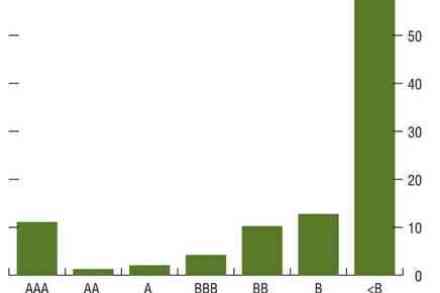
The further revelations about the astonishing costs of the bank bailouts so far indicate just how much taxpayers’ money is now being used to plug the holes in the banking system.  A key cause of the bank crisis is explained by the above IMF graph, charting the decline of some of the trillions of AAA structured credit assets created during the boom.  AAA means “extremely strong capacity to meet financial commitments”, but now over 80% of the US AAA Collateralised Debt Obligations (CDOs) created between 2005 and 2007 are rated BB or lower, somewhere between junk bonds and default (and in some cases almost entirely worthless). In terms of getting things totally wrong this is hard to beat.

Bernanke trashes Brown’s tripartite system

Gordon Brown’s much heralded tripartite regulatory system failed the first time it was faced with a financial crisis, proof that taking away regulatory powers from the Bank of England was a massive mistake. Now, Ben Bernanke — who is trying to secure a second term as Fed Chairman and keep the Fed’s regulatory powers intact — is citing the Brown model as what not to do, telling the Senate banking committee: "[O]ver the past few years the government of Britain removed from the Bank of England most of its supervisory authorities.

Collective failure exposed

The National Audit Office’s report into the government's handling of the banking crisis and taxpayers’ continued exposure is a pandora’s box of financial horrors. The NAO estimate that taxpayers are underwriting liabilities exceeding £850bn and, buried in the document, is the revelation that the FSA and the Treasury gave RBS “a clean bill of health” in October 2008, days before the bank nearly collapsed. Details are scarce and I haven’t seen the relevant Treasury document to which the NAO refers; but this disclosure is astonishing, even by the standards of Fred the Shred, the FSA et al. This crisis was caused not by market failure but by systemic incompetence within the banking’s sectors most regulated arm – the commercial.

Risky business | 3 December 2009

With the largest transfer of liabilities in British history – the insurance of the risk of loss on £240 billion of toxic RBS assets by taxpayers – proceeding, there is worryingly little information being given about either what these assets may be or what risks there are to the taxpayer. Rather than the parliamentary enquiry and detailed disclosure Swiss parliamentarians demanded when UBS needed similar assistance, a small press release noting such exotics as “structured credit assets “ has been issued. The spin continues to be that there is nothing to worry about and all this money will come back fine. Bank of England data shows that UK bank exposure to the US increased increased by over half a trillion dollars between 2004 and 2007 to 1.2 trillion.

Labour’s free for all

The potentially huge exposure of UK banks in Dubai, depreciating some UK bank share prices again this morning, is a reminder of just how much UK bank lending grew in recent years. The above chart shows the growth in external claims of the UK owned banks around the world over the past decade. The sums lent almost quadrupled to nearly $4 trillion in 8 years.  Anyone interested in discovering which bubbles the UK banks (and now taxpayers) have funded can find the data on the Bank of England website - $1.2 trillion in the United States, $125 billion in Spain, $183 billion in Ireland, $50 billion to the UAE/Dubai. Bank profits soared, and the “New North Sea Oil” of booming bonus pools was taxed to fund ever growing government spending.

A nation of property owners

An Abu Dhabian official has briefed Reuters that Abu Dhabi will rescue Dubai on a “case-by-case basis”. The official stated: “We will look at Dubai's commitments and approach them on a case-by-case basis. It does not mean that Abu Dhabi will underwrite all of their debts. “Some of Dubai's entities are commercial, semi-government ones. Abu Dhabi will pick and choose when and where to assist." This is potentially bad news for the UK taxpayer, who faces the prospect of provided further cover for British banks, who invested $50bn in the region at the height of the boom. The reason we're in the firing line?

The coming sandstorm

The FT’s Alphaville blog has published a table detailing foreign banks’ exposure in the UAE. Look away now because it’s horrific. Of course not all of this lending was to Dubai, but those sort of funds are unlikely to be required by Abu Dhabi, with its gigantic oil profits and £900bn wealth fund. If Abu Dhabi doesn’t bail out its ailing partner, you can bet your bottom dollar who will.

Dodgy doings in the desert

Of all the lunacy engendered by this financial crisis, Dubai’s decision to call a six-month creditor standstill on its chief holding company is the most pronounced. Dubai’s successful but hideous entrepot model depends on the confidence capital markets, and as a rule markets don’t react to nasty shocks with a shake of the head and a song and dance routine. It’s as if plague has descended on every stock exchange in the world; investors are fleeing for safety. Overnight, shares in Asia collapsed between 3 and 5 percent, and the FTSE, Dax and Cac40 have opened around one percent down. Prepare for another black day. Will this blip develop into a crisis?

Saving the world | 25 November 2009

Today’s revised GDP data confirms that the UK remained alone of the world’s major economies in recession in the third quarter of this year*. The fact that the UK remains mired in recession long after most economies have recovered makes clear how uniquely badly positioned the UK economy was to handle a downturn.  While some investment banks continue to argue that this performance reflects the inability of the Office of National Statistics to calculate the data correctly, there is good reason to believe that this huge underperformance is grounded in reality. Economic history teaches that bank crises are amongst the worst things that can ever hit an economy. The collapse in credit availability and soaring bank margins have posed very substantial risks to economic growth.