Amazon

Make Bond great again

From our UK edition

One of the great recurring James Bond tropes is to make it look as though 007 has actually been killed before the film’s title credits. You Only Live Twice, From Russia with Love and Skyfall all begin with Bond in a position where his demise seems inevitable. Of course, he always turns up alive. (Quite what the rest of the film would consist of if he didn’t is anyone’s guess: perhaps Moneypenny dealing with probate or M arranging one of those ghastly direct cremations.) Now, however, we may have reached a danger from which even Bond cannot wriggle out. Amazon, the company responsible for one of the biggest flops in TV adaptation history, the Middle-earth prequel series The Rings of Power, has paid more than $1 billion to take ‘creative control’ of the Bond franchise.


The economic blackout movement trying to stop capitalism in its tracks

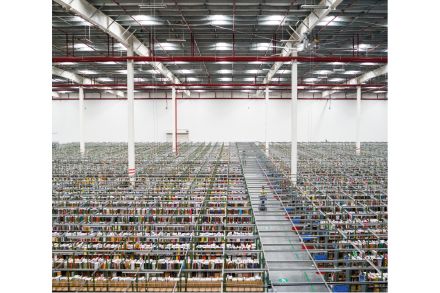
For weeks, I’ve been seeing calls for a February 28 “economic blackout” spread across my social-media feed like dandelion tufts in the wind. From midnight on February 27 to the following midnight, anyone participating in the blackout should avoid spending money at Amazon, Walmart or Best Buy. Do not buy fast food or gas, says “the People’s Union,” which is organizing the blackout. Don’t shop at major retailers. If you have to shop, make it only for essentials, like food to feed your kids, and emergency supplies, and only do it at small, local businesses. It’s possible I could participate in the blackout by accident, but I wouldn’t ever do something like this willingly. Obviously, I’m not the target audience.

oligarchy tech capitalist pigs

The shockingly earnest anti-comeback of Tom Green

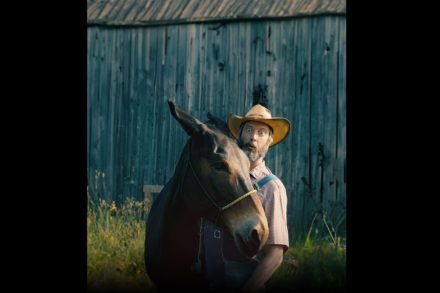
If you grew up in the 1990s and early 2000s as a Generation Xer, you either loved or hated Tom Green. You saw him as either some pioneering prankster and innovator of the cable-news troll or an obnoxious man-child desperate for attention. The truth lies somewhere in the middle, but Green’s influence on internet culture and podcasts such as Joe Rogan’s is undeniable. But then one day it just felt like he went away, much in the same way Dave Chappelle did. And just as online streaming platforms such as Netflix threw a ton of money at Chappelle, Amazon has now done the same with Tom Green. This doesn’t, however, feel like a Tom Green comeback.

Why we dramatize history — and why we should stop

A few weeks ago, a friend asked if I had watched the Newsnight interview with Prince Andrew. That interview, yes — the one with all the sweating and the pizza in Woking, in which he definitely didn’t meet Virginia Roberts Giuffre but he did single-handedly crash his reputation, and Emily Maitlis, like the Medusa of journalism she has since become, just let him tie his own noose. Of course I’ve watched it. I’m a journalist. And a twenty-first-century citizen. Who hasn’t? My friend, for one, though she pointed out that she can just watch the three-part Amazon dramatization of the whole affair, A Very Royal Scandal, which is even juicier than the interview. (“I’m the son of the sovereign,” bellows the Duke of York, played by a soapy Michael Sheen.

history

Do you have a ‘story’?

From our UK edition

As someone who worked full time in the office for 24 years and has now worked full time from home for nearly 21 – always, in both periods, on the staff – I can see both sides of the argument. But I do think the sequence matters. I would have had no idea how to work for my employers if I had begun at home. Indeed, the entire concept of a newspaper then – and even, to a large extent, now – depends on its collective capacity to find, write and edit news fast. Much of that stimulus comes from being in the same building. On Monday, Andy Jassy, the CEO of Amazon, wrote a longish letter to all employees about work methods. He praised his company’s ‘culture’, but asked whether it is best set up to ‘invent, collaborate, and be connected enough to each other’.

How did we ever come to accept the inhumane excesses of capitalism?

From our UK edition

What was neoliberalism? In its most recent iteration, we think of the market seeping into every minute corner of human existence. We think of privatisation, off-shoring and the parcelling out of services to the highest bidder. Neoliberalism takes the proud liberal individual – in pursuit of his or her happiness, rather keen on freedom – and shreds them through a mean-spirited calculator to come up with some sort of shrunken market midget, an efficient risk-evaluating robot. Neoliberalism takes the proud individual and shreds him or her through a mean-spirited calculator Yet even though the market is supposed to be the arbiter of everything, repeated state intervention appears to be necessary to sustain this otherwise perfect economic vision.

This month in culture: June 2024

The Fall Guy In theaters now Ryan Gosling’s career is rather bizarre if you think about it, from drippy romcom protagonist in The Notebook to brooding car noir hero in Drive to laughable failure in The Nice Guys to musical star in La La Land and Barbie. Now he takes a stab at renewing his hardass ways in The Fall Guy, an adaptation of Lee Majors’s 1980s series which pairs him with Emily Blunt and is, in a way, an homage to the careers of “stars who do their own stunts” even if Gosling does not do so himself. There’s even a stunt show planned for Universal Studios’ Hollywood theme park based on the movie, prior to its release.

culture

Was 2023 the year of the labor union?

It is only fitting that the low point of the American labor movement occurred in 2009, the Year of the Rat. The Great Recession may have started with Wall Street speculation in the housing market, but your average American had most likely never heard of Henry Lehman or his siblings until the day Dick Fuld drove the 150-year-old bank bearing their name into the ditch. But General Motors, Chrysler? Cars, even more than Hollywood, jazz and the semi-automatic rifle, are the quintessential American business. How could those get driven into the ground? As soon as freshly evicted homeowners finished packing the remains of their subprime split-levels into the backseats of their battered Tahoes, they went looking for culprits. They settled on the United Auto Workers.

labor

The Criterion Collection gets with the times

On the 100th birthday of Federico Fellini, Martin Scorsese reflected on his love of the iconic Italian filmmaker in a cover essay he wrote for Harper's magazine. The essay begins by pushing back against a particular excess of the modern film industry, which is “content.” Following his criticism of the predominant Marvel Cinematic Universe as “theme park movies,” Scorsese aims at streaming services for relying on automated algorithms to determine what viewers want to watch. He then praises platforms that emphasize more curation. One of them is the Criterion Channel, a service that is part of the Criterion Collection, a physical media boutique that specializes in the restoration of classic and contemporary cinema.

Should I have had a sensitivity reader review my book?

Reason magazine reported last summer on the rise of sensitivity readers, and publishers have made headlines for their plans to release sanitized versions of Roald Dahl's and Ian Fleming's works. I’m not sure what’s more depressing: the fact that publishers are hiring sensitivity readers to purify these books, or the fact that I probably should have had one review my books before they were published. In an ideal world, sensitivity readers would be in as much demand as Betamax repairpersons. But we do not live in an ideal world. We live in a world full of hypersensitive Twitter users who relish finding offense in the unlikeliest of places. Hence the proliferation of sensitivity readers, or "authenticity readers" as they’re sometimes called.

sensitivity

Is Dan Snyder finally about to sell the Washington Commanders?

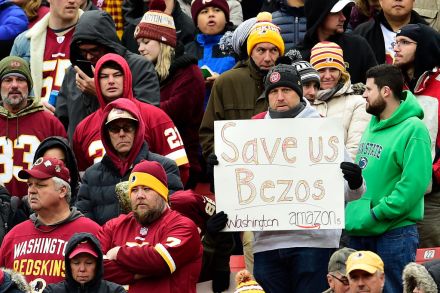
The early months of the NFL off-season are typically flush with intentionally misleading and openly manipulative media reports about how teams, free agents and draft prospects regard one another. This year, with an embattled franchise owner weighing his options about a potential sale, it's the billionaires, and also the millionaires, who are having their plans and motivations guessed at. Since November, Washington Commanders owner Dan Snyder has been making moves indicating that he's trying to unload the team he's owned for nearly twenty-five years. For many, the logical buyer is Amazon founder Jeff Bezos.

jeff bezos washington commanders

Is Amazon wasting Phoebe Waller-Bridge’s talents?

From our UK edition

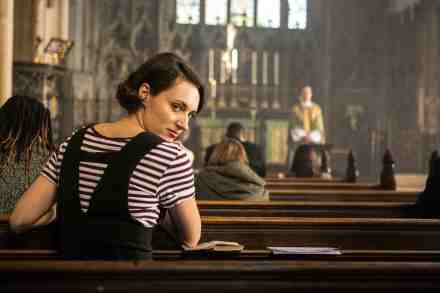
The Tomb Raider franchise seems to have been a graveyard for oddly overqualified people. Angelina Jolie played the character of Lara Croft twice after winning an Oscar, and subsequently Alicia Vikander gave the English aristocrat-turned-global adventurer a go. Neither left much of a mark – which is why it is all the more surprising that Fleabag creator and star Phoebe Waller-Bridge is to write the scripts for a new Amazon series based on the video game. It has been wryly observed that, despite her heroics in the forthcoming Indiana Jones film, Waller-Bridge herself is not expected to play Lara Croft. That’s a disappointment for those of us who would enjoy a mixture of arch smirks to the camera and jokes about kinky sex from the globe-trotting, shorts-clad daredevil.

The heart of The Rings of Power

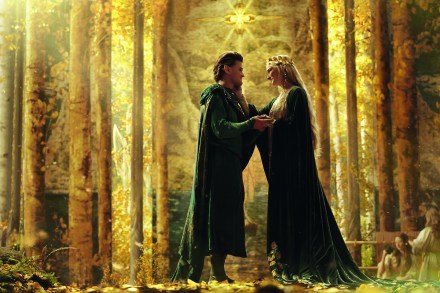
“Ours was no chance meeting. Not fate, nor destiny,” Galadriel says. “Nor any other words Men use to speak of the forces they lack the conviction to name.” The line is a bit pompous, but then so is the hotheaded elven warrior (Morfydd Clark) who speaks it in Amazon’s Lord of the Rings: The Rings of Power. Pomposity aside, Galadriel’s words reveal why the work of J.R.R. Tolkien is unique in a crowd of fantasy competitors. Anyone can give us elves and dragons and wizards. But few can match the anguished, longing note of hidden Providence in Tolkien’s Middle-earth. The Rings of Power has not yet achieved such depths of feeling — perhaps it will not be capable of doing so — but it has shown prudence in its stewardship of the story’s heart, which is encouraging.

lord of the rings of power

Amazon’s Lord of the Rings series is brimming with ponderous aphorisms

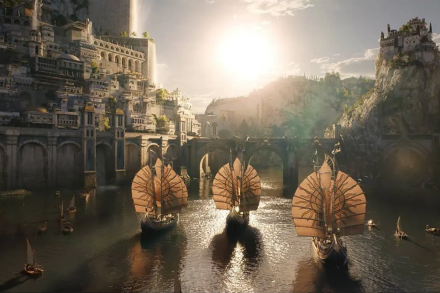
Amazon’s much-heralded Tolkien prequel The Lord of the Rings: The Rings of Power began by answering a question that has puzzled humankind — and possibly elves — these many millennia. Why is it that a ship floats and a stone doesn’t? The reason apparently is because "a stone sees only downward," whereas a ship has "her gaze fixed upon the light that guides her." And this, I’m afraid, set the tone for much of the dialogue that followed in the two episodes released so far — as, to their credit, the characters managed to exchange an endless series of ponderous aphorisms without giggling.

lord of the rings

The fight for a $15 minimum wage is won

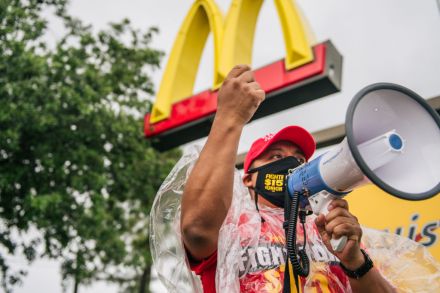
The fight for a $15 minimum wage started in 2012 with a bang. Hundreds of Walmart, port, and fast food workers walked off their jobs in protest of low wages. An organization called Fight for $15 formed in 2014 following two national strikes by laborers. Seattle became the first city to require a $15 minimum wage that same year. The White House issued an executive order that required new federal contracts to include a $10.10 minimum wage because legislation had stalled in Congress. The stalled federal push led to more state and local action. California and New York put together slow-rising $15 minimum wage laws in 2016 and 2017. Eight other states, mostly in New England, followed with plans to reach a $15 minimum wage by 2026 at the latest.

Gas prices are the new Covid

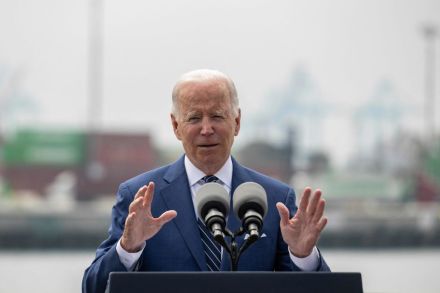
Soaring gasoline prices (they’re up 49 percent since President Biden took office) are due to “Putin’s price hikes,” claims Biden. But last I checked, Putin wasn’t stateside canceling the Keystone XL Pipeline, pursuing efforts to end federal oil and gas leasing programs, and careening our country toward more Covid-like lockdowns, social isolation, supply chain shortages, and another summer crime wave. A brief recap of Biden’s oil and gastastrophe: in January 2021, during his first days in office, the president revoked the Keystone Pipeline permit and issued an executive order that, in his own typically eloquent words, directed the “Secretary of the Interior to stop issuing new oil and gas leases on public lands and offsh- — and offshore waters, wherever possible.

My childhood Cold War fears are back

From our UK edition

On the day before my seventh birthday, which I spent at my grandma’s in Yorkshire, a young man named Raymond Jones walked into North End Music Stores in Liverpool and asked the guy behind the counter for a record on which an obscure local group called the Beatles provided the backing track for a song titled ‘My Bonnie’. The guy behind the counter was the shop’s manager and the son of its owner. His name was Brian Epstein, and as a restless budding entrepreneur he felt he should be alert to what was going on around him. Because of young Raymond’s evident enthusiasm, Brian made a note on a piece of paper saying: ‘The Beatles? Check on Monday.’ Which he did. Intrigued by what he saw, he wondered if he should become their manager.

Beware the risks of tyrannical tech

“Just think about it. Our whole world is sitting there on a computer. It’s in the computer, everything: your, your DMV records, your, your social security, your credit cards, your medical records. It’s all right there. Everyone is stored in there. It’s like this little electronic shadow on each and every one of us, just, just begging for someone to screw with, and you know what? They’ve done it to me, and you know what? They’re gonna do it to you.” — Sandra Bullock as Angela Bennett, The Net, 1995 A few weeks ago, I called the local Domino’s. The man who answered asked whether my address is an apartment or a private residence. I live in a fairly remote Michigan community of about 8,000 people.

On receiving books in the mail

I receive a lot of books in the mail. Perhaps you do, too. Some of these I order. Most come from publishers or authors hoping for a review. A few are gifts. I prefer to buy books at used bookstores. You never know what they might have on hand, and there’s nothing better than discovering a gem of a book by a writer you’ve never heard of. Plus, the price is always right. Independent bookstores are great, too. I’m no snob. I bought a book just the other day at the gamified Barnes and Noble in town — the atrociously overrated Call Us What We Carry by Amanda Gorman, who read at Joe Biden’s inauguration (more on that at some point, perhaps). But I prefer independent bookstores because, like at used bookstores, there’s an element of surprise in the store’s stock.

mail

Do we still need explorers today?

From our UK edition

In November 2017 Benedict Allen found himself at the centre of a media frenzy. He’d been in Papua New Guinea (PNG) on a one-man expedition and hadn’t been heard of for weeks. Declaring him ‘lost’, several papers turned on him, accusing him of being overprivileged and imperialistic. One even suggested the whole thing was a stunt. It didn’t help that he was picked up by a helicopter, sent by the Daily Mail. This was a story the paper’s rivals wanted to spoil. Explorer is Allen’s account of that journey and how it all began. It’s no excuse or apology, but is written with anger and passion. The story begins in adolescence, with a boy who was idealistic, stubborn and determined to travel the world alone and in his own way.