-
AAPL
213.43 (+0.29%)
-
BARC-LN
1205.7 (-1.46%)
-
NKE
94.05 (+0.39%)
-
CVX
152.67 (-1.00%)
-
CRM
230.27 (-2.34%)
-
INTC
30.5 (-0.87%)
-
DIS
100.16 (-0.67%)
-
DOW
55.79 (-0.82%)
I’ve lost control of the kitchen
Looking back, I can pinpoint my fatal blunder. It was lunch. It was like the West allowing Vladimir Putin to help himself to the Crimean peninsula without a peep, basically. This is how it happened.
My husband had invited two families to stay over the May bank holiday which bled into half term. For four days. ‘Don’t worry,’ he said, in light tones, ahead of their arrival. ‘I’ve told them they’re bringing all the food and doing all the cooking.’ As if I’d welcome this wonderful idea, when in fact what he’d suggested was the domestic equivalent of handing over the nuclear football and the codes behind my back.

The guests are delightful and I couldn’t wait to have them all (five adults and five children), but guests handling the catering was never going to happen under my roof, as my husband ought to have known.
One, I am a fast and capable cook. I came second to Ed Balls in the final of the BBC’s Celebrity Best Home Cook series (and maintain that he won because he made a pirate cake with full sails out of chocolate and he blubbed). Two, if an Englishman’s home is his castle, the female equivalent of the White House Situation Room is a woman’s kitchen.
The last thing I needed, in other words, was several other bossy middle-class parents occupying my catering HQ on Exmoor. Plus, I’d already ordered a van-busting home delivery from Sainsbury’s. On the Art of War principle that ‘supreme excellence consists of breaking the enemies’ resistance without fighting’, I replied: ‘Oh no, don’t worry! But maybe they can do lunches?’
Category error on my part. Perhaps I’m late to the party here but, as it turned out, the families didn’t really have a concept of ‘lunch’ as a separate meal, after breakfast and before supper. They simply prepared and ate fare whenever they or their children were hungry, which was, of course, all the time.
In more civilised places than the Johnson compound, i.e. Provence or Tuscany, when you have 12 people for four days it’s understood that one of the ‘main’ meals will be ‘out’, i.e. at a restaurant to spare mine hosts, and the convention is that the guests stump for this. But the farm is two miles from Tarmac. It’s an hour round trip for a pint of milk. A two-hour round trip to a pub. All meals are eaten in and none are ‘opt’.
The last thing I needed was several other bossy middle-class parents occupying my catering HQ on Exmoor
On day one, everyone arrived at teatime after extended drives on the M4 and M5. We had tea and cake, and a late-ish supper. So far, so good. Two meals down!
Day two was different. When provisioning, I’d texted my husband’s nephew to ask what his three heavenly girls ate for breakfast. ‘Bacon eggs toast juice fruit yoghurts porridge etc,’ came the detailed reply. I therefore rose at 8 a.m. to slam the first tray of bacon in, yet there were people refilling the coffee jug and boiling eggs and stirring porridge at elevenses. Still, the guests did a fine clear-up and cleared off with the kids to a local beauty spot while I made scones for tea.
Everyone returned from Tarr Steps at 1 p.m., making noises about their lunch duty, and invaded the kitchen. For hours. With what I felt was superhuman restraint – I can make an apple crumble in five minutes flat, and on Best Home Cook I made crab ravioli on a bed of fennel with a citrus jus from scratch starting with flour and water for the homemade pasta in 35 minutes – I only said ‘But how long does it actually take to boil rice?’ loudly around three times.
At 3 p.m. (!) there was a simple lunch of delicious dahl (brought from London in Tupperware) and the rice on the table. As I shovelled it in, I worked out that at this rate, there would be half an hour until tea; tea would run straight into children’s supper; and then adult supper. I had an awful vision of us all mealing non-stop till bedtime. I therefore put my fork and foot down and made an announcement. First, there would be a ‘breakfast window’ of an hour. As it was already past 3.30, I went on, we would have the scones for pudding. This went down well.
So I went to the kitchen to fetch the scones. It was then that I discovered a full tray of chicken pieces in the Aga bubbling in their juices. Genuinely panicked, I returned laden with the scones, Rodda’s and jams.
‘And what meal is all the chicken in the Aga for?’ I queried, brokenly. The table fell silent. ‘Oh I put them in, just in case the children were hungry… later,’ one perfect guest replied as a dozen arms shot out to grab the scones as if they’d been deliberately starved by colonial aggressors for months.
I sank to my chair and applied golden, crusted Rodda’s thickly to my scone. It was clear there’d still be a whole other meal ‘later’, i.e. between now and children’s supper and, after that, two more days of culinary occupation. On day three the dishwasher flooded. On day four, the Aga went out as if in protest and could not be relit.
Looking back, yes – it was lunch. Lose lunch, and you’ll be out-generalled in your own kitchen by a chicken traybake.
The guest who robbed me of my five-star rating
Bolting down the back hallway, I realised I was running away from the guests. I shut the door marked private and collapsed on to the dirty old dog sofa in the boot room.
‘You’ll never guess what I’ve done,’ I texted the builder boyfriend who was in London. ‘Left the yard hose on,’ he texted back, for I often risk emptying the well when I’m on my own by forgetting to turn off the stable yard tap after topping up the horses’ water at night.
‘No. Worse. The French people arrived and I hadn’t heated the water. You’ve got to get it on a timer,’ I said, attempting to blame him. ‘I’ll do it when I’m back,’ said the BB. Then: ‘Have you turned the yard hose off?’
Had I? I ran outside to check, vaguely aware there were guests calling me from the other side of the private door to ask for something unreasonable.
Like my hero Basil Fawlty, I find myself either running away or being horribly sarcastic. For example, as no one eats normally any more, when people start questioning the bread in the morning, and when even the gluten-free option doesn’t end the debate, I mutter: ‘There’s some nice grass outside…’
Luckily, they are too busy rejecting everything on allergy, environmental and/or humanitarian grounds to hear me. All the English want to talk about is their food ethics and intolerances. All the Americans want to talk about is whether you’re going to install a geothermal heat pump. After 20 minutes of either you’re praying for death. The French, German and Dutch travellers are the best. They don’t want to talk about anything. They just want you to leave them alone, if possible, by disappearing in your own house.
When he is here, I push the BB out in front of me. But he is often working in London, the lucky sod.
A man from Hawaii arrived, after telling me on the booking system I was not where I said I was because Google Maps disagreed.
After checking in, he tried to plan a journey to the nearest harbour town that was a 15-minute drive from the gates of the house – but by a Google route, which was sending him a convoluted way that would take an hour yet which looked direct when viewed by a satellite in space. He argued for an hour until I told him his way looked better, and he set off. He came back later, happy to have got lost.
The West Cork clientele mostly come to see something they call nature, mistaking cultivation and industrial farming for accidental greenery. This makes them largely lefty, eccentric to say the least.
‘Your dog has told me he needs healing – I’m a shaman,’ said a ditzy Canadian girl. She came down from breakfast on a cold morning in a pair of skimpy shorts and declared she was looking for an Irish farmer to marry her. ‘Can you cook?’ I asked.
‘It’s his liver,’ she said, feeling up the spaniel. ‘Is it? Is it really?’ I said, as she knelt beside him groping his chest. ‘And his liver has moved all the way up there?’ She made a face and kept feeling.
‘He’s got a blocked tear duct, as I’m sure you know, so if you could sort that it would save me the vet bill,’ I mumbled. ‘There, he is healed!’ she declared, as Dave wandered off.
She said she wanted to keep a pet cow and commune with it. I said I didn’t think her new Irish farmer husband would agree, but she wasn’t listening.
Now and then a reader comes and we have a brief respite. It’s like meeting old friends. But mostly, Basil was right. You realise you’re trying to no avail, so you may as well indulge yourself.
A young couple from Mumbai arrived with a lot of suitcases. He was something big in cashew nuts and said it would have been better if our house was an hour closer to Killarney. ‘I’ll see if we can get someone to move it,’ I said, and he laughed, but I wasn’t joking.
He had ignored instructions to input my Eire code into his satnav, and tried to import the Airbnb dropped pin locator to Google, which was showing a rough idea of the location as a dot in the village half a mile away. Naturally, he ended up at the supermarket.
‘You really need to get this sorted,’ he said, as his girlfriend petted the dogs. ‘Well we did sort it but you unsorted it,’ I murmured.
The man from Hawaii also rejected my Eire code and informed me that, according to Google, I lived in a different place in Galway. I told him to follow the Eire code nonetheless and come to this house, as he might enjoy it.
They sometimes try to arrive by bus and order Ubers that don’t exist. I offer to pick them up from the bus stop. ‘No, I’m a walker. I want to walk,’ said a Swedish girl in her twenties. On the day, her message read: ‘Please help me! I can’t walk any further!’
She had made it 100 metres up the first vertical West Cork hill and was sitting sweating on the steps of the church with a large wheelie case when I found her.
They were all giving us five-star reviews for a while, until the lad from the Midlands who arrived looking miserable, left looking miserable, and decided to rate us four stars, which instantly downgraded us to 4.92.
I nearly cried when I saw the gold laurels removed from the listing for our best room. No amount of newer reviews giving it five stars seems to budge the rating far enough to get our gold laurels back. I’m stuck at 4.94 because of one depressed Brummie. As Basil would say, this… is… typical.
In praise of camels
Laikipia, Kenya
For decades now I have kept only cattle, goats and sheep on the farm, but for the first time this week, we have a herd of dromedaries browsing in the valley. To see these beautiful creatures moving through the acacia woodland is a pleasure – and I reckon a shrewd move on my part. Camels nibble back the thick bush, which allows the pasture to sprout in the sunshine, which is good for my cows. Camels bellow yet smell sweet. They have rabbit lips with which they lovingly nibble your collar, big giraffe eyes and long, tarty eyelashes. Camels let down their milk long after cattle udders have shrivelled up in a drought. Goats are hardy but nibble bushes to the stump, whereas sheep tear grass out by the root and seek any excuse to die. A camel tends to browse only the higher branches, its soft-padded feet do not scour the ground and erode the soil like a cattle track, and it can survive for three weeks without going to water. ‘A camel man is a man,’ the Somali nomads say, ‘but a goat man is half a man – and a cow man is no man at all.’
Cyclical droughts in East Africa have been killing ever more cattle, leaving pastoralists destitute and forcing them to the margins of towns to find work as night guards, corner boys and hustlers. These youngsters are often out of sorts and, being from the poorest communities, few have the chance of an education that will help them in life. They are disinclined to take up hoe or spade and they can become angry at the modern world. Yet they are the sons of Africa’s best stockmen, who for centuries bred the finest humped Boran cattle, fat-tailed Blackhead Persian sheep worthy of an Old Testament sacrifice and the superb, snow-white Galla goat.
Some of the camel herds on the farm now are Somalis, and the Somalis are the greatest of camel men, whose poetry focuses on about three things – love, war and camels. The Somalis joke that the camel was the last animal created by Allah, who in his fatigue stuck the head of a giraffe on to a body with a lion’s skin and then, as it shuffled away, he threw the organ of a man at the camel’s rear so that it stuck on backwards. There are more camels in Somalia than anywhere on Earth and many have spilled over into Kenya, providing a diet of meat, very healthy milk and an excellent method of transport. Even their hair can be used for weaving – as anybody knows after sleeping under a Bactrian blanket from Mongolia.
Having camels on the farm awakens happy memories. My father was obsessed by camels. He made many journeys on them across Africa and Arabia’s bone-strewn deserts. In the second world war, he led a band of camel scouts on the coast of the Bab el-Mandeb Strait and spotted a surfacing Italian submarine, the Galileo Galilei, which was then captured by the Royal Navy. At my childhood home, the place was piled with camel bells, stirrups and saddles, Afar knives, the smell of sand, rancid butter, commiphora resins and tribal leather. When he was off to the Sahel he insisted on interrupting French lessons with my astonished tutor. ‘Les hommes soufflent dans le vagin du chameau pour voir si elle est enceinte!’
The Somalis are the greatest of camel men, whose poetry focuses on about three things – love, war and camels
In his eighties Dad teamed up with my elder brother Kim to persuade Maasai pastoralists in the borderlands between Kenya and Tanzania to begin raising camels, since there was none there. Decades later as one drives through that country, the place teems with them. Kim and Dad had a camp near a dry riverbed, and after a day out herding with the pastoralists we would build a fire, slaughter a goat, eat together and sleep in a circle around the dying embers. Sometimes there was little food and we lived on tea and chapatis – and, when we ran out of flour, just a bag of dried onions. On a long walk when our camels bolted with the baggage after they got spooked by a lion or a puff adder, we relied on water from puddles soupy with filth. We improvised tea by brewing up a concoction made from a local Maasai shrub and we treated the water with wood ash to flocculate the muck and offset the tang of cow dung. Tasting it with a loud smacking of his lips, Dad said contentedly: ‘Ah, well. As the Arabs say, life is like a cucumber. One day it’s in your hand, the next it’s up your arse.’
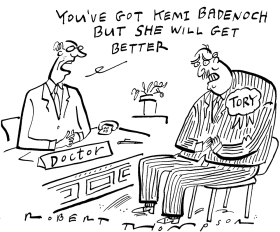
Life in 2025 is like a cucumber in all ways, I think, as I listen to the camels bellowing at nightfall a little distance from where I am writing this.
Bridge | 14 June 2025
Gunnar Hallberg is a tall, big-boned Viking of a player, who, three decades ago, decided to cross the North Sea to raid the high-stake bridge clubs of England. He’s lived here ever since, and Sweden’s loss, it turns out, has been our gain. He’s gone on to represent England numerous times in European and world championships (twice winning gold in the Seniors), and is a popular figure who’s always willing to lend his time and expertise to lesser players.
Now aged 80 (you’d never guess it), he’s still going strong, still playing for the England seniors and still a fearsome opponent at the rubber bridge table. You can find him at TGRs in London most weeks, and the game is always more fun when he’s in it. This deal cropped up recently; the stakes were £30 (per 100 points):
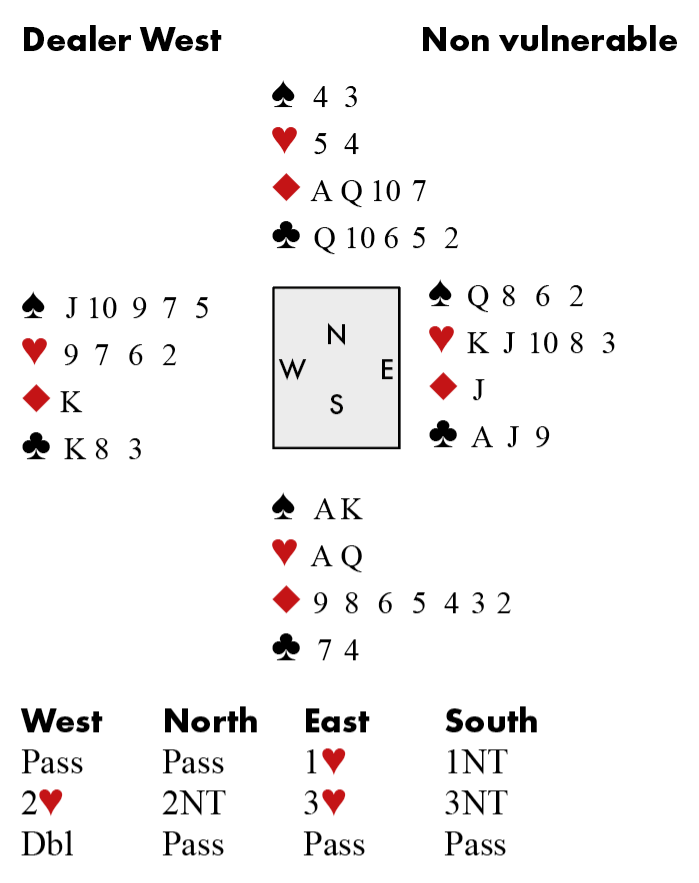
Gunnar’s 1NT overcall was a classic psyche: after seeing his partner pass, he pretended to have a strong balanced hand, intending to run to 2♦️ if doubled. It was what happened next that was so unusual: not many players would bid on to 3NT and then pass a double! When his partner bid 2NT over West’s 2♥️, however, Gunnar knew he must have seven or eight points. Those points were most likely in the minors. And he surely had length in the minors too, as he hadn’t overcalled 2♠️. So over East’s 3♥️, he bid 3NT.
West, as it happens, was the former England international Robert Sheehan, a superb and solid rubber-bridge player. But Gunnar didn’t panic-run. 3NT, he worked out, had as good a chance as 4♦️. And when Robert led the ♠️J, he was soon claiming 11 tricks and +750. Fortune favours the brave, as every Viking knows.
How to ruin a city
Why would you choose to make a city crappy? Plenty of cities don’t have much going for them. But when they do, it takes a certain amount of skill to actively wreck them.
Take London, for instance. Anyone in charge of our capital needed only to maintain it, if not improve it. Yet in almost a decade as mayor, Sadiq Khan has overseen a decline which is obvious to any resident or visitor.
That first sign of rot – the tolerance of minor crime – is everywhere. It might be graffiti on the Tube. Or it might be the fact that it is risky to hold a mobile phone in the street or park a bicycle. Khan’s police aren’t interested in minor crimes such as phone and bicycle theft. And they’re not much interested in major crimes either, such as stabbings.
Yet somehow, it doesn’t matter. Khan was re-elected mayor last year, and this week he went off to Buckingham Palace to become Sir Sadiq.
It’s a similar story with Gavin Newsom in California. He has been governor of America’s most beautiful and prosperous state since 2019, and won re-election in 2022. Before that he was mayor of San Francisco, which should be one of the world’s most beautiful cities. But Newsom has a skill for wrecking everything he touches.
During his mayoralty, San Francisco became ever more dystopian. The rich would descend from unaffordable apartment complexes on to once-desirable streets where the ‘unhoused’ roamed around on crack and exposed themselves furiously. It became perfectly normal to walk down any road and think you must have been transported into a zombie movie, with the undead pushing around trolleys of their possessions. Under Harvey Milk in the 1970s, San Francisco famously cracked down on dog littering. By Newsom’s time as mayor the one thing you could say with confidence was that whenever you saw faeces on the streets, it didn’t come from a dog.
Yet from the time of his election as governor, Newsom tried to roll out his San Francisco model across the state. The policies that had done for San Francisco and then did for Los Angeles include (in no particular order) incentivising illegal migrants to come into the state, ensuring that homelessness is encouraged and home-ownership punished, legalising just about every mind-altering substance known to man and presenting law enforcement as the enemy of the people.
If you encourage lawlessness you can be seen to be doing it for all the right reasons
Of course Newsom did all these things under the same glorious cover that Khan wears – that great cloak of left-wing ‘compassion’. Law enforcement is easy to present as lacking in compassion. Making a city a ‘sanctuary’ allows politicians to present themselves as ‘kind’ and filled with ‘empathy’. Saying that illegality cannot be allowed is ‘mean’ and ‘unkind’. Promote mass illegal migration? ‘Healing.’ Try to stop it? ‘Divisive.’
Most of the problems in America, as in Britain and Europe, can be chased down to this asymmetry. If you encourage lawlessness you can be seen to be doing it for all the right reasons. If you encourage following the law you will be portrayed as doing it for all the wrong reasons. Allow people to break the law on a grand scale and there is no punishment. Try to mop up that mess and you will be the bad guy.
So it is with the stand-off between Newsom and Donald Trump. Conservative estimates suggest that between ten and 12 million people entered the US illegally in the four years of Joe Biden’s presidency – almost doubling the number of illegals in the country. Trump has already fulfilled his campaign promise of sealing the southern border, so that the number still breaking into the country via that route is effectively zero. But he is also intent on fulfilling his campaign promise of removing the people already in the country who shouldn’t be. He and his border tsar, Tom Homan, have made it clear that they are prioritising the removal of the more than half a million illegal migrants who are thought to have criminal records.
On a good day the Trump administration has managed to deport around 800 illegals. But you can do the math yourself on how long it would take to complete the task. At the current speed, assuming there are no more legal or physical challenges, Trump and Homan might be able to deport all the illegal migrants with a criminal record by 2027 or 2028. If they want to deport the millions who came in between 2020 and 2024 alone, President Trump would have to remain in office for years, if not decades. Which is not actually a proposal.

The unrest that broke out in Los Angeles this week was not even the result of Homan’s team simply detaining illegal migrants. They were seeking people who were engaged in criminal activity. But the unwiser parts of the American left decided to assume their normal position. They blamed law enforcement for causing the problem and pretended that the resulting violence was peaceful. All this as the public could see footage of masked left-wing activists spitting in the faces of policemen and throwing stones at them.
Now Trump has sent in the National Guard and Marines and told ‘insurrectionists’ that ‘if they spit, we will hit’. Newsom, Hillary Clinton and other Democrat bigwigs are pretending that it is Homan, Trump and law enforcement who are the bad guys, while the people burning cars on the streets and looting the local Apple store are merely reacting to the provocation.
Which brings me back to that central imbalance of our time – in the US as here. Why is the person who caused the mess allowed to be presented in the kindliest light, while the people trying to clean up after them must be portrayed in the crappiest?
My plan for Prevent
In the autumn of 1940, British cities were being bombed every night by large aeroplanes whose provenance was apparently of some considerable doubt. While the public almost unanimously believed the conflagrations to have been caused by the Luftwaffe, the authorities – right up to the government – refused to speculate. Indeed, when certain members of the public raised their voices and said ‘This is all down to Hitler and Goering and the bloody Germans!’, they received visits from the police who either prosecuted them for disturbing the peace or put their names on a list of possible extremists.
The nights grew darker. The number of towns and cities subjected to these nightly bombardments widened. Very soon everybody in the country knew somebody whose home had been destroyed or who had themselves been killed. The government was forced to take action, and so in November 1940 it came up with what it called its ‘Prevent’ strategy, which aimed to protect British cities from further destruction.
In the introduction to this new policy, civil servants listed possible vectors for these bombing raids and top of the list, by some margin, were the Slovaks. A senior intelligence officer told the public: ‘The greatest threat to our nation today is from the Slovaks. We must train our people in how to spot Slovaks and report them to the police whenever they can.’ The Germans were also mentioned, further down the list of possible perps, but the wording here was heavily caveated. Yes, some Germans may have been involved, but over all the German population was utterly devoted to peace and regretted the nightly infernos every bit as much as did the people who suffered under them. Our own air force was directed to drop its bombs on Bratislava, Kosice, Poprad and (the consequence of an understandable confusion over the names of the two countries) Maribor. And yet for some mystifying reason, the raids on Britain did not lessen.
This seems to me exactly the response of our government(s) and most importantly of Prevent to the threat from Islamic terrorism. Let me be clear: I am not remotely comparing Muslims with Germans or Islam with National Socialism – I am simply saying that, in effect, this is what our government would have done in 1940 if it had been gripped by the same cringing witlessness and outright lying that possesses seemingly all of our authorities today when it comes to terrorist attacks upon the British people.
You may be aware of the manifestly stupid quote from the Prevent halfwits that people who believe that ‘western culture is under threat from mass migration and a lack of integration by certain ethnic and cultural groups’ are cultural nationalists at risk of becoming the kind of extremists who end up murdering people. People who believe the above probably consist of 70 per cent of the British population and, if his latest speeches are anything to go by, include the Prime Minister. And yet this stuff pervades everything Prevent puts out, while at the same time exonerating Islam and in some cases even those Muslims who do become terrorists (because they have suffered, you see).
If people who support Brexit or worry about immigration are extremists, you’re going to get pretty high figures
So, for example, Bolton council’s useful ‘Prevent’ handbook singles out ‘right-wing extremists’ as being at the forefront of terror attacks in the UK, and these extremists include people who are cultural nationalists: ‘Cultural nationalism is ideology characterised by anti-immigration, anti-Islam, anti-Muslim, anti-establishment narratives, often emphasising British/English “victimhood” and identity under attack from a perceived “other”.’ Islamic terrorism is also mentioned – but, again, heavily caveated. Then there’s Prevent’s own list of people who were picked up under its guidelines: 45 per cent were related to extreme right-wing radicalisation (230); 23 per cent were linked to Islamist radicalisation (118); the rest were related to other radicalisation concerns, including incels and those at risk of carrying out school shootings.
But then I suppose if people who proclaim their support for Brexit or worry a bit about immigration are extremists, you are going to get pretty high arrest figures. If you add into the mix the fact that simply to associate Islam with terrorism you are guilty of Islamophobia, then you can see why we’re in the state we’re in. Incidentally, when she was Prime Minister, Theresa May, to her credit, drafted a new introduction to the Prevent guidelines which made it clear that the biggest threat to British security was al Qaeda, not Tommy Robinson et al. But that message does not seem to have sunk in with those in Prevent.
It seems almost pointless to run through the facts. The truth is that almost every fatal terrorist attack in Britain since 2001 has been perpetrated by Islamists. All bar three. Have these people got a twisted or perverted understanding of Islam, as Prevent insists? I haven’t a clue. I am no Quranic expert. I’m just, y’know, taking their word for it. Further, 80 per cent of the Counter Terrorism Policing network’s investigations are related to Islamism (2023). Some 75 per cent of MI5’s surveillance cases are Islamists. There are around 40,000 potential jihadis being monitored by our security services. There is not the remotest doubt as to the provenance of the gravest terror threats to our country. It’s not the shaven-headed nutters with swastika armbands. It is Islamists.
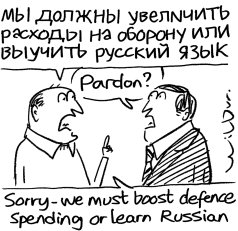
Nigel Farage’s answer is to sack everyone working in Prevent. That seems a perfectly reasonable suggestion. But I may have a better one. Scrap Prevent entirely and initiate a new network of monitoring and reporting which focuses solely on Islamic terrorism. Junk the sixth-form philosophising over what is meant by the term ‘extremist’ and locate the problem precisely where it is: somewhere within our Muslim communities, even if we accept that our Muslim communities may not want them there. In short, get real and tell the truth. This kind of approach worked pretty well 85 years ago.
How to game the social housing system

John Power has narrated this article for you to listen to.
Westminster council has announced that every single social housing tenant in the borough will receive lifetime tenancies. No test of need. No review of income. No incentive to move on. Once you’ve been awarded a property, you can stay as long as you like. When you die, your adult children may be eligible to inherit the lifetime tenancy too.
Social housing tenants in Westminster pay around a fifth of what renters on the open market spend. They also have access to more than one in four properties in the borough, from flats in postwar estates to £1 million terraced houses. The council says it’s bringing stability to people’s lives but for many young professionals dreaming of their own home, it looks like something else: a bribe.
Angela Rayner has secured £39 billion more for social and affordable housing this week. Local councils will use this money not only to build houses, but to buy them from private landlords. It’s a form of class warfare which targets the most politically invisible demographic – young, propertyless professionals – whom the state exploits mercilessly.
One woman told me that she and her partner rent privately on a joint income of more than £100,000, yet still cannot afford to buy in Westminster. ‘We walk past people every day who are being subsidised to live in the middle of London, while we can barely get by,’ she said.
You may scoff at the plight of high-earning professionals, but do the maths: a couple in London on £100,000 loses around £27,000 to tax, £30,000 on rent and 9 per cent of income over £28,000 to student loans before travel and bills. For many professionals, working hard simply doesn’t add up.
They are not alone in feeling this way. Another woman I spoke to recently bought a flat in a converted west London maisonette, only to find Japanese knotweed growing into her garden from a neighbouring property. ‘If I had normal neighbours, this would have been fixed years ago. But because the flat happens to be owned by a housing association, they’re not dealing with it.’ She could lose tens of thousands on the value of her home, while her neighbours don’t face any consequences.
This sense of imbalance is not new, but it’s becoming harder to ignore. One woman found herself living above a man who is fresh out of prison. He was placed there by the local authority and uses the property to deal drugs, smoke weed and house his illegal XL bullies. When she complained, he threatened her with his dogs. When she spoke to the council, she was told the placement was intentional, to keep him away from ‘negative influences’ in a nearby estate.
Voters, paying ever more in housing costs, want a system that also rewards those playing by the rules
Middle-income earners are paying for a model that rewards dysfunction. In the course of reporting this piece, I spoke to a senior housing officer with more than three decades’ experience, a social worker in one of London’s most ethnically segregated boroughs and a former official who has witnessed profound changes in social housing. All spoke of claimants who game the system.
‘People know what to say,’ explained one officer. ‘They’ll allow mould to grow in their temporary accommodation to get on the council flat track. Or say their partner’s become abusive. That gets them priority.’ I was told that some families encourage their daughters to declare themselves homeless while pregnant. ‘Everyone knows how it works,’ one official said. ‘You get her on the list and she’ll get a flat in a couple of years. They’ll take her back in the meantime, then she moves out when a property is offered.’
Once housed, few ever leave. ‘There’s no incentive to move,’ said the social worker. ‘If you start earning, you don’t lose the flat. If you stop, you get help again. People treat it like an inheritance.’ In boroughs such as Tower Hamlets, entire communities have been built around this model. ‘There’s halal butchers, Islamic schools, mosques. The infrastructure is there.’
The patterns are impossible to ignore. In Tower Hamlets, 67 per cent of Muslim households are in social housing. The reasons are complex: economic clustering, migration history, support networks, but the result is visible.
Often newcomers are helped by others who know how the system works. ‘You ask around, someone tells you what to do,’ the former officer said. ‘It’s ingrained.’ Fraud happens too, sometimes spectacularly. In Greenwich, Labour councillor Tonia Ashikodi was convicted of applying for council housing while owning multiple properties. In Tower Hamlets, another Labour councillor and solicitor Muhammad Harun pleaded guilty to housing fraud. Staff across multiple boroughs have been caught taking bribes. But most manipulation is quiet, legal and invisible.
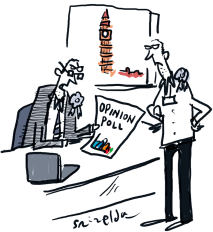
While middle-income Londoners compete with one another in the housing market, the government buys up more properties, removing them from the private rental pool. Westminster council has just spent another £235 million buying hundreds more properties. Those are now off-limits for those looking to rent or buy, pushing up the price of remaining homes. Here, too, are the hidden costs of the groaning social housing system.
‘If you earn £100,000, you lose your child benefit, your tax allowance, your eligibility for support,’ one young professional told me. ‘But the person in the flat next door could be on full housing benefit and you’re paying for them to live there.’ For many, that’s the injustice. The problem isn’t that people are housed, but that they are housed indefinitely, unconditionally and often with more security than those footing the bill.
If we’re serious about fairness, long-term benefit claimants should be rehoused in cheaper areas. This isn’t about punishing those people. In fact, it’s the kinder thing to do: it would free up homes for teachers, nurses, civil servants, people who make cities function and who are priced out.
A new politics may be emerging from this tension. Not one of ideology but of exasperation. Last month, shadow justice secretary Robert Jenrick published a video in which he confronted fare-dodgers on the Tube, asking why they felt they could get for free what everyone else had to pay for. It went viral for a reason. Voters, paying ever more in taxes and housing costs, want a system that also rewards people who play by the rules.
OnlyFans is giving the taxman what he wants
Fenix International occupies the ninth floor of an innocuous office block on London’s Cheapside. The street’s name comes from the Old English for marketplace, and once upon a time Cheapside was just that: London’s biggest meat market with butcher shops lining either side of the road. Today, the street houses financial institutions and corporate HQs.
But Fenix still runs a marketplace. Some may even call it a meat market, albeit one that operates on the phones of hundreds of millions of users worldwide. Its name: OnlyFans.
OnlyFans is best understood not just as a porn site, but as a social media platform with a paywall. Creators – mostly women – post photos, videos and voice notes behind monthly subscriptions. Users pay extra to tip the women, customise content and have one-to-one chats with their favourite models. Not everything on OnlyFans is X-rated, but that’s the content that makes the money.
An entire ecosystem has grown around OnlyFans since it was founded nine years ago by two British brothers, Tim and Thomas Stokely. One ‘e-pimp’ explained that successful models outsource much of their work to offshore call centres to give the illusion of intimacy with customers. Low-paid workers in Venezuela or the Philippines are hired to impersonate creators over text chats, maintaining dozens, even hundreds, of relationships with lonely men.
OnlyFans’ profits are enormous. In 2023, it generated nearly £5 billion in sales – up more than 2,000 per cent in four years. The company paid £127 million in tax last year, £110 million of that in corporation tax. Because Fenix is based in London, the bulk of that cash is flowing straight into the Treasury. For comparison: Britain’s fishing industry – supposedly a red-line issue in Brexit – brings in just £876 million and pays next to nothing in corporation tax, while also receiving £180 million a year in tax concessions.
We don’t think of OnlyFans as a media company (if we think of it at all) and so we ignore what it is in business terms: a staggering success. With more than four million ‘content creators’ and 305 million subscribers, it would easily rank in the top three British publishing companies. It is perhaps the most successful creator-based subscription service ever. Traditional platforms can’t compete – OnlyFans’ revenues are twice that of North America’s Aylo, which operates the world’s biggest porn websites.
Britain’s sex industry brings in far more to the economy than politicians are comfortable admitting
Britain’s sex industry brings in far more to the economy than politicians are comfortable admitting. The Office for National Statistics estimates Britons spend in excess of £6 billion annually on it. It is one of the few British industries which remains a net (digital) exporter.
Indeed, OnlyFans is perhaps the strongest unicorn (a privately held start-up worth more than $1 billion) in the country. It’s more profitable than any other British tech start-up. And it’s doing something our other digital start-ups can’t: exporting to America while keeping tax revenues onshore. Two-thirds of its revenue now comes from the US, proving that even in a global tech economy dominated by Silicon Valley, British firms can still compete.
OnlyFans’ success makes it all the more striking that, according to Reuters, Fenix is in talks to sell. Los Angeles-based Forest Road Company is leading a group of investors in negotiations to buy the business for £6 billion. It’s rumoured that other suitors are vying for attention and that shares may be sold on the stock market. Either way, one of Britain’s few successful exports could soon be gone.
It’s awkward to defend pornography, and so politicians don’t try. Parliament hosts thousands of lobbying events every year – payday lenders, bookies, vape companies, even arms dealers turn up for drinks and canapés. There is no ‘sex tech reception’.
Ministers fall over themselves to visit impressive-looking factories that are in fact barely relevant. For example, Glass Futures, a research and production plant for the glass industry based in St Helens, was recently picked by Keir Starmer as the perfect location for his speech decrying ‘Farage’s fantasy economics’. The plant is a not-for-profit that makes £7 million in annual sales. OnlyFans pays more in tax in a month than Glass Futures earns in a year. But no MP would be caught dead at OnlyFans’ Cheapside HQ, despite, I’m told, many invitations to visit.
Neither has any politician ever defended the porn industry in a debate on innovation, exports or growth. The most recent House of Lords research note on ‘the impact of pornography on society’ contains no mention of the words ‘economy’, ‘tax’ or ‘finance’.
Of course, money isn’t everything. The harms of porn – to women, to relationships, to the minds of teenage boys – are real and considerable. We might well be better off banning the whole thing. But if we are going to wage a moral war on porn, we should at least be honest about what we’re sacrificing. The money is real – and it’s already in the bank of HMRC.
What caused the Ballymena riots?
The County Antrim town of Ballymena endured a second night of rioting on Tuesday, as protestors aimed fireworks and missiles at the police. The Police Service of Northern Ireland (PSNI) responded with water cannon and baton rounds. Thirty-two officers have been injured in the violence in Ballymena so far, and homes and businesses have been set alight. The PSNI described the attacks on properties as ‘racially motivated’, and the Police Federation claimed its members had ‘prevented a pogrom’. The North Antrim MP, Jim Allister, criticised ‘successive authorities’ for failing to ‘manage integration or address local concerns in the town.
The violence broke out after protestors rallied peacefully at first in the aftermath of an alleged sexual assault against a teenage girl at the weekend. On Monday, two boys, who spoke through a Romanian interpreter, appeared in court charged with attempted rape. This incident followed two similar alleged attacks in recent weeks. Some of the protestors expressed anger that the violence had undermined their cause, while local politicians blamed ‘elements’ from outside the town for much of the disorder.
That homes where foreign nationals were known to live were targeted was a particularly sinister aspect of the violence. In the nearby village of Cullybackey, a Filipino night-shift worker at the Wrightbus factory, which is best known for making London’s iconic Routemaster ‘Boris buses’, had his car destroyed outside his family home. On Tuesday evening, some members of Ballymena’s growing Filipino community, which locals generally regard as unobtrusive and industrious, marked their doors with the flag of the Philippines, and the message: ‘Filipino lives here’.
These signs were poignant reminders of how wanton and indiscriminate the violence has become. Ballymena has similarities to many places across the rest of the UK that have experienced unrest caused by migration over the past two years. Some of the rioters may have come, as claimed, from Belfast and other towns, drawn by the excitement of trouble and coordinated by social media. At the same time, the violence was something of a cry of despair from a community that has been changed radically by immigration and feels like its opinions have been ignored.
Until relatively recently, Ballymena was a prosperous town, with a reputation for being populated by hard-working, thrifty Ulster Scots. During the last decade or so, it experienced rapid deindustrialisation, as major employers left, went bust or downsized. The town’s Michelin plant, which produced its first tyre in 1969, closed in 2018.
Meanwhile, the Gallaher’s tobacco factory finally shut for good in 2017, at the cost of 860 jobs, after 75 years of manufacturing cigarettes. At its prime, the facility, whose operations have moved to Poland, employed over 2,000 people.
Immigration has most seriously affected communities that were already blighted by poverty and other social problems
Many of the town’s remaining large employers, like Moy Park, which makes processed chicken products and is owned by the multinational food producer Pilgrim’s, have turned to migrant labour to fill posts and keep costs low. Some local workers are reluctant to work twelve hour shifts, in unpleasant conditions, but there is still resentment that immigrants are coming to Ballymena to work and occupy housing, while better paid, higher status industrial jobs have disappeared.
The protestors’ allegations against the town’s Roma population are slightly different to the complaints about migrant workers. The violence this week centred on the Clonavon Terrace area, which, in common with other deprived parts of Ballymena, now has a majority of foreign-born residents. About half of the street’s inhabitants identify as Roma. There are allegations that the community’s arrival coincided with an increase in crime in Ballymena and high-profile sex trafficking cases have involved Romanian nationals living in the town.
Like many other parts of the UK, and the island of Ireland, immigration has most seriously affected communities that were often already blighted by poverty and other social problems. The Harryville area, beside Clonavon, was once a tight-knit, working-class neighbourhood. It already struggled with low educational attainment in comparison to other near-by localities, but now 60 per cent of pupils in its local primary school don’t speak English as a first language.
The attacks on the police and the targeting of immigrants’ homes in Ballymena were deplorable and self-destructive. Indeed, alongside the racist aspect to this violence, it has caused damage and disruption to the rioters’ own communities, as well as hampering the authorities’ attempts to provide justice for the sex-attack victim (whom the rallies were supposed to support). Yesterday, Ballymena Protestant Boys, one of the town’s many flute bands, which are linked closely with grassroots loyalist culture, called for protests to stop, because the ensuing trouble was ‘causing chaos’ in the town.
In common with last summer’s immigration riots, the desire to hit out, particularly at blameless individuals who happen to be migrants, is indefensible. That does not mean that the frustrations that underlie these attacks are not real or justifiable. The violence in Ballymena points to another British community that feels powerless to protect its children, uphold its way of life or retain its identity, in the face of changes that have been forced upon it.
It’s no surprise that Prevent has gone to the dogs
Conquest’s Second Law states that the behaviour of an organisation can best be predicted by assuming it’s controlled by a secret cabal of its enemies – and that certainly seems to apply to Prevent (although it’s a ‘programme’ rather than an organisation). Prevent is a key strand of the counter-terrorism framework introduced after the 7/7 bombings and aims to stop people becoming radicalised. Given the historical context – and the fact that 75 per cent of MI5’s counter-terrorism work involves monitoring Islamist extremists – you’d think the main focus would be radical Islam. At least, you would if you weren’t familiar with Conquest’s Second Law.
Is Prevent actually controlled by a cabal of Britain’s enemies?
Of the 6,817 people referred to Prevent in the year ending 31 March 2023, just 11 per cent were suspected of Islamist extremism, compared with 19 per cent in danger of succumbing to ‘extreme right-wing terrorism’. And according to a Prevent Refresher Awareness Course on the Home Office website, one of the three most common subcategories of extreme right-wing terrorist ideology is ‘cultural nationalism’. As defined in the training materials, this encompasses the belief that ‘western culture is under threat from mass migration and a lack of integration by certain ethnic and cultural groups’.
In other words, if you’re a white working-class lad who’s expressed disquiet that there are whole neighbourhoods in Leicester and Bradford where no English is spoken, you may find yourself in the Prevent programme alongside a Hamas-supporting Muslim teenager who’s been caught downloading a bomb-making manual. Ironically, treating a young patriot as a potential terrorist because he’s worried about recent arrivals from Yemen and Sudan might actually end up radicalising him. Does that mean the masterminds who’ve designed the Prevent Refresher Awareness Course should refer themselves to Prevent?
In my capacity as head of the Free Speech Union, I wrote to the Home Secretary about this course last week, gave the letter to the Telegraph and the paper stuck it on the front page, which was gratifying. But, really, the fact that Prevent has gone off the rails shouldn’t come as a surprise. Sir William Shawcross carried out a government review in 2022 and warned that its officials were preoccupied with ‘mildly controversial or provocative forms of mainstream, right-wing-leaning commentary’ while ‘ignoring Islamist narratives’. Among his findings was that some ‘moderate’ Islamic groups funded by Prevent, supposed to provide young Muslims with a wholesome alternative to extremism, supported the Taliban.
But perhaps his most jaw-dropping revelation was that Prevent’s Research, Information and Communications Unit published a report in 2019 analysing the social media posts of a group it dubbed ‘actively patriotic and proud’ and discovered to its horror that one political figure revered by these radicals was Jacob Rees-Mogg: a man, said the report, ‘associated with a far-right sympathetic audience and Brexit’. Quick, round them up before they plant a bomb under Broadcasting House.
The same team of researchers listed books, films and TV programmes that were also red flags. These included The Lord of the Rings, Nineteen Eighty-Four, the poems of G.K. Chesterton, The Bridge Over the River Kwai, The Great Escape, The Dam Busters and Yes Minister.
Only last year, a former civil servant wrote of a counter-terrorism course for senior officials she’d attended at King’s College London. All the participants had to research a topic and give a presentation and one woman, whose brother had fled to Syria and joined Isis, chose Prevent, which she condemned as ‘racist’ because it focuses on Islamist extremists. (If only!) Sir William’s report was dismissed by one of the course lecturers because he’s ‘the type of person who would say all current counter-terrorism professionals are woke’ – and the same lecturer went on to brand Douglas Murray and Joe Rogan ‘far right’ and said, because it wasn’t possible to ban them, ‘society needs to find other ways to suppress them’.
So is Prevent actually controlled by a cabal of Britain’s enemies? Perhaps that’s an exaggeration, but the people who run it seem to have an intense dislike for Englishness, particularly as expressed in quintessentially English culture. They pretend that having an affection for Orwell’s ‘old maids bicycling to holy communion’ means you’re at risk of becoming a terrorist, when the reality is they just hate this nostalgic vision of England and are looking for ways to suppress it.
The spending review is 45 minutes I will never get back
Rachel Reeves looked a little surprised at the cheers from the Labour benches that greeted her as she stood to give the Commons details of the spending review. As well she might: there can’t be many places where her presence is met with such enthusiasm; the National Reserve of Mauritius perhaps? Or Reform HQ? I’m sure her continued presence in No. 11 raises some smiles there.
‘My driving purpose since I became chancellor has been to make working people in all parts of our country better off’, began Reeves. It was interesting to learn that she has a ‘driving purpose’. I had assumed that she just existed – like nitrogen or lichen – without any definite end goal. It was tragic too to learn that, having finally chosen a purpose to her existence, the Chancellor had selected something at which she is definitively rubbish.
Oratory isn’t the Chancellor’s strong suit either. If she has the presence of a noble gas then she has the delivery of a malfunctioning SatNav. In her weird staccato she rehearsed all the same old catchphrases we’ve come to know and hate: ‘£22 billion black hole’, ‘14 years’, ‘fixing the foundations’. The Prime Minister smiled a self-satisfied smirk as she did so, presumably in the manner in which the owners of Mynah birds do when they teach them to say something filthy.
Alongside telling us things we already knew – ‘we’ve secured a trade deal!’ – and repeating asinine catchphrases, the Chancellor dropped in things which were presumably meant to sound inspiring. ‘We are renewing Britain’ she droned. Why can I not escape the sense that this was a threat?
‘We’ve been crunching the numbers, looking at the assets and the liabilities’ she continued in her one-woman crusade to kill off every other member of the House of Commons by surfeit of platitudes. ‘Who’s the liability?’ came a cry from the Tory benches. The Prime Minister scowled furiously and craned his neck to see who had made the remark. He had the air of a substitute teacher on the edge of a breakdown.
Of course, none of the numbers had actually been crunched. Ironically for a woman who had made a great song and dance of turning the Office for Budget Responsibility into a Universal Arbiter of Moral Truth, the Chancellor hadn’t bothered to run any of these figures past them. She could have been reading out her Lotto numbers for all we knew.
In terms of the substance there was a little more money for defence – though mostly deckchair rearrangement – and yet more poured into the great Moloch that is the NHS. This however seemed to mostly be so she could take a lame pop at Reform. Mr Farage made a sort of hostile squirm at her as she did so. She then accused him of spending too much time in the pub. Reeves doesn’t go to pubs, presumably she never gets past the car park, being mistaken for a bollard in a wig. I suspect after her jobs tax she’s probably barred from most of them anyway.
The Labour faithful
looked glum
She ended with what she clearly thought was a stirring speech: ‘In place of chaos, I choose stability, in place of decline, I choose investment, in place of pessimism, division and defeatism, I choose national renewal’. Now we know what St. Francis of Assisi would have sounded like if he’d had access to LinkedIn.
This might just have been the effect of almost an hour of Reeves’s oratory, but the Labour faithful looked glum. I detected only two proper cheers – one for the NHS cash injection, the other for a throwaway mention of Labour’s spite tax on private schools. Save for a few of the more Stakhanovite toadies who nodded vigorously throughout, the enthusiasm was at a temperature so low it could have been measured in Kelvins.
Those of us who had still somehow clung onto our wills to live after this desultory 45 minutes were treated to a broadside by Mel Stride. Reeves was, he said, impossible to take seriously, ‘weak, weak, weak’ and ‘not an iron chancellor but a tin foil one’. This seems unfair – tin foil is actually useful.
Only proper welfare reform can bring true ‘national renewal’
Rachel Reeves’ Spending Review does more than set budgets. It exposes a contradiction at the heart of Labour’s approach to government: a party that wants to rebuild the state won’t take the hard decisions needed to make that possible. The review was more painful that it needed to be for Labour, because Labour MPs have shied away from serious welfare reform.
Two mistaken ideas dominate much of the progressive conversation about the public finances. The first is that the state can go on doing more and spending more forever, with no real constraint. The second is that all talk of welfare reform is right-wing cruelty. Unless and until Labour challenges both ideas head-on, hopes of ‘national renewal’ will be forlorn.
A pound spent on welfare cannot be spent on services.
Zoom out a bit from the spending review and you see that the big story is this: the government is now squeezing the departmental spending budget (known in Whitehall as the Departmental Expenditure Limit, or DEL) not because it wants to, but because it has avoided confronting the larger challenge of welfare (part of Annually Managed Expenditure, or AME).
In this Spending Review, DEL totals around £600 billion, covering the entire range of public services: education, local government, defence, justice, and more. AME is also around £600 billion, of which more than £300 billion is welfare and pensions. That last total includes things like the winter fuel payment, if you’re wondering. The latest OBR forecasts show that welfare spending will be £373 billion by 2028/29 – 10.8 per cent of GDP.
A pound spent on welfare cannot be spent on services. No government can credibly promise better public services – in education, housing, policing, or local government – while letting welfare continue to rise unchecked.
The numbers tell the story clearly. This year, welfare and pensions will consume more than a quarter of all public spending, and more than the NHS and schools budgets combined. Housing benefit alone exceeds £30 billion. Disability benefits are rising by billions each year. The Office for Budget Responsibility warns that without intervention, total welfare spending will reach £373 billion by the end of the decade – 10.8 per cent of GDP.
In the face of all this, Rachel Reeves is doing what serious chancellors have to try to do: holding the line on the public finances, maintaining market credibility, and trying to restore a sense of control to government spending. She might not be getting much love from her colleagues these days, but people who manage serious money know she and her agenda are a big part of what makes Britain a viable investment prospect. Hence endorsements from people like Jon Gray at Blackstone this week.
Wall Street and Westminster are far apart, however. She remains an essential part of the Labour government but in SW1, Reeves is being made to carry the political cost of choices the wider Labour party refused to make. The squeeze in departmental budgets is not simply the result of Treasury caution or ideological parsimony or the failures of the last lot. It is the consequence of a collective failure to act on welfare.
This is the real argument Labour must now have – with itself. The idea that refusing to touch welfare is a sign of compassion is a luxury belief. The people who feel the effects of tighter departmental budgets are not the comfortable. They are the users of struggling schools, underfunded councils, overstretched housing services, and a broken justice system. If you want a capable state, it needs capacity – fiscal, administrative, and political. And that means making choices.
The Scottish experience offers a sobering warning. There, SNP ministers have made generous promises on welfare – from expanded child payments to free prescriptions – all in the name of social justice. But the fiscal arithmetic is unforgiving. The Scottish Fiscal Commission has warned that spending commitments on welfare are rising faster than revenues and that, without reform, significant cuts will be required in other areas to keep the budget balanced. In other words: if you don’t reform when you can, you will be forced to cut when you must. And the cuts will land hardest where they hurt most – on services for everyone.
Labour MPs in Westminster would do well to study that lesson closely. Because the same pressures are now unfolding across the UK. A refusal to act on welfare spending will require ever more brutal decisions on departmental budgets. This undermines the very institutions progressives claim to value – and plays straight into the hands of those who argue that the state itself is broken beyond repair.
None of this means abandoning the principles of social justice. A strong, compassionate welfare state is a hallmark of any civilised society. But a sustainable welfare state is essential to a functioning society. Reforming welfare is not about punishing the poor. It is about preserving the system – and making sure it can continue to command the trust and consent of the public.
Disability benefits are the clearest case in point. Forecasts from the Institute for Fiscal Studies show annual increases of 9 per cent, driven in part by looser eligibility rules and assessments increasingly disconnected from work potential. If this continues, the entire system risks losing legitimacy — not just financially, but politically. The danger is not just overspending. It’s public backlash and declining support for the principle of collective provision. Progressives should not wait until that moment arrives to make their case for change.
Labour grumbling at Rachel Reeves for this tough Spending Review is misplaced. She is not the villain of this story. She is dealing with the consequences of Labour’s wider reluctance to confront fiscal reality. The real question isn’t why the Chancellor is holding firm – it’s why more of her colleagues didn’t help make her job easier.
If you’re a Labour MP who found this Spending Review painful then you need to trace that pain back to the choices you’ve refused to make on welfare. If you still can’t support sensible, necessary welfare reform (yes, winter fuel payments again) then be honest: you’re not protecting the vulnerable. You’re starving the services that vulnerable people rely on most.
The language of priorities isn’t a soundbite. It is the essential discipline of governing. And Labour is now in government. If the party wants to lead a serious renewal of the British state, it has to match its ambitions with equally serious choices. Reforming welfare isn’t a betrayal of the progressive tradition. It is the only way to uphold it.
Because if Labour lets the unchecked growth of welfare spending destroy the state’s ability to function, it will not be the rich who suffer. It will be the people the left exists to serve. The people who most need a capable, compassionate, focused government that works. The people who will turn to Reform if a state hollowed out by unchecked welfare spending fails them and their communities.
Britain doesn’t need more affordable housing
This afternoon’s spending review mostly consisted of rehashed announcements, and in fact Tory plans that had been quickly rebadged. But there was one commitment that stuck out. The Chancellor Rachel Reeves is planning to spend £39 billion – serious money even by the standards of an organisation as extravagant as the British state – on ‘affordable’ and ‘social’ housing. Following her announcement, the scaffolding will almost certainly be going up in Blackpool, the spades will be turning over the ground in Preston, and the cement mixers will be churning in Swindon. But there’s just one problem: the UK doesn’t need more ‘affordable homes’ – it just needs more places for people to live.
According to the Treasury, it will be the ‘biggest boost to social and affordable housing investment in a generation’. The £39 billion set aside by the Chancellor will be spent by local authorities. Admittedly, when you work out that it is spread out over ten years, instead of just one, and when you also work out that £3.9 billion a year is only the equivalent of 13,400 homes at the current average house price in the UK, it is not quite so impressive.
Just let private companies build the homes their customers are willing to pay for
But even so, by recent standards the government is at least putting more cash into building. Local authorities will be able to start, to use one of the government’s favourite cliches, ‘to ‘putting shovels into the ground’.
All Reeves is doing, however, is creating what will very soon turn into a nationalised building corporation. Eventually, it will probably be renamed Great British Homes, and will take its place alongside the newly created Great British Railways and Great British Energy. And yet, that is the last thing the UK needs right now. We know from long experience that the least efficient way – by a very wide margin – of delivering any product or service is to get the state to do it.
In fact, what the UK needs is a more liberalised, free market in building. It needs fewer restrictions, a smaller green belt around London and other major cities, a loosening of environmental restrictions, curbs on judicial reviews of planning decisions, and the removal of targets and controls on prices. Just let private companies build the homes their customers are willing to pay for wherever they might want them.
After all, there is plenty of pent-up demand, and there is no shortage of finance available if firms are allowed to build. And best of all, just by building more houses, they will also, of course, become more ‘affordable’ (because, er, that is how supply and demand works: when supply increases the price goes down).
The UK already has one of the most dysfunctional housing markets in the world. Reeves’s only solution is to throw billions of pounds of extra state planning at it – and we can hardly be surprised if that doesn’t work.
Randi Weingarten’s anti-Trump national uprising sounds ‘mostly peaceful’
“Authoritarianism can be stopped,” Randi Weingarten, head of the American Federation of Teachers, was saying, even though Weingarten was a prime mover, if not the prime mover, behind years-long Covid-era school closures that crushed education opportunity for an entire generation. But we’ll stop this particular round of authoritarianism, she said, with our voices and our bodies: “We have to be on the streets in a very, very public way.”
This was on an AFT organizing call yesterday evening for No Kings, a massive nationwide protest taking place this coming Saturday, which had been scheduled long before last weekend’s Battle of Los Angeles. A sweeping round of anti-Trump marches and rallies will take place in nearly 2,000 municipalities around the United States, which you won’t be able to avoid unless, say, you have a standing commitment to attend a children’s birthday party at Dave and Buster’s.
The unfolding tragedy in LA loomed large over the call. “I want to send a lot of love to the people in LA,” Weingarten said. “Virtually everyone I know in LA is peace-loving, whether documented or undocumented.”
This did beg the question: who does Randi Weingarten know in LA who isn’t peace loving? But she moved on to say that the Founding Fathers didn’t want power “centered on one man,” and then she lost Internet connection, which she later told us was because her wife was teaching a Zoom class on Gandhi in another room.
This organizing Zoom featured a couple of guest stars. MSNBC host the Reverend Al Sharpton called in, literally, because we didn’t see his face. He sounded kind of bored, saying, “We can vote for different candidates and different propositions later,” that now is the time to be unified, and that what’s currently going on “goes back to the days of Roman chariots.” Maybe Sharpton lost reception going through a tunnel, because he was gone quickly.
Governor Andy Beshear, a Kentucky Democrat, made a more significant guest appearance, wearing a golf shirt, with a blurry portrait of Abraham Lincoln behind him. Beshear looked uncomfortable, like someone who showed up at the church potluck with the wrong dish, and seemed to be rehearsing some sort of liberal-centrist response to the State of the Union address.
It became quite clear that the AFT had pitched this call mild, on purpose. The people who have been on the ground in Los Angeles and in other US cities where protests against ICE are growing are mostly from the Hard Revolutionary division of the resistance, unafraid of a little smoke and light jail time. No Kings has broader ambitions, appealing to angry MSNBC grandpas and perpetually traumatized Facebook Jennifers who just want to Do Something while Making Good Trouble. They stand on the precipice of activating their blacked-out Instagram square moment of the anti-ICE movement. Randi Weingarten, who projects as a grandmotherly lesbian, is a good avatar for them.
Weingarten popped in and out of the call depending on whether she was winning the fight for internet access in her condo. The other significant voice on the call was Leah Greenberg, one of the founders of the progressive protest group Indivisible.org, who, compared with the other people on the Zoom, looked young and fresh and happy, as though she sleeps in a vegetable crisper until it’s time to activate. She said that President Trump is trying to “play the strong man on TV” and that he and Stephen Miller are trying to manufacture a crisis. By contrast, No Kings will be a day of “joyful, peaceful defiance.”
“This is a moment that it’s crucial for everyone to see that the opposition is big, it is bold, it is powerful, and it is everywhere,” Greenberg said.
But while the vast majority of No Kings events around the US will almost certainly be jolly, PG-rated People’s Uprisings, this summer is brewing a dark undertone. If my social media feed is a good indication, and it is, people are angry, are scared, and are openly calling for armed resistance, for “hiding people in our attics,” or both.
Saturday could fizzle, but it could also be a huge flashpoint in modern American history, with President Trump hosting a parade for the 250th anniversary of the Army on one hand, and millions of people marching or milling around every state in the union, chanting “no justice, no peace” on the other. It’s enough to make any true freedom-loving person want to hide away from these swirling, annoying tides of history.
“No Kings is not a call for violence,” Greenberg made sure to tell her audience of retired teachers Tuesday night. But an email blast that Indivisible sent out to its audience due to gather in downtown Chicago, always a protest hotspot, at noon on Saturday, sounded a much more urgent message:
“With the actions taken against protesters in Los Angeles this weekend, the Trump MAGA regime seeks to unleash the military within our borders to advance its agenda of abductions and intimidation, violating our freedoms and our right to equality under the law… NO SOLDIERS IN OUR STREETS! NO DISAPPEARING OUR NEIGHBORS! NO FASCIST DICTATORSHIP IN AMERICA! NO KINGS!”
Sounds “mostly peaceful,” whether you’re documented or undocumented. If you’re planning to turn out, you may want to find a sitter for the kids, unless you want to introduce them to the sound of flash grenades and the smell of tear gas.
You might even find yourself marching next to Randi Weingarten, because a teacher’s work is never done.
Khan takes a pop at Reeves over spending review
There were always going to be winners and losers in Chancellor Rachel Reeves’s spending review and it appears that Sadiq Khan’s London has pulled the short straw. The Labour mayor’s frustration at the Chancellor deepened this week ahead of her speech today over fears that the capital wouldn’t a sufficient cut of the government’s cash. Today, that has proved to be the case: while a four-year settlement was announced for Transport for London, Khan has lamented that it is ‘disappointing’ there had been no promise made by the Treasury to ‘invest in new infrastructure London needs’. The gloves are coming off…
In a statement released after the spending review announced, Khan went on:
I remain concerned that this Spending Review could result in insufficient funding for the Met and fewer police officers. It’s also disappointing that there is no commitment today from the Treasury to invest in the new infrastructure London needs. Projects such as extending the Docklands Light Railway not only deliver economic growth across the country, but also tens of thousands of new affordable homes and jobs for Londoners. Unless the government invests in infrastructure like this in our capital, we will not be able to build the numbers of new affordable homes Londoners need.
Shots fired! Indeed there was only a scattering of references made to the capital city throughout Reeves’s speech, with the Chancellor focusing more on projects further afield – from upgrades to the TransPennine route to the Acorn carbon capture project in Aberdeenshire – in a bid to reassure voters across the country that the Treasury had their interests at heart. The NHS emerged as a clear winner today, while defence has also come away from the review well. But thanks to Reeves’s tight constraints, not everyone will be left satisfied by today’s statement. Will anyone else come out and express their disappointment publicly, however? Watch this space…
Swinney stages reshuffle amid SNP infighting
It’s a busy day in politics and the SNP is keen not to be left out of the action. As Chancellor Rachel Reeves unveils her spending review in London, today the Scottish Cabinet has undergone a reshuffle. The looming return of ex-net zero secretary Mairi McAllan from maternity leave had in recent weeks sparked speculation about how First Minister John Swinney would reorganise his top team, and his party’s rather dismal result in last week’s Hamilton by-election has led to much frustration – public and private – about the strategy deployed by the SNP government. Swinney’s reshuffle today may be modest, but the First Minister has, with 11 months to go (and barring any major upsets), created the cabinet to lead the SNP into the 2026 Holyrood election.
There remains significant anger within the party about the SNP’s by-election strategy, with some concluding that the Nats need to incorporate a stronger independence message into their 2026 campaign.
What has Swinney changed? McAllan has returned in a new role, as housing secretary, while a new drugs and alcohol policy minister has been appointed following the death of Christina McKelvie – which prompted the Hamilton by-election. Now former social care minister Maree Todd will take on the portfolio – just as new figures this week reveal that drug deaths in Scotland have soared by a third since the opening of the SNP’s drug consumption facility. Tom Arthur has become social care minister, previously holding the employment and investment post. His previous duties will be split between Deputy First Minister Kate Forbes, who has the economy portfolio, and Richard Lochhead, who has become minister for business and employment. Today’s changes bring the Scottish Cabinet total to 12 MSPs – just 25 per cent of whom are men – while the ministerial team has reduced to 11.
Meanwhile ex-housing minister Paul McLennan has left government after his role was developed into a cabinet post. His departure comes after today’s Daily Mail story that highlights his public attack on the SNP leadership after the party’s disappointing result in the Hamilton by-election. The nationalists placed second, just 500 votes ahead of Reform. While it was always set to be a close contest, pollsters generally predicted that the SNP would just clinch victory ahead of Anas Sarwar’s Labour party – and many within the party blame Swinney’s ‘SNP vs Reform’ framing. ‘If you’re going into an election, it is about giving people reasons to vote for the SNP, not against Reform,’ McLennan noted critically. ‘Was it a slightly negative campaign? Possibly. Was there a mixed message? People might have seen it that way.’ Meanwhile SNP MP Seamus Logan wrote in the National that the result is ‘a reminder if any were needed that while it was necessary for the party to “steady the ship”, this is insufficient in and of itself to bring the electoral success necessary to advance independence politically.’
It’s not just Logan and McLennan. Others have concluded that the party’s underwhelming result proves the nationalist need to incorporate a stronger independence message into their campaign ahead of next year’s Scottish parliament elections. As reported by the Herald, a ‘secret’ summit of SNP insiders have even gathered to plot to remove Swinney from the top job. The 25 in attendance agreed that the First Minister had a fortnight to come up with a new independence strategy or he could face a leadership contest at the SNP’s conference this October. While there are a number of nationalist politicians who are known to have the appetite for the top job, each comes from a slightly different faction of the group. And whether parachuting in yet another unelected SNP leader less than a year before the next Holyrood election will make the party more competitive in next year’s polls is not quite evident.
Swinney’s reshuffle today doesn’t mark any real change in direction for the SNP leader ahead of the 2026 poll. But after last week’s by-election, party strategists are considering how best to proceed over the next 12 months. The First Minister’s strategy of keeping his head below the parapet and keeping schtum on independence has managed to stabilise the SNP ship, and following the tumultuous leadership of Humza Yousaf, the party is making a recovery in the polls. But while the SNP is polling at around 30 per cent and on track to become the largest party in Holyrood next year, the nationalists are still far from winning a majority. As Hamilton’s result last week showed, they wouldn’t be wise to assume they’re immune to the threat of Reform.
Elon Musk kisses the ring
“I regret some of my posts about President @realDonaldTrump last week. They went too far,” Elon Musk wrote on X at 3 a.m., after six days of soul-searching.
Since this wee-hours confession from the onetime right-hand man of the President of the United States, several of Musk’s most searing posts about Trump from last Thursday have vanished from the internet – though screenshots are forever. Looking for Musk’s post alleging that the President was connected to the sex trafficker Jeffrey Epstein? Now you’ll see, “Hmm…this page doesn’t exist.” Based on the X CEO’s track record on the topic, Cockburn thinks “Godwin’s Law” could use a variation. Introducing Elon’s Law: “As an online discussion grows longer, if it involves Elon Musk, the probability of him accusing his adversary of being a pedophile approaches one.”
Also missing from Musk’s feed are his assertion that Trump should be impeached and J.D. Vance should replace him and that the President’s tariffs will cause a recession this year.
But Musk has not walked back much of what he posted last Thursday, including a plea for the formation of a third political party and a call to fire every senator and representative who “betrayed the American people” – aka, voted for the “Big, Beautiful Bill,” set to raise the national debt.
Trump does not appear rattled by his separation from the world’s richest man. The President has yet to walk back any of his own statements on Musk, who he claimed was “wearing thin” and just “went CRAZY!” On Saturday, Trump told NBC he was “too busy doing other things” to reconcile with the former DoGE head. “I have no intention of speaking to him,” Trump said.
In an interview with the New York Post, which aired Wednesday morning, Trump echoed his earlier sentiments, saying he hasn’t “thought too much about him in the last little while,” but he has “no hard feelings” towards Musk.
“I don’t blame him for anything but I was a little disappointed,” Trump said.
The President also did not appear vexed by Musk’s pedophilia finger-pointing. “That’s called ‘old news,’ that’s been old news, that has been talked about for years,” Trump said Saturday. “Even Epstein’s lawyer said I had nothing to do with it. It’s old news.”
NHS the only winner in Reeves’s spending review
Rachel Reeves has just taken her seat after delivering the first spending review since the pandemic. The plans outlined today set departmental budgets for the next three years and infrastructure spending for the next four. Total departmental spending will rise by 2.3 per cent – but, predictably, the spoils will not be shared evenly. The NHS and defence will take most of them. In real terms, the health service is set to receive a 3 per cent annual rise, leaving combined spending on the other departments with not even a 0.2 per cent increase. Britain continues its transformation into a health service with a country, and maybe a few guns, attached.
Reeves opened with a rhetorical nod to her self-declared mission: ‘My driving purpose is to make working people in all parts of the country better off’. She also took aim at Conservative economic policy, declaring austerity a ‘destructive choice for the fabric of our society.’ This echoed a strangely revisionist claim by her junior minister, Torsten Bell, who recently insisted Labour is ending austerity while sharing a graph that showed public spending surging under the previous government.
The problem Reeves faces is that austerity, at this point, is more of a vibe than a technical definition. A recent Ipsos poll showed that half the population already believes we are living through it. And given how unevenly the new funding is distributed, it’s unlikely many will feel a real difference in public services. Even the NHS – despite receiving the lion’s share of today’s new cash – has a history of adding to its headcount of doctors and nurses without improving productivity.
Meanwhile she attempted to revive ‘securonomics,’ as if it were a choice rather than a necessity facing nearly all of the West. Defence is set to rise to 2.6 per cent of GDP in two years. But the previous goal of hitting 3 per cent in the next parliament was conspicuously absent. As Paul Johnson noted, it’s now safe to assume that target won’t be met.
There’s more sleight of hand to contend with. Reeves hinted that some of the increase in defence spending could include funding for intelligence services. So the real question becomes: how much of this uplift will go toward tanks, ships and drones and how much is just creative accounting?
For Labour backbenchers who had hoped Reeves might take the IMF’s advice and loosen her fiscal rules to allow for more ambitious investment, Reeves delivered a blunt message: ‘My fiscal rules are non-negotiable.’
Reeves’s review does nothing to acknowledge, let alone address, the mountain of unaffordable commitments facing the Treasury
That may sound responsible, but it demands a leap of faith. The assumption is that these spending commitments will survive more than a few months, let alone the full three- and four-year timetables set out today. With economic growth expected to weaken in the latter half of the year and the jobs market collapsing – despite Reeves’s upbeat claim that ‘this government is backing British business’ – it’s hard to escape the conclusion that she may be forced to return to the Commons in the autumn with plans for spending cuts, tax rises, or most likely both.
The most notable line from Reeves’s speech in the Commons today was her saying that it was ‘not right that children and future generations pay for the choices we make today.’ Yet her review does nothing to acknowledge, let alone address, the mountain of unaffordable commitments facing the Treasury: a sickness benefits bill approaching £100 billion, a state pension system on an unsustainable path, and debt interest payments that continue to hobble our ability to invest. The Covid-induced state splurge certainly now seems permanent.
Starmer returns to his favourite PMQs subject: Liz Truss
‘Mr Speaker, he loves talking about Liz Truss – why? Because he wants to hide from his economic record.’ Kemi Badenoch didn’t need to do much guesswork ahead of today’s Prime Minister’s Questions: she knew Starmer would bring up the former prime minister.
Starmer always likes to mention Truss, as Badenoch pointed out, but today he was nailed on to do so as part of the groundwork for Rachel Reeves’ spending review speech. The Tory leader, though, wanted to prepare the ground for her party’s narrative about what Reeves was having to do. She opened by pointing out that:
Since Labour took office, inflation has nearly doubled, growth has halved and unemployment has surged. Is this what the Prime Minister meant when he tweeted the economy is improving?
It is not unusual for Starmer to talk about one of Badenoch’s predecessors
Starmer had his own statistics, saying more people were in work, and that there were ‘tens of thousands of jobs’ coming in various industries as a result of investment in defence, nuclear and other sectors. Badenoch moved onto the winter fuel payment U-turn, saying Starmer had argued that its removal was necessary in order to balance the books. ‘But the books are not balanced, in fact, they are worse,’ she added, asking him ‘in what way are the books now balanced?’
Starmer complained that Badenoch had clearly missed cuts to interest rates, growth figures, the strategic defence review, investment in local transport, social housing and so on. It wasn’t a very convincing list, given the Prime Minister was largely referring to announcements about things the government wanted to do, rather than concrete achievements. But that’s not unusual in politics.
Neither is it unusual for Starmer to talk about one of Badenoch’s predecessors. He did so in his next breath:
She stands there to lecture us and I say, Liz Truss is obviously back in vogue: advising Reform officially now, haunting the Tories.
He then goaded Badenoch with quotes from her and some of her colleagues about the mini-Budget, adding, ‘They’ve learned absolutely nothing’.
The Tory leader carried on talking about the winter fuel payment, running the Chamber through the chronology of ministers claiming that removing the benefit was necessary to avoid a run on the pound, only to then change their tune and say they could reinstate it. ‘Why can’t the Prime Minister admit that he made a mistake?’ she asked.
Starmer brought up his other favourite Tory attack: the £22 billion black hole, before listing other things the government had done – most of which he’d mentioned at least twice in this session already. He teased Badenoch that she had remarked at the weekend that she would ‘be getting better in the role’, and demanded that she ‘start by apologising for the Liz Truss budget’.
Badenoch’s reply was quite funny, if unintentionally, for its confidence. ‘Mr Speaker, I get better every week! He gets worse!’ She added that he had no answers on how to make the economy grow, and claimed the strategic defence review was unravelling too. Then she demanded that Starmer admit that he would have to fund that review and the U-turn by putting everyone’s taxes up.
Starmer made a (poor) joke that Badenoch liked to rehearse her fury before PMQs. He repeated his weekly line about the Tory leader refusing to say if she would reverse the national insurance increase, and Badenoch replied that ‘every week I come here to tell him the truth’. But it’s not the Tories telling the truth that has driven many of the decisions in today’s Spending Review. It’s fear of Reform.
SNP plotters should think twice before moving against John Swinney
For those who feel Scottish politics has become a little dull of late, fear not: a rebel faction within the SNP is plotting to make things very interesting again. Today’s Glasgow Herald brings the news of a secret summit of top SNP insiders at which plans to remove incumbent party leader (and Holyrood first minister) John Swinney were discussed. The paper says 25 ‘senior’ figures gathered on Monday to consider the boss’s future after the SNP’s surprise defeat in last week’s by-election in Hamilton, Larkhall and Stonehouse, a seat they had held uninterrupted since 2011.
‘The Presbyterian schoolmaster might fly in Perthshire, but in the rest of Scotland it just does not land’
The conspirators are reportedly frustrated by Swinney’s moderation on domestic policy and his failure to ramp up efforts to take Scotland out of the United Kingdom. They are said to be giving Swinney two weeks to present a new independence strategy or face a leadership challenge before the year is out. Some of their language is incendiary. An unnamed plotter describes the party’s situation as being ‘like Groundhog Day’, referring to Swinney’s previous, less than successful turn in the leader’s chair between 2000 and 2004. The conspirator charged Swinney with having ‘no energy, no fire, no boldness, no long-term vision’ and said that, when it came to making the case for independence, he had ‘failed on probation’. In an especially cutting remark, the Swinney critic said: ‘The Presbyterian schoolmaster might fly in Perthshire, but in the rest of Scotland it just does not land.’
This is bracing language considering Swinney has been credited with stabilising the SNP’s political fortunes after the chaotic 14-month reign of Humza Yousaf and re-establishing a stout polling lead over Scottish Labour. What he has not done is restart efforts to achieve independence, largely stalled since the 2022 Supreme Court ruling that the Scottish parliament cannot lawfully legislate for an independence referendum without Westminster’s consent. The next generation, who came of age politically during the 2014 referendum, are impatient for a fresh constitutional fight and for their own turn at the top of the party. There are those eager to see Stephen Flynn become SNP leader, though none quite so eager as Stephen Flynn himself, and the party’s most senior figure at Westminster will be standing for Holyrood next year.
SNP gradualists will greet talk of ousting Swinney with horror. Undoubtedly, he handled Hamilton poorly, but he has been a stabilising force and has carefully navigated the party out of the identity politics cul-de-sac.
SNP ministers are at last able to go a day, sometimes two, without talking about gender. Besides, felling Swinney before next spring’s Scottish parliament elections would involve giving the party its forth leader – and Scotland its fourth first minister – in a single parliamentary term. The Nationalists made plenty of noise about the Tories’ ever-changing leaders during the last Parliament. They could expect to be reminded of their own words if they chuck Swinney for someone else.
Whatever becomes of this anti-Swinney plot, all factions of the party will remain bound by a political paradox they would rather not confront: that the voters want the SNP but not the thing the SNP wants.