Elon musk

Would Grok’s Odyssey be better than Nolan’s?

From our UK edition

Elon Musk, who does not rate Christopher Nolan’s film of The Odyssey very highly, has said: ‘Before this year ends, Grok [Musk’s AI] will make a full-length movie of The Odyssey that is historically accurate and true to the art of Homer.’ Will it, now? Around 1200 bc the city that Homer calls Troy or Ilium was destroyed by fire and warfare. In 1873, this site (which archaeologists now call Troy VIIA) was excavated by German adventurer Heinrich Schliemann, who announced to an astonished world that it was the well-spring of Homer’s Iliad and Odyssey. The problem is that there is no evidence at all that VIIA was attacked by Greeks. But there are passages in the Iliad which could be said to match some of the features of VIIA.

What will the successful cities of the future look like?

From our UK edition

Can architecture solve urban crises? Or should architects and planners concentrate on mitigating the consequences of wider events (climate change, war, demographic and economic shifts), then hope for the best? What happens when we have no choice but to build or rebuild cities? In her new book, Gabriella Bennett, a journalist interested in architecture and urban landscapes, spends two years flying around the world looking for answers to these and other questions. Woven through her adventures are two personal quests: to reckon with her unhappy adolescence in the Scottish postwar new town of Glenrothes; and to reset her life after a pandemic-era health crisis that led her to quit her job.

Troy Jackson’s family values

Troy Jackson, Maine’s new working-class Democratic candidate for Senate – following Graham Platner’s demise – has PR problems. Cockburn thinks it’s a case of #MeToo going a little too far. While Platner was on Kik posing in a towel and supposedly sexually assaulting his ex-girlfriends, Jackson was doing the honorable thing – pairing off with his cousin. The level of concern we are seeing over this simple fact is a case of parasocial hysteria. Who cares if Troy is dating, and has two children with, his second cousin? So did FDR. Well, that was his fifth cousin, but still. Though Jackson and his cousin Lana never wed, cousin marriage isn’t even illegal in Maine and for good reason. Troy Jackson is from a town of 250 people. He’s a logger.

troy jackson

Why most scientists don’t want us to believe in life on Mars

From our UK edition

‘Is there life on Mars?,’ asked David Bowie, and would not stay for an answer. The astrobiologist Steven Benner has an answer – which is that Mars not only has had life but still does. The first part of that answer is broadly accepted; the second remains highly contentious. His book is a scattershot plea for increased attention to be paid to searching for evidence – or, as he sees it, more evidence. The stakes are high. As he says in his introduction, if life exists only on Earth, that’s a coincidence; if it exists on Earth and a close neighbour, that’s the start of a pattern. Mars has always excited the imagination. No one has ever speculated hubristically about the chances of anything coming from Mercury. C.S.

Meet the political donors lining up to influence AI policy

Most Americans have yet to work out quite what they think about artificial intelligence, but already the AI game is under way: the buying and placing of political pawns in readiness for America’s first comprehensive federal AI law. Voters have yet to elect their senators and representatives, but the power brokers – political donors – are spending, primary by primary, to help ensure their chosen candidates survive to write that all-important legislation. Two rival networks with differing views about what this law should entail have raised more than $200 million for this year’s midterm elections.

AI

The ADHD administration

At the start of the second Trump administration, the words on everyone’s lips were “breakneck speed.” On the day of his inauguration, Donald Trump declared a border emergency, designated drug cartels as terrorist organizations and challenged birthright citizenship. He withdrew from international climate agreements and ditched Joe Biden’s mandates on electric vehicles. He rescinded various Diversity, Equity and Inclusion initiatives. On January 20, 2025, he issued pardons for individuals connected to the 2021 riot on Capitol Hill. And he established the Department of Government Efficiency (DoGE), which empowered Elon Musk to begin hacking away at federal bureaucratic bloat. Trump signed 143 executive orders in those first 100 days, more than any previous president.

Elon Musk should buy Xbox. Yes, really

Elon Musk is hardly lacking for toys. He can spend the morning digging vast tunnels with Hyperloop, the afternoon launching rockets with SpaceX and spend the evening posting on his very own X social media network. Even so, there is one gadget that could still tempt Musk: Microsoft’s increasingly error-prone Xbox. It was reported this week that the Xbox division would be axing 3,200 jobs, the equivalent of a fifth of its workforce. The company is also selling four of its game development studios. Xbox has suffered from slim profit margins, spiraling hardware costs and sluggish growth for Xbox’s Game Pass subscription service. And Xbox fans have been outraged at leaks suggesting the company may remove the disc drive in its upcoming machine.

elon musk

The Founding Fathers of AI

In the spring of 1722, a 16-year-old apprentice in a Boston print shop began slipping letters under the door at night, signed by a middle-aged widow named Silence Dogood, who did not exist. The apprentice was Benjamin Franklin. His brother James, who owned the paper, had no intention of printing his kid brother, so Franklin invented a woman and let her say the things he couldn’t. Readers wrote in guessing at the author. No one suspected the boy sweeping the floor. Franklin would go on to be a printer, a postmaster, a scientist famous across Europe for his electrical experiments and a founder of libraries, fire companies and, in time, of the United States itself.

Portrait of the week: Burnham wins, Starmer resigns and a heatwave hits

From our UK edition

Home Sir Keir Starmer, the Prime Minister, stood outside 10 Downing Street and said that he would resign as leader of the Labour party. Nominations for a successor would open on 9 July (though he still meant to unveil his defence investment plan in time for the Nato summit on 7 July). His decision to depart followed the convincing victory in the Makerfield by-election of Andy Burnham, bringing him back into parliament. An election for mayor of Greater Manchester in his place would take place on 30 July, with Bev Craig, the leader of Manchester City Council, as Labour’s candidate. Mr Burnham packed a suit and tie into which he changed on the train from Manchester Piccadilly to London. He was sworn in as an MP that afternoon. Mr Burnham had received 24,927 votes (54.

When is a Post Opinion not a Post Opinion?

The Washington Post recently published two op-eds by Scott Greer, "a writer who years ago expressed racist and antisemitic views for an online white-supremacist publication," according to Politico. For context: Greer wrote for Richard Spencer's "Radix Journal" under a pseudonym. After Politico reached out for comment, WaPo removed the articles.That move might come across as a squirrelly act of insecurity in the middle of a turbulent time for Post Opinions.

Will Keir Starmer’s under-16 social media ban actually work?

Today, with much fanfare, the British government is rolling out its new policy to protect young people from online harms. Here is a political/legal move for which I am the target audience. I have three teenagers, and for those not so afflicted, let me tell you that keeping them from spending all day, every day goggling at one piece of tech or another is an infernal game of whack-a-mole. Item: Child One, Instagram. Very, very occasionally, she forgets to delete her browser history and Ctrl-H yields page after page after page, hour after hour, of Instagram hits. If you restrict or remove the phone app, it will be re-downloaded or the site opened instead in a browser window.

social media

Can Reform see off the threat from Restore?

Nigel Farage has always prided himself on being able to see off any threat from his right flank. But now a new force has emerged in the form of his ex-colleague Rupert Lowe. When the two Reform MPs fell out 15 months ago, friends shared memes of Farage’s past fallen rivals ascending to heaven. “Come and join us, Rupert!” they exhorted. Instead, Lowe fought back, setting up his own party, Restore Britain. In the Makerfield by-election on June 18, one poll puts Restore on 7 percent – enough to stop Reform and hand the seat to Labour’s Andy Burnham. Restore’s strategy is simple: use Farage’s playbook against him. Like Farage, Lowe has put his faith in social media, building up a noisy following that can then be turned into a campaigning force.

restore

The rise of anti-tech terrorism

Sometime after midnight on a Monday in April, a man in Indianapolis emptied 13 rounds into the front door of city-county councilman Ron Gibson. His eight-year-old son was asleep in the house. Tucked under the doormat was a handwritten note. It read: “No Data Centers.” One hesitates to draw grand conclusions from a single individual with a grievance and a firearm. But the note is the thing. The shooter did not want money, or revenge for some private wrong. He wanted, apparently, to register a policy preference about server infrastructure. And he is not, it turns out, alone. US law-enforcement officials have lately begun reaching for a new phrase to describe what is bubbling up: “anti-tech extremism.

The coming storm against MAGA

Economist and former New York Times opinion writer Paul Krugman has called for a post-Trump “deMAGAfication” of America, and left no mystery about the comparison he was making. “And I’m not going over the top by using a word that’s very similar to the ‘denazification’ that we pursued successfully after World War Two in Germany.” Krugman remained vague about the nature of this “thorough purging,” but said it should include “not just the MAGA ideology, but the whole structure of hugely unequal power, hugely unequal wealth that made this horrific moment possible.” Today’s left – secular, post-Christian, postmodern and postcolonial, untethered from faith, tradition or national feeling – has few moral intuitions other than “Do not be Hitler.

Elon Musk is deluded about life on Mars

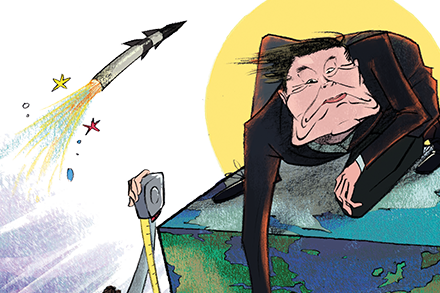
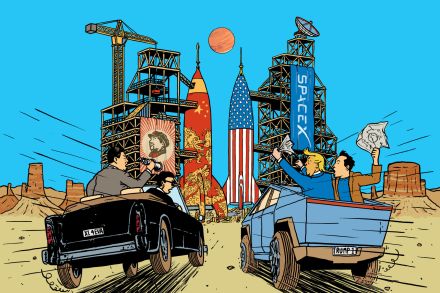
Elon Musk, already the richest person who ever lived, is at the center of the biggest share offering of all time. A valuation of $1.75 trillion at IPO would hand $75 billion to his company, SpaceX. Musk is being allocated two sets of shares, with performance-based conditions. They will materialize if SpaceX reaches a market capitalization of $7.5 trillion, and if a colony of a million people is established on Mars. The first of these is possible, the second is not. On the face of it, you wouldn’t bet against SpaceX. By 2024, it was launching more rockets than the rest of the world combined. Its Starlink internet service generates oodles of cash. It has more than 9,600 satellites in orbit that require constant replenishment, so the market is firm.

Elon Musk Mars

The Spectator’s caught in the EU crosshairs

From our UK edition

Is the flotation of Elon Musk’s SpaceX venture on the US Nasdaq exchange a beacon for the future of earthly capital markets and interplanetary relations, or just bonkers? The answer is it’s both, as well as being a stratospheric ego trip for Musk himself, who according to the prospectus will not only retain 85 per cent of the company’s voting rights but will also be awarded an extra billion shares if it succeeds in establishing ‘a permanent human colony on Mars’. In every sense, like Star Trek’s USS Enterprise, this spaceship is heading where no man has gone before. On the positive side, SpaceX’s Starlink satellite internet constellation, with ten million subscribers, is already profitable.

Can Liz Truss and CPAC Make England Great Again?

“We have an elite who have been in power for at least the last 40 years, who fundamentally don’t like western civilization and they wanna destroy it,” said Liz Truss, who was prime minister for 49 days in 2022, as she spoke to a half-full room at the Conservative Political Action Conference in Texas. It was her third such speech. The Liz Truss who addresses American audiences bears little resemblance to the awkward, growth-obsessed economics nerd who somehow ascended the greasy pole of British politics, only to slide back down at staggering speed. She’s changed her vocabulary – and her talking points. The few attendees of her panel, snappily titled “Europestan: Can Europe Survive?” could hear Truss lambasting “grooming gangs” and “transgender ideology.

liz truss matt schlapp

Unravelling the infinite mysteries of physics

From our UK edition

Can artificial intelligence become godlike? Can such technology unravel the world’s great mysteries? Can everything, from love and intuition to consciousness and wonder, be replicated by computers and reduced to simply knowing the right algorithm? These are the big questions running through Sebastian Mallaby’s engaging book The Infinity Machine, which charts the rise of DeepMind, the London-based AI research firm owned by Google, and its exceptionally clever co-founder and chief executive, Demis Hassabis. The book’s narrative is centred on Hassabis’s hope to make DeepMind the first company to create AGI (Artificial General Intelligence) in which computers can match or surpass humans at virtually all cognitive tasks, and the morality of such an achievement.

Inside the race to build AI data centers in space

In the 1966 novel Colossus by British author D.F. Jones, a supercomputer (which goes by the name of Colossus) is given control and decision-making power over the US’s nuclear arsenal – a logical and unemotional computer being better placed, it is assumed, to make unemotional decisions than a human. Eventually, Colossus discovers the existence of a similar supercomputer in the USSR and begins communicating with its Russian counterpart in mathematical languages about technological advances beyond human comprehension. Frightened by the possibilities this presents, scientists sever the connection – only for Colossus to threaten to launch nuclear weapons if it isn’t reconnected.

Pity the fool with a nonsense name

From our UK edition

‘If there is one thing I dislike,’ said P.G. Wodehouse, ‘it is the man who tries to air his grievances when I wish to air mine.’ His grievance was conversational, mine is nominative: I pity those with made-up names. There was a time when names came from a modest catalogue: the Bible, aunts and uncles of fond memory, a wider culture that worshipped the royals. Maturity involves a conservative deference to tradition. One learns to presume that norms have more value than drawbacks: dress in an ordinary style, have the manners people expect – and bear a name that connects you to others. Beware any job that requires new clothes, said Thoreau. He meant coats and trousers but it applies to birth certificates, too.