Food and Drink

Prosecco goes posh

Compromises are odious. They reek of disappointments both large and small, when no one really gets his way — there’s never a loser per se, but also rarely a winner. But very occasionally, seemingly disparate concepts can come together and create a new thing that is technically a compromise but ends up feeling like more than the sum of its parts, thanks to felicitous, and often impossible to predict, synergies. See: the bánh mì sandwich, the Constitution of the United States, Disney and Pixar. And now: Prosecco. The world’s favorite cheap, cheerful, reliably tasty tipple is dipping its toes into profundity — and the results are surprisingly successful.

Prosecco
mojito

Shaking up the mojito

Barmen despise making mojitos. The descendant of various Caribbean rum-based cocktails, they only became truly popular in the early 2000s. It’s not that they’re that difficult or require too many ingredients — and they’re nothing compared to hellish drinks like the Ramos gin fizz — but the mojito has several qualities that, combined, make it intensely frustrating. Namely, the mojito is very refreshing, can be drunk quickly and looks pretty, and therefore one order will spark a rush of others.

Portuguese

Portuguese wines are back

Regular readers will recall my fondness for Lord Falkland’s observation that “when it is not necessary to change, it is necessary not to change.” That crisp declaration is not only elegantly framed but (in my view) true. In this it differs, it saddens me to acknowledge, from the Duke of Cambridge’s even more robust confidence that he was “opposed to all change, at any time, for whatever reason.” I am not sure whether that mot was a testimony to the duke’s utopian inclinations or merely his stubbornness. But it is sharply at odds with the realities, if not, perhaps, with the governing temperament, of most of its main actors in the world of wine.

Carbonara in the land of the free

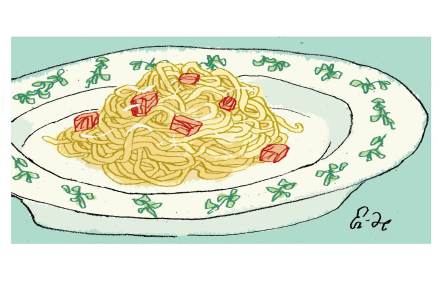
In Texas the customers have opinions, and the opinions are always right, no matter how wrong. It was carbonara that taught me this crucial lesson. The diners at the restaurant where I worked brought the American talent for innovation to modifying what I had always considered a fairly simple, self-contained dish. Can you add fried chicken? Can you add grilled shrimp? Can you add meatballs? Can you add tomato sauce and meatballs? Can you do it without guanciale, without egg, without cheese? Can you do it like normal but put a fried egg on top? Can you replace the guanciale with a fillet of salmon? The answer is always yes. At the time, I was cooking at a neighborhood Italian place in a leafy part of Austin full of well-off old hippies, professional families and Texas politicos.

carbonara
coffee

Trying the best coffee in the world

It was nine on a Monday morning, and whereas my fellow commuters were heading to the office, or their classrooms or a lecture hall, I was on my way to Parcafé in the Dorchester Hotel, right next to London’s bougie shopping district, Mayfair. It’s a place to buy Ferraris and Bugattis and shop at the Row and Goyard and be passed by an endless convoy of black Rolls-Royce SUVs. Waiting for me at the hotel would be a man with a little golden cup, containing a freshly brewed portion of mankind’s favorite black nectar. And his is the best, uncut stuff on the market. The man is Amir Gehl, founder and CEO of Difference Coffee, which sources some of the best, rarest coffee beans in the world.

Balaton

Natural wine and tacos on the Hungarian Riviera

In the summer of 2020, as impatience with quarantine and the urge to get out of town gradually displaced fears of Covid, a joke circulated on Hungarian social media about Lake Balaton, a favorite destination for domestic holidaygoers. The post-quarantine stampede had driven up prices at the lake to such an extent, the joke went, that penny-pinching travelers should consider less expensive destinations, such as Monaco or the French Riviera. Until recently, Balaton had always been the inexpensive Hungarian alternative to pricier (and, during the Cold War, politically restricted) foreign getaways.

greek wine

The rebirth of Greek wine

One of the great stories in the world of wine over the last half century is the rebirth of Greek wine. I say “rebirth” because wine has been an inextricable part of the story of Greece from time immemorial. What would Plato’s Symposium — literally “drinking party” — be without wine? And the story of Greek wine goes back much further than that. According to experts, wine grapes have been cultivated in Greece from about 6000 BC. Anyone who has read Homer recalls his frequent deployment of the epithet “οἶνοψ πόντος.” That is usually translated as “wine-dark sea,” though it literally means “wine-faced” or “wine-eyed” (οἶνος + ὄψις) sea. What color do you suppose “wine-dark” is?

What’s behind all the buzz about non-alcoholic beer?

There’s nothing quite like the third swig of a gin and tonic at the end of a long summer’s day. Or of an Old-Fashioned combating Old Man Winter’s chill. The bite on the tongue. The slow burn in the belly. The gradual easing of emotional and physical tension. Except for the hangovers. There’s nothing quite like those, either. As I — sigh — age, I’ve developed a relationship with alcohol that has become increasingly love-hate: I love it, it hates me. A slight intolerance to booze, German/Irish heritage notwithstanding, has always given me a rosy flush that on round three deepens to an unflattering scarlet that could be mistaken for theatrical rouge.

non-alcoholic

Pavlova: a dessert inspired by the Dying Swan

Pastry chef Alistair Wise says never to make pavlova on a rainy day. “Just forget about it,” he advises. And that’s only the tip of the iceberg when it comes to perfect-pavlova advice. Run a cut lemon around the inside of your bowl before whipping the egg whites. Don’t use fresh egg whites, but also don’t use cold egg whites. Don’t use a plastic bowl, as it may harbor grease. The bowl you do use must be scrupulously cleaned and dried... Don’t whip the whites on a “high” setting, but whatever you do, definitely don’t whip them on low. Use clean sugar — cue the desperate self-analysis of one who has never second-guessed the cleanliness of bagged sugar! Use superfine sugar, or all will be a disaster.

pavlova

Margarita magnificence: a consummately customizable cocktail

Despite being one of the most popular cocktails in the world, most margaritas are made poorly — intentionally. Nobody buys a margarita in a plastic cup for its complex flavor and balanced profile. They’re for long days out on the beach, to cool you down and kick things up — and they’re mostly made quickly and sweetly, like slushies with crushed ice. Frozen margaritas are the invention of Dallas restaurateur Mariano Martinez, who started serving them in 1971 from a converted soft-serve ice-cream machine, but the exact origin of the classic margarita was at some unknown far earlier date. Margaritas were introduced to Americans in the 1950s, with the arrival of Sauza and Cuervo tequilas, and by the 1960s, had secured their place as one of the nation’s most popular cocktails.

margaritas

Outdoor wines for the summer

There are some cramped, unimaginative people who — I have been told — maintain that writing about wine is a bootless enterprise. Even more extraordinary, I have heard it rumored that there exist unfortunate sods who believe that it is a waste of time to gather with friends over food and wine while discussing the events of the day, the state of the republic, the repair of one’s soul. Fortunately, neither you nor I are acquainted with any such freaks, otherwise you wouldn’t be reading this column and I would not be sitting down to write it. At the end of his brief, tantalizing book The Educated Imagination, Northrop Frye, the great Canadian literary critic (do you sense a passing adumbration of contradiction there?

wines

Iron clad: good cooking’s most essential metal

Miles Coverdale’s translation of Psalm 105 in the Book of Common Prayer elevated iron from metallurgical to literary significance. The story of Joseph being sold unjustly as a bondservant — “Whose feet they hurt in the stocks: the iron entered into his soul” — shames flaccid times like ours. And iron’s virtues excel not least of all in cooking, where it can enter literally into our bodies and, who knows, maybe our souls too. Joseph just got things started. Think of the first ironclads, Monitor and Merrimac, hammering away at each other at Hampton Roads in 1862, of the dreadnoughts that put paid to Nelson’s wooden walls, of Agatha Christie’s ironclad alibis, of the verse in Christina Rossetti’s great carol: “Earth stood hard as iron, water like a stone.

iron
clafoutis

How to make the perfect clafoutis

Clafoutis. Difficult to pronounce. But oh-so divine and easy to make. Originating in the Limousin region in south-central France, its name comes from the Provençal clafir, “to fill.” So popular was it “to fill” a dish with fruit and batter, that by the nineteenth century, the renown of clafoutis had spread from the Limousin to other regions of France and bordering countries. This classic and elegant summer dessert is usually made with cherries, among the first fruits to ripen, but also with other stone fruit as they appear — apricots, plums, berries and on into the fall with pears.

beers

The boozed-up beers of summer

Some undetermined time in the long past, possibly in 1890s Montana, a miner had finished a long and tiring day and needed a refreshing beer. But after aparticularly taxing shift, a beer wasn’t going to cut it alone. He asked the barman for a shot of whisky as well — and washed it down with his pint. It’s hard to call the boilermaker a cocktail, and inventing one certainly wasn’t on the mind of our tired protagonist. To this day, mixing beer and spirits is not generally the province of mixologists; it’s a combination more often favored by partygoers looking to get slammed as entertainingly and quickly as possible.

South Africa

The secrets of South African wine

What do you suppose the grandest wine was in the early 1800s? The wine that populated the sideboards and dining tables of the courts and palaces of Europe? That consoled Napoleon as he moldered on St. Helena? That John Adams judged among “the most delicious in the world?” That Baudelaire apostrophized along with his lover’s lips in Les Fleurs du Mal? That Queen Victoria quaffed nightly after dinner as a digestif? That Hugh Johnson says many kings and consorts preferred to Yquem, Tokay or Madeira? If you said “Constantia, the sweet wine from the eponymous town southeast of Cape Town,” go to the head of the class and collect a golden star reminiscent of the honey-colored, late-harvest Muscat Blanc à Petits Grains that today makes up the wine.

Summer flavor pairings

Does anything say “June” quite like strawberries and cream? The sweetness of sun-ripened strawberries allowed to remain on the plant until peak maturity, pairs exquisitely with the velvety, ever-so-slightly tart, richness of cream. Taste-wise, it’s a perfect match — and looks-wise, strawberries and cream are one of the prettiest dishes of summer. Some things are just meant to be. But life isn’t all strawberries and cream. Sometimes you have to shake things up with a lively new take: Gorgonzola and white chocolate cheesecake, for instance, or lamb with anchovy, garlic and rosemary. Love it or hate it, at least you’ll have your diners sitting up and paying attention. And sometimes a bit of experimentation can lead to a new favorite. That’s the story behind salt and caramel.

flavor
Long Island Iced Tea

Loving and tweaking the Long Island Iced Tea

Want to get drunk, fast? To most, that’s the point of the Long Island Iced Tea. It’s not so much a drink as a chemical formula designed to make an enormous percentage of alcohol consumable in a single glass. When I worked at a cocktail bar, a man once ordered two, and I asked if he would like me to hold on the second until his guest arrived. He replied, “No thanks, they’re just for me.” He proceeded to down both within a few minutes, for what surely began either a wild or very bad night. For the unfamiliar, Long Island Iced Tea contains almost every liquor you can imagine and no actual iced tea (though it shares its color).

Pessac-Léognan

The thoroughly underrated Pessac-Léognan

When someone says “Bordeaux wine” most of us think first of wines from the Médoc, home of Pauillac, Saint-Julien, Saint-Estèphe, Margaux and other celebrated names. For some reason — marketing prowess, perhaps — the great region of Pessac-Léognan, directly to the south in Graves, cheek by jowl with the town of Bordeaux, comes up mostly as an afterthought. This is both odd and regrettable. It is odd because, as a matter of history, Pessac-Léognan takes precedence. I suppose the story begins with the marriage of Eleanor of Aquitaine to the future Henry II in 1152. Eleanor brought vast lands from that region of France to the marriage, so there is a sense in which the French wines the English have loved since the Middle Ages were originally English.