Theatre

Yank bait

Here come the Yanks. As the summer jumbos disgorge their cargoes of wealthy, courteous, culture-hungry Americans, the West End prepares to bag a fortune. Death of a Salesman is just the kind of timeless post-war classic that Americans adore, isn’t it? Not quite. Arthur Miller is mistrusted in his homeland. For starters he was a closet pinko who kept the closet door wide open. He was wooed by Hollywood but spurned every inducement. He married Marilyn Monroe and failed to make her happy. And top of the chargesheet is this play, which proposes that the American dream is a con, a swindle, a diabolical cruelty that hounds mortals to death by engorging their bellies with fantasies of happiness. It’s a superb artefact but relentlessly uncomfortable to sit through.

Four play | 14 May 2015

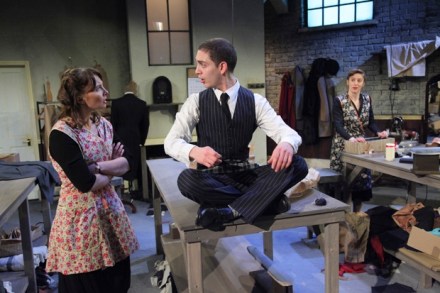
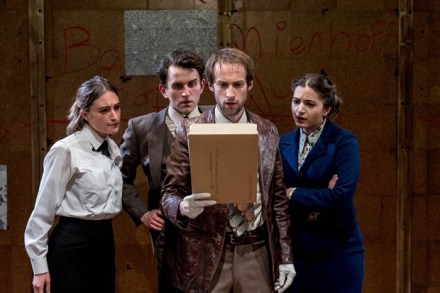
If Julian, Dick, George and Anne had become terrorists they’d have called themselves The Angry Brigade. It’s such a Wendy house name. The quartet of violent outcasts met in a Camden squat in the late Sixties and moved to Stoke Newington where they rented a house to deflect unwanted attention. They began planting bombs around London in the hope of jerking the proles from their consumerist trance and sparking a communist war. They preferred catchy locations for their fireworks: the Albert Hall, a BBC film unit, an MP’s garden. And it took the cops ages to track them down and sling them in jail. James Graham’s new play uses a neat staging device. There are four terrorists and four detectives, and the same actors play both hunters and quarry.

Pinter without the bus routes

David Mamet is Pinter without the Pinteresque indulgences, the absurdities and obscurities, the pauses, the Number 38 bus routes. American Buffalo, from the 1970s, is one of Mamet’s early triumphs. Don is a junkshop owner who believes a customer cheated him over a rare nickel so he gets his young pal Bob to steal it back. An older friend, Teach, persuades Don to ditch Bob and let him commit the burglary. That’s it. That’s all that happens in this narrow, gripping thriller, which takes the brutal male culture of the Wild West and imports it to the Chicago slums where three lonely outcasts fight desperately for scraps of cash and friendship. On paper it all sounds grey, miserable and petty. On stage it’s magnificent, multicoloured, vast and tragic.

Losing the plot | 30 April 2015

Enter Rufus Norris. The new National Theatre boss is perfectly on-message with this debut effort by Caryl Churchill. Her 1976 play about inequality screams, ‘Vote Ed’ at triple-klaxon volume. Not that anyone in the audience was won over. They’d made up their minds long ago. Which is just as well because the play is hopelessly ineffective on every level. Churchill must be the most over-rated writer the English theatre has produced. She has virtually no dramatic skills. She can knock out humourless preachy rhetoric by the yard but as for the rest of it she hasn’t a clue. She can’t write a plot. She can’t create a human individual or differentiate one character from another with quirks of thought, word or deed.

Stage fright

The smash hit Matilda, based on a Roald Dahl story, has spawned a copycat effort, The Twits. Charm, sweetness and mystery aren’t Dahl’s strong points. He specialises in suburban grotesques who commit infantile barbarities. But his prose is sensational. No ‘style’ at all, just the simplicity and clarity of a master copywriter. He’s as good as Orwell. Mr and Mrs Twit are a pair of malignant outcasts who enjoy tormenting innocents. They keep a family of monkeys in a cage and they glue birds to trees and shoot them. You can read the story in about 20 minutes. It probably took Dahl a bit longer than that to write. And Enda Walsh’s essay-crisis adaptation may have delayed him for a day or two.

Death by politics

Dead Sheep is a curious dramatic half-breed that examines Geoffrey Howe’s troubled relationship with Margaret Thatcher. Structurally it’s a Mexican bean. It leaps all over the 1980s and it keeps shifting genre from cabaret to tragedy via cheesy political satire. Some actors are impersonators, some are caricaturists, some are neither. James Wilby’s study of Howe avoids his personal mannerisms, the pensive shabbiness, the punctilious, worried eyes, and the soft beguiling purr of his vocal chords. Instead Wilby presents him as a bewildered monk tiptoeing around a lion’s den. Steve Nallon does Mrs Thatcher as a drag-queen which looks pretty odd next to Wilby’s straightforward Howe but Nallon is a master vocalist.

Ayckbourn again

Experts are concerned that Alan Ayckbourn’s plays may soon face extinction. Fewer than 80 of these precious beasts still exist in their natural habitat, so theatre-goers will be cheered to know that the National Theatre has created a genetically identical replica and released it into the wild. Rules for Living, fashioned by Sam Holcroft from the Acykbourn blueprint, is a bourgeois natter-fest in which bickering couples meet for a fractious Christmas summit. The characters are a bit nice and a bit nasty. Stephen Mangan plays a failed cricket star married to a soak in a frock. They have an only child who suffers from this year’s must-have mental disorder.

Bad Jews at the Arts Theatre reviewed: strange, raw, obsessive and brilliant

Bad Jews has completed its long trek from a smallish out-of-town venue to a full-scale West End berth. Billed as a ‘hilarious’ family comedy it opens on a low-key note in a New York apartment where three cousins have gathered for grandpa’s funeral. Daphna is a puritanical vegan Jewess, training as a rabbi, who wants to move to Israel, marry a soldier and serve in the IDF. She’s insanely jealous of Jonah and Shlomo, whose parents have bought them a flat before either has found a job. Shlomo (who calls himself Liam) is a ‘bad Jew’ obsessed with Japanese culture who intends to marry out.

Blunt and bloody: ENO’s Sweeney Todd reviewed

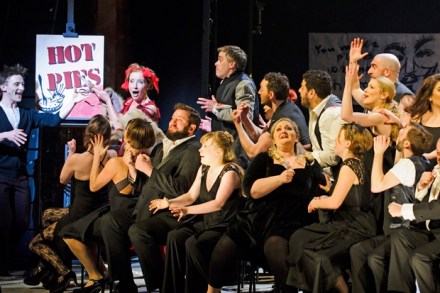
A wicked deception is sprung in the opening moments of this New York-originated concert staging of Stephen Sondheim and Hugh Wheeler’s Sweeney Todd. The English National Opera orchestra, liberated from the pit, is duly assembled on stage at the London Coliseum; flower arrangements and a Steinway grand add to the formality, and right on cue the conductor and cast, suitably attired in evening wear and with scores in hand, take their places behind a line of music stands. The applause dies and Bryn Terfel turns to the conductor, clears his throat and nods. The whirring ostinato introducing ‘The Ballad of Sweeney Todd’ begins — furtively — and Sweeney, of course, has the first word.

Shrapnel at the Arcola works for the slayers, not the slain

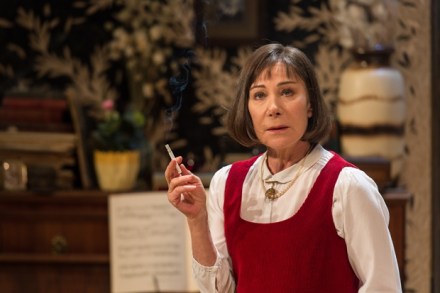
Quite a hit factory these days, the Hampstead Theatre. The latest candidate for West End glory is Hugh Whitemore’s bio-drama about Stevie Smith. Not an obvious choice. The script, from the 1970s, recreates the atmosphere of Stevie’s life with effortless accuracy. Her vocabulary, her taste in clothes, her habits of thought and expression appear by magic as if drawn from the evidence of intimate friends. Yet Whitemore never met his subject. Zoë Wanamaker plays her as an adorable suburban eccentric, whose razor-sharp intellect peeps out from behind a façade of emerald pinafores and sherry decanters. Stevie (Florence Margaret Smith) was born in Hull in 1902 and lived nearly all her life in Palmers Green.

Radiant Vermin at the Soho Theatre reviewed: a barmy little sketch posing as a revolutionary satire

Philip Ridley is best known as the screenwriter of The Krays, in which Gary and Martin Kemp played Ronnie and Reggie as a pair of tanned and lisping choirboys. Ridley loves to bang his own gong. And he’s got enough gongs to raise quite a racket. The Smarties Prize, the W.H. Smith Mind-Boggling Book Award, the George Sadoul prize, the best director award at the Porto Film Festival. His action-packed CV even features trophies he nearly won but didn’t: the London Fringe Best Play Award (nominated); the Carnegie Medal (shortlisted). And no London writer has shown more literary potential than Ridley. He remains the only earthling ever to receive the Evening Standard’s ‘most promising’ award in both film and stage categories. How are those promises shaping up?

The Armour at Langham Hotel reviewed: three new playlets that never get going

One of last year’s unexpected treasures was a novelty show by Defibrillator that took three neglected Tennessee Williams plays, all set in hotel rooms, and staged them in suites at a five-star dosshouse in central London. The Langham Hotel, an antique hulk of marble and glass overlooking Broadcasting House, is justly proud of its raffish literary history. Arthur Conan Doyle once met Oscar Wilde there for a chinwag and a cup of tea and by the time the bill arrived they’d conceived a fictional detective named Holmes. The Langham’s management is keen for Defibrillator to repeat last year’s success but how? Search the archive for more plays set in hotels? Dramatise a short story with a hotel location? Commission some brand-new inn-based drama?

Why George Bernard Shaw was an overrated babbler

When I was a kid, I was taught by a kindly old Jesuit whose youth had been beguiled by George Bernard Shaw. The provocative ironies of ‘GBS’ were quoted everywhere and he was, for several decades, the world’s leading public intellectual. But as a schoolboy I found it hard to assent to the infatuations of my elders and though I relished Shaw’s aphorisms (‘we learn from history that we learn nothing from history’) I conceived a suspicion that he was smug and overrated. A babbler. Perhaps even a bore. Man and Superman, rarely revived at full length, offers us GBS with all the taps running. Imagine Fry, Brand and Norton rolled into one and given a bushel of coke to snort.

Muswell Hill reviewed: a guide on how to sock it to London trendies

Torben Betts is much admired by his near-namesake Quentin Letts for socking it to London trendies. Letts is one of the few individuals who enjoys the twin blessings of a Critics’ Circle membership card and a functioning brain so his views deserve serious attention. The title of Betts’s 2012 play Muswell Hill shifts its target into the cross hairs with no subtlety whatsoever. Curtain up. Married couple, Jess and Mat, are nervily tidying their yuppie dream home in expectation of supper guests. Jess is a sex-bomb accountant. Mat is a blankly handsome scribbler whose debut novel keeps getting rejected. Then a missile strikes. Mat casually mentions his acquaintanceship with an Australian electrician whom Jess has been secretly entertaining. Tense silence. The doorbell rings.

How to Hold Your Breath, Royal Court, review: yet more state-funded misanthropy

‘We hate the system and we want the system to pay us to say we hate the system.’ The oratorio of subsidised theatre rises, in triumphant blast, at the Royal Court whose current empress Vicky Featherstone has chosen to direct an interesting new play by Zinnie Harris. I’d call it a quasi-symbolist extraterrestrial tragicomic chicklit road-movie spoof with Chomsky-esque anti-corporate neo-collectivist socioeconomic textual underpinning but I fear this may lend it a clarity of purpose, and a firmness of character, which it doesn’t quite possess. We start with Dana, a chippy frump on the last lap of her sex life, bedding a UN drudge named Jarron who claims to be ‘a demon, a devil, a god’.

A tatty new theatre offers up a comic gem that’s sure to be snapped up by the BBC

New venue. New enticement. In the undercroft of a vast but disregarded Bloomsbury church nestles the Museum of Comedy. The below-stairs space wears the heavy oaken lineaments of Victorian piety but the flagstones have been smothered with prim suburban carpeting, wall-to-wall. There’s a bar in one corner. Yes, a bar in a church. With prices high enough to make you take the pledge. The ecclesiastical shelves are crammed with books, magazines, scripts and photographs that summon up the ghosts of our comedy heroes. A big carved pew, centrally plonked, invites the worshipper to sit and read, let us say, the autobiography of Clive Dunn or the diaries of Kenneth Williams. The sheer incongruity of this arrangement causes palpitations in the brain.

Tom Stoppard’s The Hard Problem review: too clever by half

Big event. A new play from Sir Tom. And he tackles one of philosophy’s oldest and crunchiest issues, which varsity thinkers call ‘the hard problem’. How is it that a wrinkled three-pound blancmange sitting at the top of the spinal cord can generate abstract thoughts of almost limitless complexity? In real life Sir Tom is said to have such a flair for philosophical chitchat that he can fire off searching observations about Descartes, mind-body dualism, the nature of immateriality, being and non-being, the ‘cogito’ and so on, until those around him have slithered into a coma. Which is not rude of them.

My Night With Reg at the Apollo Theatre reviewed: a great play that will go under without an interval

Gay plays crowd the theatrical canon. There are the necessary enigmas of Noël Coward, like The Vortex or Design For Living, which are slyly aimed at an audience of knowing code-breakers. There are the proud, defiant (and rather tedious) pleas for understanding like La Cage Aux Folles. And the gayest of them all, My Night With Reg, is also the least overtly gay because it dispenses with all homosexual caricatures. There isn’t an interior designer, a flight steward or a hair stylist in sight, let alone a Liberace fetishist, or a Maria Callas wonk. The characters are mainstream yuppies who are exactly like hetero folk, except that they seduce one another with very little encouragement and an enviably high success rate. We’re in the 1980s.

Young Vic’s Bull, review: a new Mike Bartlett play to bore you into catalepsy

A knockout show at the Young Vic. Literally. The stage has been reconfigured as a boxing ring to make Mike Bartlett’s play, Bull, feel like a sporting fixture. This is a common conceit, even a cliché, but here it’s done superbly. The auditorium floor is squash-club yellow and the stage is surrounded by a casual standing area that creates the ragged informal atmosphere of a training arena. Excellent stuff. The play is a wordy, tricky, shifty, nasty, faithless thing. The characters lie about their backgrounds so it’s hard to know who, or what, to latch on to. More problematically the plot is infertile. Nothing grows or develops. At curtain-fall the position is the same as at curtain-rise. We’re in a workplace.

Old Vic’s Tree: Beckett plus Seinfeld – plus swearing

‘Fucking hell. You twat. Fuck off. Fuck. Fuck.’ These dispiriting words are the opening line of Tree, a newish play by the lugubrious comic Daniel Kitson, whose stand-up show once transported me into the heavenly arms of Lethe. His script opens with a chance encounter between two oddball smart Alecs. The outdoor setting, borrowed from Beckett, is a suburban cul-de-sac where a single tree is about to shed its autumn raiment. One man crouches in the branches, another stands below. They exchange confidences, observations, food and witticisms. At the end, one departs. This is a play of quips and anecdotes but no significant action. The tree-dweller is an eco-warrior protesting at the council’s policy of bough amputation and trunk eradication.