Theatre

Like eating 58 luxury chocolates: The Flying Lovers of Vitebsk reviewed

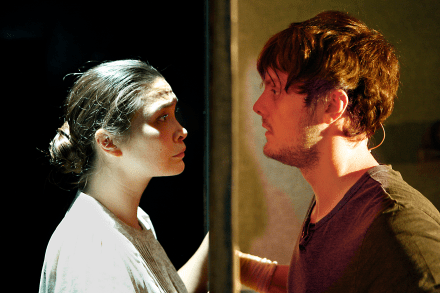
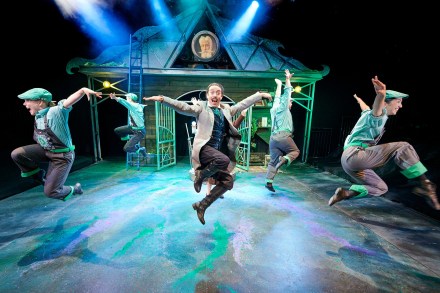
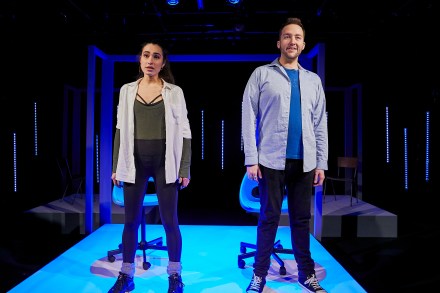
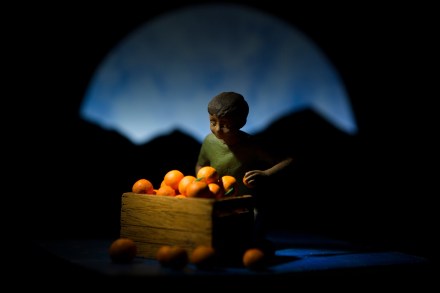
The Flying Lovers of Vitebsk begins with a phone conversation between a pretentious art critic and a man called Marc. This turns out to be Marc Chagall, the expressionist painter, who was born in Vitebsk in Belarus in 1887. It would have been helpful to include his name in the title. Emma Rice, the director, relies on her usual blend of dances, songs and pretty lighting to tell her tale. She has very low expectations of her audience. The sad characters cry. The happy characters laugh. The amorous characters dance rapturously. Everyone sings a lot. The script consists mainly of plot points written in clunky, airless prose. ‘It was the best exhibition I’ve ever had,’ announces Marc after an early success in Berlin.

Absorbing and beautifully designed: Jane Eyre reviewed

Blackeyed Theatre is another victim of the virus. Its production of Jane Eyre was midway through a UK tour, and due to visit China for a month, when the pandemic shot its plans to bits. Last month the show was revived on stage and committed to film. Kelsey Short (Jane) leads a team of just five actors who tell the story as Charlotte Brontë wrote it. The costumes, hairstyles and habits of speech seem authentically Victorian. The director, Adrian McDougall, has rejected the fashionable habit of presenting Jane as a rad-fem freedom fighter surrounded by grotesque male oppressors. His version reminds us how sympathetic the novel is towards men. Mr Rochester (Ben Warwick) is a romantic enigma, a dashing, grizzled buccaneer who is also decent, honourable and kind-hearted.

Skilful and riveting: The Poltergeist at the Southwark Playhouse reviewed

Sasha is angry. He’s a gay artist on his way to his niece’s birthday party and he keeps popping codeine pills to get him through the dull ceremony ahead. His devoted boyfriend, Chet, hasn’t realised that Sasha’s drug habit is a full-blown addiction but Sasha is highly secretive. He shows us two sides of his nature at once. Outside, he’s a friendly smiling uncle who dutifully attends family celebrations. Inside he’s spitting with rage at his brother’s cosy life and its trite domestic rituals. When he greets his pregnant sister-in-law he grins politely while fuming to himself: ‘There’s a billion family photos here. If I spat anywhere I’d hit one.

As an essay in cheap comedy the show is a great success: Emilia reviewed

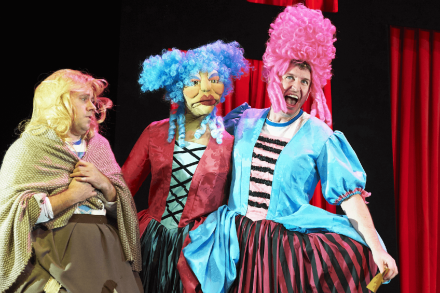
Emilia is a period piece about Emilia Bassano who may have been the ‘dark lady’ of Shakespeare’s sonnets. The writer, Morgan Lloyd Malcolm, declines to turn the subject into a history play and instead creates a larky sketch show with snippets of literary gossip. Our heroine enters as a frightened teenager contemplating the horrors of courtship: ‘Men sniff at me like dogs.’ Marriage, she shudders, will crush her, mind and body. ‘As I grow, I must shrink.’ She’s also a poet who needs a publisher but she’s thwarted by institutional sexism in the book trade. ‘Women’s poetry?’ screeches a male reader. ‘The most dangerous rubbish I’ve ever seen.

Racists will love it: National Theatre’s Death of England – Delroy reviewed

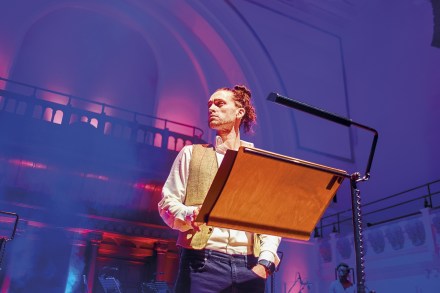
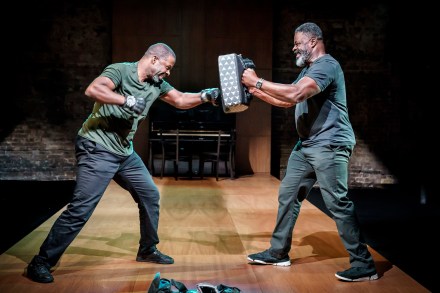
Death of England: Delroy is a companion piece to Death of England, which ran in February at the NT and examined the white working classes. Here the focus is on a successful black Briton, Delroy, who votes Tory and feels at home in multicultural society. The charismatic Michael Balogun plays him as a complex, shrewd and humane figure. He likes to mock white people who judge others according to superficialities like accent and pronunciation. And he recalls his horrified excitement when a white girl at school calmly placed her finger inside his boxer shorts. Delroy has plenty of white pals including his girlfriend, Carly, who is expecting their child. The only antisocial voice in his life belongs to his mother, a Jamaican bigot, who objects to Carly’s ethnicity.

The Beeb could turn this script into TV gold: Howerd’s End reviewed

It’s touch and go whether the theatre will survive this latest assault. Some venues have pushed back their entire programme by four weeks, which is chaotic but manageable. Theatres mounting a panto are in a trickier position because they can’t trust Gove and Johnson not to extend the curfew into the festive season. November is the month when companies start to book venues for the Brighton Festival in May. What to do? Take the plunge or wait it out for another year? And the big decision about Edinburgh 2021 will have to be faced before the winter is over. The lockdown in spring was a financial and professional calamity but this new onslaught adds a spiritual element — despair.

Finally a lockdown drama that will endure: James Graham’s Bubble reviewed

Theatres can open if they want to. That’s the current position. The only factor keeping a playhouse dark is a lack of guts or imagination on the part of its leadership. A small pub in Vauxhall, The Eagle, is mounting new plays in its garden space to raise everyone’s morale. Punters must wear masks and sit in bubbles. ‘We’re adhering to the government guidelines,’ announced the artistic director before the start, ‘which are changing all the time.’ The show is a feelgood musical about drifters and dreamers in their twenties trying to make it in New York. Waverley wants to be an actress but her plans are blown off course by a tempting job offer from a law firm. What to do?

The mix of slapstick and sermonising is certainly original: In Bad Taste reviewed

In Bad Taste is a slapstick comedy about five female terrorists who murder the governor of the Bank of England. They chop him to pieces, cook him in a casserole and devour the lot. Their plan is to ‘eat the rich’, literally, and to trigger a worldwide revolution. After this grimly hilarious opening the script takes a sharp U-turn when one of the women makes a speech denouncing misogynists. The others agree to drop the revolt against the wealthy and to hunt down nasty men instead. Each woman suggests a candidate for execution: a male colleague who works too sluggishly, a father-in-law who makes judgmental comments, a drunkard who gropes barmaids. The killing begins. Nine victims are axed to death and their bodies cannibalised. The police launch a manhunt.

The jackboot zealotry of ushers is ruining theatre

Southwark Playhouse has revived an American show, The Last Five Years, whose run was cancelled in March. In advance, I received an email outlining the theatre’s new rules, which appeared to exceed the minimum legal requirements. At the venue, I found that the main entrance had become the exit while the side door had become the main entrance. What for? Perhaps an unsubtle reminder that ‘everything’s changed now, pal, so get used to it’. The queue on the pavement moved at a turtle’s pace because the usher gave each playgoer a homily about the new regime before allowing them to pass through Checkpoint Charlie. Inside it was like an army hospital. Sentries in the corridors regulated our access to the loos.

A night of angry pipsqueaks: Young Vic’s 50th birthday gala reviewed

When Kwame Kwei-Armah took over the Young Vic a ‘Black Lives Matter’ sign was strapped to the front of the building. One of BLM’s aims is the overthrow of capitalism and it’s widely assumed in theatreland that Kwame, who is great fun to meet, has embraced this goal by adjusting the Young Vic’s pay structures so that he earns no more than the bar staff and the cleaners. Happily the pay cut seems not to have affected his mood, and last weekend he was fizzing with anticipation as he hosted the Young Vic’s 50th birthday gala. ‘We’re in the house. Make some noise,’ he cried. ‘Shake off the cobwebs!’ He introduced a medley of performances by ‘artists, thinkers, academics and musicians’.

Enjoyable but hardly classic Alan Bennett: The Outside Dog & The Hand of God reviewed

The season of Alan Bennett’s Talking Heads continues at the Bridge. In The Hand of God we meet Celia, a posh antiques dealer, who befriends old maids in the hope of acquiring their valuables cheaply. Like everyone in her trade she uses play-acting and mind games to give her the advantage while haggling. If her enemy falters, she pounces. A man visits her shop and becomes visibly excited by a framed drawing which Celia hoped to flog for £30. Spotting his eagerness, she trebles the price. He pays up and hurries out. Later she learns that the drawing was by an old master whose style she failed to recognise. Millions have slipped through her fingers. Kristin Scott Thomas is well cast as this suburban snake in the grass. All the visuals are beautifully judged.

Does Rada seriously believe George Bernard Shaw was an Irish Mengele?

What has happened to Rada? The Royal Academy of Dramatic Art is the latest arts establishment to have gone mad. In the summer, it issued a self-flagellating public statement that it was institutionally racist and would ‘decolonise the curriculum and end racism’. The ‘actor-vists’ are clearly unhappy with the place. They should all be busy learning how to be heard at the back of the stalls. But these days, the enunciation course has a ‘d’ in front of it. The student body — or a noisy part of it — is now calling for a purge of the school’s illustrious benefactor, George Bernard Shaw, after whom one of the school’s theatres and a special fund are named. Why? He is accused of being a racist and a eugenicist.

Brilliantly performed twaddle: Old Vic’s Faith Healer reviewed

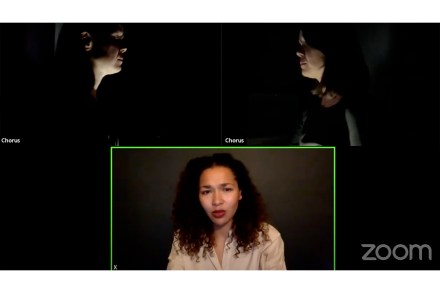
The Old Vic refuses to reopen. Director Matthew Warchus says the social distancing rules make it impossible for him to reach the 70 per cent capacity he needs to break even. That was true in the old days when the Vic had to put on lavish fare and tempt audiences away from the opulent variety of the West End. But the competition has gone. Warchus is free to mount cheap, simple dramas which recoup their costs quickly. Curiously, this is what he’s doing with Brian Friel’s three-hander, Faith Healer, but the show is performed in an empty house and watched live by spectators via Zoom. The pandemic has made Warchus allergic to playgoers. What a shame. When Lilian Baylis ran the Vic during the Great War she kept it open even when Zeppelins were bombing London.

Covid marshals are killing theatre: The Shrine & Bed Among the Lentils reviewed

Covid marshals have invaded theatreland. Arriving for a weekday matinee at the Bridge, I was greeted by stewards holding up illuminated boards. ‘PLEASE WEAR A FACE COVERING.’ Inside, the seating had been rearranged into clumps of twos and threes with the odd single perch sticking out like a toadstool. Nicholas Hytner offered us a pair of the best-loved scripts by his favourite living playwright, Alan Bennett. The afternoon was stuffy and I took sips from a bottle of water in accordance with signage which suggested that masks might be removed for the purposes of drinking. After each glug I diligently replaced my covering. Ten minutes into the show, I was visited by a Covid marshal who informed me that the position of my mouth-wear dissatisfied him.

An investor should snap up this weepy musical: Sleepless reviewed

It has roughly the same proportions as Shakespeare’s Globe. The Roman Theatre in Verulamium (St Albans) is an atmospheric ruin with low flint walls, a banked rampart and a single stone column. Historians estimate that the circular space, measuring about 40 yards in diameter, would have enabled 7,000 spectators to watch plays, gladiatorial contests and executions. That figure seems too high. A capacity of 1,500 might be nearer the mark. These days the venue hosts outdoor theatre. Playgoers who sit at the edge of the auditorium can reach out and touch the ancient flint walls and run their fingers across the grain of the Roman concrete. During the August cold snap I watched The Taming of the Shrew, by Folksy Theatre, under an ominous grey sky.

Defund theatres – and give the money to gardeners and bingo halls

For nearly six months our subsidised playhouses, notably the National Theatre, have been dark. What have we missed? Not much. Some would say nothing at all. And this has come as a surprise to those of us who were led to believe that the subsidised theatre is critical to ‘the national conversation’. It turns out that the nation can happily debate political and social issues without the help of playwrights or actors. Perhaps it’s time to re-examine our state-funded theatres and the reasons we support them. The National Theatre was set up in 1963, soon after the establishment of the Royal Shakespeare Company in 1961, and both received funding from the Arts Council, which was founded in 1946.

Edinburgh Festival is in ruins – but there’s one gem amid the rubble

The virus has broken Edinburgh. The shattered remnants of the festival are visible on the internet. Here’s what happened. The international festival has been reduced to one filmed theatre commission and a handful of videoed musical offerings. The Fringe has survived but in a horribly mutilated form. Two of its most prestigious brands, the Pleasance and the Assembly Rooms (which host hundreds of shows between them every year), have pulled out entirely. They’re so well established that they’ll have no difficulty restarting in 12 months’ time. Another big name, the Gilded Balloon, is offering a few online shows and some recorded highlights from previous years.

Unique and disturbing: Donmar Warehouse’s Blindness reviewed

Okay, I admit it. I have a girl crush on Juliet Stevenson. Ever since I first saw her in the 1990 film Truly, Madly, Deeply with Alan Rickman, I have loved her sexy, round and intelligent tones. Imagine how excited I was to discover, therefore, that you can have Juliet in your ear for a whole hour and 15 minutes while you sit through a so-called ‘sound installation’ — or rather an audio staging — of Blindness, the current offering at the Donmar Warehouse and the first opening since lockdown. Sitting in a darkened theatre studio, with strobe lighting and headphones, you are seated in your own space, and socially distanced from 40 other people.

The New Normal Festival shows how theatre could return

So the madness continues. Planes full of passengers are going everywhere. Theatres full of ghosts are going bust. My first press night since March took place at a monumental Victorian building in Wandsworth where concerts are staged in an open-air courtyard. The entry process was less fussy than I’d expected. I didn’t need my phone and there was no ‘track and trace’ nonsense. A masked official aimed a ray gun at my face and showed me a reading — 36.4ºC. I’d passed the temperature test. He then pointed me towards a hand sanitiser. ‘Is it compulsory?’ I said politely. A look of fear crossed his eyes, as if violence were about to erupt, and he meekly repeated his request that I soap down my mits.

From riveting Hitchockian melodrama to bigoted drivel: BBC’s Unprecedented reviewed

Back to the West End at last. After a four- month lay-off, I grabbed the first available chance to catch a show in central London. I joined 20 enthusiasts at the ‘West End Musical — Silent Disco Walking Tour’, which convened outside a Fitzrovia pub. We were given a pink bracelet and a set of headphones that pumped musical hits into our ears. Our cheerleader, Sean, introduced us to his helpers, Tiny Tom and Sticky Vicky, who taught us a quick dance move. It transpired that we were the performers as well as the audience. We set off across the West End like a military convoy of unemployed choristers. At Old Compton Street we belted out ‘A Spoonful of Sugar’ from Mary Poppins.