Theatre

A well-meaning but dull Official History: Olivier’s Normal Heart reviewed

The Normal Heart is not about Aids. Larry Kramer’s play is set in New York in 1981 at a time when clinicians were struggling to find a link between a handful of rare diseases that struck only gay men and heroin addicts. The term ‘Aids’ wasn’t adopted until late in 1982. And this dampens the wheels of Dominic Cooke’s production. A playgoer is likely to stifle a yawn as the characters on stage try to discover medical facts that have been common knowledge for decades. There are other problems with Kramer’s ageing script. The story follows an indignant activist, Ned, who has to persuade the city authorities to take the plague seriously. He embarks on a laborious campaign whose numerous battlegrounds the script exhaustively covers.

Gripping slice of old-fashioned entertainment: Old Vic’s Camp Siegfried reviewed

Boy meets girl. Girl gets pregnant. Then the entire world collapses. That’s the story of Camp Siegfried, which is set in the late 1930s at a holiday park in Long Island where German-Americans come to enjoy the outdoor life and to celebrate their ancestral culture. The boy is a strapping 17-year-old who chats up an awkward geeky girl with little sexual experience. Or so it seems. The boy is keen on Germany’s dynamic new chancellor but the girl finds Hitler too ‘excitable’. But when she’s invited to give a speech to the entire camp, she becomes an overnight convert and extolls the Nazi virtues of unity and patriotism. And she’s tempted to believe a rumour that the Führer himself travelled from Germany to hear her speak.

Jennifer Saunders is brilliant: Blithe Spirit at the Harold Pinter Theatre reviewed

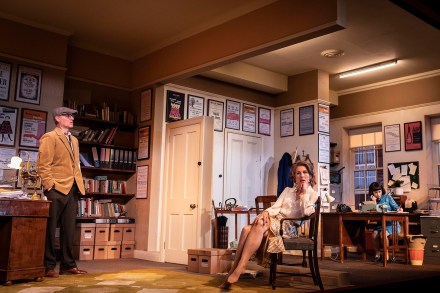
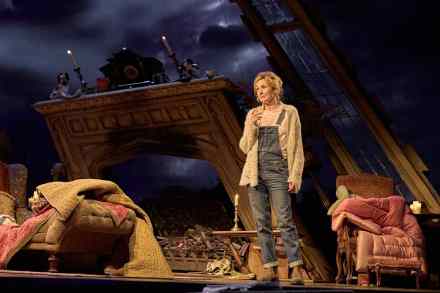
Blithe Spirit is a comedy with the plot of a horror story. Charles, a middle-aged novelist, lives happily with his second wife, Ruth, but he accidentally conjures up the spirit of his first wife, Elvira, during a séance. He becomes the target of a ghostly murder plot. Elvira decides to bump Charles off and enjoy his company in the afterlife. The play was one of Noël Coward’s biggest hits and although the script is 80 years old, this production features intriguing new material. The spiritualist, Madame Arcati, suffers from wind. She refers to her dietary anxieties several times and she mentions her dislike of red meat and roast pigeon.

Sexist, classist and pro-global warming: Frozen, at Theatre Royal Drury Lane, reviewed

Frozen the musical declares war on woke politics. The 2013 Disney movie has been turned into a song-and-dance show that openly celebrates sexism, classism and misogyny. Plus, it salutes the joys of global warming. It’s set in a Scandinavian realm ruled by a kindly monarch who lives in a castle attended by fawning servants. No sign of social mobility here. An impetuous young princess, Anna, falls in love with an eligible duke, Hans, but their betrothal annoys Anna’s sister, Princess Elsa. This is dangerous because Elsa has magical powers that she can’t control. She accidentally casts a spell on Anna, who falls to the ground with a terrible illness. Things get worse when a cold snap arrives from the north and plunges the entire kingdom into a new ice age.

Tsunami of piffle: Rockets and Blue Lights at the Dorfman Theatre reviewed

Deep breath. Here goes. Winsome Pinnock’s new play about Turner opens with one of the most confusing and illogical scenes you’re ever likely to see. A teacher on a school trip is showing her pupils a Turner painting displayed in a gallery housed inside a ship donated by the producers of a film starring a famous actress, Lou, who happens to be on board wearing a sumptuous outfit for an awards ceremony, which she plans to avoid for fear that a coveted prize will be handed to a rival. Lou invites the school teacher to an after party that is scheduled to start when the awards ceremony ends. She then gets distracted by the sight of movement on the surface of the Turner canvas. The painted figures, frets Lou, appear to be shifting and jerking.

Glib and snarky: Andrew Lloyd Webber’s Cinderella, at Gillian Lynne Theatre, reviewed

It’s a rum beast the new Andrew Lloyd Webber musical. Cinderella is set in Belleville, a European city of 18th-century vintage, whose inhabitants are fixated with the body beautiful. Cinderella, a pasty Goth, rejects this ethos and vandalises a statue that commemorates a handsome prince who recently died in battle. Cinders is punished by being chased into a forest and tied to a tree but she’s rescued by her best friend, Prince Sebastian, who will inherit the throne as soon as he marries. Sebastian and Cinders are pals whose friendship is destined to blossom into romance. They can’t see this. We can. And that’s the story. Oscar-winner Emerald Fennell has created a heap of trashy, unsympathetic characters.

Captures the rapturous gaiety of the original: Globe’s Twelfth Night reviewed

The new Lily Allen vehicle opens in a spruced-up terrace in the East End. Allen plays a self-satisfied yuppie, Jenny, whose cynical husband has invited two ghastly friends over for a bitchy booze-up. At first sight this looks like a Hampstead comedy from the 1970s but it’s a horror story, and it has a huge black hole at its core. A classic horror yarn should be driven by a single, powerful premise. In Ira Levin’s Deathtrap, a failing playwright has to bump off a talented rival to restore his fortunes. In Psycho, a bland motel is terrorised by a deranged and violent loner. Even Shakespeare dipped into the horror genre. In Hamlet, a vacillating prince is ordered to commit murder by his father’s ghost.

Homeric levels of misery: Paradise, at the Olivier Theatre, reviewed

The National Theatre has given Sophocles’s Philoctetes a makeover and a new title, Paradise. This must be ironic because the location is hell on earth. The action starts in a dirt circle sprawling with smashed military gear where a group of plump female vagrants are waking up in a clutch of filthy old tents. They’re living on a Caribbean island which also houses a prison for migrants. In a nearby cave dwells an exiled Homeric archer, Philoctetes, who survives by eating squirrels which he kills with his handmade bow. A committed anti-vegan, Philoctetes shuns the plentiful rice, garlic and mangos that grow naturally in the tropics. Enter two British soldiers in contemporary battle fatigues, who want to track Philoctetes down. The Brits are called Odysseus and Neoptolemus.

Sinatra, Bacon and a YouTube star: Edinburgh Fringe Festival round-up

Sinatra: Raw (Pleasance, until 15 August) takes us inside the mind of the 20th century’s greatest crooner. The performer, Richard Shelton, catches Sinatra in confessional mode in the 1970s as he looks back on his chequered career. In the early days, a promoter suggested the stage name ‘Frankie Satin’ but his tough-minded mother, Dolly, vetoed the idea. The show’s best sections investigate the harrowing details of his tangled and doomed romance with Ava Gardener. Fame and wealth never sweetened Sinatra’s prickly character. ‘Drink is my worst enemy,’ he quips, necking whisky from a tumbler. ‘But, like the Bible says, you’ve got to love your enemies.

Ian McKellen is riveting: Hamlet, at Theatre Royal Windsor, reviewed

Ian McKellen in his early eighties plays the Dane in his mid-twenties. A production with such a strange innovation should be conventional in all other details so that the virtues and demerits of the experiment can be judged in the right context. But Sean Mathias’s show adds extra puzzles. Elsinore is a modern palace ruled by Claudius, in a charcoal suit, and Gertrude in a chic emerald dress, pinched at the waist. Nice togs. But the audience knows how a constitutional monarchy works and that a rightful heir succeeds automatically and peacefully. So why are these murderous nutcases roaming the corridors plotting to slit each other’s throats? That contradiction goes unexplained.

One for hardcore Tennessee Williams fans only: The Two Character Play reviewed

It can be difficult to remember that Tennessee Williams, the great songster of the Deep South during the 1950s, was still churning out plays when he died in 1983. In the 1960s he was past his peak and he began to experiment with form, perhaps hoping to compete with fashionable youngsters like Tom Stoppard and Harold Pinter. Hampstead Theatre staged the world première of his absurdist melodrama The Two Character Play in 1967. And now, a mere 54 years later (an interlude that hints at its merits as a crowd-pleaser), the show has returned to its cradle. Sam Yates directs. This is an obscure and sometimes baffling script that features some excellent innovations and ideas.

What a comic treat: The Game of Love and Chance at the Arcola reviewed

Lady Sylvia is a gorgeous aristocrat whose hand is sought by the charming Dorante whom she has never met. To avoid the stiff formalities of courtship, Lady Sylvia swaps places with her maid and observes Dorante from the safety of pretended servitude. But instead of falling for Dorante, she becomes enamoured of his manservant. However, there’s another wrinkle coming in Marivaux’s classic comedy. Deronte’s manservant, unbeknown to Lady Sylvia, is actually Dorante himself, who has pulled an identical switcheroo with his valet. The story is so hopelessly contrived that its sheer artificiality becomes part of the joke. This production of The Game of Love and Chance, directed by Jack Gamble, captures the fun-loving spirit of the original.

A shrill, ugly, tasteless muddle: Romeo & Juliet reviewed

What shall we destroy next? Romeo & Juliet seems a promising target and the Globe has set out to vandalise Shakespeare’s great romance with a scruffy, rowdy, poorly acted and often incomprehensible modern-dress production. It starts with two lads having a swordfight using curtain poles. Enter the Prince who fires a gun and halts the action. Then the preaching starts. ‘Rather than trying to understand the nature of the violence, the Prince threatens the community,’ says an actor. These intrusions continue. ‘Patriarchy,’ says someone else, ‘is a system in which men hold power.’ The slogan appears on a screen as well.

This play is a wonder: Bach & Sons at the Bridge Theatre reviewed

Bach & Sons opens with the great composer tinkling away on a harpsichord while a toddler screeches his head off in the nursery. The script becomes a broader portrait of a richly creative and competitive family where everyone is bright, loud, witty, inventive, good-natured and affectionate. Bach teaches the elements of composition to his gifted sons. ‘Rules provoke expression. They challenge your ingenuity.’ And the audience is unobtrusively schooled in the elements of counterpoint by four actors singing ‘Frère Jacques’. Bach considers Carl’s work good but workmanlike. Wilhelm is better, a wayward, inspired and anarchic talent. When Carl hears this verdict he falls into a jealous rage but it doesn’t last.

Enjoyable in spite of the National’s best efforts: Under Milk Wood reviewed

Before the National Theatre produced Dylan Thomas’s Under Milk Wood they had to make a decision. How could they stuff this dazzling, rapturous comic tone-poem with misery and pain? The policy at the NT is that ticket holders must endure a play rather than enjoy it. They had four options. Racism, homophobia, misogyny and mental illness are the sources of woe most favoured by modern theatre-makers. The NT duly ticked box four, mental breakdown, and hired a writer, Siân Owen, to supply the necessary dollops of torment by penning a one-act melodrama as a preamble to the script itself. The setting is an old folks’ home which looks like a branch of Wetherspoons or an activity centre for pensioners.

This interactive Doctor Who show is as bombastic, fey and tedious as the TV series

Death of a Black Man is a little-known script from the 1970s written by Alfred Fagon who suffered a fatal heart attack in 1986, aged 49. It’s an intriguing but sloppily written play set in 1973 about a pair of black London teenagers who are hustling for cash in the music business and the furniture trade. Shakie has lucked his way into a Chelsea flat where he makes money flogging African chairs to gullible Americans. His best friend, Stumpie, needs a loan to bring a band of African drummers to the UK. Meanwhile Shakie’s ex-girlfriend, Jackie, has returned from Jamaica to sponge off him and enjoy the high life. Scriptwriting blunders abound. Fagon uses soliloquys to reveal motivation. ‘I wonder who owns this flat,’ says Jackie to herself.

Godot Is a Woman will have you laughing all evening and arguing all night

Godot Is a Woman opens with three tramps standing on a bare stage beneath a solitary upright. This isn’t Samuel Beckett’s famous drama about a pair of vagrants, Vladimir and Estragon, who wait in vain for a mysterious visitor. This is a spoof in which a trio of actors (two female, one non-binary) seek a licence to perform the script that Beckett insisted must be played by male actors only. The upright prop is a telephone box and the thesps are trying to get through to the Beckett estate. They’re answered by a robotic female voice. ‘You are 9,124th in the call queue.’ A burst of inane lift music fills the air and the actors pass the time by performing a comic dance routine that lasts 15 minutes.

Two hours of kitsch tomfoolery: Amélie at the Criterion reviewed

The latest movie to turn into a musical is Amélie, from 2001, about a Parisian do-gooder or ‘godmother of the unloved’. Some rate Amélie as the worst film ever made in France. Some consider it the worst film ever made. Our heroine is a 20-year-old waitress, a sort of proto-Greta, who plays truant from her restaurant job and wanders around Paris doing nice things to random strangers. Her inspiration is a box hidden by a child in her apartment 40 years earlier which she wants to restore to its original owner. Or, as the clunky narrator puts it, ‘Why is she holding that box like her future is inside it?’ Amélie’s odyssey brings her into contact with all kinds of misfits, pests and layabouts who belong in a magic realist novel.

A Shakespeare play at the Globe whose best features have nothing to do with Shakespeare

Back to the Globe after more than a year. The theatre has zealously maintained its pre--Covid staffing levels. On press night, there were eight sentries patrolling the forecourt where just 42 masked spectators watched a revival of Sean Holmes’s A Midsummer Night’s Dream. The Globe describes his show as ‘raucous’. The action is set in a forest near Athens during the classical era but the text uses 16th-century English. So it seems crazy to add a third time zone but most directors do so unquestioningly. This modernised production features an array of multicoloured stylings inspired by funfairs and Caribbean carnivals. The palette is a mad rainbow of acid pinks, savage yellows, eye-stabbing greens and brutal scarlets.

A brilliant, tense, ragged slice of drama: Waiting for Lefty reviewed

A Russian Doll is a monologue about Putin’s campaign to swing the Brexit vote in his favour. It stars Rachel Redford whose Borat accent becomes grating after a little. She plays Masha, a computer wizard and language expert, who works for a firm of hackers appointed to spread fake news ahead of the referendum. Masha uses two techniques. She poses as a British Facebook subscriber and drops scary comments on to her timeline. ‘If we don’t leave the EU, Muslim extremists will flood the country.’ Her other ploy is to share a quiz about bikinis with her female correspondents. If the offer is taken up, the bots can harvest data from the correspondents and from their followers too. These methods seem rather time-consuming and haphazard.