Theatre

Stupendously good: Much Ado About Nothing, at the Lyttelton Theatre, reviewed

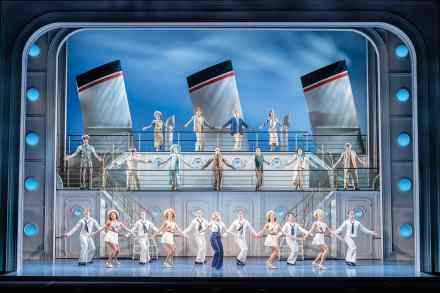
Simon Godwin’s Much Ado About Nothing is set in a steamy Italian holiday resort, the Hotel Messina, in the 1920s. A smart move, design-wise. The jazz age was one of those rare moments in history when every member of society, from the lowliest chambermaid to the richest aristocrat, dressed with impeccable style and flair. The show is stupendously good to look at it and it kicks off with a thrilling blast of rumba music from a jazz quartet on the hotel balcony. Even sceptics of jazz need not fear these players. The musical score is a triumph for one simple reason: there are no jazz solos. https://www.youtube.com/watch?

An entertaining display, clearly destined for Netflix: Patriots, at Almeida Theatre, reviewed

Patriots, by Peter Morgan, is a drama documentary about recent Russian history. And though it’s a topical show it’s not entirely up to date. The central character, Boris Berezovsky (1946-2013), was a schoolboy maths wizard who went into academia and published 16 books before entering politics. His Jewish background excluded him from the leadership of Russia so he became king-maker to Boris Yeltsin. An early contact, the deputy mayor of St Petersburg, asked for Berezovsky’s help. The rising youngster seemed to be harmless, malleable, and rather needy so Berezovsky installed him as a tame prime minister. Thus Vladimir Putin’s career began. Berezovsky owned a TV station that criticised the handling of the Kursk submarine disaster in 2000. And Putin was incensed.

Hytner hits the bull’s eye: The Southbury Child, at the Bridge Theatre, reviewed

The Southbury Child is a comedy drama set in east Devon featuring a distressed vicar, Fr David, with a complex addiction history. Alex Jennings stars with his habitual urbane charm. Is there perhaps a credibility gap there? Jennings seems far too decent, clever and friendly to be a problem drinker who likes nothing better than a fling with a randy wench. And, more crucially, he doesn’t face the fallout from his days of boozing and bedhopping. His dramatic task is unconnected to his personal flaws. https://www.youtube.com/watch?v=z8Nei2P9xeA A little girl has died in controversial circumstances and her parents want balloons at her funeral. No way, says the vicar. The family fight back.

Right play, wrong place: The Fellowship, at Hampstead Theatre, reviewed

Roy Williams’s new play is a wonky beast. It has two dense and cumbersome storylines that aren’t properly developed. Dawn is a mother grieving for her eldest son who was murdered by a gang of white boys. Her younger lad is dating a white girl who used to hang out with the killers. It’s a heavy start. But Williams doesn’t explore this web of bereavement and forbidden romance and turns instead to Dawn’s sister, Marcia, a barrister, who is dating a white MP. ‘Giles is one reshuffle away from being a cabinet minister.’ Dawn claims that all white people are die-hard racists who pine for the old days when the N-word was in regular use. She pours scorn on Marcia’s blossoming affair with Giles.

If you see this show you’ll want to see it again – directed properly: The Glass Menagerie, at the Duke of York’s Theatre, reviewed

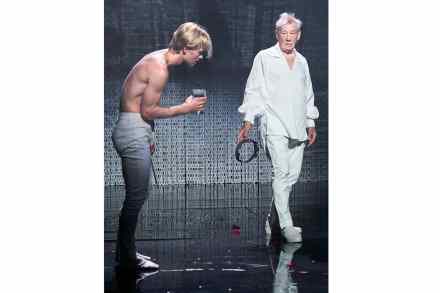
The Glass Menagerie directed by Jeremy Herrin is a bit of an eyeball-scrambler. The action takes place on a huge black platform flanked by 1930s antiques: a typewriter, a broken piano, a reel-to-reel tape recorder and a smattering of Anglepoise lamps. This cryptic setting suggests that the play is being developed in a Museum of the Great Depression, and the show we are seeing is the latest rehearsal. It’s not clear what purpose is served by this fiddly imposture. And although the act of sabotage doesn’t quite destroy the show, it’s touch and go during the opening 20 minutes. Herrin has shared the role of Tom between two actors. Tom Glynn-Carney is a character who participates in the action and Paul Hilton is a narrator who explains the drama to us.

Bloated waffle: Jitney at the Old Vic reviewed

The Old Vic’s new show, Jitney, has a mystifying YouTube advert which gives no information about the play or the characters. If the producers paid for the marketing themselves, they’d do a better job. https://www.youtube.com/watch?v=4AZK_C3lqsM The advert fails even to mention that ‘Jitney’ is Pittsburgh slang for ‘taxi’ and that the action is set in a cab firm in the 1970s. The boss, Becker, is a growling despot who dominates his crew of uppity young drivers by glaring at them psychotically. The prattling cabbies hang around the office gossiping about casual sex and petty crime. Or they ogle porno magazines. Or they show off their bedroom technique by thrusting their pelvises towards the viewers in row A.

Joyously liberating: Tony! [The Tony Blair Rock Opera] reviewed

Harry Hill’s latest musical traces Tony Blair’s bizarre career from student pacifist to war-mongering plaything of the United States. With co-writer Steve Brown, Hill has created a ramshackle, hasty-looking production that deliberately conceals the slickness and concentrated energy of its witty lyrics, superb visuals and terrific music. The last thing it wants to seem is sophisticated and it starts off with a parade of New Labour grandees, all grotesquely overblown. John Prescott is a violent northern drunkard who wants to punch everyone in the face – including the Scots because ‘they’re too far north to be proper north’. Robin Cook is a cerebral sex maniac.

Gandhi’s killer is more loveable than his victim: The Father and the Assassin reviewed

Dictating to the Estate is a piece of community theatre that explains why Grenfell Tower went up in flames on 14 June 2017. The abandoned block stands, like a cenotaph, a few minutes’ walk from the social club where the show is presented. The local council never cared much for Grenfell’s 120 families. Plans to destroy the tower and expand the estate – with higher rents, of course – had long been under discussion. A one-bedroom flat in west London goes for half a million pounds so there were profits galore to be made. ‘A gold mine for the council,’ said one developer, ‘and they don’t even have to dig for gold.

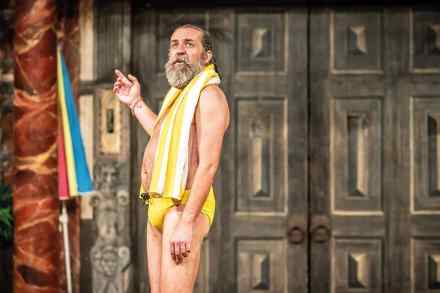
Newcomers will need to read the play in advance: Julius Caesar, at the Globe, reviewed

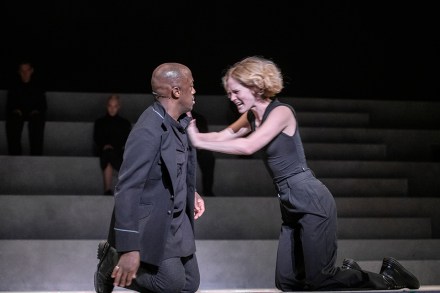
Some things are done well in the Globe’s new Julius Caesar. The assassination is a thrilling spectacle. Ketchup pouches concealed inside Caesar’s costume explode bloodily with each dagger blow and the conspirators are doused in dripping scarlet gore. During the assault, Caesar fights back and very nearly survives. Highly realistic. Afterwards, his statue is toppled and rolled off the stage in a subtle echo of Colston’s ducking in Bristol docks. The crowd relished every minute of this pacy, high-energy show even though the visuals are wildly confusing. Brutus (Anna Crichlow) is a lesbian who sports a beige pashmina, a white T-shirt and a fetching gold turban. She looks like the deputy chairperson at a seminar about dolphins.

Hard to believe this rambling apprentice-piece ever made it to the stage: Almeida’s The House of Shades reviewed

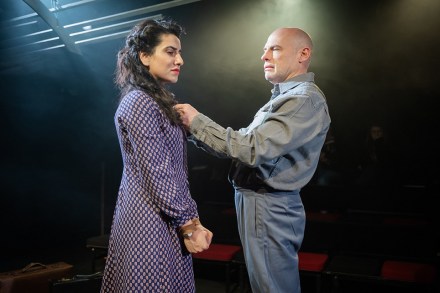
The House of Shades is a state-of-the nation play that covers the past six decades of grinding poverty in Nottingham. The action opens in 1965 with a corpse being sponged down by an amusingly saucy mortician. The dead man, Alistair, sits up and walks into the kitchen where he natters with his prickly, loud-mouthed wife, Constance (Anne-Marie Duff). They seem to live in the city’s most dangerous dwelling. People keep dying. Then they come back to life to make a speech or two. Constance’s pregnant daughter doesn’t survive a back-room abortion and she shows up half a dozen times in a skirt dripping with blood. Alistair expires again and returns to life to tell us what it’s like to die. How the writer, Beth Steel, researched this experience isn’t clear.

The playwright seems curiously detached about rape: The Breach, at Hampstead Theatre, reviewed

Hampstead’s latest play is a knotty rape drama by Naomi Wallace set in Kentucky. Four teenagers with weird names meet in a hired basement. Hoke and Frayne are boys. Jude is a girl whose younger brother, Acton, gets bullied at school. Their chat is aggressive, cynical and funny. Jude boasts that she’s already lost her virginity but she’s proud to have slept with just two men: ‘You’ve got to do six or seven to qualify for slut.’ Hoke claims to have groped his 34-year-old aunt when she was drunk, ‘but she never knew it happened so in a way it didn’t’. Great opening dialogue. Wallace’s attitude to sexual assault is curiously detached. She seems to think rape is ‘just one of those things’ Then it all goes haywire.

Two hours of bickering from a couple of doughnut-shaped crybabies: Middle, at the Dorfman Theatre, reviewed

‘I fink I doan luv yew any maw.’ A marital bust-up drama at the National Theatre opens with a whining Cockney, Maggie, telling her City whizzkid husband Gary that their relationship is over. Gary and Maggie are aspriring underclass types who’ve achieved bourgeois prosperity: John Lewis kitchen, vintage wine rack and a ceramics collection. They have an eight-year-old daughter at a private school where she learns ballet steps and the piano instead of watching road-rage videos on YouTube like a council-house kid. She’s called Annabelle, by the way, and one wonders if Gary and Maggie style themselves ‘Garfield and Margaret’ at the school gate.

Angry diatribes and amusing pranks: Donmar Warehouse’s Marys Seacole reviewed

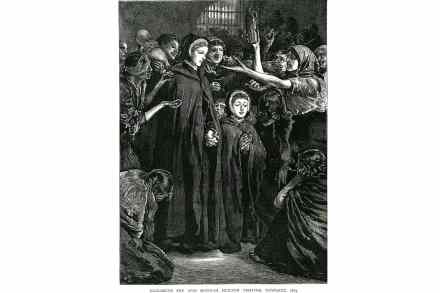
The title of the Donmar’s new effort, Marys Seacole, appears to be a misprint and that makes the reader look twice. Good marketing. The show is a blend of Spike Milligan-esque sketches and indignant speeches about race but it starts as a straightforward historical narrative. Mary Seacole enters in Victorian garb and introduces herself as a woman of half-Scots and half-Caribbean heritage who believes that ethnic differences create hierarchies of competence. Her veins, she says, flow with ‘Scotch blood’ and this gives her an entrepreneurial advantage over her ‘indolent’ Caribbean neighbours. Inflammatory stuff. If a white author embraced that supremacist creed, there’d be outrage.

Muddled, tricksy and cheap: The Corn is Green at the Lyttelton Theatre reviewed

The Corn is Green by Emlyn Williams is a sociology essay written in 1938 about a prickly tyrant, Miss Moffat, who tries to civilise Wales by setting up a village school where sooty-faced miners are taught to read and write. Miss Moffat is an unmarried English layabout who has money to burn and time on her hands and so, of course, she wants to ‘help’. You know the type? Director Dominic Cooke treats the script as a period joke and the actors are encouraged to mock their characters mercilessly. Hoots of cheap laughter echo around the theatre. The show is presented very weirdly as a sort of botched technical rehearsal with lots of clunky sound effects and a Writer/Narrator on stage who paces about and shouts directions at the actors.

This Trump satire is too soft on Sleepy Joe and Cackling Kamala: The 47th at the Old Vic reviewed

Trump is said to be a gift for bad satirists and a problem for good ones. He dominates Mike Bartlett’s new play, The 47th, which predicts that the 2024 presidential election will be a run-off between Trump and Kamala Harris. Bertie Carvel’s Orangeman is a subtle and highly amusing spoof that never descends into exaggeration or grotesquery. The visuals are convincing: the sandy blond wig, the baggy golfing outfits, the spare tyre around the midriff. Excellent design work. And Bartlett captures the repetitive lullaby pulse of Trump’s rhetoric. Like a lot of liberals, he seems to admire Trump and this show reflects a perverse fascination with its target. The script is understandably soft on Sleepy Joe and his faltering brainpower.

Could the Arts Council pay Americans to keep this stuff in America? Daddy and The Fever Syndrome reviewed

The Fever Syndrome is a dramatised lecture set in a New York brownstone occupied by the super-brainy Myers family. The old man, Prof. Richard, is an IVF expert whose daughter, Dot, wants to defrost her embryos and have a second baby. Cue lots of chat about in vitro technology in the 1970s. Dot’s daughter, Lily, has a hereditary ailment that causes epileptic seizures. This, too, is discussed in further Ted Talk passages. And Prof. Richard suffers from incontinence and Parkinson’s disease so these conditions are aired as well. It’s perfectly riveting for medics. Less so for civilians who may not share the view of the Myers family that everyone in the Myers family is a world-class intellectual. Robert Lindsay stars as Prof.

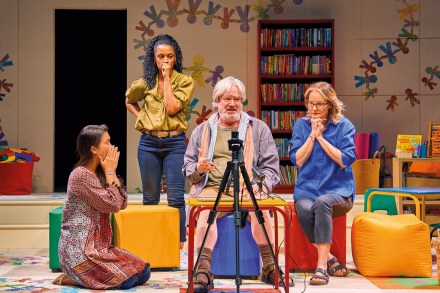
Shakespearean directors could learn from this: the National Theatre’s Hamlet for 8- to 12-year-olds reviewed

The NT has rejigged Hamlet for 8- to 12-year-old children. It’s a decent attempt to cover the highlights at a sprint lasting just 90 minutes. A few gripes. The medieval setting is unclear because the courtiers wear matching red and yellow suits, like Butlins entertainers. Why not military costumes? British kids are used to seeing the royals in uniforms. And a martial emphasis would tell us that Elsinore is a heavily armed dictatorship where family rivalries may spill over into civil war. More swords and bucklers are needed. Before curtain-up, the cast fanned out across the stage to wave at the children and have a chat. This broke the ice and ensured that the little tinkers kept quiet during the show.

A play for bureaucrats: David Hare’s Straight Line Crazy reviewed

It’s good of Nicholas Hytner to let Londoners see David Hare’s new play before it travels to Broadway where it belongs. Few Brits will know the subject, Robert Moses, an urban planner of the 1920s who built the roads and bridges that gave New Yorkers access to seaside resorts in Long Island. This is a play for bureaucrats. Nit-picking and box-ticking are the main points of interest. Squiggles on forms. Correct signatures at the bottom of proof-read documents. Hare is copying George Bernard Shaw and his script is a celebration of rhetoric above all other qualities. Dialogue-junkies will enjoy the screeds of quickfire chatter that keep the play motoring along. And like Shaw, Hare omits many of the elements that make a drama feel lifelike.

It’s years since I saw anything as nasty as this: Cock at the Ambassadors Theatre reviewed

Cock was written by Mike Bartlett in 2009 while he was in Mexico at a drama conference. The title suggests a cockpit where three characters compete for sexual dominance. W, meaning Woman, is a childminder attracted to a gay man, John, who is thick but handsome and deeply involved with M, or Man. W adores John even though he can’t stand women. ‘They’re like water when you really want beer,’ he says, charmlessly. When they have sex she politely asks him not to treat her genitals ‘like a Travelodge’. After a brief fling, W decides she wants to marry John and raise a family with him in domestic bliss. But John isn’t so sure. He describes his girlfriend to others as ‘tall, manly and with big hands’.

A must-see for Westminster obsessives: Riverside Studios’ Bloody Difficult Women reviewed

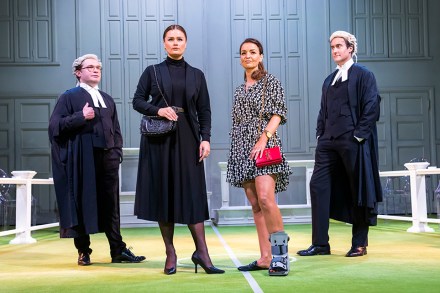
Bloody Difficult Women is a documentary drama by the popular journalist Tim Walker, which looks at the similarities between Gina Miller and Theresa May. It’s well known that Walker detests our current prime minister and he refuses even to allow the Johnson name to sully his script. So although Boris was a key player in the story, he doesn’t appear on stage. Nor does May’s husband, Philip. And her influential advisers, Nick Timothy and Fiona Hill, are omitted too. Their names are mentioned constantly but we never meet them as characters. Slightly frustrating. May herself comes across as weak, secretive and limited. Plainly she was never suited to high office.