Theatre

Cruel but shamefully enjoyable: Vardy v Rooney – the Wagatha Christie Trial reviewed

The Wagatha Christie affair began in 2019 when Coleen Rooney accused Rebekah Vardy of selling stories from her private Instagram account to the Sun. Rebekah denied the charge and sued Coleen. The case reached the High Court last summer and has now arrived in the West End in a verbatim script by Liv Hennessy. The staging is brilliantly funny with the court presented as a football pitch where a set of TV pundits explain the legal niceties to us. Rebekah, the plaintiff (and husband of former England striker Jamie Vardy), is cross-examined by David Sherborne of 5RB chambers who acts for Coleen. Sherborne begins by attacking Rebekah’s claim that she never leaks personal information by reminding her of a tabloid story about her former lover, Peter Andre.

The art of the panto dame

There is nothing more panto than a dame. The grandmother of today’s dames is Dan Leno (1860–1904), a champion clog dancer and music-hall performer, not much taller than Ronnie Corbett. He was preceded by others, notably James Rogers, who in 1861, in Aladdin,played a character called Widow Twankey, named after a cheap and revolting tea. But Leno was the first modern prototype dame – a befuddled genius in a frock with a fantastic line in patter. He created the role of Mother Goose in a play written for him by J. Hickory Wood and starred in a legendary run of 16 pantos at Drury Lane that finished him. He died insane and an alcoholic at the age of 43 – a warning to his artistic descendants. Fast forward to Theatre Royal Plymouth, 1992.

The acting rescues it: National Theatre’s Othello reviewed

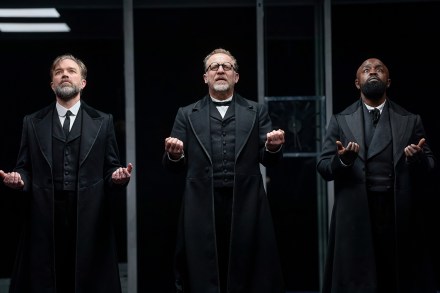
Crude eccentricities damage the potential brilliance of Othello at the National. Some of the visual gestures seem to have been approved by crazies from the neo-fascist fringe. The Moor is first seen doing a work-out with a punch bag but he doesn’t strike the bag, he grabs a broom handle and uses it to perform some fancy martial arts moves. The action starts and Othello is accused of spiriting Desdemona away from her father’s house and seducing her by trickery or witchcraft. During these scenes he’s stalked by a mob of extremists who dangle nooses and threaten him with daggers. That’s just silly. Othello is the foremost warrior in Venice. Anyone who drew a knife on him would be dead within seconds.

An unexpected heartbreaker: Elf the Musical, at the Dominion Theatre, reviewed

Elf opens with an unbelievable premise. Buddy was abandoned as a baby and adopted by Santa’s elves and he spent a happy childhood making Christmas gifts in their factory at the North Pole. The action begins when Buddy decides to track down his real father in New York, but when he arrives he finds a community sunk in greed and cynicism. He’s horrified to learn that everyone exploits Christmas for financial gain. His dad, Walter Hobbs, turns out to be a bullied publishing executive who has no time to spend with his wife and his lonely younger son. Buddy’s mission is to restore love to this broken family and to repair the fractured society of New York. Along the way, he starts a corny romance with a sexy blonde elf, Jovie, who works in Santa’s grotto at a department store.

Wordy, overwritten flop – perfect for the BBC: Noor, at Southwark Playhouse, reviewed

A heroic Asian woman parachutes into occupied France to work for the resistance and help overthrow the Nazis. This sounds like a fictional yarn but the story of Noor Inayat Khan is true. Her family were well-educated Sufi Muslims, who counted Gandhi among their friends, and they raised Noor as a pacifist intellectual who spoke several languages. And that’s the first oddity of the show. We aren’t told what drives Noor to side with Britain in a war that violates her family principles. And because we don’t know why she’s fighting, we’re bound to lose interest in her progress. This wordy and overwritten flop is perfectly configured to become a ten-part BBC drama Other puzzles emerge. She’s engaged to be married but we learn nothing about her fiancé.

Rebecca Humphries is dynamite – pity about the play: Blackout Songs, at Hampstead Theatre, reviewed

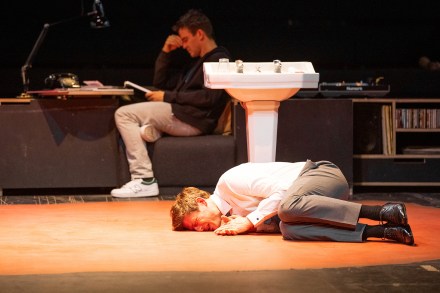
Viewers watching a good romcom need to fall in love with three things. The boy, the girl and the affair itself. The new Hampstead melodrama, Blackout Songs, scores just one out of three. Rebecca Humphries is adorably chic and sexy as the Soho seductress who drifts from bar to bar, picking up men. Her toyboy is a disappointment, a teenage deadbeat who has none of her louche gusto. And his character is a puzzle when it ought to be crystal clear. At the start of the action he wears a neck-brace and speaks with a stammer. In the next scene, his neck has healed and his stammer has vanished as well. Is he two characters? Or is he a con man who assumes different personalities, and if so why? He dresses in a paint-spattered tracksuit but he claims to be a welder, a rock star and a fine artist.

The UK Drill Project, at The Pit, reviewed

The UK Drill Project is a cabaret show that celebrates greed, criminality and drug-taking among black males in London. It opens with a septet of masked performers, sheathed in dark Lycra, singing a rhythmic poem while pretending to fire guns and stab people with knives. These sad young rappers are desperate to look scary because they’re scared themselves. And though they claim to be artists, their purpose in writing ‘drill’ songs and posting videos online is to protect their drug profits and to intimidate rival gangs. Musically, they lack accomplishment. They can’t play instruments and appear to own none. Harmony and melody are alien to them.

The dialogue ripples with energy: King Hamlin, at the Park Theatre, reviewed

King Hamlin is a shock-horror drama about gang crime in London. Hamlin, aged 17, has left school without learning any useful facts or skills. He even lacks a shirt to wear so he shows up for a job interview looking like a vagrant and starts to swear at his future boss. No work for him. He dreams of studying computer software but he doesn’t own a laptop and seems incapable of getting one. His life is devoid of functioning adults. There’s no teacher, relative, or competent older friend to advise him. No father, of course. His poor dad was knifed to death because he was ‘too good for the hood’. Which is a new cause of crime in London. An excess of virtue can get you stabbed, it seems.

Kids will enjoy this new show at the West End’s newest theatre more than adults: Marvellous, @sohoplace, reviewed

London has a brand-new theatre – yet again. Last summer, a cabaret venue opened in the Haymarket for the first time. More recently, the Marylebone Theatre near Regent’s Park held its debut show. And now Nica Burns of Nimax Theatres has announced a new venture, @sohoplace, which she says is the first West End venue to open for 50 years. The playing area is a hoop-shaped enclosure with rising tiers of seats overlooking a deep oblong pit. Cage fighting and mud-wrestling could be staged here to great advantage. The poster for the debut show, MARVELLOUS, features the title in bright pastel letters with a yellow balloon, a pair of clown’s shoes and a perky budgerigar.

This production needs more dosh: Good, at the Harold Pinter Theatre, reviewed

Good, starring David Tennant, needs more dosh spent on it. The former Doctor Who plays John, a literary academic living in Germany in 1933, whose cosy life is disrupted by troublesome females. His mum is a cranky basket case dying in hospital and his wife is a manic depressive who can’t look after their kids. Both women speak with Scottish accents. John has a fling with a third Scotswoman who studies Goethe at his university. Weirdly, all three women – mum, wife and girlfriend – are played by the same actress. Couldn’t the producers fork out for a proper cast? They certainly didn’t spend more than a fiver on the set, which looks like an abandoned bomb shelter made of cardboard.

Mirthless, artless farrago of jabber: The Doctor, at Duke of York’s, reviewed

The Doctor is an acclaimed drama from the pen of writer-director Robert Icke. We’re in a hospital run by a famous medic, Dr Ruth, whom the Cockney characters call ‘Dr Roof’. Two major problems beset Dr Roof who has to raise funds for a new private wing while grappling with her partner’s early-onset dementia. A Catholic priest barges in and demands to visit a dying patient. Dr Roof refuses. Then she punches him in the face to prove who’s boss. Her ill-advised left hook plunges the hospital into crisis, and the senior staff gather in the boardroom to sort out the mess created by Dr Roof’s violent temper. All the doctors wear white coats, like pantomime boffins, which seems an unlikely costume nowadays.

A show for politicians: John Gabriel Borkman, at the Bridge Theatre, reviewed

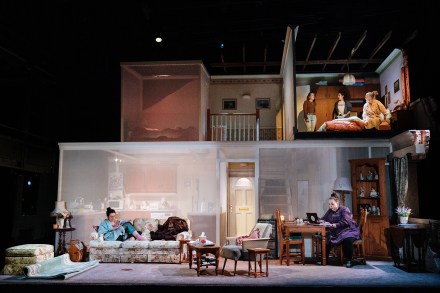
Clunk, clunk, clunk. John Gabriel Borkman opens with the obsessive footfalls of a disgraced banker as he prowls the attic of a shabby townhouse. On a beaten-up sofa lies Gunhild, his estranged wife, who guzzles Coke and watches TV game shows. The whole place stinks of stagnation and failure. The reclusive Borkman was once the country’s best-known banker until envious colleagues accused him of embezzlement and got him sent to jail for five years. After his release, he began a life of self-destructive solitude. The family are more riven with feuds than the royals. Gunhild loathes her twin sister, Ella, while Borkman blames both women for his downfall. His one hope, his son Erhart, openly shuns him and prefers the company of a sexy local seductress.

Worthy of Wilde: Eureka Day, at the Old Vic, reviewed

Eureka Day is a topical satire set in a woke school in America. An outbreak of mumps has led to calls for a vaccination programme that will prevent the school from being quarantined and shut down entirely. The script, written in 2018, has acquired new layers of meaning since the Covid terror. It opens with a playful sketch in which four white teachers and a black parent try to agree how many ethnic categories should be recognised by school officials. Their friendly conversation conceals a toxic seam of racial suspicion and hostility. The writer, Jonathan Spector, is probably a rock-sold liberal who wants the world to know that the woke cult has gone too far. The play’s highlight is a 20-minute passage of comedy which reaches a peak of hilarity that would make Oscar Wilde envious.

A masterpiece: Rose, at Park Theatre, reviewed

Look at this line. ‘I’m 80 years old. I find that unforgivable.’ Could an actor get a laugh on ‘unforgivable’? Maureen Lipman does just that in Rose, by Martin Sherman, a monologue spoken by a Ukrainian Jew who lived through the horrors of the 20th century. In the opening sections, Lipman plays it like a professional comic and she fills the theatre with warm, loving laughter. Rose’s dad is a hypochondriac who spends all day in bed. ‘He never stopped dying but as far as we could tell there was nothing wrong with him.’ Eventually he loses his life when a wardrobe stuffed with pills topples on to him. ‘He was crushed to death by medicine.

A tremendous show that will attract serious attention from the West End: Rehab – The Musical reviewed

Rehab: The Musical opens with a boyband star, Kid Pop, getting busted for possession of cocaine. The judge sentences him to a course of treatment at the Glade which he attends with great reluctance. Giving up marching powder is the last thing on his mind. ‘I said no to drugs but they just wouldn’t listen.’ His sharky agent, Malcolm Stone, wants to prolong Kid Pop’s notoriety by sending an undercover ‘addict’ to the Glade to spy on him and leak stories to the press. Stone hires a luscious sex bomb, Lucy, to take on the job, and it’s obvious that Kid Pop will seduce her and their affair will end in redemption for both parties. Predictable enough, perhaps, but the couple’s journey is a joy to experience.

Rhapsodic banalities: I, Joan, at the Globe, reviewed

‘Trans people are sacred. We are divine.’ The first line of I, Joan at the Globe establishes the tone of the play as a public rally for non-binary folk. The writer, Charlie Josephine, seems wary of bringing divinity into the story too much, and he gives Joan a get-out clause to appease the agnostics. ‘Setting aside religiosity we’ll settle for more of a street god, a god for the queers and drunks… a god for the godless.’ What can ‘a god for the godless’ mean? No idea. Joan throws in a few more hipster platitudes about ‘elevating our humanity, finding the unity hidden inside community, remembering our collective connectivity fuels courageous creativity [sic]’.

Our prison culture is more barbaric than it was in 1823: Elizabeth Fry ‘The Angel of Prisons’ reviewed

The Angel of Prisons dramatises the life of the penal reformer Elizabeth Fry, who lived near Canning Town. She married a wealthy Quaker, Joseph Fry, who encouraged her philanthropic work which she managed to pursue while raising 12 children. Early in life, Fry had been a party girl who loved dancing, and this production shows her practising her moves to a soundtrack of thumping contemporary music. The script, by James Kenworth, blends present-day London vernacular with the dialect of the early 19th century. It’s easy to watch and it delivers heaps of information without any hint of lecture-hall formality. When Fry visited the mixed-gender Newgate Prison near the Old Bailey she found her vocation.

The show works a treat: Globe’s The Tempest reviewed

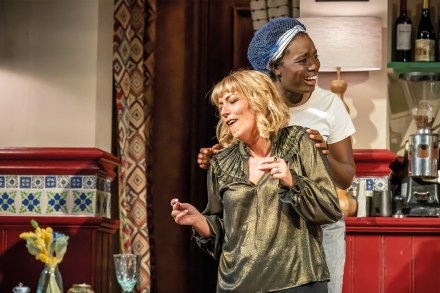
Southwark Playhouse has a reputation for small musicals with big ambitions. Tasting Notes is set in a wine bar run by a reckless entrepreneur, LJ, whose business bears her name. In real life, LJ’s bar would go bust within weeks. It serves vintage wines to a clientele of wealthy tipplers who chug back large tureens of Malbec and claret but who eat no food. The staff help themselves to free champers and Burgundy whenever they choose, and the boss fusses around like a mother hen making sure her brood are safe and content. Bad punctuality is never punished and the staff improvise each shift as they go along. But the emotional atmosphere of LJ’s feels right.

The Dane gets an interpretive dance makeover: Ian McKellan’s Hamlet reviewed

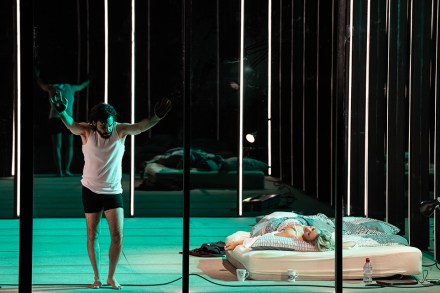
Ian McKellen’s Hamlet is the highlight of Edinburgh’s opening week. In this experimental ballet, Sir Ian speaks roughly 5 per cent of the lines, accompanied by a hunky blond dancer, Johan Christensen, who offers a physical interpretation of the Dane’s melancholy. The other roles are played by a ballet troupe in olde worlde costumes. The performing area is a black thrust stage, gleaming like patent leather, surrounded by low spotlights and swirling dry ice. It looks like Elsinore recreated by a cruise-ship designer. Newcomers will find the story mystifying. Hamlet smoulders longingly at Horatio and they dance like a hot couple at a gay night spot.

I can’t recommend this Cole Porter musical highly enough: Anything Goes, at the Barbican, reviewed

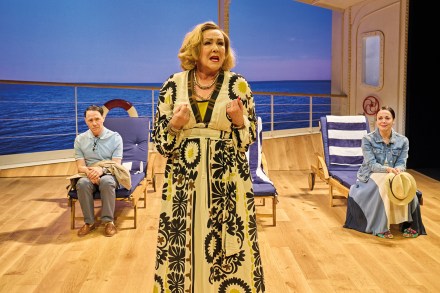
The Barbican’s big summer show is billed on the website as ‘the sold-out musical sensation, Anything Goes’. The term ‘sold-out’ is a strange way to describe a production that’s keen to get your business. You’d be forgiven for clicking away and hunting for a show with seats available. What the Barbican means is that this is a revival of an earlier production that did great business. And that may explain why tickets aplenty are available even on a busy Friday night. This version stars Kerry Ellis as the showgirl, Reno, who falls in love on a transatlantic cruise ship. Virtually every number is a classic. If you read any couplet from the title song you’ll be humming the melody all day. https://www.youtube.com/watch?