The turf

How John Egan has stayed in the saddle

Pop stars rock on nowadays into their seventies. And jockeys too – despite the physical dexterity and instant-decision-making required – are lasting longer. Jimmy Quinn and Franny Norton only quit the saddle in their mid-fifties; Joe Fanning is still going strong at 55. On a sweltering Ascot day recently I enjoyed a chat with John Egan, who was handling the heat better than much younger rivals and is still in demand at 56. Remembering past successes, including the Irish 2000 Guineas on Indian Haven, July Cups on Les Arcs and Passive Pursuit and an Ebor Handicap on 100-1 shot Mudawin, I asked if there was a particular race he still hankered after winning. Egan smiles easily but the answer was a pistol shot: ‘I want to win them all.

Labour is risking the future of racing

The only political party with a serious chance of winning office I will ever vote for again is the one which acknowledges that in all probability and at least for a while it will increase taxes. Every party piles up promises that they will be the ones to get Britain working again. But building power stations, reservoirs and schools costs money. So does hiring doctors and nurses, filling potholes and getting trains to run on time. Some claim they will finance their plans by creating growth, some by taxing the rich. Then voters discover that the growth fairy remains elusive and the rich have been re-defined to include them: public regard for politicians takes another dive.

‘Boldness was his friend in betting and in life’: A tribute to the great Barry Hills

I have always enjoyed Royal Windsor Racecourse, as it styles itself. It may not have quite so many dignitaries popping in from the castle up the road as Royal Ascot does, but it has long been famed for its friendliness and approachability. Jockeys moving from the weighing room to join their mounts under the parade ring trees pick their way between picnics and the Pimm’s and Caribbean cocktail outlets, readily pausing for autographs. In times long past, a former clerk of the course once responded to jockeys complaining about the cold autumn changing room by bringing in a bottle of whisky from the Stewards’ Room.

Is racing becoming too predictable?

An inquest into the Derby in the Oakley household was to be expected. Mrs Oakley, who bets about as often as you will hear Liz Truss say ‘I’m sorry: I got it wrong’, called me at Epsom this year asking for a fiver each way on Lambourn. Since the ten-time Derby winning trainer Aidan O’Brien had two more favoured candidates in Dela-croix and The Lion In Winter, I persuaded her to think otherwise and had some explaining to do after his Lambourn came home a comfortable 13-2 winner in the hands of the veteran jockey Wayne Lordan. What has also surprised me is the downbeat tone of reactions elsewhere to this year’s Derby, with commentators bemoaning an overall lack of excitement and pizzazz.

The racing victory I’ve enjoyed the most

Allegedly the most effective rain dance in the world is that performed by Native American Hopi Indians. The biennial 16-day rite conducted by the Snake and Antelope fraternities involves participants jiving around a column of rock in feathered dress carrying snakes in their hands and mouths. As our dry spring moves into what could be an even drier summer, the local shops in Newmarket, Lambourn and Middleham might be wise to stock up on feathers and plastic reptiles. Fortunately, before Sandown’s key evening meeting last Thursday there had been just enough precipitation to take the sting out of the ground and embolden trainer Ed Walker to run his talented Almaqam, an entry in the Prix de l’Arc de Triomphe, in the feature event, the Group 3 Brigadier Gerard Stakes.

The intrigue of the jockeys merry-go-round 

Nearly always a thriller, Newbury’s Lockinge Stakes, instituted in 1958 and a Group 1 race since 1995, is an ever-welcome signpost to the Flat season. The Guineas Classics have started the three-year-old stories; the Lockinge shows us which older horses will be battling for supremacy over a mile. For four-year-olds and upwards, it has been won by great horses like Brigadier Gerard, and I will never forget Frankel scorching away from his field to win by five lengths in 2012. This year’s running promised a special quality, perhaps the best for decades, with a jockeys merry-go-round adding to the intrigue. Notable Speech had won last year’s 2000 Guineas and Sussex Stakes, Rosallion the Irish equivalent along with the St James’s Palace Stakes at Ascot.

My ones to watch this season

With racing there is always a little history involved. One of the few top races John Gosden has never won as a trainer is the one-mile 2,000 Guineas, and many of us hoped that after a scintillating performance in the Craven Stakes his Field of Gold was going to fill the most significant hole in his trophy cabinet. That eye-catching run had ensured that, like his Gosden-trained sire Kingman, Field of Gold started favourite. Sadly, just like his sire, he finished half a length second in the Guineas last Saturday, narrowly failing to catch the Charlie Appleby-trained winner Ruling Court. Gosden doesn’t do sour grapes and few would contest his post-race comment: ‘The winner has kicked and gone and we ran out of racetrack. Given another 25 yards, it would have been ours.

Is an Epsom renaissance on the way?

Through 30 years of living within walking distance of the Derby course I was ever hopeful of seeing Epsom’s status revived to the 600 horsepower training centre it once was with the likes of Walter Nightingall turning out winners for Winston Churchill. There have been brief dawns as when Laura Mongan won the St Leger with Harbour Law in 2016, or Adam West won the Nunthorpe with Live in the Dream. Hard-working and capable trainers such as Simon Dow and Jim Boyle have kept the Epsom flag flying, but too many yards were lost to housing developers as numbers dropped to only 150. Last Wednesday though I stood at the top of the seven furlong sand gallop on Epsom Downs with a man whose arrival with 46 horses to take over a historic Epsom yard could be part of a significant Epsom renaissance.

The Mullins men are a force to be reckoned with

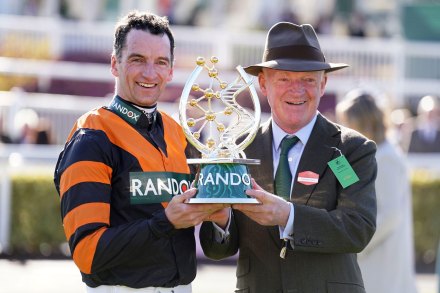
Where would racing be without Willie Mullins? Even for a man who regularly rewrites the record books, who has 17 times been Irish National Hunt Champion Trainer, has collected 113 Cheltenham Festival winners, including four Gold Cups, and who has won the Grand National twice before, his feat in training the first three in this year’s Aintree spectacular (and five of the first seven) was incredible. Only Michael Dickinson’s first five home in the Gold Cup of 1983 compares. Yet what was different about Mullins’s success in mopping up £860,000 of the £1 million of prize money on offer was the emotional intensity. The Irish maestro is maddeningly decent: invariably modest over his successes, graceful in defeat.

My highlights from the Cheltenham Festival

When Poniros, trained by Willie Mullins, swept home in this year’s Triumph Hurdle as the first 100-1 Cheltenham Festival winner since Norton’s Coin won the Gold Cup in 1990, one of the very few people who had backed him was my regular racing companion Derek, known in this column as the Form Guru. His successes are normally a reward for rising before the dawn-chorus blackbirds have gulped their first worm and ploughing through the stats for a horse which had possibly shown a glimmer of form on a wet Thursday at Uttoxeter the April before last. But with Poniros there was no form. Not the merest trace. The ex-inmate of Ralph Beckett’s Flat racing yard had never jumped a single hurdle in public. So how had Derek picked him?

The Sandown meeting that’s a good predictor of next year’s prospects

I never enter a Cheltenham Festival week without thinking of the Irish punter who won enough on champion hurdler Istabraq to pay off the mortgage on his house. He then lost the lot when Ireland’s hope Danoli failed to win the Gold Cup. ‘To be sure,’ he declared, ‘it was only a small house anyway.’ Alas, publication dates mean that this column must be penned before this year’s Festival starts, and I began my week with feelings so mixed about the fortunes of Istabraq’s owner J.P. McManus that they should have been rattled in a cocktail shaker.  As racing’s biggest benefactor and a man with an impeccable record in looking after his ex-racers, J.P. has deserved every one of the 78 Cheltenham Festival winners he has amassed over 40 years.

The strange superstitions of the racing world

In racing, superstitions are rife. I once saw a trainer remonstrate with an owner for displaying a green handkerchief: green, he insisted, was unlucky (although it doesn’t seem to work that way for owners Simon Munir and Isaac Souede, whose ‘double green’ colours have been carried to success in many top races). Henrietta Knight, who trained Best Mate, is famously superstitious: straw on the way is OK, but if she sees a load of hay en route to the races she’s so sure of bad luck that she’s inclined to turn back. She couldn’t bear to watch Best Mate’s Gold Cups from the stands and hid in a tent behind the weighing room. Former jockey Sam Thomas, who’s making a name for himself as a trainer by successfully targeting big handicaps, seems to be of the Henrietta school.

What has Nicky Henderson done to irritate the racing gods?

‘It may well be that true riches are laid up in heaven,’ declared the blues composer W.C. Handy, ‘but it’s sure nice to have a little pocket money on the way there.’ A good turnout can therefore always be relied upon for Newbury’s £155,000 William Hill Hurdle which last Saturday carried a prize of £87,218 for the winning horse. The richest handicap hurdle in Britain has been one of my favourite races since its inception as the Schweppes Gold Trophy (under other sponsors it has also been run as the Tote Gold Trophy and the Betfair Hurdle). I never attend without seeing in my mind’s eye the tilted trilby figure of the ex-commando Captain Ryan Price, who won the race four times in its first five years.

From the army to Folly House: the story of Jamie Snowden

It is around 3 a.m. in Northern Ireland in the early 2000s as two British soldiers share a dank ditch waiting for the dawn. ‘What will you do when you leave the army, Sir?’ asks Corporal Jordan Wylie. ‘I’m going to train racehorses,’ says Captain Jamie Snowden. ‘And I’m going to make some money and send you a horse to win the Grand Military Gold Cup.’ As an in-demand amateur rider starting with point-to-points at 16, Jamie had already won Sandown’s trophy for services riders. At Sandhurst in 2002 on a day when his platoon were due to endure the rigours of gas attack training, he was booked out instead to ride Folly Road in the historic race when the originally booked rider couldn’t make it following a mortar attack.

Will Kia Joorabchian’s gamble pay off?

A generous new Levy deal would be nice, as would English-based trainers producing as many winners as their Irish counterparts at this year’s Cheltenham Festival. But perhaps the most important development for British racing in 2025 is that the massive gamble being taken by the 53-year-old Anglo-Iranian Kia Joorabchian should begin to pay off. Joorabchian, who has made a tidy fortune from investment companies and football dealings, has been a racehorse owner for more than 20 years and over 200 winners have carried his colours. Now he has committed himself to ambition on a totally different scale.

Hurrah for Constitution Hill

Hallelujah, he’s back. What we needed to take racing’s attention off the miseries of inadequate prize money, shrinking attendances and structural problems was a genuine superstar, and when Constitution Hill galloped elegantly and professionally to Boxing Day victory in Kempton Park’s Christmas Hurdle, over the formidable Irish mare Lossiemouth, that was precisely what we saw. In the social-media age, every saloon bar grump’s six-pint mutterings seemingly qualify as expert opinion Lossiemouth is trained by the legendary Willie Mullins. Her sex allowance gave her a 7lb advantage in the weights and she had already had a race to sharpen her up, while Nicky Henderson’s charge hadn’t run since he won the corresponding race the year before.

My racing reads of the year

You didn’t want to approach Davy Russell before a race. He spurned selfies with owners and didn’t talk to the lad or lass leading up because he was ‘in the zone’ – his mind focused totally on the race ahead. Yes, in Davy Russell: My Autobiography (Eriu, £20), written with the knowledgeable Donn McClean, we get the stories of his two Grand National victories on Tiger Roll, his Gold Cup success on Lord Windermere and his years as Ireland’s champion jockey. But it is his reflections on race-riding which make it  my racing read of the year.

My picks for Cheltenham and the Twelve

With farmers outraged, the nation’s biggest employers warning the Budget will bring increased prices and lost jobs and growth out of sight, Rachel Reeves has certainly confirmed that economics is the dismal science. It hasn’t got any easier either finding winners. For the previous two Flat seasons this column’s Twelve To Follow showed profits of £59 and £157 to a £10 level stake. The jumpers last winter rewarded us with a handsome £246. But currently I’m like a US senator unseated at an election. He called in his staff and declared: ‘That was an unmitigated disaster: so get out there and mitigate.’ Soaking wet gallops and soggy tracks didn’t help. King of Steel and Classical Song were injured and didn’t see a racecourse.

The brilliance of Alastair Down 

Long before I could afford to go racing I began collecting racing books, my first jumble sale acquisition the marvellously entitled Sods I Have Cut On the Turf by 1920s jockey Jack Leach. Leach, who was friends with Fred Astaire and Edgar Wallace, kept his weight down by jogging wearing four sweaters and three long johns under a rubber suit but always had a good steak dinner with wine. ‘If possible I used to take off an extra 3-4lb so that I could have a small sandwich and a glass of champagne before racing started. This made me feel a new man – and if I had a few ounces to spare I had another glass for the new man.

My fears for the National Hunt Chase

World politics is dire but so long as Mick Herron is writing spy novels, David Mitchell is raising laughs and Bukayo Saka is scoring goals there is joy available and I have lived to see the start of another proper jumps season at the Cheltenham Showcase meeting. Saturday’s racing did, however, provide a sharp reminder of how the Irish dominated last season’s Cheltenham Festival, winning 18 of the 27 races, including 12 of the 14 Grade One contests. Irish trainers Ian Patrick Donoghue, John McConnell, Gordon Elliott and Henry de Bromhead won four out of the seven races, and you have to wonder how hard some home-based handlers are trying when only one of the five runners in the William Hill novices hurdle came from an English yard.