Television

If you are of a certain age, you’ll really enjoy Tina Fey’s The Four Seasons

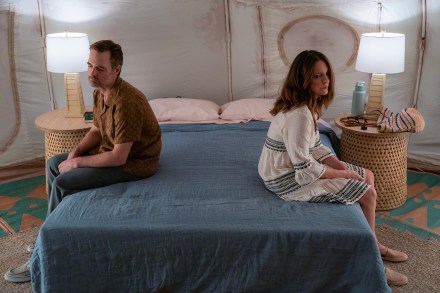
The Four Seasons is one of those shows you notice in the ‘Top TV Programmes on Netflix’ section, see it’s some kind of glossy romantic comedy starring American actors you’ve vaguely heard of, and skip past quickly in search of something with zombies or subtitles. This would be a mistake though because, at least if you are of a certain age, you’re really going to enjoy it. I think the litmus test is whether you’re old enough to remember the 1981 Alan Alda film on which it is based, which I do, just about, vaguely. It’s that kind of movie where a bunch of old friends who have been holidaying together regularly since university – does anyone actually do this? – are discombobulated by and rebond over a traumatic event.
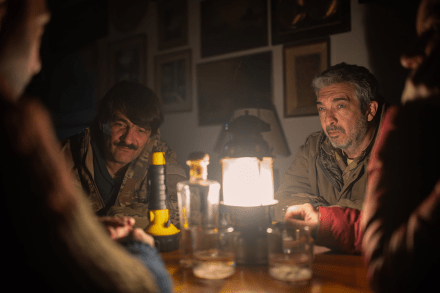
Better than Hollywood: Netflix’s The Eternaut reviewed

‘Next time you do a review, you’ve got to find something you like. You’ve been far too negative,’ said the Fawn. ‘Well, it’s hardly my fault if everything on TV is crap at the moment. I can’t just call up good stuff to order,’ I said. ‘Try,’ said the Fawn. Luckily – and unwontedly – Netflix has come to my rescue with a dystopian sci-fi series called The Eternaut. Though I’m not totally convinced by the name – a conflation of ‘eternity’ and ‘astronaut’ – it’s a very enjoyable watch, which confirms, yet again, Delingpole’s Iron Law of Television: always go for the shows with subtitles. This one is from Argentina, based on a graphic novel written by Hector German Oesterheld with artwork by Francisco Solano-Lopez.

Confection of sex, bad history and nonsense: Apple TV+’s Carême reviewed

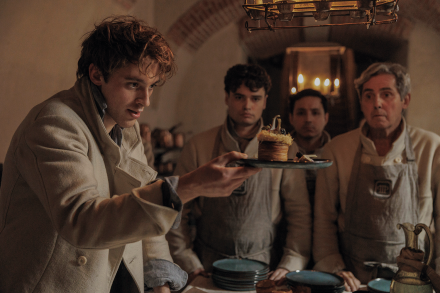
Antonin Carême was known as the ‘chef of kings and the king of chefs’. His patrons and employers included Talleyrand, Napoleon, the Prince Regent, Tsar Alexander and the then richest man in France, James Rothschild. He popularised the tall ‘toque’ hat worn by chefs; he either invented or perfected culinary classics including the vol-au-vent, the profiterole and the mille-feuille, as well as sauces including velouté and béchamel. All this he managed to achieve despite having come from a desperately poor background, raised in a shack in revolutionary France and sent off as a young lad to help make ends meet as a kitchen boy and later as apprentice to Paris’s best patissier. A fascinating rags to riches story, you might think.

How come the only Palestinians Louis Theroux met were non-violent sweeties?

Louis Theroux: The Settlers was never likely to be a programme with much of a narrative arc – and so it proved. In the first 30 seconds, Louis put it to a Jewish householder on the West Bank that his house was ‘quite deep in what are called the Palestinian Territories’. ‘You call it the Palestinian Territories,’ the man replied. ‘I call it the heart of Judea.’ And that, on the whole, was that. Louis travelled from one Jewish settlement to another, doing his best to challenge the inhabitants with his faux-naif questions and impressive range of quizzical expressions. And yet, of course, none of them budged an inch.

It should be illegal for TV baddies to profit from their psychopathic acts

I’m about to give away the opening scene of the latest gangsters-are-cool drama MobLand. Don’t worry. It won’t spoil anything. By the end of this review you won’t want to watch even a moment of this dog’s breakfast of an atrocity of charmless, witless, misbegotten, amoral tripe anyway. So we’re in a basement with Tom Hardy, playing his usual amiably ruthless hard-man character. This time he’s called Harry Da Souza and he’s the chief fixer for a London-based Irish crime family called the Harrigans. On this occasion, Da Souza is mediating between two lower-tier rival gangs, whom he has orders to make apologise to one another. After much tense negotiation, the gang leaders agree to shake hands but refuse to apologise.

Good lawyers make for bad TV

Given that TV cameras aren’t allowed to film British criminal trials, Channel 4’s new documentary series Barristers: Fighting for Justice is a courtroom drama without the courtroom. As for the drama bit, the programme does its excitable and occasionally successful best – but isn’t always backed up by its own participants, who on the whole are a serious and disappointingly discreet bunch. All of them, you imagine, would have plenty of cracking tales to tell after a few drinks. As things stand, however, they stick firmly to no-shit-Sherlock generalisations. ‘What I do is present the defence case on behalf of my client,’ said one in Tuesday’s episode. ‘It’s very important that innocent people aren’t convicted,’ argued another.

Surprisingly good: Amazon Prime’s Last One Laughing reviewed

‘What will it take to make Richard Ayoade laugh?’ If you find this question about as enticing as ‘Whose turn is it to deworm the cat?’ or ‘What is Keir Starmer’s favourite plant-based ready meal?’ I really don’t blame you. But still if you watch Last One Laughing (Amazon Prime), I think you might change your mind. The idea of this reality series is to confine ten comedians for six hours in a Big Brother-style enclosure and ban them, on pain of expulsion, from being amused by one another’s jokes. One misplaced smirk gets you a yellow card; the next ill-judged titter and you’re out on your ear. The winner, as per the title, is the last one laughing.

How fun is it being part of an Amazonian tribe? 

Tribe with Bruce Parry ran for three fondly remembered series in the mid-2000s. Now, upgraded to Tribe with Bruce Parry, it’s back, still championing traditional ways of life – including that of a TV presenter who lives among remote peoples, takes loads of drugs with them and marvels at their closeness to nature. Sunday’s episode featured some other age-old practices, too. Parry, for example, duly travelled up an Amazon tributary to a village where the locals were initially suspicious of ‘the white man’. He then won them over by mucking in with the chores and eating plenty of insects and grubs. His companions this time were the Waimaha, who live in the Colombian rainforest, communing with its spirits.

Dope Thief is a cut above your usual inner-city crime-drama porn

I really had no interest in watching Dope Thief. It’s another of those crime dramas set in a bleak-looking city – possibly there are some pretty parts of Philadelphia but we only get to see the bad bits – where everyone seems to be on welfare or a drug dealer, or both, everything looks washed out, grimy and grey, and where you could die horribly any second. And I get quite enough of all this on my increasingly rare trips to London. But I was desperate. I’ve finished the second season of Severance (very good; definitely worth the effort); White Lotus will only see you through one night a week; season three of Reacher is so dismal it doesn’t even qualify as ‘so bad it’s good’. So I needed something else and the online reviews for Dope Thief looked decent.

Netflix’s Adolescence is seriously flawed

Bradley Walsh: Egypt’s Cosmic Code may sound like a pitch by Alan Partridge – but, impressively, the programme itself manages to be even odder than its title. Naturally, Tuesday’s opening episode began with Bradley emphasising that his interest in Ancient Egypt long predates his signing of the contract for the show. Indeed, it was back when he was an apprentice at Rolls-Royce that he first realised ‘whoever built the pyramids, it certainly wasn’t the Ancient Egyptians 4,500 years ago’. Sharing his scorn for this discredited idea was Tony McMahon, an ‘investigative historian’ who showed up now and again to say bonkers things in an authoritative and sonorous manner.

I’m warming to Meghan Markle – only joking

You know that urge when you’ve got friends coming for the weekend and you just have to spend the previous week putting together all the essentials for a successful stay: personalised bags of truffle-flavoured popcorn and pretzel nibbles for their bedside; hand-blended, sensually curated bath salts; layer cake flavoured with honey from your private hives; etc? Well, if you’ve never had that urge, I’ve got some disappointing news: With Love, Meghan may not be the programme for you. Wait, no, actually, it might yet. But not for pleasurable reasons. Only for car crash-TV reasons. It’s like the lifestyle-TV equivalent of one of those rare public appearances by Mark Zuckerberg where he pretends he is not a robot.

Anjelica Huston is comprehensively upstaged in the BBC’s new Agatha Christie

Coincidentally, two of this week’s big new dramas began with a fourth wall-busting declaration of their narrative methods. At the start of Towards Zero, BBC1’s latest Agatha Christie adaptation, a man we later discovered to be a lawyer addressed the camera. ‘I like a good detective story,’ he told us. ‘But they begin in the wrong place. They begin with the murder’ – which should instead ‘come at the end of a long chain of cause and effect’. Get Millie Black opened with a voice-over explaining that ‘This is just another story about Jamaica… But like all stories in this country, it’s a ghost story’. As it transpired, both programmes followed their own prescripts – but in one case, with distinctly mixed results.

I think I’ve found the perfect TV series

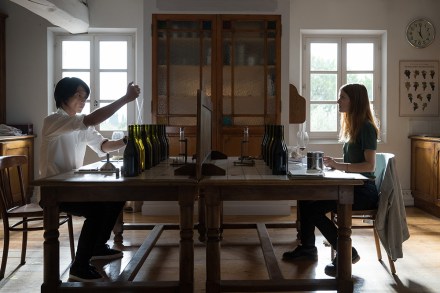
Drops of God is one of those gems of purest ray serene that cable TV prefers to keep hidden in its deep unfathomed caves because it thinks you want something more lowbrow. Try finding it by accident: you won’t. When I looked for it on Apple – which doesn’t have all that many shows – I had laboriously to type in its name. It wasn’t offered to me in the recommendations. If I hadn’t been tipped off by my friends Candy and Diarmuid, I would never have seen it. I had been lamenting, as I often do, the dearth of stuff to watch on TV that doesn’t put you through the emotional wringer.

The White Lotus is off to a shaky start

The White Lotus, now back for a third series, could perhaps be best described as Death in Paradise for posh people. Most obviously, this is because its plots revolve around murders in an idyllic location – only with a far bigger budget, a much starrier cast and several episodes per story. But there’s also the fact that it follows the same pattern every time. So it was that season three began this week, rather like its predecessors, with some lovely scenery, a dead body and a caption reading ‘One week earlier’. After that, we duly watched a bunch of rich, good-looking Americans arriving at a luxury White Lotus resort where they were welcomed by the resolutely smiling staff and a nervous manager, before gazing round and marvelling at the beauty of it all.

Is work really more fun than fun?

Wouldn’t it be marvellous if instead of going to work every day we could contract out the tedium to avatars of whose daytime activities we could remain blissfully unaware? This, in essence, is the premise of the dystopian drama Severance, but I’m not sure it’s a fantasy many of us actually nurture. Noël Coward once said: ‘Work is more fun than fun.’ And though I wouldn’t push it quite that far – it would be true only if you were a huntsman or a Master of Fox Hounds – I think most of us would be pretty bereft without the adrenaline buzz of deadlines, the thrill of office flirtations, the rapier play of banter, the juice of gossip and the creativity of fiddling your expenses and getting one over on your fatuous, irritating, know-nothing superiors.

Stately, sly and well-mannered: BBC1’s Miss Austen reviewed

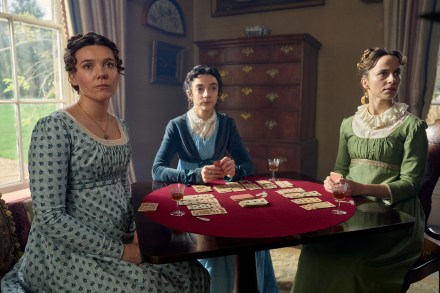
It is a truth universally acknowledged that lazy journalists begin every piece about Jane Austen with the words ‘It is a truth universally acknowledged’, so I’ll fight the temptation. In any case, the Miss Austen at the centre of BBC1’s new Sunday-night drama isn’t Jane, but her beloved sister Cassandra, best known for destroying most of Jane’s letters. Given that this has rendered our knowledge of the woman’s biography tantalisingly sketchy, Cassandra has attracted her fair share of resentment from Janeites. But rather cunningly, Miss Austen both exonerates her and takes full advantage of the sketchiness: high-mindedly questioning our entitlement to snoop into Jane’s private life, while feeling free to speculate on what that private life might have been.

Not a complete waste of time: Netflix’s La Palma reviewed 

Netflix is the television equivalent of pasta and ready-made pesto: a slightly desperate but acceptable enough stand-by when you’ve got home late, you haven’t time to prepare anything more nutritious and at least it fills the gap without too much pain or fuss. It is an adamantine rule of television that foreign-language dramas are always superior La Palma is classic Netflix. You wouldn’t necessarily rave about it to your friends. But if, as I do, you have one of those wives who gets really pissed off if there’s not a programme ready and waiting to be viewed while supper’s still hot and, in a panic, you click on La Palma, you won’t feel at the end of the final episode like your time has been totally wasted. This is due, in part, to the location.

Certainly intriguing: Apple TV+’s Prime Target reviewed

Needless to say, there have been any number of thrillers that rely on what Alfred Hitchcock called a MacGuffin: something, however random, that the goodies have to find before the baddies do. Less common are those where the MacGuffin is the mathematical formula for prime numbers – which is where Apple TV+’s latest show comes in. His first thought on seeing a 204 bus was that 2042 is the sum of three consecutive cubes Prime Target began in ‘Baghdad, Iraq’ – and therefore in a bustling market. Or at least it bustled until a large gas explosion opened up a hole in the ground leading to a spectacular medieval chamber. For a while, the chamber went unexplained as we cut to ‘Cambridge, England’ – and therefore to eight strapping young men rowing on the river.

Irritating but watchable: American Primeval reviewed

American Primeval should really be called Two Incredibly Annoying Women In The Wild West. Yes, the first title is more clickbaity, whetting the prurient viewer’s appetite for the savage, primitive violence that splatters over every other scene. But the second is more accurate. Not since Lily Dale in Trollope’s Chronicles of Barsetshire have I rooted so fervently for the protagonist to meet a sticky end as I have with this series’ two feisty heroines. The Wild West depicted in American Primeval is grotesquely, mindlessly violent One, Sara Rowell (Betty Gilpin), is a mother on the run from the law.

Playing Nice is beautifully done – but they miscalculated the opening scene

There must have been a time when slow-burn psychological thrillers didn’t start with a scene of high drama followed by a caption that reads ‘Three months earlier’ – but if so, it’s getting hard to remember it. The latest programme to deploy the tactic was Playing Nice, which began with James Norton running towards the sea screaming ‘Theo!’ as a child’s body bobbed, face-down, in the waves. He was next seen, post-caption, laughing with his pre-school son in various picturesque Cornish locations while using the word ‘buddy’ a lot. Not to be outdone in the great-parent stakes, his wife also piled on the cuddles for little Theo. Before long, Miles had developed the habit of glowering menacingly when nobody was watching This idyll, however, didn’t last long.