Portrait of the week

Portrait of the week: Bank failures, a ‘Budget for growth’ and a new Duke of Edinburgh

Home Jeremy Hunt, the Chancellor of the Exchequer, delivered what he called a ‘Budget for growth’. He abolished the cap on savings for tax-free pensions and promised help with childcare costs. The Office for Budget Responsibility forecast a fall in inflation to 2.9 cent by the end of 2023 and a fall in GDP of 0.2 per cent. Twelve regions for new investment zones were named. Corporation tax would rise to 25 per cent but for small businesses capital expenditure would be tax deductible. Nuclear power and quantum computing would be encouraged; back pain and mental health problems discouraged. The pothole fund would grow. Holyhead Breakwater would benefit. Duty on alcohol went up, but duty on draught products in pubs would be less.

Portrait of the week: Small boats, stamp price hike and a new job for Sue Gray

Home Suella Braverman, the Home Secretary, introduced the Illegal Migration Bill, intended to stop people crossing the Channel on small boats. It would ban those who entered Britain illegally from claiming asylum or re-entering in future, and would place a duty on the Home Secretary to deport them ‘as soon as reasonably practicable’. Writing to MPs, the Home Secretary said there was a ‘more than 50 per cent chance’ that it was incompatible with the European Convention on Human Rights. She also said she had ‘pushed the boundaries of international law’. Rishi Sunak, the Prime Minister, rang the President of Rwanda to tell him to expect deliveries. The price of a first-class stamp is to go up from 95p to £1.10 on 3 April.

Portrait of the week: Sunak’s Brexit deal, Hancock’s WhatsApp messages and a cucumber crisis

Home The Northern Ireland Protocol was modified by something called the Windsor Framework, agreed between Rishi Sunak, the Prime Minister, and Ursula von der Leyen, the President of the European Commission. He said that Stormont would be able to apply a brake to new EU goods rules; the brake would allow the UK government to apply a veto. Goods from Britain for Northern Ireland would travel through a ‘green lane’ with fewer checks, and those that might move on into the EU through a ‘red lane’. The ban on importing British chilled sausages and seed potatoes would end. After announcing the agreement, Mrs von der Leyen was granted an audience with the King at Windsor Castle. Mr Sunak visited Northern Ireland.

Portrait of the week: Protocol palaver, a tomato shortage and trains that don’t fit tunnels

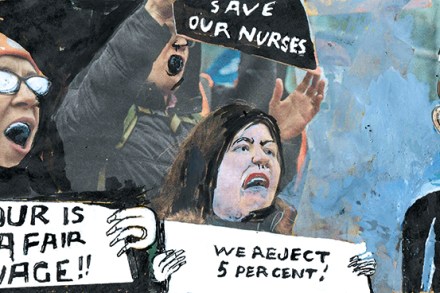
Home Britain spent £5.4 billion less than it received in taxes in January, despite support for private customers’ energy bills. Public borrowing so far this financial year is £30.6 billion less than predicted by the Office for Budget Responsibility. The Royal College of Nursing called off next week’s 48-hour strike in England to restart talks with the government. The government recommended offering public sector workers such as judges, policemen, teachers, doctors, nurses and dentists in England and Wales pay rises of 3.5 per cent; the recommendations will be considered by independent pay review bodies. Supermarkets saw a dearth of tomatoes, attributed to bad weather in Morocco and Spain.

Portrait of the week: Sturgeon resigns, inflation falls and a crown for Camilla

Home Nicola Sturgeon, the First Minister of Scotland, announced her resignation. Jeremy Corbyn will not be a Labour candidate at the next general election, Sir Keir Starmer, the Labour leader said. A boy and girl, both aged 15, were charged with the murder of Brianna Ghey, a 16-year-old transgender girl, at Culcheth, Cheshire. A revision of the Northern Ireland Protocol was predicted, under which goods from Britain destined only for Northern Ireland would not face physical customs checks; but bananas would face a tariff lest they be smuggled into the Republic. Six members of a gang, Michael Malik Ahmed, Roshan Clark, Kaijuan Henry, Zakariah Yusuf, Jessy Ouma and Joseph Opoku, who wielded knives and machetes to steal watches in Clapham and Chelsea, were convicted of robbery.

Portrait of the week: Rishi reshuffles, Truss talks and a trigger warning for Shakespeare’s Globe

Home Rishi Sunak, the Prime Minister, rearranged the deck chairs. The Department for Business, Energy and Industrial Strategy was broken up, and Grant Shapps, the Business Secretary, was put in charge of a new department: Energy Security and Net Zero. Kemi Badenoch, the Trade Secretary, added business to her portfolio, as the new Secretary of State for Business and Trade. Michelle Donelan, the Culture Secretary, became Secretary of State for Science, Innovation and Technology. The Department for Digital, Culture, Media and Sport had its ‘Digital’ lopped off and was put under Lucy Frazer. The new Conservative party chairman is Greg Hands, reckoned a safe pair.

Portrait of the week: Workers striking, economy shrinking and Tesco buys Paperchase

Home Teachers went on strike. Train drivers and railway workers went on strike for two days, with a day’s rest in between. Civil servants belonging to the Public and Commercial Services Union went on strike, including some who work for Border Force. Firemen voted to go on strike. Nurses and ambulance staff decided to go on strike next week. During a visit to Darlington, Rishi Sunak, the Prime Minister, told an audience of health workers: ‘I would love, nothing would give me more pleasure, than to wave a magic wand and have everyone, all of you, paid lots more.’ The Commons voted for a bill to impose minimum service levels in some kinds of work during strikes. The International Monetary Fund said that the UK economy would contract by 0.6 per cent this year.

Portrait of the week: Taxing times for the Tories, tanks for Ukraine and a giant Antarctic iceberg

Home Nadhim Zahawi, minister without portfolio and chairman of the Conservative party, was asked to explain how a penalty formed part of a £5 million tax payment he had made. Rishi Sunak, the Prime Minister, asked Sir Laurie Magnus, his newly appointed ethics adviser, to examine whether Mr Zahawi had broken the code of conduct on ministerial behaviour. The appointment of Richard Sharp as chairman of the BBC was under review by William Shawcross, the Commissioner of Public Appointments, after it became known that in 2020, before his appointment, he had contacted Simon Case, the cabinet secretary, about an offer of a loan of £800,000 by Sam Blyth, an old friend of Mr Sharp’s, to Boris Johnson, then PM. The government borrowed £27.

Portrait of the week: Sunak vs Sturgeon, Nepal plane crash and Mexico bans smoking on beaches

Home The government prevented the Gender Recognition Reform (Scotland) Bill, passed by the Scottish parliament, from proceeding to royal assent, under Section 35 of the Scotland Act, because of its ‘serious adverse impact’ on the operation of the Equality Act 2010. It was blocked by a statutory instrument laid before parliament by the Scottish Secretary, Alister Jack. The Scottish National party leader in the Commons, Stephen Flynn, called opponents to the bill ‘rabid gammon’. Nicola Sturgeon, the First Minister of Scotland, sought judicial review. Rishi Sunak, the British Prime Minister, had visited Scotland a few days before to help some Sea Scouts toast marshmallows and to have dinner with Ms Sturgeon.

Portrait of the week: Harry’s confessions, house prices fall and Cornish space launch fails

Home Government ministers held short meetings with trade union representatives as strikes continued by ambulance drivers, teachers, bus drivers and driving test examiners. A bill was introduced to require some workers to provide a minimum level of service during strikes in the NHS, education, fire and rescue, border security, nuclear decommissioning and public transport. Evri, the courier formerly known as Hermes, said ‘Our service has not been as good as we would have liked’ as parcels were reported delayed or undelivered. James Cleverly, the Foreign Secretary, and Maros Sefcovic, a vice-president of the European Commission, held ‘cordial and constructive’ talks on Northern Ireland trade.

Portrait of the week: A&E crisis, Alps snow shortage and walrus cancels fireworks

Home The Royal College of Emergency Medicine said some A&E departments were in a ‘complete state of crisis’. Railway workers belonging to the RMT union and Aslef began five days of strikes. Rail fares will rise by 5.9 per cent from March after the government decided to cap them; usually they go up a percentage point more than the July inflation figure, which in 2022 was 12.3 per cent. More than a million households with prepayment meters did not redeem their monthly energy support vouchers during the cold spell in December; postal strikes and difficulty of contacting suppliers were blamed. In December, the Bank of England had raised UK interest rates to their highest level for 14 years, to 3.5 per cent from 3 per cent.

Portrait of the year: Russia invades Ukraine, the Queen dies and Britain gets through three prime ministers

January Civilians participate in a Kyiv Territorial Defence unit training session as Russia amasses troops on its border, 29 January 2022 (Getty Images) The first day of the year reached 16.3°C in St James’s Park, London. In France, 874 cars were set alight for the new year. Southern Railway suspended services because of staff absence through Covid. The legal obligation to wear face coverings in England ended. Sue Gray delivered her report into Downing Street parties. Together Energy became the 28th energy supplier to go bust as wholesale gas prices rose. Inflation reached 5.4 per cent. Some 1,339 migrants crossed the Channel in small craft. Around 100,000 Russian troops massed on the Ukraine border.

Portrait of the week: Christmas rail strikes, Lady Hussey’s resignation and Indonesia’s sex ban

Home The RMT union decided to add a couple of rail strikes just before and after Christmas to those planned. Nurses, ambulance workers, driving test examiners, baggage handlers at Heathrow and bus drivers joined in. Postmen hoped to fit in another six strikes before the end of the month; Currys stopped using Royal Mail parcel delivery. ‘This is a time to come together and to send a very clear message to Mr Putin that we’re not going to be divided in this way,’ said Nadhim Zahawi, chairman of the Conservative party. ‘Our message to the unions is to say this is not a time to strike.’ Conor Burns had the Tory whip restored after being cleared of misconduct.

Portrait of the week: Record migration, nurses on strike and Christmas turkeys struck down

Home Rishi Sunak, the Prime Minister, proposed in his speech at the Lord Mayor’s Banquet to treat China with ‘robust pragmatism’. The Chinese ambassador to Britain was summoned to the Foreign Office following the arrest and beating of a BBC journalist, Ed Lawrence, in Shanghai. Net migration reached 504,000 in the year to June – the highest recorded, the Office for National Statistics estimated. A man was arrested in Gloucestershire over the deaths of at least 27 people who drowned in the Channel in a dinghy last year. Migrants with symptoms of diphtheria would be put into isolation, ministers said, as more than 50 cases were detected.

Portrait of the week: Eggs rationed, hosepipe ban lifted and Supreme Court rejects Scotland’s referendum bid

Home The Supreme Court ruled that the Scottish government does not have the power to hold an independence referendum without the UK government’s consent. A meeting of NHS Scotland heard that ‘unscheduled care is going to fall over in the near term before planned care falls over’. One proposal was for rich people to pay; Nicola Sturgeon, the First Minister of Scotland, repudiated the idea. Labour said that it would abolish the House of Lords and replace it with a ‘new, reformed upper chamber’. The Manston migrant processing centre, crowded during the summer with thousands who arrived in England on small boats, was cleared of people. The RMT union announced more rail strikes on 13, 14, 16 and 17 December and 3, 4, 6 and 7 January.

Portrait of the week: record inflation, record NHS waiting lists and the return of Trump

Home Jeremy Hunt, the Chancellor of the Exchequer, said, ‘We’re all going to be paying a bit more tax’ as he polished up his Autumn Statement. ‘The number one challenge we face is inflation,’ said Rishi Sunak, the Prime Minister. The annual rate of inflation rose to 11.1 per cent from 10.1 per cent the month before. Regular pay increased by 5.7 per cent in the year to September but its real value fell by 2.7 per cent because of inflation. In a survey of grocery prices, the consumer group Which? found Heinz tomato ketchup had gone up 53 per cent in two years and Anchor spreadable butter by 45 per cent. Unemployment rose a little from 3.5 to 3.6 per cent, but an increase in the economically inactive was largely attributed to the long-term sick, of whom there are now 2.

Portrait of the week: Williamson resigns, nurses strike and Norwegian royal quits

Home Sir Gavin Williamson resigned from the cabinet as minister without portfolio following publication of texts he had sent (annoyed at not being invited to the Queen’s funeral) to the chief whip Wendy Morton, full of swear words. ‘There is a price for everything.’ A former civil servant said that Sir Gavin had told him to slit his throat, which he denied. Rishi Sunak, the Prime Minister, agreed with Jeremy Hunt, the Chancellor of the Exchequer, £35 billion of tax cuts and £25 billion of tax rises, in time for the Office for Budget Responsibility to peruse the proposals before the Autumn Statement next Thursday. The Bank of England had raised interest rates by 0.75 percentage points to 3 per cent.

Portrait of the week: A migrant crisis in Manston, elections for Northern Ireland and Matt Hancock heads for the jungle

Home Suella Braverman, the Home Secretary, spoke in the Commons of an ‘invasion on our southern coast’ by migrants in small boats. ‘Let’s stop pretending that they are all refugees in distress,’ she said. ‘The whole country knows that is not true.’ She was reacting to a crisis at a migrant processing centre in Manston, Kent, built for 1,600 but housing 4,000. David Neal, the independent chief inspector of borders and immigration, called it ‘really dangerous’. He said an Afghan family had lived in a marquee there for 32 days. It was made more crowded after migrants were moved following an attack with three petrol bombs on a Border Force migrant centre in Dover by a man in a car who then killed himself. On Saturday alone, 990 migrants crossed the Channel.

Portrait of the week: Sunak in No. 10, pasta gets pricier and Russia hits Ukraine’s energy grid

Home Rishi Sunak, aged 42, became Prime Minister. At the weekend Boris Johnson had flown back from a holiday in the Dominican Republic in response to the resignation of Liz Truss. She said she could not ‘deliver the mandate on which I was elected by the Conservative party’. The 1922 Committee devised a hurdle of 100 nominations for any MP to be considered as leader, with secret ballots of MPs and, if two candidates remained, an online vote by party members. It was thought that if Mr Johnson secured 100 votes, the membership would elect him. At 9 p.m. on Sunday, the day before nominations closed, he withdrew from the contest. Next day, a minute before nominations closed, Penny Mordaunt withdrew. So Mr Sunak won.

Portrait of the week: Truss says sorry, Hunt reverses mini-Budget and Kanye West buys Parler

Home Liz Truss said in a BBC interview as Prime Minister that she wanted to ‘say sorry for the mistakes that have been made’. Declaring that she would lead the Conservatives into the next election, she addressed blocs of MPs: the One Nation group one day, the European Research Group the next. She watched Jeremy Hunt, the Chancellor of the Exchequer whom she had just appointed to replace Kwasi Kwarteng, deliver a statement to the Commons reversing most of the provisions of the ‘fiscal event’ of 23 September. The new Chancellor announced the end of current subsidies for domestic energy bills in April, preferring something that ‘will cost the taxpayer significantly less than planned while ensuring enough support for those in need’.