Portrait of the week

Portrait of the week: Face masks in schools, vegan nuggets in Burger King and Big Ben bongs again

Home The warmest New Year’s Day on record saw a temperature of 16.3˚C (61.3˚F) in St James’s Park, London. A restored Big Ben rang in the new year for the first time in four years. Boris Johnson,the Prime Minister, announced he would soldier on with Plan B against coronavirus. The government, he said, had identified 100,000 critical workers to receive daily lateral flow tests. Some people would be treated at home in 2,500 ‘virtual beds’. Covid was widespread, thanks to the Omicron variant. In the seven days up to the beginning of this week, 911 people had died with coronavirus (compared with 858 in a week a month earlier), bringing total deaths (within 28 days of testing positive) to 148,778.

Portrait of the year: Lockdown, protests, parties and Matt Hancock’s kiss

January The United Kingdom found itself in possession of a trade agreement with the EU. Coronavirus restrictions were tightened. The Oxford-AstraZeneca vaccine was administered with authorisation for the first time; retired doctors could not vaccinate before undergoing ‘diversity’ training. To prevent vaccines being exported from the EU to Northern Ireland, the EU prepared to invoke Article 16 of the Northern Ireland Protocol, but soon changed its mind. The Capitol in Washington, DC was overrun by weird people, one with horns, supporting President Donald Trump, despite his electoral defeat. Joe Biden was inaugurated as President a week later. February The government promised to legalise the drinking of coffee by two people on a park bench.

Portrait of the week: No. 10 parties, a ten-year drugs strategy and Burmese arrest

Home Sajid Javid, the Health Secretary, said that the Omicron variant of coronavirus was spreading by community transmission in ‘multiple regions of England’. He gave the number of cases detected as 336 by 6 December, and the next day another 101 were found. Anyone coming from a foreign country would have to pass a coronavirus test within two days of catching a plane to Britain. A newlywed couple who had to pay £2,285 to stay in a quarantine hotel published photos of food such as a slice of quiche covered with sliced carrots in a plastic container. Sainsbury’s asked workers to postpone Christmas parties until the new year. Despite setbacks, more than 20 million booster vaccinations had been given.

A new Covid variant, a Labour reshuffle and a Twitter resignation

Home In a nervous response to the entry into Britain of the Omicron variant of Covid-19 — B.1.1.529 — the wearing of face coverings in shops and public transport was made law again, though by statutory instrument not by an Act of Parliament. Anyone deemed to have been in contact with a Covid sufferer faced ten days’ house arrest. MPs voted in support of the measures after their introduction. Pubs and restaurants were exempt, but schoolchildren over the age of 12 had to wear masks in communal areas. ‘If we all decrease our social contacts a little bit, actually that helps to keep the variant at bay,’ said Dr Jenny Harries, the head of the UK Health Security Agency. But the government said people could go on with Christmas plans.

Portrait of the week: Boris’s shambolic CBI speech, more Covid protests and Kyle Rittenhouse is cleared

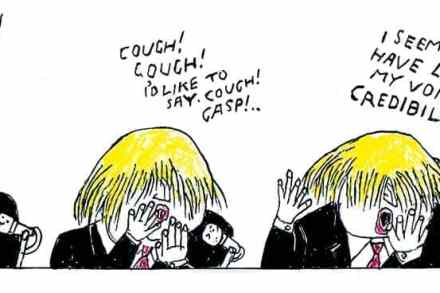
Home Boris Johnson, the Prime Minister, praised Peppa Pig in a speech to the Confederation of British Industry: ‘Who would’ve believed that a pig that looks like a hairdryer... has now been exported to 180 countries?’ Then he lost his place and said: ‘Forgive me. Forgive me. Forgive me.’ Nineteen Conservative MPs voted against the government on a clause excluding means-tested council support payments from a new £86,000 lifetime limit on social care costs; it would mean a lost inheritance for heirs of people with assets worth no more than the limit. The writer J.K. Rowling was hounded by militant trans campaigners. ‘I’ve now received so many death threats I could paper the house with them,’ she said.

Portrait of the week: a Liverpool terror attack, the end of COP26 and the Belarus migrant crisis

Home The UK terror threat level was raised to severe after a taxi exploded and burst into flames just before 11 a.m. on Remembrance Sunday outside Liverpool Women’s Hospital, killing the passenger. He was Emad Al Swealmeen, 32, a failed asylum-seeker from the Middle East, who had converted from Islam, and was confirmed in 2017 at Liverpool Anglican Cathedral nearby. He had previously been sectioned for six months under the Mental Health Act because of his behaviour with a knife. The detonator seemed to have gone off but not the bomb. The taxi driver, whose wounds required hospital treatment, was praised for his courage. The Countess of Avon, widow of the former prime minister Anthony Eden, died aged 101.

Portrait of the week: Tory sleaze, NHS jabs and Elon Musk’s shares

Home NHS staff in England will have to be fully vaccinated against Covid by the spring. Britain had ordered 250,000 courses of a Pfizer antiviral pill available from early 2022 shown to cut the risk of hospitalisation or death from Covid by 89 per cent. Britain approved another antiviral pill, developed by Merck, and ordered 480,000 courses. In the seven days up to the beginning of this week, 1,185 people had died with coronavirus, bringing the total of deaths (within 28 days of testing positive) to 141,743. (In the previous week deaths had numbered 1,097.) Numbers remaining in hospital stayed at about 9,000. Rolls-Royce gained the backing of private investors and the government to develop small modular reactors to produce nuclear energy.

Portrait of the week: Fishing friction, Greta’s singalong and terror in Tokyo

Home Boris Johnson, the Prime Minister, told delegates to the 26th Conference of the Parties to the United Nations Framework Convention on Climate Change (COP26) in Glasgow: ‘It’s one minute to midnight on that doomsday clock and we need to act now.’ He left the conference the next day. British companies would have to publish plans on reaching net zero by 2050. India said it would reach net zero by 2070. Greta Thunberg, aged 18, stood in Govan Festival Park leading a chorus of ‘You can shove your climate crisis up your arse’ to the tune of ‘Ye cannae shove yer grannie aff a bus’.

Portrait of the week: Queen stays home, Boris rubbishes recycling and pay freeze thaws

Home The Queen will not attend the COP26 meeting in Glasgow next week; she had resumed light duties after having spent a night in hospital for ‘preliminary medical checks’. The Queen would address COP26 by means of a recorded video. ‘The recycling thing is a red herring,’ Boris Johnson, the Prime Minister, told a press conference attended by schoolchildren. ‘You can only recycle plastic a couple of times, really. What you’ve got to do is stop the production of plastic.’ The protestors calling themselves Insulate Britain blocked main roads into London and approaches to the M25. Amazon Web Services was awarded a contract to provide a high-security cloud system for GCHQ, MI5 and MI6.

Portrait of the week: David Amess’s death, net-zero plans and contraceptives for hippos

Home Sir David Amess, aged 69, the Conservative MP for Southend West, was stabbed to death while taking a constituency surgery at Leigh-on-Sea, Essex. Police stopped a priest reaching him to administer the last rites. They arrested Ali Harbi Ali, 25, a British man of Somali heritage, who was detained under the Terrorism Act. The Queen agreed that Southend should be granted the status of a city, which Sir David had long campaigned for. Dennis Hutchings, 80, a former soldier on trial in Belfast for the attempted murder of John Pat Cunningham, 27, in 1974, died after catching Covid. In the seven days up to the beginning of this week, 830 people had died with coronavirus, bringing the total of deaths (within 28 days of testing positive) to 138,527.

Portrait of the week: power failures, toy shortages and Boris’s Marbella mountain villa

Home In an extraordinary wrangle between government departments, the Treasury accused Kwasi Kwarteng, the Business Secretary, of ‘making things up’ by saying he had held talks with the Treasury about helping companies badly hit by soaring energy prices. With the price of wholesale gas having risen fourfold in a year, businesses expected to close factories. To stir the pot of government discord, some demanded that Boris Johnson, the Prime Minister, should ‘knock heads together’, though he was on holiday in the mountains above Marbella at a villa belonging to Lord Goldsmith of Richmond Park. There were signs that prime-ministerial favour rested upon Mr Kwarteng.

Portrait of the week: Facebook’s blackout, California’s oil spill and Rishi’s kitchen sink

Home Boris Johnson, the Prime Minister, said he did not think Britain was in a crisis; he wanted it to move towards ‘a high-wage, high-skill, high-productivity economy’ that was not addicted to cheap foreign labour. Rishi Sunak, the Chancellor of the Exchequer, told the Conservative party conference in Manchester that he had committed £500 million to renew job-support schemes, now that furlough and the £20 a week universal credit bonus had ended. Of the unemployed, he told Sky News: ‘We are throwing literally the kitchen sink at helping them.’ A group of people in the street shouted ‘Tory scum’ at Sir Iain Duncan Smith and hit him with a traffic cone; there were five arrests.

Portrait of the week: Petrol panic, Labour’s meltdown and China’s crypto crackdown

Home The crisis of the week was a shortage of fuel at garages. ‘There is no need for people to go out and panic buy,’ said Paul Scully, the small-business minister. That set motorists queueing. BP had shut some petrol stations and blamed a shortage of heavy goods vehicle drivers. Grant Shapps, the Transport Secretary, blamed ‘one of the haulage associations’ for leaking details of a government meeting at which fuel industry people expressed concerns that fuel stocks were at two-thirds of normal levels. But Rod McKenzie, the managing director of policy and public affairs at the Road Haulage Association, said it wasn’t him.

Portrait of the week: Gas prices soar, cabinet reshuffled and a green light for travel

Home To prevent a shortage of meat, which relies on carbon dioxide in its packaging, the government gave millions of taxpayers’ money to an American company to reopen a fertiliser works at Stockton, Co. Durham, that produces the gas as a by-product. The plant had been shut down because of a rise in wholesale gas prices caused by calm weather preventing rival wind-energy production, a fire at an interconnector reducing electricity supplies from France, and Russia putting up the price of its gas exports. Gas-supply companies began to go bust because the government price-cap prevented them from charging as much as they paid for gas. There was clamour for money from the government, either for gas companies or to keep down consumers’ bills next year.

Portrait of the week: Boosters, Emma Raducanu and the Taliban’s new rules

Home The government decided to offer booster vaccinations to those over 50. Children aged 12 to 15 would be offered one dose of the Pfizer-BioNTech vaccination. This followed a declaration by the Joint Committee on Vaccination and Immunisation that it could not recommend vaccination for these children for their own health benefit alone; the chief medical officers of England, Scotland, Wales and Northern Ireland then recommended it, taking into account the effect on disrupted schooling. Sajid Javid, the Health Secretary, said that plans for vaccine passports in England would not go ahead. But Boris Johnson, the Prime Minister, held up a Plan B in terrorem for the winter if people insisted on falling ill with Covid.

Portrait of the week: Tax rises, Tube gets busier and Taliban names its government

Home Boris Johnson, the Prime Minister, announced a new tax in the Commons branded a ‘health and social care levy’. It would increase National Insurance paid by employees and employers by 1.25 percentage points from April 2022. A year later it would become a separate tax that even pensioners still earning would have to pay. Share dividends would also see an extra 1.25 per cent tax rate. Of the £12 billion a year raised, only £1.8 billion would go to social care for the next three years. Some of the tax would go to meet the increased tax bill of the NHS as an employer paying the levy. From October 2023 there would be a cap on personal care liabilities of £86,000 over a person’s lifetime, though this would not cover accommodation.

Portrait of the week: Britain leaves Afghanistan, hurricane hits New Orleans and Gove goes clubbing

Home Britain brought its last troops home from Afghanistan, having flown out more than 15,000 people since 14 August; but the operation failed to evacuate perhaps 1,000 eligible Afghans, some of whom had worked for the government, and 100 to 150 British nationals. Pen Farthing, who runs an animal charity in Afghanistan, returned in an aeroplane he had chartered with 94 dogs and 79 cats; ‘Meanwhile my interpreter’s family are likely to be killed,’ commented Tom Tugendhat, the chair of the Foreign Affairs Select Committee, who has served in Afghanistan. In the seven days up to the beginning of the week, 765 people had died with coronavirus, bringing the total of deaths (within 28 days of testing positive) to 132,376. (In the previous week deaths had numbered 697.

Portrait of the week: the chaotic evacuation from Kabul

Home At the virtual G7 emergency summit that he was chairing, Boris Johnson, the Prime Minister, urged President Joe Biden of the United States to prolong the evacuation from Kabul of Nato forces, nationals and dependants beyond 31 August. But the Taliban said no. Britain took 8,600 people out of Afghanistan in ten days, but Ben Wallace, the Defence Secretary, said: ‘We won’t get them all out.’ Tony Blair, the former prime minister who had sent British forces to join in the invasion of Afghanistan in 2001, said that America’s decision to withdraw had been made ‘in obedience to an imbecilic political slogan about ending “the forever wars”’.

Portrait of the week: the Taliban take Afghanistan

Home Parliament was recalled after the rapid fall of Afghanistan to the Taliban. Dominic Raab, the Foreign Secretary, returned from a foreign holiday on Sunday. Boris Johnson, the Prime Minister, declared as Kabul fell: ‘We don’t want anybody bilaterally recognising the Taliban.’ But Mr Raab said that Britain recognised states, not governments. Britain sent an extra 300 soldiers to help extract British citizens and people such as interpreters now in danger. Ben Wallace, the Defence Secretary, wept when he said on the radio that some people for whom Britain had responsibility ‘won’t get back’ from Afghanistan.

Portrait of the week: Cameron’s cash, A-grades abound and Tower Bridge won’t budge

Home With less frightening domestic data on the coronavirus pandemic to ponder, subjects such as the rivalry between Boris Johnson, the Prime Minister, and Rishi Sunak, the Chancellor of the Exchequer, found time for discussion. The seven-day average of coronavirus cases detected by tests remained below 30,000. In the seven days up to the beginning of the week, 637 people had died with coronavirus, bringing the total of deaths (within 28 days of testing positive) to 130,281. (In the previous week deaths had numbered 524.) In a week, numbers remaining in hospital fell from 5,943 to 5,631. Three quarters of adults had received two doses of vaccine, but numbers crept up very slowly for first vaccinations, because of the low uptake by those under 35.