Portrait of the week

Portrait of the week: barbecues are banned, Burnham is fooled and Farage wins Clacton

Home The temperature reached 38.1ºC at Kew Gardens, Surrey. In the West Midlands a wildfire at Stourbridge burnt down 19 houses and damaged 18. The government sent out a loud siren sound and a message to all mobiles in England and Wales warning of a ‘very high risk of wildfires’. So-called Statutory Guidelines temporarily banned the sale of disposable barbecues. More than 8,000 South East Water customers in Kent found supplies disrupted. A burst water main cut off travel by road between Heathrow’s terminals. Two passengers were seriously injured when three carriages of a train from London Victoria to Eastbourne were derailed and fell onto their sides near Lewes. A train from Southend to London Liverpool Street was derailed at Wickford.

Portrait of the week: Burnham starts his UK tour, Jason Arday quits and the sun is eclipsed

Home Andy Burnham, the Prime Minister, began a tour of the United Kingdom, making small announcements. But on the matter of the early release of the killers of PC Andrew Harper, he said he was ‘increasingly confident’ that work to increase space in prisons would ‘prevent their early release altogether’. All 50 chief constables in the United Kingdom urged him to prevent it. Probation officers voted in favour of strike action over the early release scheme. Trains in the north-west of England were disrupted for two days after a 90-second power failure in Manchester affected a Network Rail operations centre and signalling. More regions were declared to be in drought, encompassing 45 million people, of whom 27 million are restricted in their use of water.

Portrait of the week: Drought declared, Manchester elects new mayor and 70,000 enter Ceuta 

Home In 19 English counties 1mm or less rain fell in July. Tom Bradshaw, the president of the National Farmers’ Union, said that yields of wheat and oats were ‘very, very poor’. Fire affected 375 acres of Suffolk at Dunwich Heath. Shell agreed to sell its European onshore renewables arm, including solar farms, to France’s TotalEnergies. BP’s profits rose to the highest since 2022, after the war in the Middle East pushed up oil prices. BP put its UK offshore oil and gas business up for sale. A trial by researchers at King’s College London started recruiting 220 children aged 11 to 16 to assess puberty blockers after the High Court rejected a legal challenge.

Portrait of the week: No. 10 North, Burnham meets Zelensky and European wildfires  

Home Andy Burnham, the Prime Minister, summoned cabinet ministers for a day at No. 10 North – Heron House in central Manchester, shared with intelligence agencies – which he reached by private jet to Glasgow, where he had an appointment, and another private jet south to Manchester. President Volodymyr Zelensky of Ukraine became the first international visitor to Mr Burnham, who told him: ‘You can count on the UK for as long as it takes.’ He decided to speed up the independent review of adult social care being undertaken by Baroness Casey of Blackstock. He said that he wanted schools to offer technical courses to children aged 14 and over.

Portrait of the week: Burnham becomes PM, America strikes Iran and Spain wins World Cup 

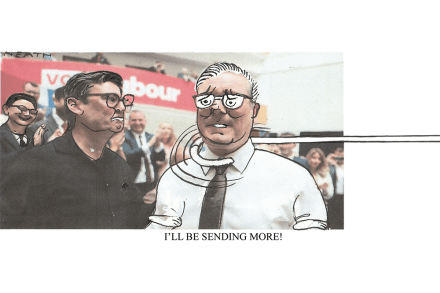
Home The King accepted Sir Keir Starmer’s resignation as Prime Minister and asked Andy Burnham to form an administration. In Downing Street, he made a short speech without notes, saying that his first instruction would be to end rough sleeping. He invited President Donald Trump to Manchester. He also spoke to President Volodymyr Zelensky of Ukraine and President Emmanuel Macron of France. He promised a ‘cost of living government’, and removed VAT from domestic energy bills for six months from October, giving an average saving of 86p a week. Bus fares in England would be capped at £2 from 2027. Mr Burnham appointed a cabinet of 12 women and 11 men, gunning for Starmer loyalists.

Portrait of the week: Burnham’s triumph, the IRGC proscribed and babies called Andrew 

Home Police launched a murder inquiry into the death of Ann Widdecombe, the former MP, aged 78. Her body was found with head wounds at her house on Dartmoor. They arrested a 28-year-old white British man in Rotherham, South Yorkshire. Counter-terrorism police took over the investigation two days later and rearrested the suspect on suspicion of commission, preparation or instigation of acts of terrorism. Police called it a ‘targeted’ attack. She had been a minister in Sir John Major’s administration, an MEP for the Brexit Party and, since 2023, a member of Reform, serving as its immigration and justice spokesman.

Portrait of the Week: Resignations, royal farces and World Cup wins

Home Nigel Farage, the leader of Reform, announced that he would leave parliament (by applying to be Steward and Bailiff of the Manor of Northstead) and then fight a by-election at Clacton. ‘It’s a chance to stick two fingers up to the entire Establishment,’ he said. His announcement came after a report in the Sunday Times saying that he did not declare, on becoming an MP, benefits received in the preceding year from George Cottrell, 32, who spent eight months in jail in America after admitting a charge of wire fraud in 2016. The main parties and Restore said they would not put up candidates against Farage.

Portrait of the week: No. 10 heads north, Stokes retires and earthquakes hit Caracas

Home Andy Burnham, who was expected to become prime minister on 20 July, took off his tie and put on a dark T-shirt for a speech in which he said he would establish a ‘No. 10 North’ in Manchester as the ‘nerve centre of a rewired Britain’. He promised council houses, welfare reform and ‘good growth in every postcode’ by means of ‘Manchesterism’. He took no questions. Sir Keir Starmer, the Prime Minister, presented the delayed defence investment plan, and said that spending would rise by £15 billion by 2030. He landed his successor with £4.7 billion of the sum being left unfunded. The Ministry of Defence would also have to find £10.7 billion in efficiency savings in the next four years.

Portrait of the week: Burnham wins, Starmer resigns and a heatwave hits

Home Sir Keir Starmer, the Prime Minister, stood outside 10 Downing Street and said that he would resign as leader of the Labour party. Nominations for a successor would open on 9 July (though he still meant to unveil his defence investment plan in time for the Nato summit on 7 July). His decision to depart followed the convincing victory in the Makerfield by-election of Andy Burnham, bringing him back into parliament. An election for mayor of Greater Manchester in his place would take place on 30 July, with Bev Craig, the leader of Manchester City Council, as Labour’s candidate. Mr Burnham packed a suit and tie into which he changed on the train from Manchester Piccadilly to London. He was sworn in as an MP that afternoon. Mr Burnham had received 24,927 votes (54.

Portrait of the week: Belfast riots, Starmer bans TikTok and Trump turns 80

Home The electors of Makerfield decided who might be prime minister. After John Healey resigned as defence secretary, Al Carns resigned as armed forces minister. Mr Healey had declared that Sir Keir Starmer, the Prime Minister, had ‘been unable, and the Treasury has been unwilling, to commit the resources that the nation needs to defend the country’. Dan Jarvis was appointed Defence Secretary. Air Chief Marshal Sir Richard Knighton, the Chief of the Defence Staff, said the armed forces would have to ‘dial back’ operations without more funding. Belfast had multiple nights of anti-immigrant rioting in response to the terrible knife attack on Stephen Ogilvie. Two Ukrainian men were found guilty of plotting firebomb attacks on properties linked to Sir Keir Starmer.

Portrait of the week: Belfast burns, Sullivan resigns and the Iran ceasefire cracks 

Home A horrible video circulated on social media of a man on the ground in a Belfast street being stabbed in the head. His life was saved by bystanders, one with a hurling stick; a Sudanese man, aged 30, who had arrived from Dublin and been granted leave to remain, was charged with attempted murder. In reaction, houses were set on fire and a bus and cars were burnt; in east Belfast, 100 masked men kicked in doors and broke windows, saying they were ‘getting the foreigners out’. J.D. Vance, the American Vice-President, blamed the death in Southampton of Henry Nowak on ‘the mass invasion of migrants’. David Lammy, the Justice Secretary and Deputy Prime Minister, said he had phoned Mr Vance and told him he was wrong.

Portrait of the week: Sturgeon speaks, Henry Nowak’s killer is jailed and Mandelson messages are released

Home Vickrum Digwa, 23, was jailed for life with a minimum term of 21 years for the murder of Henry Nowak, 18, who was stabbed several times; the victim was handcuffed and arrested while he was telling police he had been stabbed and saying ‘I can’t breathe’. Sir Keir Starmer, the Prime Minister, said that he ‘felt sick’ watching bodycam footage of the incident. Nicola Sturgeon, in a remarkable interview with the BBC about the embezzlement of £400,310.65 by her now-estranged husband, Peter Murrell, said she expected ‘a legal process to recover the money from Peter’, but she emphasised that: ‘I am not guilty of that embezzlement, so nothing that belongs to me should be part of that.

Portrait of the week:  Tony Blair intervenes, Peter Murrell pleads guilty and temperatures hit a May high

Home Sir Tony Blair, the former Labour prime minister, said in a 5,700-word essay: ‘The Labour party is playing with fire; or, more accurately, with its future, and that of the country.’ He said the party shouldn’t choose a new leader before deciding policy. In the first part of his government-commissioned report into economic inactivity by young people, Alan Milburn highlighted the 957,000 people aged between 16 and 24 who were not in work, training or education. Rachel Reeves, the Chancellor of the Exchequer, suspended import tariffs on chocolate and biscuits and gave away children’s tickets on buses during the month of August. She reduced VAT from 20 per cent to 5 per cent on children’s meals and zoo tickets from 25 June to 1 September.

Portrait of the week: Streeting resigns, HS2 stalls and ebola spreads to Uganda

Home Sir Keir Starmer, the Prime Minister, found his position challenged after Wes Streeting resigned as Health Secretary. At the same time Angela Rayner, the former deputy prime minister, announced that her tax troubles had been resolved after a payment of £40,000 in stamp duty that she owed. Andy Burnham, the mayor of Greater Manchester, was given permission by the National Executive Committee of the Labour party to stand for parliament in the Makerfield by-election, brought about by the resignation of its MP Josh Simons. Reform chose as its candidate Robert Kenyon, a self-employed plumber, who had stood in 2024. Mr Streeting caused trouble for Mr Burnham by saying that ‘leaving the European Union was a catastrophic mistake’.

Portrait of the week: Labour’s civil war begins, government borrowing rises and Trump arrives in China

Home Sir Keir Starmer, the Labour leader, made a speech without a jacket or tie in an attempt to save his premiership after local election results that were disastrous for his party. He promised to nationalise British Steel, to make ‘an ambitious youth experience scheme’ the heart of a new arrangement with the EU and to offer unemployed young people a job, training or work placement. Even before most local election votes had been counted, he said: ‘I’m not going to walk away and plunge the country into chaos.’ He told a divided cabinet: ‘The Labour party has a process for challenging a leader and that has not been triggered.

Portrait of the week: Golders Green attacked, borrowing costs soar and rat virus hits cruise ship 

Home Two Jewish men aged 76 and 34 were stabbed in Golders Green, north London. Essa Suleiman, 45, a British man born in Somalia, was charged with their attempted murder and, earlier on the same day, that of Ishmail Hussein (whom he had known for about 20 years) in Southwark. The Golders Green attack was declared a terrorist incident. Sir Mark Rowley, the commissioner of the Metropolitan Police, condemned Zack Polanski, the leader of the Green party, for reposting a message on X accusing the police of ‘repeatedly and violently kicking a mentally ill man in the head when he was already incapacitated by Taser’; Mr Polanski apologised.

Portrait of the week: Starmer avoids ethics inquiry, Birmingham’s bin strikes end and Trump is targeted

Home The House of Commons voted 335 to 223 against a Conservative-led motion to refer Sir Keir Starmer, the Prime Minister, to the Privileges Committee over his claims about the vetting of Lord Mandelson; 14 Labour MPs voted for the motion. Morgan McSweeney, the Prime Minister’s former chief of staff, who had recommended the appointment of Lord Mandelson, told the Foreign Affairs Committee that No. 10 had wanted Lord Mandelson in post ‘quickly’ but that officials were never asked to ‘skip steps’. Sir Philip Barton, the former permanent under-secretary at the Foreign Office, told the committee he was ‘presented with a decision’ made by the PM and ‘told to get on with it’.

Portrait of the week: Olly Robbins is sacked, inflation rises and the Strait of Hormuz is (briefly) opened 

Home Sir Keir Starmer tried to explain himself to parliament after Sir Olly Robbins was sacked as permanent under-secretary of state at the Foreign Office, its chief civil servant. Sir Keir complained that as Prime Minister he had not been told that Lord Mandelson had failed to satisfy UK Security Vetting when he took up his post as ambassador to Washington. Sir Keir said that he had not been told before 14 April. In the Commons he said: ‘I did not mislead the House.’ Even before Lord Mandelson’s appointment, the Cabinet Office had compiled a due diligence report, given to the Prime Minister, which cited concerns about the peer’s ties to China and Russia. Zarah Sultana, the Your Party MP, had to leave the Commons chamber after saying: ‘The Prime Minister is a bare-faced liar.

Portrait of the week: Trump attacks the Pope, Trump praises the King and Melania goes public

Home Lord Robertson of Port Ellen, the former secretary general of Nato, said: ‘We are under attack. We are not safe... Britain’s national security and safety is in peril.’ The government ran out of time to pass legislation to give the Chagos Islands to Mauritius before the end of the current session of parliament. Sir Keir Starmer, the Prime Minister, visited Saudi Arabia, the UAE, Bahrain and Qatar. He said in the Guardian that renewable energy would give Britain resilience in an unstable world. The IMF forecast that the Iran war would hit Britain’s economy the hardest, among G7 countries, reducing its estimate for growth this year to 0.8 per cent, from the 1.3 per cent predicted in January.

Portrait of the week: Trump threatens Iran, Kanye is banned and Artemis II heads to the Moon 

Home The government withdrew an offer to create 1,000 more training posts for doctors in England after the British Medical Association refused to call off a six-day strike by resident doctors. In a speech at a White House Easter lunch, President Donald Trump of America mocked Sir Keir Starmer, the Prime Minister, for having to consult his team about sending ‘two, old broken-down aircraft carriers’ to the Middle East. Seven people protesting at Lakenheath RAF base were arrested on suspicion of supporting the proscribed group Palestine Action. Chris Rokos, the billionaire hedge fund owner, is to donate £190 million to the University of Cambridge to found a school of government.