Opera

Weaving the colours of music 

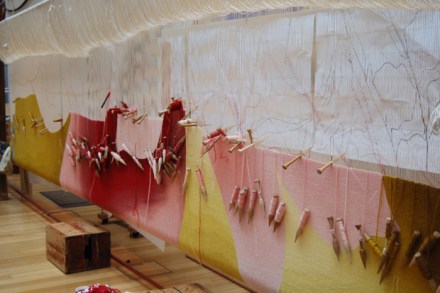
One loom, six metres in length, currently dominates the great, light-filled weaving hall of Edinburgh’s renowned tapestry workshop, Dovecot Studios. At its side sits Master Weaver Naomi Robertson, threading yarn from countless dangling bobbins between and around taut vertical strings, each dabbed with tiny, code-like markings. The tapestry, which is growing slowly upwards from the base of the loom, forms a spread of pinks, reds and golds, shifting horizontally through rich tonal ranges. The subject is as yet unclear. Given the intensity of the colour in this tapestry, it may seem surprising that its architect should be the painter Alison Watt, known for her bleached-out portraiture and paintings of white cloth.

The ENO’s Magic Flute ignores everything that makes Mozart’s opera great

A new production of The Magic Flute is something to look forward to, if with apprehension. How many aspects of this protean masterpiece will it encompass, and how many will be neglected or distorted? The answer, in the case of Simon McBurney’s effort at the Coliseum, is that almost everything that contributes to the work’s greatness is ignored or reduced, so that an evening that should be spent in a state of growing elation merely induces irritation deepening to rage, with patches of life-draining boredom. Not that the first-night audience shared my view, to judge from the roar of applause that greeted the final curtain, and the frequent guffaws and outbursts of clapping during the work.

Keith Warner’s Wozzeck doesn’t make me as angry as it used to

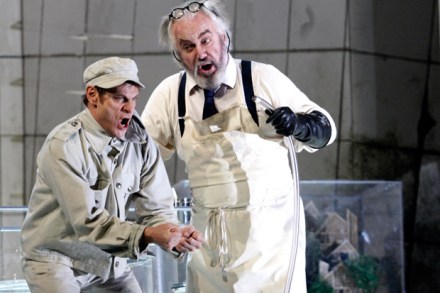
When Keith Warner’s production of Berg’s Wozzeck was first produced at the Royal Opera, nine years ago, it made me more angry than any that I had ever seen. At its first revival in 2006, my response was milder, though still outraged. Now, on its third outing, I mind it even less, partly because the musical performance is so strong. Warner has returned to oversee this revival, which, if memory serves, is little different from the last one, so he still regards Wozzeck as the portrayal of an experiment, with Wozzeck as the guinea pig, and the rest of the cast, with minor exceptions, as his tormenting experimenters. Most of the stage is a huge white room, suggesting a nightmare hospital or a morgue, and containing four large vitrines, with huge toadstools, etc. in three of them.

If ‘Greek’ is playing within 200 miles of where you live — watch it

This week chanced to give me a fascinating study in contrasts and comparisons: Mark-Anthony Turnage’s Greek at the Linbury Studio, Britten’s Death in Venice at the Grand Theatre Leeds. Two English operas from the latter half of the 20th century, both with mythological undertones and overtones, one of them the noisy announcement of his presence by a young composer, the other the last testament, a dying fall, of the ultimate Establishment figure who contrived also to be seen as an outsider; one full of profanities and vicious humour, the other both subversive and genteel, without a trace of irony or laughter. Death in Venice, the opera, has never much appealed to me.

I hope you spotted the epic ‘existential struggle’ in Les vêpres siciliennes — I didn’t

Verdi’s Les vêpres siciliennes is his least performed mature opera, even in its more familiar version as I vespri siciliani. So mounting it with a top-ranking cast and an interesting production is just what the Royal Opera should do in a so far seriously under-celebrated Verdi bicentenary year. What has actually happened is that we have a first-rate musical performance and a dismally confusing, cluttered, pretentious and conspicuously consuming production by the most fashionable of Continental directors, Stefan Herheim, abetted by the set designs of Philipp Fürhofer and the ideas of his regular dramaturg Alexander Meier-Dörzenbach.

Michael Tanner: With seven scenes, Eugene Onegin really doesn’t need any more pauses

This year’s live relays of New York Met performances have a markedly Slav flavour, with Shostakovich’s rare The Nose next up, and later Dvorak’s Rusalka and, most interestingly, Borodin’s Prince Igor. It kicked off with Tchaikovsky’s Eugene Onegin, the most popular though not the finest of his operas. On the first night there were sustained protests both outside and inside the Met, against the Putin crony Valery Gergiev and against Anna Netrebko, a supporter of the plutocrat dictator. Odd that there aren’t more protests, when you think that people still get heated and even write books about musicians who stayed in the Third Reich, often acting courageously. There were no protests, alas, before the matinée that was broadcast.

A Fledermaus worth seeing for all its inadequacies

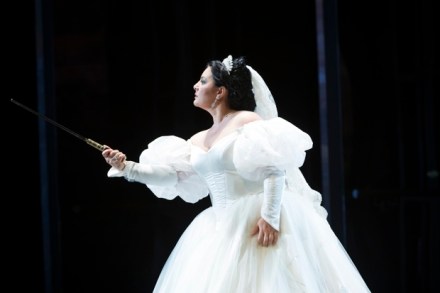
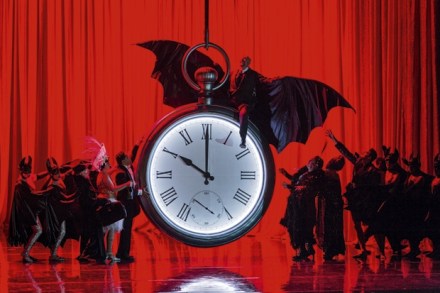
Johann Strauss’s Die Fledermaus (but if it’s given in English, why not The Bat? Does that somehow sound too unglamorous?) is not only the greatest operetta ever composed, as everyone agrees, but also, in my view, a great work, to be ranked with the finest comedies in any genre. That is, beneath its featherbrained hedonism there is a core of seriousness, conveyed as usual by Strauss in glittering music that never lets you forget that all good things come to an end, usually sooner than you expect. But that is only part of its claim to an exalted status that the term ‘operetta’ seems to deny. As in many great comedies, several of the characters spend much of the time in disguise, and sing some of their most telling music when they are pretending to be someone else.

A sensational week for opera: sensationally good and sensationally bad

It’s been a sensational week for opera in London, with a sensationally good performance of Strauss’s Elektra at the Royal Opera, and a sensationally terrible production of Fidelio at English National Opera. Charles Edwards’s production of Elektra is revived for the second time, but this is quite the finest account of it, thanks above all to the conducting of Andris Nelsons and the assumption of the title role by Christine Goerke. This opera can, and usually does, remind me of lying on the road under a deafening drill, and reinforces my admiration for the tact with which Wagner places his climaxes.

Why do people talk such nonsense when describing opera? American Lulu and Le Nozze di Figaro reviewed

Why would anyone want to adapt Berg’s Lulu, a masterpiece even if a problematic one? According to John Fulljames, who is the producer of the version of Lulu that Olga Neuwirth has come up with, ‘the Lulu plays now stand neutered within the familiar history of male authored texts which define women from a male perspective...Neuwirth turns this on its head. For the first time, Lulu is allowed to tell her own story...We [the audience] listen and watch but do nothing and so become complicit in her nightly repeated murder.’ How can people talk such nonsense?

Turandot is a disgusting opera that is beyond redemption

It’s a cynical start to the Royal Opera’s season to have this 1984 production of Puccini’s last opera Turandot. Not that a new production would improve things, whatever it was like. Turandot is an irredeemable work, a terrible end to a career that had included three indisputable masterpieces and three less evident ones, counting Il Trittico as one. Any operatic composer who gets to the stage, as Puccini had, of searching through one play or novel after another, dissatisfied with any subject he is offered, should almost certainly give up.

Did the Proms’ Billy Budd turn a mystery into a mess?

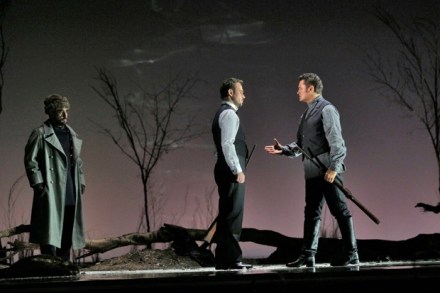
The many opera performances at the Proms this year have all been so successful, especially the Wagner series, that I hope it doesn’t require a centenary to include them in future seasons. One of the things that has made them so vivid to the audiences in the Albert Hall has been the immediacy of the contact between singers and public, despite the hall’s vast spaces. It would be nice, but vain, to think that the present breed of directors, with their concepts and conceits, might learn that the simpler the productions they mount, the more their audiences are likely to respond to the works; but the tendency in opera houses is to regard the opera as written by the librettist and composer as mere raw material to be twisted into any shape that might make it relevant and shocking.

Do I wish I’d gone to see Peter Grimes on the beach at Aldeburgh? No

With a tidal wave of Peter Grimeses about to engulf us — performances in London, Birmingham and Leeds in September alone — there is also, from 5 September, the film of the celebrated Peter Grimes on Aldeburgh Beach at more than 80 cinemas in the UK.  The film was made in June during the three live performances that occasioned ecstatic reviews from all who saw and wrote about them. I didn’t go to any of them, for rather cowardly reasons. But now, having seen the film of the occasion, do I wish I had?

Mark Elder and the Hallé surpassed any other account of Parsifal that Michael Tanner has heard

The Proms season of Wagner operas — pity they didn’t do them all; Die Meistersinger would have been specially welcome, since no one else is doing it either — concluded appropriately with Parsifal, conducted by Sir Mark Elder. The conducting at all these performances has been remarkably good, but in some respects Elder was the most striking of all. Working with his orchestra, the Hallé, he produced an account of this miraculous score which, for a combination of passion and precision, surpassed any other that I have ever heard. Without for a moment stinting on climaxes, Elder and the Hallé explored and expounded the refinements and economies of Wagner’s subtle masterpiece to a point that would have left Boulez open-mouthed with admiration.

Six hours with Stockhausen

Arriving for the world première of Stockhausen’s opera Mittwoch aus Licht (Wednesday from Light), we were greeted by the sight of two Bactrian camels, delightful and patient creatures, standing almost immobile for at least an hour while many visitors inspected them, before leaving in Joseph’s Amazing Camels coach. The one we saw later on stage was a pantomime camel, out of which, unzipped, a man stepped, after the animal had done an elaborate dance and been offered champagne. Zany and utopian, this is characteristic Stockhausen as I remember his works from the 1970s, before his long semi-eclipse, as people lost patience with his pretensions, his extreme prolixity, the tiresomeness of his childish sense of humour, the sheer datedness of what he was producing.

Tippett’s Midsummer Marriage is an opera of exuberant genius — but forget about the text

Whenever Michael Tippett’s first opera, The Midsummer Marriage, is revived, there is a chorus of voices, including mine, complaining that it should be done much more often, for it is a work of exuberant genius, full of wonderful musical invention, and life-affirming in the way that Britten’s operas never are (with, I think, the exception of Albert Herring). Yet the Prom performance, semi-staged, it was claimed, but rather less than that, did make clear, while doing justice to Tippett’s score, why Marriage is always likely to be something of an outsider.

Wagner at the Proms

It would be interesting to know why Tristan und Isolde was placed in the Proms programme in between Siegfried and Götterdämmerung. You might as well programme Othello between acts four and five of King Lear. Wagner wrote Tristan and Die Meistersinger between acts two and three of Siegfried, and to be really chic some company should have mounted the Ring and the two others in that order. But dramatically it makes no sense, and that partly accounts, I think, for the lukecool reception that the performance of Tristan has had in the press. All told, I found it one of the more striking performances I have heard of Wagner’s masterpiece in recent decades.

Is this the best Ring ever?

The first complete performance of Wagner’s Ring cycle at the Proms is already, less than a week after its conclusion, being hailed as historic and will soon be mythic, an appropriate status and designation for this amazing and amazingly great work. Even Radio 3 ‘presenters’ who have music degrees but have always quailed at the thought of anything so daunting have breathlessly confessed that it was among the very greatest musical experiences of their lives. Some of us have been saying that for quite a time, without making much impression other than that we are the members of a weird and even sinister cult. Still, better late than never.

Michael Tanner’s Glyndebourne experience is ruined by the traffic

What could be more delightful than going to Gyndebourne with someone who has never been before, arriving in time for a Figaro or Ha-Ha Tea at the Mildmay Hall, taking a stroll round the grounds, which incidentally have been considerably changed this year, and for the better (though the slightly alarming jungle near the opera house is still thriving in its sinister way), then going in for the first half of the opera, suitable exclamations from the newgoer about how enchanting it is, what wonderful sightlines, perfect temperature, and so forth, then in the long interval going to the Nether Wallop for the superb buffet, returning unbuttoned for the second half, and driving — in my case, being driven — tired but relaxed and stimulated home? That’s what one imagines.

A formidable cast for Covent Garden’s Capriccio

Richard Strauss’s operatic swansong Capriccio made an elegant and untaxing conclusion to the Royal Opera’s season. It was done in concert, but there was a fair amount of acting, more from some of the participants than others. Renée Fleming as the Countess, who feels she has to choose between a poet and a composer, wrung her hands, strode around as much as her fabulous silver and black gown allowed, and in the final scene smote her brow in best distraught Joan Crawford manner; the others huffed and flounced and strode off into the wings, and there was, as much as there can be in this strange opera, a sense of people interacting rather than just singers doing their thing.

Opera review: Longborough’s tiny stage takes on the Ring – and wins

There are no two ways about it: Wagner’s Ring cycle, the biggest challenge that any opera company can face, has been mounted with triumphant success in Longborough, and now presumably has been laid to rest. Nine years ago, at the Cambridge Arts Theatre, I saw the first attempt to stage it, in Jonathan Dove’s drastically cut version, and with skeletonic orchestration, and though there was some decent singing, on the whole I was unimpressed.