Music

British choirs can’t match up to those from abroad

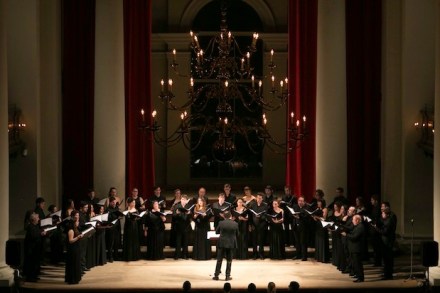
To curate a festival these days is to put oneself in the firing line. There is every chance that all one will earn is the charge of stirring up apathy. It is a risk; and there will be no knowing how it has gone until it is much too late to withdraw gracefully. In the recently concluded first edition of the London International A Cappella Choral Competition, held at St John’s Smith Square, it could have gone either way. What will stick in my mind is how the wind got behind it round about day three, so that by the end a packed house could go mad at a Spanish victory.
In the mood for Parsifal, my Passiontide fare

This week, I have been mostly listening to Parsifal. Not the St Matthew Passion, which is my usual Passiontide fare. And, boy, it’s been quite an experience. You have to be in the mood for the Bach, but for the Wagner you really have to be in the mood. Parsifal is nearly five hours long. I’m reluctant to say that not a lot happens, because it’s a story of overpowering philosophical transformation. But, alas, no two commentators agree on the nature of that transformation and, unlike the Ring Cycle,  it doesn’t offer many plot twists by way of distraction. The knights who guard the Holy Grail, the chalice of the Last Supper, have lost their second most precious possession, the lance that pierced Christ’s side.

Pop has become a conservative art form and an old man’s game

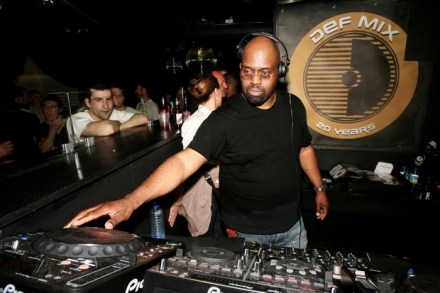
It is coming to something when relatively young pop stars die not of drugs or misadventure but, essentially, of old age and decay. Frankie Knuckles, the house DJ and producer, breathed his last recently at the age of just 59, and several ageing ex-clubbers of my acquaintance told me that it was the end of an era. But it always seems to be the end of an era these days, and very rarely the beginning of one. We read that the New Musical Express, that inky irritant to generations of music lovers who bought it every week even if they disagreed with every word it printed, now sells about three copies a week and is in danger of going under.

The mean, bullying maestro is extinct – or should be

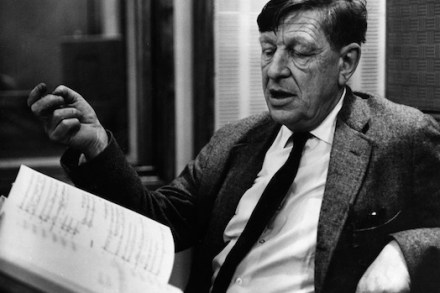
W.H.Auden once wrote: ‘Real artists are not nice people. All their best feelings go into their work and life has the residue’ — which puts those who aspire to be artists in a bit of a quandary. Is it a measure of one’s success as a ‘real artist’ that one is not a nice person? Is it in fact possible to be a real artist and a nice person? And, if it is not, is it better to be a real artist or a nice person? Auden, who was speaking from first-hand experience, implies that it must be one or the other. By the time he wrote this, Auden was sure of his standing both as an artist and as a person. His friends might say that he was a nicer person than he thought he was, but no one was going to say he was not a great artist.

Menuhin is the world’s toughest violin competition. Why is it packed with Asians, and no Brits?

‘The truth is,’ says Gordon Back, lowering his voice, ‘that if the violin finalists from the BBC Young Musician of the Year were to enter the Menuhin Competition, they wouldn’t make it to the first round.’ Not through the first round, note, but to the first round: they wouldn’t be good enough to compete. Back is artistic director of the Menuhin, held every two years in a different country. In effect, it’s a search for the next Yehudi Menuhin, who recorded the Elgar concerto with the composer at the age of 15. Some critics think Menuhin never quite fulfilled that astonishing early promise — but I wouldn’t dare suggest that to Gordon Back.

Addicted to Vole

Earworm: what a wonderful word. It describes, as nothing else quite can, the effect a really invasive melody can have on your consciousness. Hear the song once and you will hear it again and again, on a loop in your brain. At the pub quiz the other night, the answer to a question was Brotherhood of Man, and at least two of us subsequently suffered the torture of hearing ‘Save Your Kisses For Me’ in our heads for the rest of the evening. I don’t usually think of myself as Drinking To Forget, but this evening might have been an exception. So are people who love pop music more susceptible to earworms, or are people who are susceptible to earworms more likely to love pop music?

Less subsidy means better music

One of the unlooked-for side effects of the financial crisis has been what might be called the desocialising of music funding. Whereas once many arts organisations could expect to survive solely on public money, just recently there has been an almost unseemly rush to tap private sources of cash. The time lag between the original catastrophe and the realisation that oblivion may be just round the corner is probably explained by the disinclination of politicians to dump high-profile organisations overnight. But now, finally, there is no escape. Philanthropists the world over are besieged.

Are hymns dying? 

I love a good hymn, so long as I’m not expected to sing it. Lusty declarations of faith sound ridiculous coming out of my mouth and embarrass the hell out of me, so I pretend that I’ve forgotten to pick up a hymnbook on my way in. If someone shoots me an accusatory glance, then I move my lips like John Redwood singing the Welsh national anthem. (Talking of whom, has it dawned on the jolly self-important Dr Redwood, former Fellow of All Souls, director of Rothschild’s, cabinet minister, etc., that one day he’ll be remembered only for that delicious video clip?) The earliest Christian hymns were chanted — but when we talk about a ‘hymn’ in everyday speech we mean a harmonised sacred song in which every verse uses the same melody.

Prefab Sprout’s comeback gives hope to the over-50s

Every musical career has its own narrative, and most of them include at least one comeback. To come back, you first have to go away; then you have to stay away; and finally, when everyone has forgotten your name, you wander nonchalantly back under the arc-lights and wave modestly to screaming fans and waiting reporters. Well, that’s the plan, anyway. As has been discussed here before, the gaps between record releases for all but the most irresponsibly prolific artists have become so wide that simply making another album becomes a comeback in itself. Thus has the currency of the comeback been devalued. Sometimes it feels as though there’s a different one every day. A few of them could usefully have stayed away a little longer.

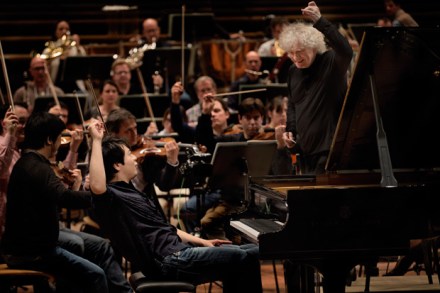
How Claudio Abbado bridged old and new

Not long ago the great conductors of classical music were general practitioners. They expected to give satisfactory interpretations of music written from the beginnings of symphonic composition to the present day, and audiences took it for granted that, if they knew what they were doing with Mozart and Beethoven, they could be trusted with Handel and Stravinsky. Their orchestras adopted the same approach and, within a narrow definition that bespeaks a more innocent age, everyone was content.

Goodbye, Claudio Abbado. You helped us glimpse eternity

Fellini’s credo ‘the visionary is the only true realist’ could also be applied to the life of Claudio Abbado, who died earlier this week in Bologna at the age of 80. It would be wrong to think of Abbado as a dreamer, for conducting at the angelic heights to which he ascended is a matter of serious thought, but he had the gift, rarer than is commonly supposed, of liberating musicians. Being liberated, they gave performances of such beauty and emotional power that those who heard them will consider their lives enriched; in many cases transformed.

I know how to cure my music addiction

About 30 years ago, not long before he died, my father bought an LP of Sir Clifford Curzon playing Schubert’s last piano sonata, in B flat D960. He was slightly defensive about the purchase. You see, he already had a record of Alfred Brendel playing the same piece. ‘It’s a bit of an extravagance,’ he said, ‘but I think in this case it’s worth it.’ Of course it was worth it! First, the B flat sonata touches the sublime in almost every bar. I was so lucky that, thanks to my father’s impeccable taste, it was one of the first pieces of classical music I got to know after we bought our first stereo in the early 1970s.

All I want next Christmas is new Christmas songs 

Three months until spring. Four months until the start of the cricket season. And only nine months until the radio starts playing ‘Merry Xmas Everybody’ again. Or have you heard enough of Christmas songs by now? Many of us had heard enough of them by Christmas 1988. Every October they return. The first strains of Shakin’ Stevens emerging tentatively from high street shops. Shane MacGowan and Kirsty MacColl, still bickering. Greg Lake, possibly alone now in believing in Father Christmas. Roy Wood’s enormous beard, wishing it could be Christmas every day. And for three months of every year his wish is granted. Millions of Britons suffer the consequences.

Lang Lang: You can’t compare Bach and Schoenberg, or Justin Timberlake and The Beatles

As Lang Lang walked from the stage at the Royal Albert Hall in November, a little girl emerged from the audience to embrace him. It was a disarming moment that seemed to symbolise the impact of the 31-year-old Chinese pianist. He has rock star appeal. And then, for Lang Lang, the end was the beginning. Following three Mozart piano sonatas and four Chopin Ballades, he played six encores. After the third or fourth, he asked us, ‘Shall we keep going or shall we go home?’ A Cuban dance, a Chinese piece...When he finally finished with an explosion of Scriabin, thousands rose to their feet in recognition of his virtuosity. I joined them, despite having been disappointed by his Mozart.

Could this be the year of C.P.E. Bach?

Looking through the list of composers who celebrate some sort of anniversary in 2014 is a depressing business. I don’t think I have ever seen such an anonymous collection of small-time nobodies, and yet for them to appear on a list at all suggests that they did something of note, and that someone has heard of it. The only really big name to qualify is that of Richard Strauss, who was born 150 years ago. Often half-centenaries seem a little forced, not worth the fuss; nonetheless I anticipate there being some fuss about this one, since the cupboard is so bare.

Music to listen to when you’ve broken up with a precious friend

Beethoven’s Hammerklavier Sonata is thrilling and brain-twisting. Its nickname derives from the fact that it was published as a sonata ‘for the hammer-action keyboard’, which just means a piano. But the notion of hammering suits this work. It’s his longest sonata — a late one, No. 29 in B flat, Op. 106 — and a mighty piece of machinery. I’ve been listening to it for 40 years and I’m not even close to grasping its details. It’s far more of a mental puzzle than the sublime last trio of sonatas, Opp. 109–111, whose construction is less tortuous. The Hammerklavier has been in and out of my CD player a lot recently, for two reasons. I’ll explain later.

Albums of the year? Some years we can answer it, some years we can’t 

Albums of the year? What a good question. Some years we can answer it, some years we can’t. The essence of pop music is its newness, its absolute determination to upgrade itself and keep on upgrading itself, often beyond anyone’s interest in its upgrading itself. Accordingly, there are some years when the paid-up music obsessive has to retrench and consolidate and — quite simply — stop buying new records until he can find somewhere to put them. I only bought about 25 new CDs this year, of which only five or so were new-new-new. As yet, none of them has really come through. But there’s time. There’s tomorrow, there’s next week, and there’s the rest of my life to get the most out of the David Bowie album.

The splendour of the English carol

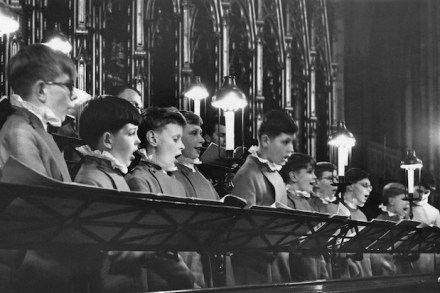
The most celebrated Christmas carol, ‘Silent Night’, belongs to Austria. Father Joseph Mohr, the priest at Oberndorf, a small village near Salzburg, wrote it in 1818. Set to music by Franz Xaver Gruber, it was sung on Christmas Eve at the church of St Nicholas: Stille Nacht, heilige Nacht. It is the most celebrated carol for it captures the stillness of a winter night, the wonder of Christ’s birth, and the hope of all mankind for peace. But when it comes to the celebration of that birth nothing surpasses the English tradition. On Christmas Eve millions of people all over the world will tune in not to Oberndorf but to King’s College, Cambridge, where the choristers take us, as they have since 1918, through the Festival of Nine Lessons and Carols.

A century before Miley Cyrus, it was male performers — like Nijinsky — who bared all 

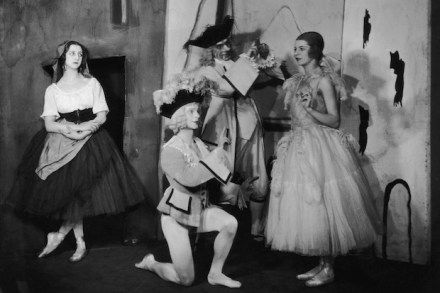
While the airwaves resonate with celebrations of Britten’s birth, I cannot help thinking that what was happening in Paris at that very moment was light-years away, not only from Lowestoft, but also from London. The cultural distance between the two metropolises can never have been greater than it was in 1913, and one can only imagine what Lowestoft was like then. The Britten family home, where Benjamin was born, is still standing, but it gives few clues to the life the family lived — inevitably restricted not only by location but also by lack of money. His father had once had the dream of becoming a gentleman farmer, but in the end had to settle for being a dentist. Cut to Paris, where the most glamorous if not notorious episode in the history of classical music was unfolding.

Peter Phillips: I saw the other side of John Taverner

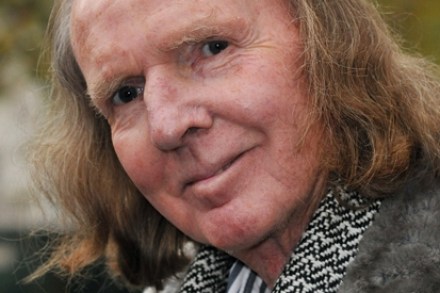
When I first met John Tavener in 1977, he was still largely known for his dramatic cantata The Whale, which had been performed at the Proms in 1969. By then both John and his Whale had acquired considerable glitter, partly by having the veteran newscaster Alvar Lidell associated with it, and partly through its eventual connection with the Beatles, who had issued it on their Apple label in 1970. He never wrote anything quite like it again, though one notices that even this early and iconoclastic piece is based on the bible. I always wondered what his now famous religious sense really consisted of. I never fully bought the unsmiling preacher, which became his public persona in later life, since in private he was never like that.