Low life

Bidding a fond, and drunken, farewell to the awe-inspiring Mark Amory

Rubbing shoulders with political suits on the pavement outside the Westminster Arms, I drank two pints of Spitfire. Pump primed, I strolled the 50 quaint yards along Old Queen Street and entered the Spectator offices through the open door of number 22.  An elderly chap on his way out said, ‘You’ve missed the speeches.’ I said, ‘Is all of literary London in there?’ ‘I wouldn’t know about that,’ he said huffily. I went downstairs to the party and grabbed a ready-poured gin and tonic from the drinks table of one’s dreams.
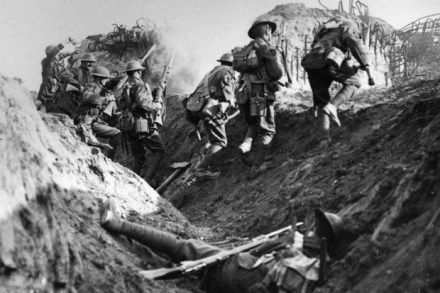
‘My boy was my all’: letters from a bereaved mother to a Somme widow

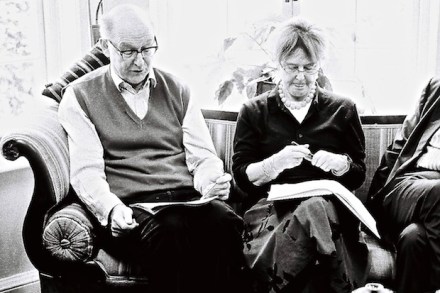
My maternal grandmother (née Clarke) had six brothers, all keen poker players. All six volunteered to fight in the Great War, and only one, Sergeant Herbert Clarke, of B Company, 10th Battalion, Royal Fusiliers, failed to return to civilian life afterwards. He was blown up by a shell during the second week of the Battle of the Somme. Shortly before the shell got him, Herbert had taken some leave and married his sweetheart, Dolly. Dolly never got over him. Just before she died, she passed on Herbert’s army papers and tiny, secretly kept diary to my aunt.

Hello trees, hello sky, hello armoured riot police

What a beautiful day, I thought, as I nodded to the porter in the bowler hat and stepped out of the Westminster hotel into October sun and wind, with a dramatic, fast-forwarding sky overhead, and the dry crackle of leaves underfoot. Lovely London. Solid, masculine, powerful, exciting London. Beautiful London. Outside Westminster Abbey the pavements were thronged with tourists pointing their cameras and smartphones at anything and everything, from the traffic cops to the decorative spikes on the railings. Pret à Manger was packed with riot police in full battledress queueing nicely for their mid-morning caffeine fix. I crossed over the road into Parliament Square and passed a statue of what looked like a black troll.

The karmic rewards of becoming a vegetarian

 ‘Is that you, Sister?’ It was Tom misdialling again with those thick, stubby fingers of his. ‘No, it’s me: Jerry,’ I said. I held the phone away from my ear as he whooped and yelled his love and overjoyed greetings. Tom, unfortunately, is going to hell on a poker. No one has seen him sober or straight for months. Mention his name to any local personality who is proud of being a reprobate and they go all prissy on you. ‘He’ll be dead in a year the way he’s going,’ they’ll say, shaking their heads. Or it’s, ‘Someone needs to have a serious word with that guy.’ Tom is another of Sharon’s exes. He was the one after me.

Karl Miller called me his ‘great white hope’. I failed him, of course

As I think I said in this column the other week, I used to sneak into English lectures at University College London, while officially studying at the School of Oriental and African Studies round the corner. I attended these lectures with such keenness and regularity that an English student called John Bradley, who now writes sometimes on Middle Eastern politics for this paper, one day asked me to contribute to the London Review — a UCL student literary magazine. I chose to review a handbook of ferret husbandry by the artisan hunter D. Brian Plummer, who was my favourite writer at the time. I’d never written anything other than school or college essays before, let alone had anything printed.

Chatting up Katherine Mansfield

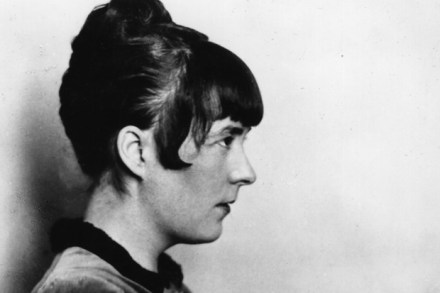
I like the New Zealand writer Katherine Mansfield, who according to Virginia Woolf smelt like a civet cat and had a hard, cheap face, and who was the only contemporary writer of whom she was remotely jealous. I like her writing and I like what I read about her short life. I’m not saying she was a great writer. I’m only saying that my imagination finds her writing voice oddly congenial. It strikes it as supremely impersonal, poker-faced and tart, with a quietly powerful undertow of sexual recklessness. But that might be just me. Funny things, writers’ voices. I suppose we meet them halfway and we either embrace them or we don’t. Kathleen Mansfield Beauchamp and I embraced.

A visit to a drugs den above a fishmongers with Miss South America

‘Stand outside the fishmongers in 20 minutes and call this number,’ she said, ‘and I can arrange it.’ On Saturday evening I was scrubbed up for a big night out. I was wearing a black jacket and black jeans, which is overdressed for a night out in this seaside town. But Jupiter, said Shelley von Strunckel, was making a spectacular conjunction with Uranus, my ruler, lending me enormous powers of attraction. So I thought I might as well dress up for the occasion. After 20 minutes, I stood outside the fishmongers and called the number.

A game of dominoes turns ugly

I’m round at Amy and Bill’s for Sunday afternoon tea. Amy and Bill are my in-laws, kind of. When I was courting their daughter, I used to spend most of my spare time sitting around Amy and Bill’s kitchen table. She was 15 when I started going round there, I was 26, and I suppose if I were an old TV entertainer or disc jockey, I should be tidying up my affairs before officers from Operation Yewtree beat a lively tattoo on my front door. But Amy and Bill welcomed me in to their family from the start. If they had an objection to my courting their daughter, it was to my social class rather than her age. I can remember Bill grumbling that he would have preferred that his daughter went out with someone of her own class, which I suppose is rural working class.

The bump in the night that changed my mind about pygmies

Music of the Forest on Radio 4 last week was a profile of the anthropologist Colin Turnbull, 1924–1994, who achieved celebrity with his book The Forest People: A Study of the Pygmies of the Congo (1961), which presented such an inspiring vision of a prelapsarian, non-violent, egalitarian society that it became a cult classic of the counterculture. Turnbull appeared to have stumbled on an ideal and idyllic society, proving Hobbes wrong. The life of a pygmy, by this account, was very far from being ‘nasty, brutish and short’. (Or ‘nasty, British and short’ as academics are fond of saying.) What gave his pygmies the advantage over other primitive peoples, said Turnbull, is that they weren’t in thrall to the spirit world. They fear no evil.

An undergraduate anorak at 32

When I was 32, tired at last, for the moment anyway, of seizing the day, I stopped drinking and gave up smoking and enrolled for two A-levels in one year at the local technical college. My decision coincided with a state decision to expand the middle class and I was awarded a small government grant. I found I was ripe for study, passed both exams with good grades and applied to Hertford College, Oxford, to read English. The choice of college was specifically and perhaps idiotically based on a romantic obsession with Evelyn Waugh’s life and work.

Glazed tiles, a barred window: it must be another morning in a police cell

In my late twenties, it was not unusual for me to wake up in a police cell wearing a paper suit. Waking to glazed tiles and a high barred window, and not knowing how one got there, is a bad way to start the day. On this particular occasion, I opened my eyes and pieced together that the party in the nurses’ home had gone on all night, that I had continued to drink, and that I had then gone to a football match. The last thing I remembered clearly was standing on the terrace drinking cider and vodka out of a vodka bottle. (My pals told me later that two St John Ambulance guys had carried me out of the ground on a stretcher.) At that time I was a trainee psychiatric nurse. Booze at the social club in the hospital grounds was cheap, and the nurses were a hard-drinking crowd.

What I learned working in the lunatic asylum

In 1984 I was 27. Since leaving school I had done unskilled manual labour, when I could get any. Then l worked as a nursing assistant and then a trainee nurse in an 840-bed psychiatric hospital at Goodmayes in Essex, formerly the West Ham Lunatic Asylum. It was like a walled town. I ate, slept and socialised in there and became institutionalised and a bit mad, I believe. In ordinary life, among relatively sane people, one becomes fairly confident about the parameters of so-called normal human behaviour. They are narrow parameters, and all the time getting narrower, I think. But if you live in a large mental hospital, these parameters widen drastically, or even disappear altogether.

A road trip in the company of Long John Silver and an exciting pair of thighs

I live in south Devon. Last week I went up to north Devon, to visit a friend who was renting a cottage on the coast for a week. Devon is a big county. I decided to go by train to Barnstaple and then by bus. At Exeter the train caught fire, however, and we were herded off and packed into an old charabanc that could barely get up the steep Exmoor hills. At Barnstaple, finally, I waited at stand J of the austere bus station. Punctually, a minibus drew up and six of us climbed on: a blond lad with airline tags on his backpack; a man-mountain in a baggy suit carrying a guitar case; a middle-class woman who greeted the driver with genial condescension; a pair of teenage lovers, she showing as much as possible of an exciting pair of thighs; and me.

I might have no testosterone but I do have a Fiat Barchetta

I’ve might have no testosterone. (My production is currently being stopped by injection once every three months.) But what I do have is a Fiat Barchetta, bought for a grand on a whim on eBay. It’s the prettiest little two-seater, an old-school, fun drive, with a lot of growl and it makes people smile. Left-hand drive. I’ve had it a month and so far I have yet to see another on the road. The one obvious change thus far in my testosterone-free personality is my taste in music. I’ve gone from liking aggressive stuff like ZZ Top and AC/DC to preferring soppy Nick Drake and Joni Mitchell. The theme from Out of Africa. Gentler stuff. Triteness. I love you-oo. Also tabernacle choirs. Even folk.

The indiscreet charm of Jim Davidson

Le tout Torquay was there, cramming into the Princess Theatre with a drink in each hand ten minutes after the show had begun. I pressed in among them. Jim Davidson, in a black shirt, a baggy old pair of jeans and business shoes, was already onstage introducing his show and bantering with people in the front row. ‘What’s the matter with you in the wheelchair, love?’ he said, cupping his ear at her. She was blind, she said. ‘Then what the fuck are you doing right down here at the front?’ (Laughter.) ‘Can you see anything at all, love?’ She couldn’t, she said. ‘Well, just to give you an idea,’ he said, vainly smoothing his hair, ‘I look a lot like Brad Pitt.’ (Laughter.

My grandson’s Great Leap Forward

‘Oscar!’ cried Miss Herd as I arrived. She was standing at the classroom door releasing her charges one by one as the parent, or in my case the grandparent, arrived to escort them safely back to their respective homes. Oscar came solemnly out in his navy Academy sweatshirt carrying his red Fireman Sam lunchbox and placed his four-year-old hand in his grandfather’s 57-year-old one. We headed off to the car. ‘Did Tom play with you today?’ I said. Tom, by all reports, is omnipotent and capricious in his choice of playmates. ‘No,’ said Oscar tragically. I was standing in on the school run for Daddy, who had to work an extra 12-hour shift at the care home unexpectedly. Oscar lives with Daddy and goes to stay with Mummy at the weekends.

I am walking to the Spectator party — sober, clean and in all my finery

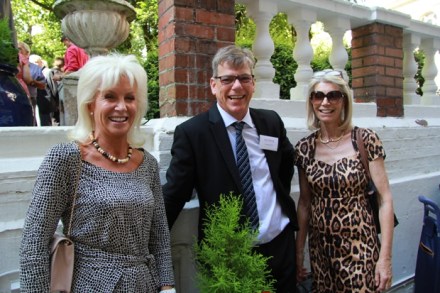
They do love a party at The Spectator. I was invited to four in ten days last week: the Apollo Summer party, the Spectator ‘At Home’ Summer party, the annual Spectator ‘Meet the Readers’ afternoon tea party, and our Spectator arts editor, the great Liz Anderson’s farewell party. I hadn’t been up to town this year, and on the train journey up from Devon, I felt like a hick up from the sticks. But I love London and I had that same old heart-lift as I stepped down from the train under the great iron roof of Paddington station, then passed along the platform beneath that giant unkempt simpleton representing the Great Western Railway employees who fell in the first world war. But my favourite arriving-in-London moment was yet to come.

Honesty, simplicity, integrity: not what I want the morning after

Tap tap tap at the door. I opened my eyes. ‘Check-out 10.30,’ said a neutral or possibly slightly hostile female voice on the other side of the door. I looked at my phone. As I looked, the clock changed from 10.29 to 10.30. Then I heard what I perceived to be the irritated rustling of a large plastic bag and receding carpeted footfalls. This wasn’t a hotel as such. It was a ‘club’ into which non-members like myself are welcomed and charged slightly more than members. I’d chosen it because it was called the Penn club, and it was in Bloomsbury, and I’d seen it advertised in the Times Literary Supplement, and, being densely stupid, or romantic, or both, I had imagined it to be some sort of a writer’s club.

A circle of love with Brown Eagle Feather

‘I’m wasted,’ said Trev, meaning not that his life is futile, but that his mind was overwhelmed by illegal drugs. He conceded it. It wasn’t often that drugs ruined him, but tonight they had, and credit where credit’s due. We were a disparate post-pub gathering of about a dozen people. At a push you might call it a party. The house was small, the party confined to a brightly lit kitchen and a square, semi-dark living room. Everyone bar me was in the kitchen doing this, that and the other. I was standing in the darkness of the living room listening to Hawkwind on the CD player and thinking that surely they were the greatest band in the world, ever. Then Trev came in from the kitchen with this latest report on the state of his mind.

My night in a room haunted by falling cannonballs

On Saturday night I went to Charlie’s 69th birthday party. What a gaff he’s got. The rather snooty description of the Grade II listing sums the place up as ‘a slightly provincial but nonetheless interesting example of an early to mid 18th-century gentleman’s house which has a remarkably complete interior and has not suffered from any extreme 20th-century modernisation’. The writer is quite correct: inside the house, apart from the telly and the odd iPad lying about, George I might still be on the throne, poaching a capital offence, and John Wesley fervently preaching to multitudes in a field just outside the parish bounds. You can look out of any window and the views are the same as then, too.