Low life

Low life | 9 April 2015

Spectator Life’s third birthday party was a glamorous affair. It had paps, pop stars and Pippa. One went in and waiting at the top of the stairs were Spectator Life’s editor and deputy editor, super-dazzlers both, offering their cheeks to be kissed. We drank Bellinis. There is a new economic theory which claims that people often act more irrationally than economists in particular imagine. One of its key terms is ‘discounting the future’, which is another way of saying that in certain circumstances people often behave as if there were no tomorrow. The Spectator Life birthday party was a bit like that. Speaking for myself, I discounted the future so comprehensively that it was a case of Everything Must Go.


One day the Condor and the Eagle will fly wing-tip to wing-tip

The pub was disappointingly empty, so I took my first pint of the evening upstairs, where some sort of New Age society was holding a public talk and discussion. I gave the woman seated just inside the meeting room my £5 entry fee and found a spare seat at the back next to a big bloke with a beard. In the five minutes or so before the talk began, I counted 47 other people in the room, all of them white. Five chaps had advanced male pattern baldness, another had very obviously dyed hair (black). The total number of beards was six, including a goatee. Average age, at a guess, was 50. About ten people were over 70. Only three people had chanced a check or patterned jumper, dress or top; the rest wore plain — boring shades of brown mainly. Only one person was morbidly obese.

Football in front, infibulation behind

I’m watching Manchester City being taken to the cleaners by Barcelona on the telly, while at the table behind me my Parisian feminist intellectual hostess Natalie is discussing female genital mutilation with her Malian girlfriend Fatou. Football in front, infibulation behind. Fatou: ‘It goes without saying: how can you say that female genital mutilation is not a disgusting and barbaric practice? How, in this day and age, can a woman allow herself to be oppressed in this medieval fashion? The practice is pure evil. The suffering of those little girls is impossible to imagine: infections, gangrene, septicaemia, cysts, fistulae, perpetual bleeding. And in the name of what? It is not a Koranic law. But you know what? I don’t care if it isn’t or if it is.

My afternoon in a Gallic version of Betfred

For the Cheltenham Festival I received the customary tipster circular from my pal Soapy Joe. Soapy’s most convincing credential as a horse-racing tipster is that he is banned from every high street bookmaker in the land because he takes too much money off the poor souls. I slept with him once. I woke up in an upstairs bedroom of a Gloucestershire stately home on the second morning of our week-long Cheltenham Festival house party, pieced together where I was, and why, and saw, sitting up in the next bed, Soapy in his stripy pyjamas listening to the commentary of a horse race in Dubai or somewhere on a pocket radio. ‘Good morning, Soapy,’ I said. ‘How did you get on yesterday by the way?

Lunch with Max Beerbohm’s brother’s grandson

It’s a silly, chippy complex, I know, but I often feel, on the rare occasions that I am induced to attend a lunch or dinner party, that I don’t belong. This truth or delusion occasionally overwhelms me and I sit there, paralysed, unhappy and silent. It’s a pity. Today we were six for Sunday lunch and so far — apart from knocking over the coatstand, twice, during what one would have thought to be the simple act of hanging a jacket on one of the hooks, and breaking it in two — so good.

Mahler’s Fifth is the perfect soundtrack to a tooth extraction

Frantic chewing of sugar-coated nicotine gum had caused my left lower molar to go irretrievably rotten, and the dentist finally extracted it after a prolonged and heroic struggle. Mahler’s Symphony No. 5 in C-sharp minor was playing in the background and the extraordinary thing was that from start to finish the music exactly mirrored the vicissitudes of his battle to pull the tooth out. While we waited for the anaesthetic to take effect the music was gently soporific. As he applied his pliers to the tooth and carefully loosened it, the mood darkened and built to a turbulent climax until I gestured with an unhappy hand signal that I could feel the roots twisting in a place that the anaesthetic had yet to reach.

The day an ancient and very wonderful sport died

Last week was the tenth anniversary of the last running of the English hare-coursing classic, the Waterloo Cup. I shan’t start raving on about the perversity of banning a so-called blood sport in which the death of the hare, should it happen, is seen as a failure. Suffice to say that in the last season of legal coursing under English Coursing Club rules, 160 hares were registered as killed — one in nine hares coursed. Three months after the Hunting Act had come into force, 8,000 conserved hares on ten coursing grounds had been shot, including 3,500 on the coursing grounds of the Swaffham Coursing Society (founded in 1776) alone. In 1997 I was sent up to Great Altcar in Lancashire to report on the Waterloo Cup for a newspaper.

This shower head should come with a health warning

This hotel is brand new. One half is a university students’ hostel, the other an apartment hotel. Car parking is ample and free of charge. The students we saw coming and going from the lobby were easily our social superiors. The check-in guy was clean and polite, and without being asked supplied us with a free map of the town centre and marked our position with a biro cross. Although a functionary, this man was also our social superior. ‘Are you here for business or pleasure, madam?’ he asked my companion.

My grandson’s getting into the rugby: ‘Which one’s West Ham?’

My grandson and I had a lovely hour-long swim at the leisure centre. We had the learner pool to ourselves for the first half an hour, during which we threw and dived for our little weighted plastic sharks. Then a stocky man, tattooed like a Maori, and his little boy entered the pool. The little boy, Conrad, was in the same primary-school class as Oscar, so they teamed up and went away with the fairies together. They played a game in which they took turns to stand rigidly to attention at the pool’s edge, then topple forward, still rigid, face-down into the water. Result: eye-watering belly flops that weren’t as painful as they looked, they said. Their belly-flop game released Conrad’s father and me from our duties as entertainment managers.

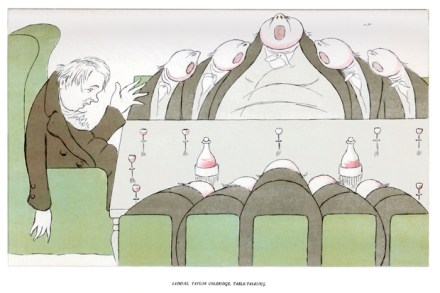
My initiation into the fellowship of wine (I swallowed)

This month’s wine club lecture was on red burgundy. The members were settling themselves at two large tables when I arrived, about ten to each one. I took an empty seat at the table farthest from the door and looked diffidently around, hoping to meet a welcoming eye. Not one. Presumably members were tired of sharing the mysteries of their deity with people who came only once, and they had evolved a wait-and-see policy. Everyone had brought their own wine glass. There were glasses of every size and shape. Most had a notebook and biro also at the ready. The woman sitting directly opposite me now spoke to me accusingly. ‘Where’s your glass?’ she said. I shrugged at her. ‘Didn’t you read the flier? It clearly says to bring a glass and knife.

The risks of being an Englishman on Burns Night

I’m rubbish at public speaking and detest it. Even the thought of reciting an English poem of my choice at a Burns Night Supper cast a long shadow beforehand, in spite of the strong probability that everyone at the table would be blootered when the time came for me to get to my feet. A further problem was: which poem should an Englishman choose to read at a celebration of Scottishness, if not of Scottish nationalism? Should it perhaps be an English riposte? Or would something amiable and irrelevant be more politic? A comic poem maybe? A comic poem in a comic dialect? Lewis Carroll? ‘’Twas brillig’, and so on?

Twelve miles of indefatigable misery

The taxi-driver wound his window one third of the way down and put a priestlike, confessional ear to the freezing night air. I spoke the name of my village. Twelve miles. Twenty minutes. Forty quid normally, including tip. A decent fare, considering that the vast majority waiting at this railway-station cab rank require only the short ride into town. And yet an agonised grimace contorted his miserable, flabby, unshaved face. After an omnipotent pause, however, it nodded gloomy assent and I walked around the bonnet of the 12-year-old Mondeo and climbed into the passenger seat. ‘Busy?’ I said when we were in motion, to start the conversational ball rolling.

My addiction to literary pilgrimage is akin to masturbation

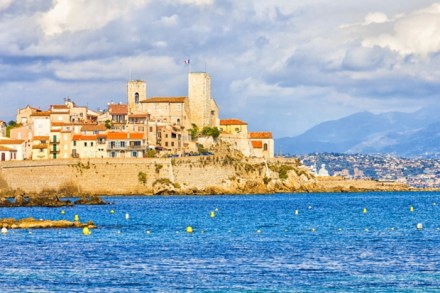
The hotel and its bright tan prayer rug of a beach were one. In the early morning the distant image of Cannes, the pink and cream of old fortifications, the purple Alp that bounded Italy, were cast across the water and lay quivering in the ripples and rings sent up by sea-plants through the clear shallows. Recognise it? F. Scott Fitzgerald’s Tender is the Night. First page. Hollywood starlet Rosemary Hoyt and her mentoring mother take ground-floor rooms at a quiet beachside Antibes hotel. Rosemary wanders out and on to the aforementioned beach, takes off her bathing robe, wades into a ‘blue as laundry water’ sea, then ‘laid her face on the water and swam a choppy four-beat crawl out to the raft’.

The joys of home and hearth and hot lemon

Over Christmas and New Year I was rotten with flu and didn’t go out once. I stayed soberly at home beside the fire with the family and enjoyed every minute. The first time I ventured out, still feeling ropy, was on Saturday morning for a look around the shops. As I came out of Superdrug, I met Sasha. She was wrapped up warmly against the cold, except for her bosoms, which were recklessly exposed and showcased by a black, lacy push ’em up and point ’em out bra. We hadn’t seen each other for months and we warmly embraced. ‘Drink?’ I said. ‘Ship?’ Sasha had lost her purse again, she said, and was retracing her steps in the high street; but yes, marvellous, sauvignon blanc, dry, large one.

That’s another year gone and, against the odds, I’m still here

A fruity voice on the train’s announcement system said, ‘Ladies and gentlemen, make sure you have all your belongings, family members and what have you with you when alighting from the train. We are now arriving in the naughty little station of Newton Abbot.’ This carriage was empty. The Teign estuary sparkled in the Sunday morning sunshine. The line from Totnes in Devon to Paddington is a lovely journey at any time of the year across the farms and pastures green of Devon, Somerset, Wiltshire and Berkshire.

Forgive us our Christmases as we forgive those who Christmas against us

After lunch on Christmas Day my father always stood at the sink in his apron and yellow Marigolds and did the washing-up. Rolling up his shirtsleeves the gentleman’s way, as he claimed it was, with two turns maximum to just below the elbow, he couldn’t wait to get started. I can see him now, paper hat, suds up his arms. However, the underlying and perhaps most pressing reason for his doing the washing-up all afternoon was that he was a furtive drinker. When my father courted my mother, he led her to believe that he was a non-smoking, teetotalling Christian believer, when in truth he was the exact opposite of those three ideals; and though a long one, their marriage essentially foundered on the rocks of those discrepancies.

The best thing about travel-writing gigs is meeting other hacks

The thing I enjoy most about travel-writing gigs is meeting other hacks. Hacks are almost invariably fun, funny, gossipy, irreverent, and they like a drink. They are well read and intelligent, but like to conceal it. They know and understand the lineaments of power as well as politicians, only they think it’s funny. On multi-hack travel gigs you can tell whether there is a drain or a nutcase in the squad during the introductions in the Heathrow departures lounge. In this case we could safely sound the ‘all-clear’. The line-up consisted of a man from the Daily Mail, a woman from the Daily Telegraph, a woman from the Sunday Times and myself. In his 50 years, the Mail man has so far visited 134 countries, mostly as an independent traveller.

The criteria for admittance to a Maldivian cemetery

Moofushi, Maldives   We clambered aboard a dhoni, the sturdy wooden boat that the Maldivians use for getting about the islands, and motored across from our high-end ‘all-inclusive’ resort to a ‘traditional’ island village for a guided tour. Maldivians are devout Muslims and it was suggested to us that we dress modestly and behave respectfully when there. Our guide was Mohamed, a self-confident 22-year-old fisherman. ‘Ask me anything. I know everything,’ he said. His village was called Himandhoo. According to Mohamed, it means ‘fishing village’. He led us first to the village school. The writing on the classroom walls was Thaana, a peculiar script resembling a cross between shorthand and Arabic.

‘Are you going out tonight, Frasier? If you are, don’t leave without me’

An hour earlier I had stepped off a plane from Dublin and I was three-quarters deaf in one ear. I had a drink in the bar at Boisdales Canary Wharf and a gander at the seating plan. Fourteen to a table. I was on table 18. I went up the stairs. Only one person was already in place: a poised woman wearing a three-string pearl necklace. Everyone else must have been finishing their cigars on the terrace. My name card placed me beside her. I put my complimentary five-pack of hand-rolled cigars on the table, plonked myself down, and said, ‘Hallo, I’m Jeremy.’ ‘Jean. Jean Trumpington,’ she said. ‘Do you smoke cigars, Jean?’ I said. ‘The last time I smoked a cigar was behind a cowshed in East Kent,’ she said.

I nearly went lost my mind in southern Spain on the trail of Gerald Brenan

Another writer I once liked very much is Gerald Brenan. Brenan served with distinction in the first world war and afterwards carted 2,000 books to Yegen, a remote village in the Sierra Nevada, to eke out his family allowance and educate himself. He was a great walker. From his house in Yegen he walked 57 miles in two days to Almeria to buy second-hand furniture, and once he walked the 71 miles to Malaga in 28 hours to meet friends. A lifelong friendship with Ralph Partridge drew him into the Bloomsbury group of writers and artists, and he spent years trying to get his well-developed leg over Dora Carrington, Partridge’s wife. Lytton Strachey visited him at Yegen, suffering agonies from his haemorrhoids on the mule trek from the coast.