Letters

Letters: ‘supercops’ won’t save us from rising crime

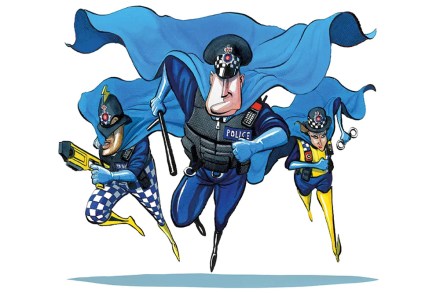
Crime stoppers Sir: If the Tories’ reputation on crime lies in the hands of these innovative supercops, then it will be sadly doomed, no matter how enterprising they may be (‘Rise of the supercops’, 5 August). Whether we like to believe it or dismiss it as woolly liberalism, the police and courts have a limited impact upon crime. The reality is that crime is driven by powerful social and economic forces, not the effectiveness of the local constabulary. In a liberal democracy, leaving the police to deal with any complex social problem, particularly one as diverse and intractable as crime, is fraught with danger. The police do have an important role to play but so do many others.

Letters: why AI may be a force for good

Parris review Sir: Matthew Parris (‘Coutts, Farage and the trouble with choice’, 29 July) omitted to mention the initial, fundamental and obvious matter of the breach of client confidentiality committed by Dame Alison Rose, who he says should not have resigned. This is surely the gravest offence any bank official – let alone the head of NatWest – can commit. Yet he puts her resignation down to a ‘silly media storm’, which was actually started by the BBC, to whom the client information was given. Further, his article relates mostly to the discretion which institutions such as banks have in choosing who to admit. But this issue wasn’t about a client’s admission to the bank, it was about expelling one for his ‘views’.

Letters: Labour’s shameful defence of Ulez 

Unfair Ulez Sir: I hope Ross Clark’s article (‘Highway robbery’, 22 July) will open people’s eyes to the unfair disadvantage Sadiq Khan has been imposing on those on lower and middle incomes in London. As a jobbing gardener who relies on the use of a van, I had just paid off the lease, with the intention of keeping the vehicle until I retired, when I became a victim of the first expansion of the Ulez zone in 2021. I live 200 metres within the boundary: driving that 200 metres in and out to go to work costs me £12.50 a day. Ulez is a regressive tax that falls particularly hard on the elderly and disabled, as there is no exemption for Blue Badge holders (Labour GLA members voted down a proposed amendment by the Conservative group to allow an exemption).

Letters: Biden is alienating Britain

Joe Shmoe Sir: Your piece ‘Not so special’ (Leading article, 8 July) was right. Joe Biden doesn’t like us and a brief 45 minutes with Rishi Sunak last week doesn’t change that. In Saudi Arabia last year, Biden compared Israel’s treatment of Palestinians with Britain’s past in Ireland. This was outrageous – what about the US historical treatment of Mexicans, Cubans and Filipinos, and Biden’s friendliness towards IRA terrorists? Britain enjoyed excellent relations with the US under Kennedy, Reagan and Clinton, all of whom had Irish ancestry, and it is self-indulgent and a dereliction for this President to make his chosen personal background an issue, as he does.

Letters: How to reform the NHS

How to reform the NHS Sir: During the pandemic I and millions of others went out every week and clapped for the NHS (‘National health disservice’, 8 July). But if you’ve experienced it lately, it’s a dystopian nightmare. Appointments regularly cancelled, paperwork missing, 1950s administration. It appears the only thing being managed at the NHS is its decline. A working group of trusted business leaders should consider ‘best practice’ at excellent private and public hospitals in the UK and across Europe, and implement reform of the service immediately. The Tories don’t have the bottle or anyone with the talent to get this under way. All the reform talk is coming from Labour, and at the election this will cost the Tories dear.

Letters: Prigozhin is the model of upward mobility

Prigozhin’s example Sir: Educationalists and policy advisers have long been concerned with identifying alternative routes of upward social mobility. The career of Yevgeny Prigozhin provides an illuminating example of precisely this (‘Crime and punishment’, 1 July). Instead of spending years swotting away at A-levels and business studies degrees, Yevgeny opted for hands-on commercial experience by running a hotdog stand in a big city. He was quick to recognise the value of physical fitness in the pursuit of ambition by engaging in regular training at a local gym. Networking was always high on his agenda, and he soon became close friends with an employee of the state intelligence agency who eventually became President of Russia.

Letters: In defence of teachers

Teacher trouble Sir: Rod Liddle (‘The trouble with teachers’, 24 June) is quite correct in what he says about the state of our schools. He also offers a glimmer of hope that at least the children in question exhibit common sense. But he is quite wrong about teachers being dim – mostly they are not. Teachers want to be able to pass on their knowledge to their pupils in a style that suits them and their students best. Why do some appear dim-witted? The answer is simple: fear. Fear of parents and fear of managers. Most parents are great and a joy to work with, but a minority – about 5 per cent – make teachers’ lives hell. It’s no coincidence that my most popular teacher training course is ‘Dealing with Difficult Parents’.

Letters: The horse that brings hope for the future

Conservative approaches Sir: Matthew Parris (‘My idea of a true Conservative’, 17 June) makes a reasonable case for small c conservatism, but he’s wrong about Brexit and he’s wrong about Trussonomics being clearly unconservative.  ‘Brexit come what may’ was the natural small-c reaction to the creation and evolution of an undemocratic EU superstate which (and we must take them at their word) was set upon ‘ever closer union’, the logical end state being a federal Europe and severe limitation of self-determination. No conservative would instinctively prefer foreign governance, even if it appeared at the outset to be benign.

Letters: Rod is wrong about J.K. Rowling

The sound of silence Sir: Charles Moore is right to draw attention to the deafening silence in the press about the present state of South Africa (Notes, 10 June). Not only has the country descended into frightening levels of violence, but the Progress in International Reading Literacy Study 2021 placed it last of all countries tested, in both reading and comprehension. How long will the ANC ruling elite remain an untouchable holy cow for our press? It is South Africans who suffer most from this implicit censorship. Margaret Vane By email Not cheap, not cheerful Sir: Emily Rhodes notes that ‘books have never been more beautiful’ (‘Cooking the books’, 10 June). While this may be true of their covers, it is certainly not true of what’s between them.

Letters: we don’t need a Covid inquiry

Toothless inquiries Sir: You rightly say that inquiries in Britain have become a form of cover-up (‘The politics of panic’, June 3). This is clear as we contemplate the delay in reporting on the Grenfell Tower fire of 2017, the £200 million spent on the Bloody Sunday report published 38 years after the event, the seven-year delay in concluding the Chilcot inquiry, and the shaming fact that Sweden has reported on its handling of Covid before our inquiry has even begun.

Letters: Jeremy Clarke was an example to us all

Goodbye, Jeremy Each week I opened The Spectator at Low Life in part to read that brilliant column and, more recently, to see how Jeremy Clarke was coping with his deteriorating health. Always hoping the column would be there; that he had, despite excruciating pain, penned us another. Like very many of his regular admiring readers, I had found the last two weeks disturbingly sad and last week we learned that he has died and is free at last from his suffering. As an oncologist, during a career treating thousands of patients, at first ones with prostate and other urological cancers, and later ones with breast cancer, I have seen the ravages of metastatic cancer in its many and varied forms and observed how people cope in their individual ways.

Letters: Britain’s net-zero ambition problem

Zero ambition Sir: How extraordinary that Ross Clark (‘Carbon fixation’, 20 May) can look at the cut-throat competition to capture the economic gains of the future and conclude that Britain’s problem is an excess of ambition. The USA stands alone as the only G7 nation not to have a net-zero target in law, but is nonetheless spending billions to achieve it. The country’s Inflation Reduction Act has proved so popular with the market that it is leveraging trillions more of private investment than previously expected, the majority in Republican-led states. Likewise China may lack a legally binding target, but enjoys a comfortable lead in core technologies following decades of investment.

Letters: What Millennial Millie needs

Lion of London Bridge Sir: Douglas Murray’s well-presented essay (‘Don’t be a hero’, 13 May) brings to mind the bravery of the Millwall fan Roy Larner, who fought off three knife-wielding religious fanatics in a terror attack, saving the lives of many others in the process. Stabbed eight times and in a critical condition, the ‘Lion of London Bridge’ managed to drive his attackers off. This was five years ago and yet, despite meeting all criteria for courage of the highest order, Mr Larner has yet to receive any public citation, let alone the George Cross he so obviously deserves. One wonders what is delaying this long overdue recognition. John B.

Letters: The real AI threat

Irreligious tolerance Sir: Your editorial ‘Crowning glory’ (6 May) celebrated the religious tolerance in Britain that will permit a multifaith coronation. However, it didn’t acknowledge that in modern Britain nearly half of people have no religious belief. This acts as a buffer, making religious differences of opinion of less importance. Britain is one of the least religious countries in the world. In more strongly religious countries, such tolerance is harder to find. Michael Gorman Guildford, Surrey Admirals on horseback Sir: If Admiral Sir Tony Radakin only had to march at the coronation (Admiral’s notebook, 6 May), he was fortunate. At the 1953 coronation, Lt Cdr Henry Leach (later Admiral of the Fleet Sir Henry Leach) was in charge of the naval element.

Letters: How to save red squirrels

Fire-fighting Sir: Your editorial raised the persistent problem of predicting major international disasters in a timely enough way to prepare (‘Eclipses and revolutions’, 29 April). The US academic Joseph Nye said that a good model for wars is to identify three types of cause: deep (the logs for a fire), intermediate (the kindling) and immediate (the sparks). The dilemma is that there are often so many crises on the brink of igniting that preparing early for dozens stretches many governments. Struan Macdonald Hayes, Kent Brain drain from Africa Sir: The majority of Sudanese doctors working in Britain will have been trained in Sudan at local government expense (Eclipses and revolutions’, 29 April).

Letters: what’s wrong with adoption?

The sins of the world Sir: Matthew Parris (‘Cross purposes’, 22 April) claims that Paul invented the Church’s teaching about redemption on the cross and that Christ was silent on the topic. This is simply not true. An obvious example is found in the gospel of Mark, chapter 10, verse 45: ‘For even the Son of Man did not come to be served, but to serve, and to give his life as a ransom for many.’ But it is Jesus’s words of institution at the Last Supper which provide the most clear explanation of what his death would achieve: ‘This is my body which is given for you… This cup is my blood of the new covenant poured out for you.’ Jesus could not have been clearer that his death was going to be a sacrifice for sins which he would make on behalf of his disciples.

Letters: The reincarnation of Anne Boleyn 

Pension point Sir: I have just read Kate Andrews’s article on junior doctors’ pay (‘Sick pay’, 15 April). While not wishing to get drawn into the rights or wrongs of their strike action, may I point out that in respect of the NHS pension scheme, for the sake of balance, the employee’s pension contribution also needs to be taken into account? The employer may well pay a 20 per cent contribution, but a junior doctor on a salary of either £29,000 or £37,000 (both figures quoted in the article) will pay 9.8 per cent of salary with a consequent reduction in take-home pay. John Etherington Wilsden, West Yorkshire Coach trip Sir: It was good to see mention of the Speaker’s state coach in your leading article (‘Reign or shine’, 15 April).

Letters: The C of E has become too broad a church

Too broad a Church Sir: I am not implacably hostile to Justin Welby; I share Christian empathy with the Archbishop’s earnest struggles to attract a spiritually dead nation back to the Church of England as described by Dan Hitchens’s article (‘The lost shepherds’, 8 April). However I cannot agree with his strategy. A liberal church is doomed to failure because it’s selling something that we already have. I ask our bishops: what is the Church’s USP? What does it offer that we can’t get elsewhere? The Church used to stand apart as a bastion against a hostile world, but if all it does is follow along behind modern secular fads then it is admitting its own redundancy. If you permit everything, you stand for nothing.

Letters: The positive case for daycare

Major mistake Sir: Douglas Murray (‘Our poor deluded MPs’, 1 April) contends that John Major is widely regarded as ‘one of the worst prime ministers in living memory’. If so, that seems unfair. Although a greyish figure, Major had to operate with a narrow parliamentary majority and a fractious party. It is often forgotten that he was instrumental in establishing the foundations of peace in Northern Ireland, for which Tony Blair is perhaps given too much credit. Moreover, it is difficult to name any of Major’s successors who didn’t leave No. 10 without black marks on their record. Ranking PMs is something for history.

Letters: Speak up for our children

Care of children Sir: At last people, namely Harriet Sergeant (‘The ghost children’, 25 March) and Rod Liddle (‘Childcare: an inconvenient truth’), are speaking up for the children. In so many areas of life today we sacrifice our children for the sake of our adult fetishes and fancies. The only people who have no political voice are our children. I am not suggesting that we lower the voting age to five; only that we try to do our best on their behalf. Why not spend the money that is going to provide 30 hours of childcare per week for babies over nine months old simply to pay the mothers to stay at home and look after them themselves? I can tell you which the babies would prefer.